Why Farm Aloe in South Africa?
South Africa is one of the world's leading producers and exporters of aloe, a crop perfectly matched to the country's climate, soils and existing farming infrastructure. The global aloe market is valued at over USD 2 billion annually and is growing at roughly 8% per year, driven by demand from the cosmetics, nutraceutical, pharmaceutical and food industries.
South Africa has a remarkable competitive advantage in aloe production. The country is home to the largest single population of wild Aloe ferox, the Cape aloe, on Earth, and its warm, semi-arid interior is perfectly suited to commercial Aloe vera cultivation. Both species command strong prices in international markets, and the domestic market for aloe-based health and beauty products is growing rapidly alongside rising consumer awareness.
For South African farmers, particularly those in the Western Cape, Eastern Cape, Northern Cape, Limpopo and Mpumalanga, aloe offers a compelling opportunity: low water requirements, drought tolerance, minimal chemical inputs, a long productive life (Aloe ferox plants can produce for 20+ years), and access to premium export markets. Smallholders, emerging farmers and commercial operations alike have found sustainable income in this sector.
Aloe Species for Commercial Farming in SA
Not all aloes are created equal. The two species with serious commercial potential for South African farmers are Aloe ferox and Aloe vera, each with different markets, cultivation requirements and profitability profiles.
South Africa's indigenous bitter aloe. Produces bitter sap (aloe bitters) and gel from the large fleshy leaves. The bitters are harvested by cutting leaves and allowing the sap to drain, no extraction equipment needed. Major export market: Europe (herbal laxatives, cosmetics, liqueurs). Wild populations exist mainly in the Western, Eastern and Northern Cape. Commercial plantations are established and profitable.
One of the most commercially cultivated aloe species. Produces a clear inner gel rich in polysaccharides (acemannan) used in cosmetics, health drinks, wound care and pharmaceuticals. Can be grown across a wide range of SA conditions, Limpopo and the Northern Cape are particularly well suited. Requires irrigation. Gel is extracted mechanically at processing facilities. Strong domestic and export demand.
A large tree aloe found across Limpopo, Mpumalanga and KwaZulu-Natal. Used in traditional medicine and increasingly in cosmetic formulations. Not widely cultivated commercially but has niche interest from the traditional medicine sector and for landscaping. A permit is required to harvest from wild populations.
The sprawling multi-stemmed aloe found across most of South Africa. Used extensively in folk medicine and gaining significant traction in the natural cosmetics sector internationally. Some South African producers are developing small commercial cultivation operations for the natural health market. Fast-growing and highly adaptable.
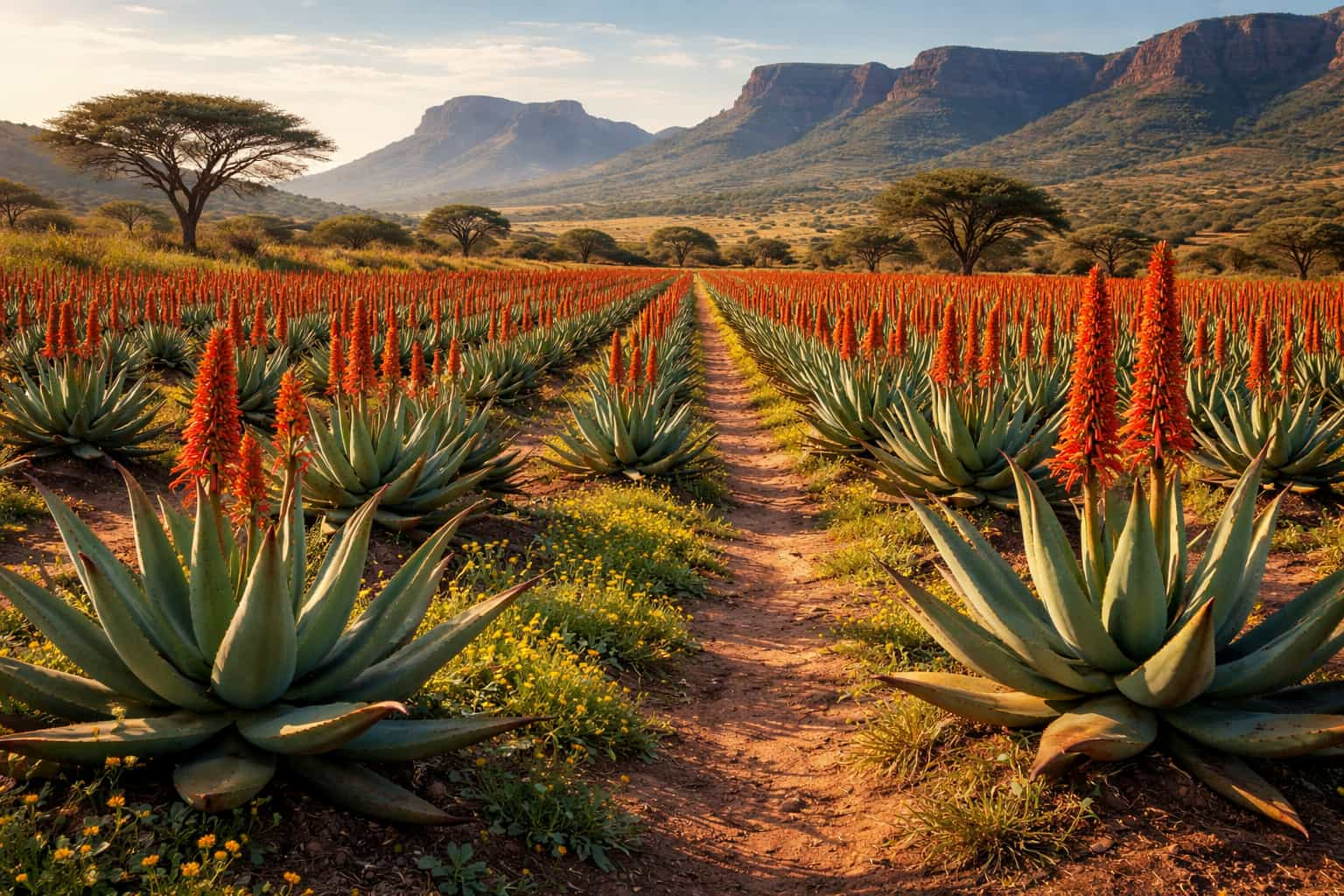
How to Grow Aloe Commercially in South Africa
Climate & Soil Requirements
Both Aloe ferox and Aloe vera thrive in warm, dry conditions that match South Africa's semi-arid and arid interior zones. Key requirements:
- Temperature: Optimal growth between 20°C and 35°C. Aloe ferox tolerates light frost; Aloe vera is frost-sensitive (avoid areas below -2°C in winter)
- Rainfall: 200–600mm per year is ideal. Aloe ferox grows well in summer and winter rainfall zones. Aloe vera performs best in summer-rainfall areas or under supplemental irrigation
- Soil: Well-drained, sandy loam soils are best. Both species are highly susceptible to root rot in waterlogged or clay-heavy soils. Soil pH of 6.0–7.5 is acceptable
- Altitude: Sea level to 1 800m. Aloe ferox naturally occurs at higher altitudes than Aloe vera
- Aspect: North-facing slopes in the southern hemisphere maximise sunlight exposure
Site Preparation
Good land preparation is the foundation of a productive aloe plantation. The investment made at this stage pays dividends for the 15–20 year lifespan of the planting. Key steps include deep ripping to 60cm on compacted soils, levelling and shaping to ensure runoff does not pool around the plants, and soil testing before any fertilizer application.
For Aloe vera in drier areas, a drip irrigation system should be installed before planting. Aloe vera in SA requires 500–800mm of total water annually, in Limpopo (annual rainfall ~400mm) supplemental irrigation of 3–4mm per week during dry spells is typically sufficient.
💡 Pro Tip: Avoid planting aloe in vleis, drainage lines or any area that holds water after rain. Root rot caused by Phytophthora is the number one cause of plant losses in new aloe plantations in South Africa, and it is almost always caused by poor drainage.
Obtain Planting Material
For Aloe ferox: source offsets (pups) from existing plants or buy from a registered nursery. Seed propagation is possible but slow. For Aloe vera: tissue culture plantfrom accredited labs give the most uniform, disease-free starts, available from several suppliers in Gauteng and the Western Cape. Pups from established mother plants are also widely used.
Planting Density & Spacing
Aloe ferox: 1 000–1 500 plants/ha at 2m × 3m or 2m × 2m spacing. Aloe vera: 8 000–10 000 plants/ha at 1m × 1m spacing for intensive leaf production; 5 000 plants/ha at 1.5m × 1.3m for semi-intensive systems. Wider spacing allows for mechanical cultivation and harvesting equipment access.
Fertilization Programme
Aloes are not heavy feeders but respond well to phosphorus at establishment and potassium during leaf development. Apply 100–150kg/ha of superphosphate at land preparation. During the growing season, a light nitrogen application (40–60kg N/ha) stimulates leaf production. Avoid excessive nitrogen, it promotes soft, watery leaf growth and increases disease susceptibility. Organic compost as a planting hole amendment significantly improves early establishment.
Weed Management
Weed pressure is highest in the first 12–18 months before the plants close the canopy. Mechanical cultivation between rows and hand weeding in-row is the standard approach. Pre-emergent herbicides registered for use in succulent crops can reduce labour costs significantly. Once established, Aloe ferox plantations are largely self-managing as the dense leaf litter suppresses weed growth.
Pest & Disease Management
Main pests in South African aloe plantations include mealybugs (treat with registered insecticide or neem oil), scale insects and aloe rust (a fungal disease causing orange spore lesions, control with copper-based fungicides). Rodents can damage young plants; bait stations around the perimeter of new plantings are recommended. Monitor for Phytophthora root rot in wet seasons.
Harvesting Aloe, Timing, Method & Yield
Aloe ferox, Bitter Sap Harvest
Aloe ferox leaves are typically harvested from year 3 onwards, when the plant has developed a substantial stem and healthy leaf crown. The traditional and most widely used method in South Africa is the ring-cut harvest:
- Stand the plant upright by cutting its lower dried leaves
- Using a sharp panga or bush knife, cut the outer row of green leaves at the base, angling toward the stem
- Stack cut leaves in a ring formation around a large plastic sheet or in a collection trough, cut-end facing inward and down
- The yellow-brown bitter sap drains naturally over 12–24 hours
- The collected sap is then concentrated by boiling or evaporation into solid aloe lump or kept as liquid
Yield from a productive Aloe ferox plant: 1–2 litres of sap per harvest with a harvest frequency of once per year. A well-managed 1-hectare plantation (1 200 plants) yields 1 200–2 400 litres of raw sap per annum, which concentrates to 120–240kg of dry aloe bitters (roughly 10:1 reduction ratio).
Aloe vera, Gel Harvest
Aloe vera leaves are harvested from the outer (older) rows of leaves once the plant is 12–18 months old. Harvest 3–4 leaves per plant per cycle, leaving the growing centre intact. Leaves should be a minimum of 40–50cm in length and 600g in weight to contain sufficient inner gel.
Processed gel yield: approximately 60–70% of the leaf weight is usable inner gel after filleting and rind removal. A well-managed Aloe vera plantation in Limpopo yields 30–40 tonnes of fresh leaves per hectare per year, translating to 18–28 tonnes of raw gel for processing.
⚠️ Harvesting wild Aloe ferox requires a permit from the relevant provincial conservation authority (CapeNature in the Western Cape; EKZNW in KZN). Commercial cultivation does not require a permit, but sales of wild-harvested material require documentation. Always ensure your supply chain is legally compliant, international buyers increasingly require proof of legal and sustainable sourcing.
What to Make & Where to Sell
The value of aloe increases dramatically with processing. Raw sap and fresh leaves are low-margin commodities; processed products command premium prices, and South Africa has a growing ecosystem of buyers, processors and export agents for both.
Domestic Market Buyers
Within South Africa, the primary buyers for raw and semi-processed aloe are:
- Natural health product manufacturers, Cape Aloes, Esse Skincare, Faithful to Nature's private label brands, and dozens of smaller formulators across the country
- Cosmetic ingredient distributors, companies like Chemiplex and Brenntag source aloe gel concentrate locally and import to supplement supply
- Traditional medicine (muthi) market, dried aloe bitters and raw leaves are widely sold through muthi shops, particularly in KZN, Limpopo and the Eastern Cape
- Distilleries and liqueur producers, Amarula, Boplaas and smaller craft liqueur producers use Aloe ferox bitters as a flavouring component
- Pharmacies and health stores, Dis-Chem, Clicks, Wellness Warehouse and Faithful to Nature are active buyers of branded finished aloe products
Export Markets
South Africa's Aloe ferox bitters have been exported to European herbal medicine manufacturers for over a century, the country supplies a significant portion of the world's botanical laxative ingredient (hydroxyanthracene derivatives from Aloe ferox). Key export markets include Germany, the Netherlands, Spain, Japan and South Korea. Aloe vera gel concentrate is exported primarily to the USA, EU and the Middle East.
To export aloe products, producers need to register with the South African Health Products Regulatory Authority (SAHPRA) if the product makes therapeutic claims, and comply with EU cosmetics regulations (EC 1223/2009) for cosmetic exports. Working with a registered export agent or a member of the South African Aloe Growers' Association (SAAGA) is strongly recommended for first-time exporters.
Aloe Farming Costs & Returns, SA 2026
| Item | Aloe ferox (per ha) | Aloe vera (per ha) | Notes |
|---|---|---|---|
| Establishment cost | R18 000 – R28 000 | R35 000 – R55 000 | Includes plants, land prep, irrigation (vera only) |
| Annual maintenance | R6 000 – R10 000 | R12 000 – R20 000 | Labour, fertilizer, pest control |
| First harvest year | Year 3–4 | Year 1.5–2 | Aloe vera produces much faster |
| Annual yield | 120–240 kg dry bitters | 18–28 t fresh gel | At steady production (year 4+) |
| Farm gate price | R300 – R500/kg bitters | R18 – R30/kg gel | Varies with quality & contract |
| Gross revenue/ha | R36 000 – R120 000 | R324 000 – R840 000 | Significant variance by processing level |
| Break-even | Year 5–6 | Year 3–4 | Assuming average prices & yields |
| Productive lifespan | 20+ years | 5–7 years (replant) | Ferox plantations outlast multiple vera cycles |
💡 Value-Add Opportunity: Farmers who process their own aloe into finished products (gel sachets, soap, capsules, drinking gel) can multiply their revenue by 5–10× compared to selling raw material. A small processing facility with a filleting table, blender, pasteuriser and bottling line costs R80 000–R150 000 to set up, often fundable through DALRRD grants or Agri-BEE financing. Contact your nearest Agricultural Finance Corporation (AFC/Land Bank) for financing options.