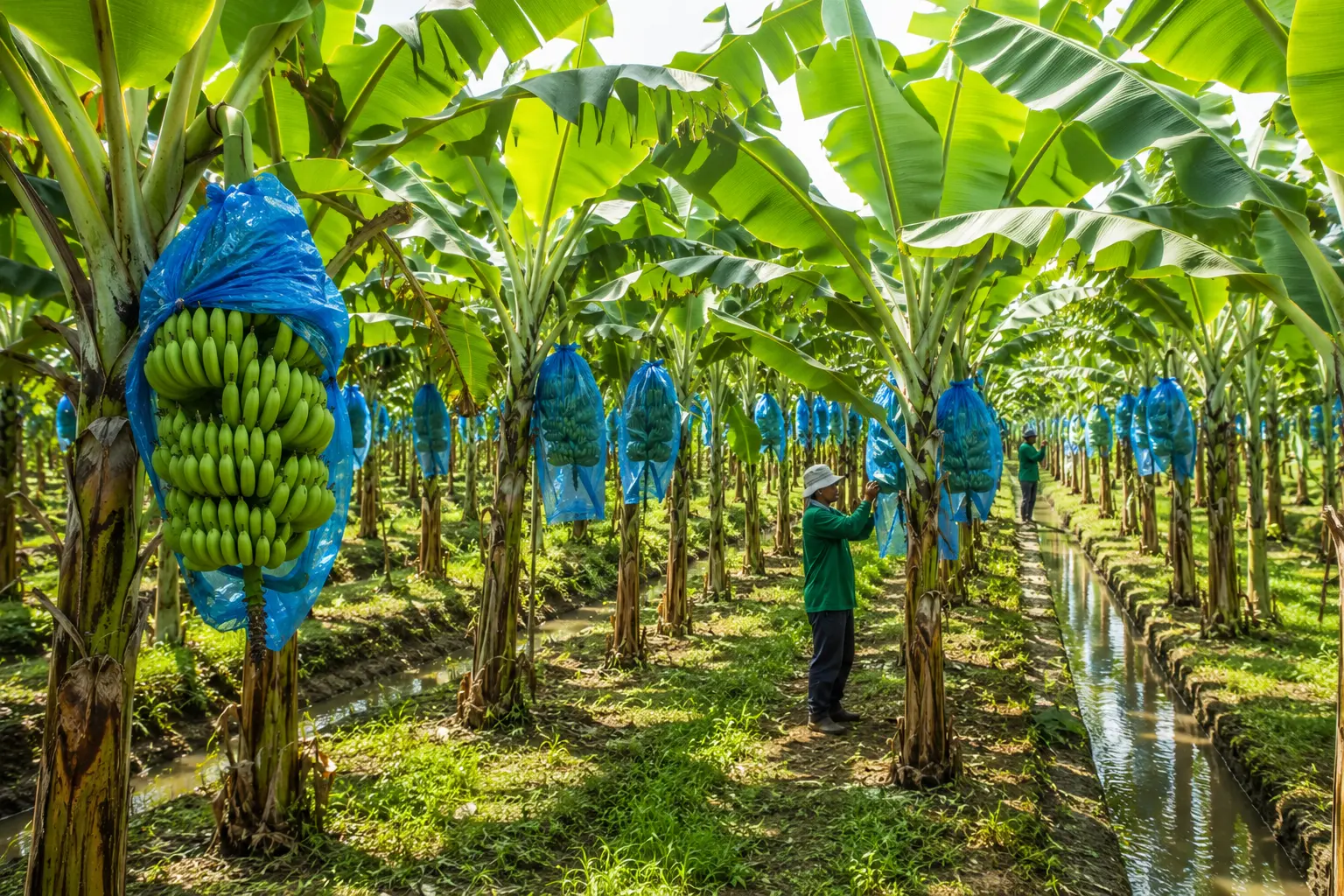
Climate and Site Requirements for Banana Farming in SA
Bananas are strictly tropical to subtropical plants and their growing requirements are non-negotiable. They are sensitive to cold, wind, and waterlogged soils. Getting your site selection right is the foundation of a profitable banana operation.
Temperature and Frost
Bananas grow best between 22°C and 32°C. Growth slows significantly below 18°C and stops below 14°C. Frost will kill banana plants outright, even a single frost event can wipe out an unprotected plantation. This limits commercial banana farming in South Africa to frost-free zones: the KZN coast and subtropical valleys, the Limpopo Lowveld (below 700m altitude), Mpumalanga Lowveld, and the tropical Northern Cape (Lephalale and Boekenhoutskloof areas).
Rainfall and Water
Bananas are high water users, a mature plant needs approximately 1,200–2,000mm of water per year. KZN's coastal areas receive 900–1,400mm naturally, but supplementary irrigation is essential during dry spells and winter months. Drip irrigation is the most water-efficient and widely adopted method in SA commercial banana farms. Critically, while bananas need abundant water, they cannot tolerate waterlogged roots, drainage is as important as supply.
Wind Protection
Banana plants are extremely vulnerable to wind. Their large leaves tatter and tear in strong wind, reducing photosynthesis. More critically, strong winds can topple entire plants when they are carrying heavy bunches. Windbreaks (using Casuarina, bamboo, or Kei-apple hedges) are essential on exposed sites. Site within valleys or on sheltered slopes where possible.
Soil Requirements
The ideal banana soil is a deep, well-drained, fertile loam or sandy loam with pH between 5.5 and 7.0 and high organic matter content. Bananas are heavy feeders and respond dramatically to good soil preparation. Main decisions include:
- Minimum soil depth of 1.0m, roots go deep
- Excellent drainage, waterlogging causes root rot within days
- High organic matter content, amend with compost at 20–40 tonnes/hectare before planting
- Conduct a full soil analysis and follow fertiliser recommendations precisely
- Avoid soils with a high clay content that stays wet after rain
Best Banana Cultivars for South Africa
The choice of cultivar is critical, not only for productivity and fruit quality, but particularly for disease resistance against Panama disease (Fusarium wilt), which has devastated banana industries worldwide. In South Africa, the following cultivars are commercially significant:
| Cultivar | Type | Bunch Size | Panama Resistance | Best Market |
|---|---|---|---|---|
| Cavendish (Williams) | Dessert | 30–55 kg | Moderate (TR4 risk) | Retail, export |
| Grand Naine | Dessert | 35–60 kg | Moderate | Retail, supermarkets |
| Dwarf Cavendish | Dessert | 25–40 kg | Moderate | Local fresh market |
| Pisang Awak (Dura) | Cooking/fresh | 20–35 kg | Good (TR4) | Informal markets, KZN |
| FHIA cultivars | Dessert/cooking | 25–50 kg | High TR4 resistance | Future commercial SA |
| Plantain types | Cooking | 20–40 kg | Good | Ethnic food markets |
Cavendish varieties (Williams and Grand Naine) dominate SA commercial production and are what consumers expect at retail level. However, the emergence of Tropical Race 4 (TR4), a new strain of Panama disease that affects Cavendish, is a serious global concern. SA has strict biosecurity protocols around plant material imports, but farmers should stay informed through industry bodies and use only certified, disease-free planting material. FHIA varieties offer TR4 resistance and are being trialled by progressive SA banana farmers as a future-proofing strategy.
🚨 Panama Disease (Fusarium Wilt), Know the Threat
Panama disease is caused by the soil fungus Fusarium oxysporum and has no cure. Once it enters your soil, it persists for decades. Prevention is everything: only plant certified disease-free suckers or tissue culture plants, never move soil or plant material from infected areas, and maintain strict farm hygiene. Tropical Race 4 (TR4) is the most dangerous strain and can devastate Cavendish plantations. Report any suspected Panama disease immediately to your provincial DALRRD office.
Planting Bananas in South Africa
Bananas are propagated vegetatively, not from seed. There are two planting material options available to SA farmers: suckers (offshoots from existing plants) and tissue culture plants (TC plants from licensed SA laboratories). Tissue culture plants are the gold standard for new plantations: they are disease-free, produce more uniform, higher-yielding plants, and establish faster than suckers. The cost of TC plants (R12–R35 per plant depending on supplier) is quickly recouped in better yields and disease security.
Planting Density and Spacing
Commercial planting densities in South Africa range from 1,100 to 1,600 plants per hectare, with popular spacings of 2m × 3m (1,667 plants/ha) or 2.5m × 3m (1,333 plants/ha). High-density planting increases early yields but requires more intensive management. Allow enough space for machinery access, harvesting heavy bunches (30–55 kg) requires a proper path system through the plantation.
Planting Time
In KZN, the best planting window is September to November, the warm spring temperatures and onset of summer rainfall give young plants the best possible start. In Limpopo, planting in August–September works well. Avoid planting in the coldest winter months (June–July) as slow establishment increases vulnerability to disease and pests.
Fertilisation and Soil Management for Bananas
Bananas are among the most nutrient-hungry crops grown in South Africa. An underfertilised banana plant produces small bunches and is more susceptible to disease. A well-fertilised plant at peak production can produce bunches of 40–55 kg. The key macronutrients are nitrogen (for rapid vegetative growth), potassium (for bunch size and fruit quality, the single most important nutrient for bananas), and phosphorus (for root development and establishment).
In KZN and Limpopo soils, potassium deficiency is extremely common, this must be corrected with potassium fertiliser (muriate of potash or potassium sulphate). Magnesium, zinc, and boron deficiencies are also prevalent in SA banana-growing soils and must be addressed through foliar sprays. A reliable annual leaf and soil analysis programme is essential for large-scale operations.
Mulching with dry banana leaves, straw, or compost between plants reduces weed competition, conserves moisture (critical during dry spells), and feeds soil biology. Organic matter breakdown between rows significantly reduces fertiliser needs over time.
Pests and Diseases in SA Banana Farming
Beyond Panama disease, South African banana farmers must manage several other significant pests and diseases. Banana weevil (Cosmopolites sorbidus) tunnels through banana corms, weakening plants and reducing yields significantly, manage with pheromone traps, good hygiene, and targeted insecticide application. Nematodes are a serious root pest in most KZN banana soils, plant tissue culture plants (which are nematode-free at planting) and consider nematicide applications in problem areas.
Sigatoka leaf spot diseases (yellow Sigatoka and black Sigatoka) cause leaf damage that reduces photosynthesis and bunch size. Fungicide spray programmes are standard in commercial SA banana farms, maintain good airflow between plants by removing old leaves (desuckering and leaf pruning). For broader integrated pest management guidance, see our dedicated resource.
Harvesting and Post-Harvest Handling
Bananas are harvested green, before physiological ripening, to allow for transport and shelf life. Harvest timing is determined by the finger filling grade, the degree of angularity of the finger cross-section. A "3/4 full" finger cross-section (still slightly angular) is the standard commercial harvest point. Over-mature fruit (fully round fingers) bruises easily and has a short shelf life after ripening.
After cutting, bunches must be handled carefully to prevent bruising and latex staining. Professional commercial operations use overhead cable systems to transport bunches from the field to the pack shed without touching the ground. In the pack shed, hands (sections of the bunch) are cut, washed in water to remove latex, graded, and packed for market. Good post-harvest handling is what separates premium grade fruit (top prices at fresh produce markets) from lower-grade produce sold at discount.
Markets and Selling SA Bananas
South Africa's banana market is primarily domestic. The Johannesburg Fresh Produce Market (JFPM) in City Deep is the largest single market for SA bananas, followed by Tshwane, Cape Town, and Durban municipal markets. Prices at these fresh produce markets fluctuate seasonally, typically R6–R12/kg for standard grade and R14–R18/kg for premium grade. Summer gluts (when most SA banana farms peak simultaneously) push prices down; well-managed farms that achieve off-season production command higher prices.
Direct supply to retail chains (Pick n Pay, Shoprite/Checkers, Woolworths) requires consistent volume, food safety compliance (GLOBALG.A.P.), and the ability to supply year-round, typically requiring a minimum of 10–20 hectares under production. Emerging farmers can access these markets through cooperative packing facilities or by partnering with established commercial producers. For government funding to establish or expand your banana operation, CASP and Ilima/Letsema grants cover infrastructure including irrigation systems and packsheds.
Banana Farming Across South African Provinces
KwaZulu-Natal remains the heart of SA's banana industry, accounting for the majority of commercial production. The warm, humid coastal belt and subtropical valley systems from Mtunzini northwards through Empangeni, Mtubatuba, and into the Zululand region are particularly productive. Limpopo's Lowveld, the Tzaneen, Hoedspruit, and Phalaborwa areas, supports significant banana production where summer temperatures are reliably warm and irrigation is available. Mpumalanga's lowveld, particularly around Hazyview and Bushbuckridge, offers similar conditions. Small-scale production also occurs in the subtropical areas of the Eastern Cape coastal zone and the Northern Cape's warmest river valley areas.