Your cart

Loading…

Register 🏠 Home 📰 Articles 🎬 Videos 📚 Guides 🚜 Farm Market 🔥 Hot Products 💚 Donate
👤 Dashboard
🌾 Farmer Login 🌾 Farmer Register 🤝 Partner Login 🤝 Partner Register 🔗 Affiliate Marketer Register 🔗 Affiliate Marketer Login 🚛 Transporter Register 🚛 Transporter Login
🌾 Browse Farming Topics
🌽 Crops
All Field Crops Maize Sorghum Sunflower Soybeans Canola Sugarcane Cotton Groundnuts Tobacco
🥬 Vegetables
All Vegetables Tomatoes Potatoes Onions Cabbage Spinach Butternut Carrots Garlic Peppers & Chilli Green Beans
🍊 Fruit
All Fruit Farming Citrus Avocados Mangoes Table Grapes Viticulture Bananas Macadamia Pecans Blueberries Figs
🐄 Livestock
All Livestock Cattle Dairy Sheep Goats Pigs Chickens Ostriches Game Farming Rabbits Horses
🌿 Speciality
Bee Keeping Mushrooms Snails Earthworms Crickets Lavender Hemp Aquaculture Tilapia Catfish Oysters Aquaponics Hydroponics Microgreens Spirulina Container Farming Olives Rooibos & Tea Hops Aloe Community Gardens Floriculture
📚 Resources
Seeds & Planting Soil & Fertilizers Composting Cover Crops Pest Control Irrigation Systems Land Preparation Equipment Crop Rotation Organic Farming Permaculture No-Till Farming Farming Grants Agri Markets Export Farming
🛒 Store
Farm Store Farm Store Sponsor a Farm Donate
🤝 Get Involved
Partners & Sponsors Sell Your Produce (Farmers) Grower Affiliate Program Deliver Farm Produce (Transporters)
ℹ️ About
About Us Contact Us Disclaimer

Tobacco Farming
in South Africa

A practical guide to growing flue-cured and other tobacco types in Mpumalanga and Limpopo, covering seedbed preparation, transplanting, fertilisation, curing barn operation, grading and market access for South African growers.

Share this page: Facebook Tweet WhatsApp Email LinkedIn

South Africa's Tobacco Industry, An Overview

Tobacco (Nicotiana tabacum) has been cultivated commercially in South Africa for over a century, with production centred in the Mpumalanga Highveld and Lowveld and parts of Limpopo. Major growing districts include Loskop Valley, Marble Hall, Groblersdal, Lydenburg, Barberton and the Komatipoort areas of Mpumalanga, as well as Lephalale and Louis Trichardt in Limpopo.

The dominant type grown in South Africa is flue-cured Virginia tobacco (FCV), which forms the basis of cigarette blends worldwide. Air-cured and fire-cured types are grown in smaller quantities. South Africa's tobacco is known for good leaf quality, particularly for its bright, golden FCV leaf produced in the Highveld conditions.

Tobacco farming is a highly technical, capital-intensive enterprise. It requires precision at every stage, from floating seedbeds and transplanting to fertilisation, topping, harvesting by leaf priming, and operating curing barns. This guide provides a practical overview for both new entrants and established growers looking to improve their production systems.
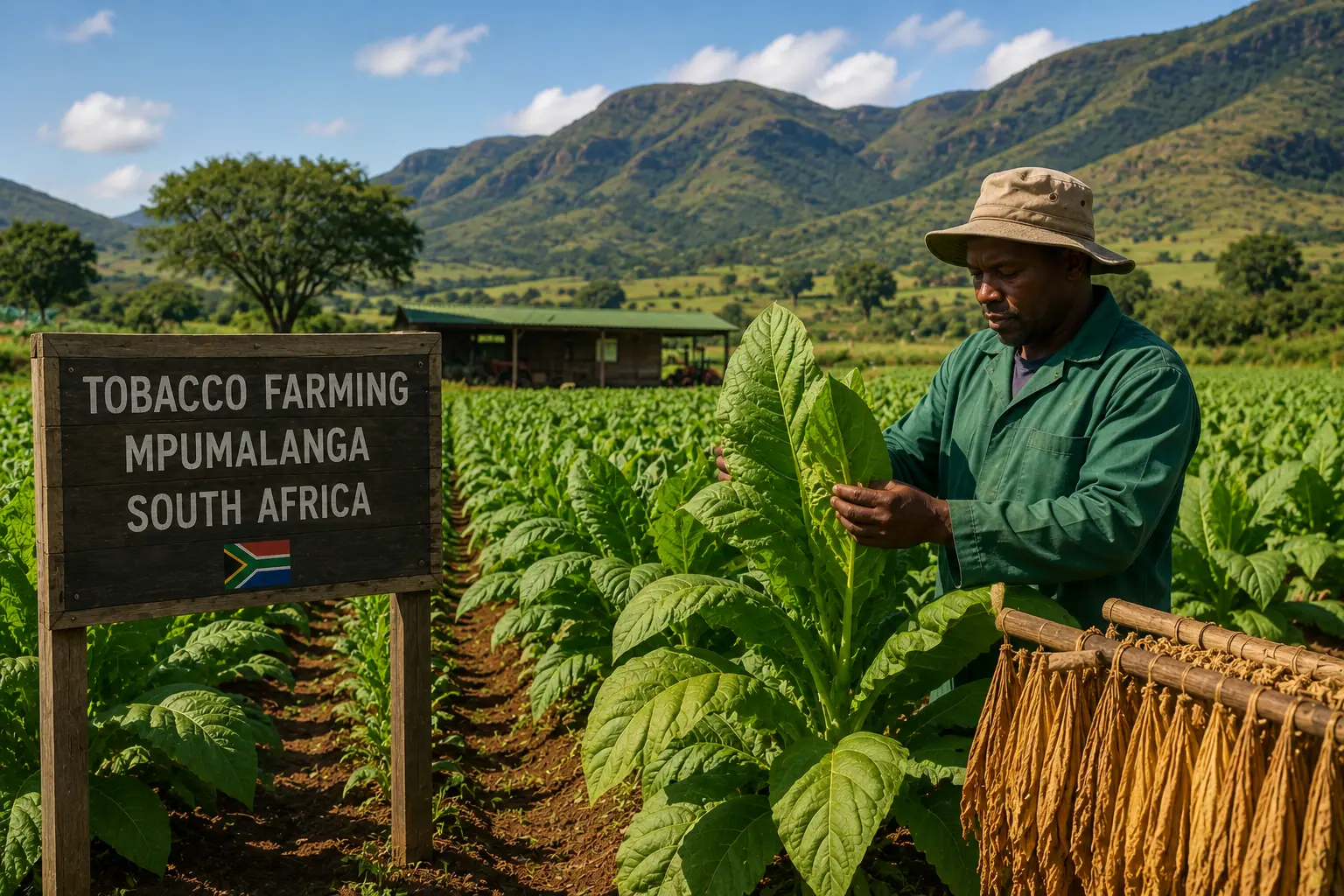
Tobacco farming in Mpumalanga South Africa, green tobacco field with large leaves

Tobacco cultivation in Mpumalanga, South Africa's primary flue-cured tobacco production region

Tobacco Types Grown in South Africa

Different tobacco types require different production, curing and marketing approaches. The main types grown in South Africa are:

Flue-Cured Virginia (FCV)
Dominant Type, 90%+ of SA Crop

The primary cigarette leaf. Bright golden colour after curing. Grown across Mpumalanga Highveld and Lowveld. High sucrose content, mild flavour. Requires bulk curing barns with heat and airflow control.

Air-Cured Burley
Smaller Volume

Lower sugar content, high nicotine. Cured by hanging in ventilated barns, no heat required. Used in blended cigarettes and pipe tobacco. Grown in limited areas of Limpopo and KZN.

Oriental / Turkish
Niche Production

Small-leafed, aromatic type. Sun-cured. Very limited production in South Africa. Grown in specific warm, dry areas. Used in blended cigarette formulations for aroma.

This guide focuses primarily on flue-cured Virginia (FCV) tobacco, as it represents the overwhelming majority of commercial production in South Africa and is the type most relevant to growers in Mpumalanga and Limpopo.

Climate & Soil Requirements

Climate

FCV tobacco performs best under specific climatic conditions that are well-matched to Mpumalanga's Highveld and Lowveld zones:

  • Temperature: Optimal growth between 20°C and 30°C. Cool nights during ripening improve leaf quality and colour development. Frost kills tobacco, production must be completed before autumn frosts.
  • Rainfall: 500–750mm during the growing season, well-distributed. Excess rainfall increases disease pressure and dilutes leaf quality. Most South African production uses supplementary irrigation to top up rainfall.
  • Sunshine: High light intensity during leaf development and ripening enhances leaf colour and quality. The Mpumalanga Highveld receives excellent summer sunshine hours.
  • Frost-free period: A minimum of 150 frost-free days required from transplanting to final harvest. Mpumalanga's growing season (October–April) typically satisfies this requirement.

Soil Requirements

Soil selection is critical for tobacco, it directly influences leaf quality, not just yield. Ideal soils are:

  • Sandy loam to loamy sand texture, good drainage, quick warming in spring, and the ability to control moisture levels through irrigation
  • pH (KCl) between 5.0 and 6.0, slightly acid. High pH reduces leaf colour quality and manganese availability.
  • Low chloride (Cl) levels, chloride is extremely damaging to tobacco leaf quality. Never use muriate of potash (KCl) fertiliser on tobacco. Use potassium sulphate only.
  • Good internal drainage, waterlogging causes root rot (black shank) and poor leaf quality
  • Moderate fertility, very high organic matter soils can cause excessive nitrogen release, resulting in poor-quality, rank leaves
⚠️ Critical: No Chloride on Tobacco

Chloride is the single most damaging element for flue-cured tobacco leaf quality. Never apply any fertiliser containing chloride (KCl, muriate of potash) to tobacco soils. Always use potassium sulphate (K₂SO₄) as the potassium source. Even small amounts of chloride cause "chloride burn" symptoms and drastically reduce leaf grade and price received at auction.

Tobacco Varieties in South Africa

South African tobacco varieties are primarily FCV hybrids selected for yield, leaf quality, disease resistance (particularly to black shank and root-knot nematodes), and suitability to local growing conditions. Key variety groups include:

Variety GroupTypeKey AttributesNotes
K 326FCVIndustry standard, excellent leaf qualityWidely planted globally; susceptible to black shank race 1
Coker 176FCVGood yield, disease toleranceUsed where black shank pressure is moderate
PVH 2110FCVHigh yield, strong disease resistancePopular in Mpumalanga Lowveld
NC 297FCVNematode resistance, good curingPreferred on nematode-infested soils
CMS 600FCVLocally adapted, good leaf colourBred for South African conditions

Variety selection should be guided by your local extension officer or the Tobacco Association of South Africa (TASA). Nematode and black shank resistance are the most important disease traits in SA production systems.

Seedbed Preparation, The Foundation of the Crop

Tobacco seeds are extremely small (approximately 12,000 seeds per gram) and cannot be direct-seeded into field soils. They must be germinated and grown in a dedicated seedbed (nursery) system for 6–8 weeks before transplanting. There are two main seedbed systems used in South Africa:

1. Float (Hydroponic) Seedbed System, Preferred

The modern float system is now the standard in South African commercial production. Seeds are sown into polystyrene trays (each with 200–288 cells) filled with a specialised peat-based growing medium. The trays float on a shallow (10–15cm deep) pool of nutrient solution in a plastic-covered greenhouse or shade-net structure. Process:

  1. Construct a sealed, level water-holding bay (concrete, polythene-lined, or galvanised steel) approximately 1.2m wide × up to 30m long
  2. Fill with clean water, never use water with high salt or chloride levels
  3. Add tobacco-specific float fertiliser at the recommended rate
  4. Sow 2–3 pre-germinated seeds per cell, or use pelleted seed at 1 per cell
  5. Float the trays and cover the structure to maintain humidity and temperature (22–28°C for germination)
  6. Monitor pH (5.5–6.5), EC (0.8–1.5 mS/cm), and water levels throughout the 6–8 week nursery period
  7. Clip (top) seedlings at 5–6cm height 2–3 weeks before transplant to promote stem hardening

2. Open Seedbed System, Traditional

Still used by some smaller growers and smallholder operations. A raised bed of sterilised soil is prepared, seeds are sown, and seedlings grown under shade cloth for 8–10 weeks. This system is lower in capital cost but more labour-intensive and vulnerable to soilborne disease and weather. Steam sterilisation or methyl bromide alternatives (dazomet) are used to sterilise the seedbed soil.

Land Preparation & Transplanting

Land Preparation

Thorough land preparation is essential for tobacco's shallow, sensitive root system. Begin 3–6 months before planting:

  1. Soil sampling: Test for pH, nutrients, nematodes and chloride levels. This is non-negotiable for tobacco.
  2. Lime application: If pH is above 6.0, use sulphur to acidify; if below 5.0, apply agricultural lime. Target pH 5.0–6.0.
  3. Deep ploughing: 40–50cm mouldboard ploughing to eliminate compaction layers and incorporate residues.
  4. Subsoiling: If a hardpan is present, subsoil before ploughing.
  5. Secondary cultivation: Disc and harrow to create a fine, firm seedbed.
  6. Ridging: Form raised planting ridges 0.9–1.1m apart, ridges improve drainage and warming of the root zone.

Transplanting

Transplanting is the most labour-intensive operation in tobacco farming. In Mpumalanga, the main transplanting window is October to November (after the last frost risk has passed and soil temperatures exceed 15°C). Float seedlings are ready when they are 10–15cm tall with 4–5 true leaves.

  • Plant spacing: 50–60cm in-row × 0.9–1.1m between rows, giving 18,000–22,000 plants/ha
  • Transplanting method: Machine transplanters (water-wheel or finger-type) are standard on commercial farms. Manual transplanting is used on smallholder operations.
  • Water at transplant: Apply 300–500ml of water or starter solution directly to the planting hole to prevent transplant shock. Irrigate the whole field within 24 hours of transplanting.
  • Replace missing plants: Walk all rows 7–10 days after transplanting and fill gaps with reserve plants from the nursery. A plant stand below 90% significantly reduces yield.

Fertilisation of Tobacco

Tobacco nutrition management is among the most precise aspects of the crop, over-fertilisation (especially nitrogen) is as damaging as under-fertilisation, producing rank, low-quality leaf. Base all programmes strictly on soil analysis results:

NutrientRate (kg/ha)SourceTiming
Nitrogen (N)50–80LAN, KAN (never urea on heavy soils)Split: 1/3 at transplant, 2/3 at 4–5 weeks
Phosphorus (P)20–40SSP, MAPAll at transplant or pre-plant
Potassium (K)100–160K₂SO₄ ONLY, NEVER KClSplit or all at transplant
Magnesium (Mg)20–40Kieserite or dolomitic limeAt transplant
Sulphur (S)20–30Elemental sulphur or K₂SO₄Pre-plant or at transplant

Nitrogen rate is the single most important fertilisation decision in tobacco farming. Excess nitrogen produces thick, dark green leaves with poor curing characteristics and low market value. Follow your soil analysis recommendation precisely.

Topping & Suckering

Topping is the removal of the flowering head (terminal bud) to redirect the plant's energy into leaf development rather than seed production. It is among South Africa's most critical agronomic operations in tobacco and must be done at the correct growth stage:

  • Top at early flower bud stage (button stage) when 10–16% of flowers are open in the terminal cluster
  • Leave the correct number of leaves per plant, typically 18–24 leaves for FCV, depending on the leaf programme and market requirements
  • Top by hand (break off the terminal bud) or with mechanical toppers on large commercial operations

After topping, axillary buds (suckers) develop rapidly at each leaf axil and must be suppressed. This is done chemically using contact sucker control agents (maleic hydrazide, fatty alcohols) applied immediately after topping. Without sucker control, the crop becomes unmanageable and leaf quality declines sharply.

Harvesting, Leaf Priming

Tobacco is not harvested all at once. Leaves ripen from the bottom of the stalk upward, and are harvested in successive "primings" (passes) every 10–14 days over 8–12 weeks. A full crop typically yields 5–8 primings over the season. Harvesting guidelines:

  • Ground lugs (leaves 1–3): Harvested first. Often low-quality, used for filler leaf. Remove when yellowing begins.
  • Cutters and bodied leaves (leaves 4–14): The highest-quality, most valuable leaves. Harvest when a light yellow-green colour appears.
  • Tips (top leaves): Harvested last. Smaller and thinner but can be good quality.

All priming is done by hand, workers walk the rows removing ripe leaves individually and stacking them in wooden or plastic transport crates. Avoid bruising or crushing the leaves, which causes dark spots and grade loss.
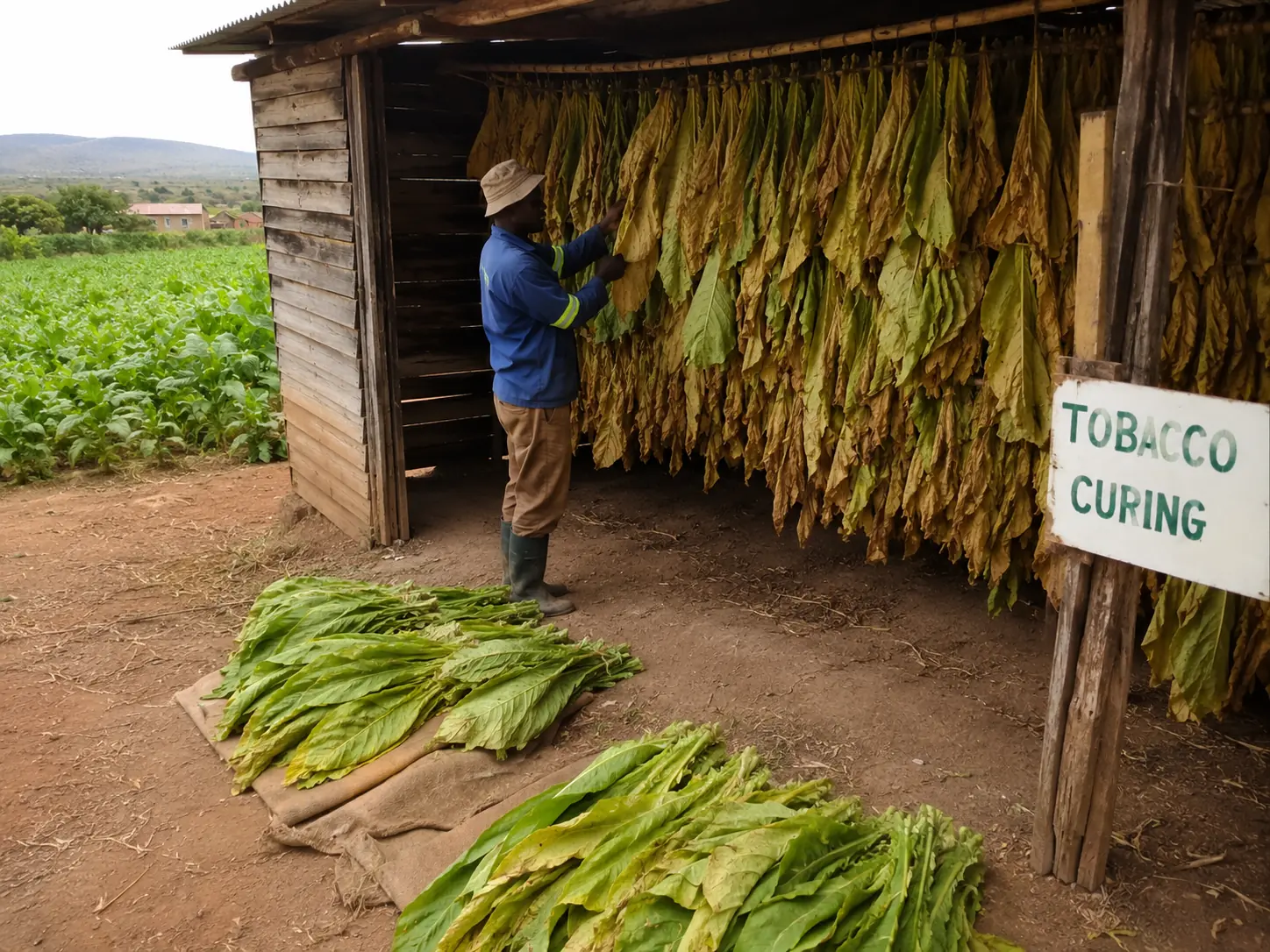
Tobacco leaf curing barn in Limpopo South Africa, flue-cured leaf drying process
Tobacco curing barns in Limpopo, flue-curing transforms green leaf to golden, market-ready tobacco

Curing Tobacco, The Flue-Curing Process

Curing is the process of drying harvested green tobacco leaf under controlled temperature and humidity conditions to develop colour, flavour and aroma. Flue-cured tobacco uses heat conducted through pipes (flues) from an external firebox, without exposing the leaf to smoke. This is what gives FCV its bright, golden colour.

Modern South African operations use bulk curing barns rather than the older stick-and-barn system. Bulk barns can hold 800–1,200kg of green leaf per curing cycle and use fans and computerised temperature controllers to manage the cure:

Flue-Curing Temperature Stages

  1. Yellowing phase (35–40°C, 24–48 hours): Leaf biochemistry converts starches to sugars and produces the golden-yellow colour. High humidity maintained.
  2. Colour fixing (45–55°C, 24–36 hours): Leaf colour is fixed and enzymes deactivated. Humidity is progressively reduced.
  3. Lamina drying (55–65°C, 24–48 hours): Leaf blade dries out completely at lower humidity.
  4. Stem drying (68–72°C, 12–24 hours): Final stage dries the mid-rib and stem. Barn fully ventilated to remove remaining moisture.

A complete cure takes 5–7 days. After curing, leaf is conditioned (allowed to reabsorb some atmospheric moisture) and then graded. Incorrectly cured leaf (whether undercured (green), overcured (brown) or scorched) is heavily penalised at the market.

Grading & Selling Tobacco in South Africa

Cured tobacco is graded into grade groups based on leaf position on the stalk, colour, damage, maturity and texture before being sold. South Africa operates both a contract (quota) system and an auction floor system for tobacco marketing.

  • Tobacco Association of South Africa (TASA): The industry body that registers growers, allocates quotas, manages the auction floor (in Hartswater and Rustenburg), and provides technical extension services.
  • Auction floor system: Baled, graded tobacco is presented on the auction floor where buyers (tobacco companies and traders) bid. Price is determined by grade and quality on the day.
  • Contract growing: Some South African manufacturers contract growers directly for specific quality grades at pre-agreed prices, reducing price risk. BAT (British American Tobacco) and Philip Morris source under contract from selected SA growers.

Register with TASA before planting, you will need a production quota and to comply with the Tobacco Products Control Act. Contact TASA or your provincial DALRRD office for registration details. See our farming grants guide for government support available to tobacco growers.

📊 Cost and market considerations

FCV tobacco yields in South Africa typically range from 1,800–2,800 kg/ha of cured leaf. Auction floor prices vary by grade and season, but top-grade FCV leaf commonly fetches R40–R80/kg (approximate current values). At mid-range yields and prices, gross income of R80,000–R160,000/ha is achievable, against input costs (seedbed, fertiliser, labour, curing fuel) of R40,000–R70,000/ha. Tobacco remains one of the highest gross income potential field crops in South Africa, but also among the most capital and labour intensive. Confirm current prices with TASA before committing.

Pest & Disease Management in Tobacco

Key Diseases

  • Black shank (Phytophthora nicotianae): The most destructive soilborne disease in SA tobacco. Causes rapid wilting and death. Manage through resistant varieties, good drainage, and fungicide soil drenches. Avoid moving soil from infested to clean lands.
  • Root-knot nematodes (Meloidogyne spp.): Cause stunting, poor water and nutrient uptake, and yield loss. Use nematode-resistant varieties and nematicides at transplanting. Rotate with non-host crops.
  • Tobacco mosaic virus (TMV): Spread by contact (hands, tools). No cure, remove and destroy infected plants immediately. Wash hands with soap before handling tobacco seedlings.
  • Granville wilt (Ralstonia solanacearum): Bacterial wilt. Soilborne, spreads through water movement. Use clean transplants, avoid waterlogging, practice strict crop rotation.
  • Blue mould (Peronospora tabacina): Downy mildew affecting both seedbeds and field crops. Managed with fungicides and good ventilation in float systems.

Key Pests

  • Tobacco aphid (Myzus persicae): Major virus vector and direct feeder. Monitor from transplanting and apply insecticides when thresholds are exceeded.
  • Budworm (Helicoverpa armigera): Caterpillar that damages the terminal bud and young leaves. Monitor from mid-season onwards.
  • Tobacco thrips: Cause silvery leaf damage and transmit viruses. Seedbed hygiene and appropriate insecticides reduce thrip pressure.

For a full integrated pest management approach applicable to tobacco and other crops, visit our pest control guide.

Crop Rotation for Tobacco

Tobacco must not be grown on the same land more than once every 4–5 years due to the build-up of soilborne diseases (black shank, nematodes, Granville wilt) and the difficulty of managing them once established. Suitable break crops include:

  • Maize, excellent break crop, breaks disease cycles and allows good chemical nematode management
  • Small grains (wheat, triticale), non-host for most tobacco diseases
  • Green manure crops (sunn hemp, lablab), improve organic matter and suppress some nematodes

Avoid tomatoes, peppers, potatoes and other solanaceous crops as breaks, they share many of the same pathogens as tobacco. See our crop rotation planning guide for more detail.

6 Steps to Your First Tobacco Crop

Tobacco is a technically demanding crop, this sequence gives you the critical checkpoints from preparation to market.

01
Register with TASA & Get a Quota
Before planting, register with the Tobacco Association of South Africa (TASA) and obtain a production quota. Without registration, you cannot sell on the auction floor or to contract buyers.
02
Soil Test & Select the Right Land
Test for pH, nutrients, chloride, and nematode levels. Select sandy loam soils with good drainage and a pH of 5.0–6.0. Avoid high-clay or chloride-contaminated soils, they ruin leaf quality.
03
Establish Float Seedbed 8 Weeks Before Transplant
Build or source a float seedbed system. Sow seeds in peat trays floating on a nutrient solution. Maintain temperature, pH and EC. Clip seedlings 2–3 weeks before transplanting to harden stems.
04
Transplant October–November
Transplant into ridged, prepared beds after the frost risk has passed. Target 18,000–22,000 plants/ha at 50–60cm in-row spacing. Apply water at the hole and irrigate the whole field within 24 hours.
05
Top, Sucker-Control & Prime on Time
Top at early bud stage leaving 18–24 leaves. Apply sucker control immediately. Begin priming from the ground leaves upward every 10–14 days as leaves ripen. Never rush or delay primings.
06
Cure, Grade & Deliver to Market
Cure each priming in bulk barns following the yellowing → colour fix → lamina dry → stem dry temperature schedule. Grade carefully, bale neatly, and deliver to the auction floor or your contracted buyer.

Essential Tips for SA Tobacco Growers

🚫
Never Use Muriate of Potash
Using KCl fertiliser on tobacco is the single fastest way to destroy leaf quality and grade. Always use potassium sulphate (K₂SO₄) as your potassium source. This is non-negotiable in FCV production.
🌡️
Monitor Curing Barn Temperatures
A poorly controlled curing cycle destroys weeks of field work. Invest in a reliable temperature controller with a temperature recorder. Walk each barn every 6–8 hours during curing to catch problems early.
🧑‍🌾
Train Your Labour Well
Tobacco is the most labour-intensive field crop in South Africa. Invest time in training seedbed workers, transplanters and primers, mistakes at each stage cost money. A skilled, experienced team is your most valuable asset.
🔄
Rotate Every 4–5 Years
Black shank and nematode pressure build up rapidly under continuous tobacco. Plan a 4–5 year rotation with maize or small grains. This is the most cost-effective disease management tool available.

Tobacco Farming FAQ

How long does it take to grow tobacco in South Africa?
From seedbed sowing to the last priming (harvest), tobacco takes approximately 20–26 weeks (5–6 months). The seedbed phase is 6–8 weeks, transplanted plants mature in 8–10 weeks, and leaf priming continues over 8–12 more weeks as leaves ripen from the bottom of the stalk upward.
Can smallholder farmers grow tobacco in South Africa?
Yes, smallholder tobacco farming exists in South Africa, particularly in parts of Mpumalanga and Limpopo. However, tobacco requires significant capital investment (curing barns, irrigation, seedbed infrastructure) and technical skill. Many smallholder programmes operate through contract arrangements with larger companies or cooperatives that provide infrastructure, inputs and market access. Speak to TASA or your provincial DALRRD office about smallholder entry programmes.
What is flue-curing and why is it important?
Flue-curing is the process of heating tobacco leaf in a bulk barn using hot air circulated from a firebox through pipes (flues). The controlled temperature and humidity schedule transforms green leaf into the bright golden colour and mild flavour characteristic of Virginia cigarette tobacco. Correct curing is directly tied to the grade and price received, poorly cured leaf loses significant value regardless of how well it was grown in the field.
How do I register to sell tobacco in South Africa?
You must register with the Tobacco Association of South Africa (TASA) and comply with the Tobacco Products Control Act (No. 83 of 1993). TASA manages the production quota system, the auction floor, and provides extension services to registered growers. Contact TASA directly or approach your provincial DALRRD office for guidance on the registration and quota application process.
What is black shank disease and how do I manage it?
Black shank (caused by Phytophthora nicotianae) is the most destructive soilborne disease of tobacco in South Africa. It causes sudden wilting, stem blackening and plant death, particularly in waterlogged conditions. Management involves planting resistant varieties (e.g. K 326 has some tolerance), maintaining excellent field drainage, applying phosphonate fungicides preventively, and strict crop rotation, never growing tobacco on infested land for at least 4–5 years.
How much does it cost to start a tobacco farm in South Africa?
Tobacco is one of the highest-capital field crops. A bulk curing barn (holding 1,000kg green leaf per cure) costs approximately R150,000–R300,000. A float seedbed structure, irrigation system, transplanting equipment and seasonal inputs add significantly more. Commercial start-ups typically require R300,000–R800,000 per 10 hectares of new production. Government CASP grants and Land Bank financing are available, see our farming grants guide for details.

Further reading and primary sources