Onion Farming in South Africa, Among the Country's Most Profitable Vegetable Crops
Onions (Allium cepa) are South Africa's most widely produced vegetable by volume and among the most consistently profitable fresh produce crops a farmer can grow in the right conditions. South Africa produces approximately 850,000 to 1,000,000 tonnes of onions per year, making it not only self-sufficient but a net exporter to neighbouring African countries including Zimbabwe, Zambia, Botswana, Mozambique and the DRC. For smallholder and commercial farmers alike, onion farming represents among the most rewarding entry points into vegetable production, provided you understand the specific variety, soil, and water management requirements this crop demands.
South Africa's onion production is concentrated in two key regions. The Northern Cape, particularly around Upington, Keimoes, Kakamas and the broader Orange River corridor, accounts for the majority of the country's commercial onion output. The warm, dry climate, sandy loam soils, and reliable Orange River irrigation make this region ideal for year-round production. The Western Cape, particularly the Ceres, Tulbagh, and Koue Bokkeveld areas, produces onions seasonally under more Mediterranean conditions, with excellent quality and strong market prices. Other production areas include parts of the Free State, Limpopo, and KwaZulu-Natal, where irrigation-supported production is increasingly viable.
For farmers who are a small-scale farmer looking to start a half-hectare of onions for your nearest fresh produce market, or a commercial farmer considering expanding to 20+ hectares targeting export markets, below, we cover the main production decisions about onion farming in South Africa, from seed selection and soil preparation through to harvesting, curing, grading and market access.
🧅 Market snapshot: Onions trade at the Johannesburg Fresh Produce Market (JFPM), Cape Town, Durban and other major markets year-round. Average farmgate prices range from R2,500 to R6,000 per tonne depending on season, grade, and market demand. During winter scarcity windows (June–August in some regions), prices can spike significantly higher. A well-managed hectare of onions in the Northern Cape can yield 40–60 tonnes per hectare under drip irrigation.
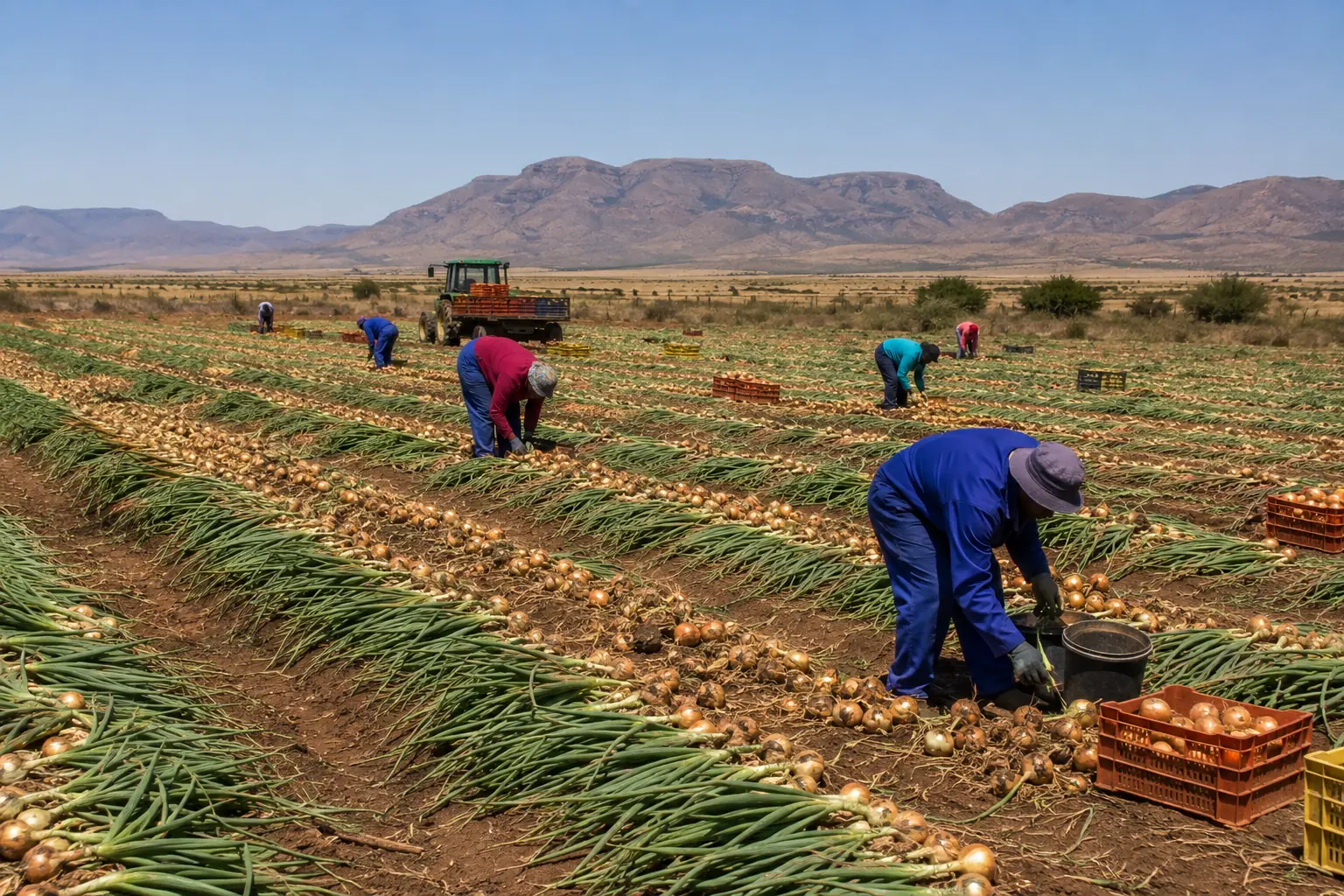
Choosing the Right Onion Variety for South Africa
Onion variety selection is arguably the single most important decision in onion farming. The wrong variety in the wrong region or season will fail to bulb properly, produce small unmarketable bulbs, or bolt to seed prematurely. South African onion production uses both open-pollinated and F1 hybrid varieties, with hybrids dominating commercial production due to their consistency, uniformity, and yield.
Onions are classified by their photoperiod response, the day-length required to trigger bulb formation. South African producers primarily grow:
| Variety Type | Day-Length | Best Region in SA | Key Examples |
|---|---|---|---|
| Short-day (SD) | 10–12 hours | Northern Cape, winter planting | Granex, Sona, Pyramid |
| Intermediate-day (ID) | 12–14 hours | Free State, Limpopo, transition seasons | Texas Grano, Serena |
| Long-day (LD) | 14–16 hours | High-altitude summer production | Stuttgarter, Robijn |
| Day-neutral (DN) | Any | Flexible, increasingly popular commercially | Catania, Fuego, Alonso |
For most South African commercial farmers, F1 hybrid short-day and day-neutral varieties dominate. Varieties such as Catania, Fuego, and Sona have built strong reputations for yield, skin quality, and shelf life in the Northern Cape. In the Western Cape, varieties suited to the cooler, longer growing season produce excellent pungency and firm skin for both local and export markets. Always purchase certified seed from registered seed companies, do not replant onion bulbs from the previous season for commercial production.
Climate and Province Requirements for Onion Farming
Onions are a cool-season crop that require specific temperature ranges during their vegetative phase and warmer, drier conditions during bulbing and maturation. Understanding your province's seasonal window is critical to planting success.
- Northern Cape (Orange River region): Ideal conditions. Plant from March to June for July–November harvest. Warm days (18–25°C), cool nights, very low humidity, and reliable irrigation from the Orange River create textbook onion production conditions. This is South Africa's primary commercial onion zone.
- Western Cape: Plant from February to April in the Koue Bokkeveld and Ceres valley for an August–December harvest window. Mediterranean climate delivers excellent quality. Suitable for both local market and export-quality production.
- Free State: Late summer and autumn planting (February–April) for a July–October harvest. Loamy soils near Bultfontein and Marquard areas suit onions well. Watch for spring frost during vegetative establishment.
- Limpopo: Irrigation-supported winter production (April–August planting). Warm summer temperatures allow earlier planting than many other provinces. Disease pressure from thrips is higher, factor this into your IPM programme.
- KwaZulu-Natal Midlands: Higher altitude plantings (April–June) are feasible with irrigation support. Not a primary onion region but increasingly viable for local market supply.
⚠️ Critical planting window: Onions planted outside their optimal photoperiod window for your region will fail to bulb correctly. Match your variety's day-length requirement to your latitude and planting season, consult seed company agronomists or your nearest agricultural extension officer before committing to large plantings in a new region.
Soil Preparation for Onion Farming in South Africa
Onions are shallow-rooted crops with 80% of their root mass in the top 30cm of soil. They demand well-structured, well-drained, friable soil with no compaction layers and a pH of between 6.0 and 6.8. Heavy clay soils that waterlog are unsuitable, onions in saturated soil will rapidly develop basal rot and fail. Sandy loam soils, like those found along the Orange River, are ideal because they warm quickly, drain freely, and allow the developing bulb to expand without resistance.
Soil Testing (6–8 Weeks Before Planting)
Submit soil samples to an accredited laboratory for pH, macro and micronutrient analysis, and electrical conductivity (EC) measurement. Target pH: 6.0–6.8. High EC soils (above 1.5 mS/cm) will reduce germination and growth, avoid saline soils or leach thoroughly before planting. Correct deficiencies based on lab recommendations rather than guesswork. See our fertilizer guide for SA-specific soil amendment guidance.
Deep Ripping and Primary Tillage
Rip the soil to 50–60cm depth to break up any hardpan or compaction layer that would restrict drainage and root penetration. Follow with a disc harrow pass to break up large clods. Leave the soil exposed for 2–4 weeks if possible to weather and allow weed seeds to germinate (which can then be destroyed before planting). See our land preparation guide for equipment options and contractor costs.
Basal Fertiliser Incorporation
Work basal fertiliser (typically a balanced compound fertiliser such as 2:3:2 or similar based on your soil test) into the top 15–20cm before bed formation. Onions have a moderate phosphorus requirement at establishment, ensure adequate phosphorus incorporation at this stage, as top-dressing phosphorus later is ineffective. Apply well-composted organic matter at 5–8 tonnes per hectare on lighter soils to improve water retention and soil biology.
Bed Formation
Form raised beds 1.0–1.2m wide with a rotary tiller or bed former to ensure surface drainage and aeration. Raised beds of 15–25cm height above the furrow significantly reduce basal rot pressure. Mark the seedling rows on the bed, most commercial operations plant 4–6 rows per 1.2m bed at 8–12cm within-row spacing. Smooth the bed surface well to ensure good seed-to-soil contact.
Pre-Plant Weed Management
Young onion seedlings are extremely sensitive to weed competition in their first 6–8 weeks. Use a stale seedbed technique, allow weed seeds to germinate after bed preparation, then destroy with a shallow pass before planting. Pre-emergent herbicides registered for onion use in South Africa (check current label registrations) can be applied at planting. Manual and mechanical weeding in early growth is critical to achieving yield targets. See our pest and weed control guide for more.
Irrigation for Onion Farming in South Africa
Water management is one of the highest-use inputs in onion production. Too little water stunts bulb development; too much creates the humid conditions that drive fungal diseases, especially botrytis leaf blight and downy mildew. Drip irrigation has become the standard system for commercial onion production in South Africa, particularly in the Northern Cape, because it delivers water precisely to the root zone, keeps foliage dry (reducing disease pressure), and allows fertigation, the delivery of soluble fertilisers through the irrigation system.
Drip systems for onions typically use flat tape emitters at 30cm spacing, with one drip line per two plant rows on wide beds. Critical irrigation stages for onions include:
- Germination and establishment: Frequent, light irrigations to maintain surface moisture without waterlogging. 2–3 irrigations per week at low volume.
- Vegetative growth (weeks 4–10): Consistent moisture, avoiding soil moisture stress that causes splitting and multiple centres in the bulb.
- Bulbing phase (weeks 10–16): Adequate moisture critical for bulb fill. Maintain 60–70% field capacity. Irrigation deficit during bulbing directly reduces yield and grade.
- Maturation and curing (2 weeks before harvest): Gradually reduce irrigation to harden the outer skin and improve storage quality. Stop irrigation 10–14 days before lifting.
For smallholder farmers without drip infrastructure, sprinkler irrigation is used, but irrigate in the morning only so foliage dries before nightfall, significantly reducing fungal disease pressure. See our detailed irrigation systems guide for setup costs, grant options, and installation advice for SA farmers.
Fertiliser Programme for Onions
Onions are moderate to high feeders, particularly for nitrogen and potassium, with a comparatively high sulphur requirement that contributes to the pungency and flavour characteristics that markets demand. A typical commercial fertiliser programme for onions in South Africa follows this general framework:
| Growth Stage | Key Nutrients | Method | Notes |
|---|---|---|---|
| Pre-plant (basal) | P, K, Ca, Mg, micronutrients | Soil incorporation | Based on soil test. Phosphorus must be incorporated, onions cannot take up P from surface applications effectively. |
| Early vegetative (weeks 2–6) | N (lower rates), S | Fertigate or top-dress | Start nitrogen at low rates. Excess N early promotes leaf over bulb. Sulphate forms of N preferred. |
| Rapid vegetative (weeks 6–11) | N (higher rates), K, S | Fertigate or foliar | Main nitrogen push. Split into multiple applications. Potassium supports cell strength and skin quality. |
| Bulbing initiation (weeks 11–15) | K, Ca, reduced N | Fertigate | Shift away from nitrogen as bulbing begins. Excess N delays maturity and reduces skin quality and storage life. |
| Maturation | Stop all feeding | — | Cease fertiliser 3–4 weeks before harvest to harden skin and improve storage quality. |
Always work with your seed company agronomist or a certified crop nutrition specialist to develop a specific programme for your soil type, variety, and market requirements. Total nitrogen requirements for onions typically range from 150–250 kg N/ha per season.
Pest and Disease Management in South African Onion Farming
Onions are susceptible to a range of pests and diseases in South Africa. A proactive Integrated Pest Management (IPM) approach, combining cultural controls, resistant varieties, biological controls where available, and targeted chemical applications, is far more effective than reactive spraying.
Key Pests
- Onion thrips (Thrips tabaci): The most economically significant pest of onions in South Africa. Thrips feed on leaf tissue, causing silvering, and transmit Iris Yellow Spot Virus (IYSV) which causes significant yield losses. Thrips populations explode in hot, dry conditions (monitor weekly with blue sticky traps. Chemical control is complicated by resistance) rotate between registered chemical groups. See our IPM guide for rotation schedules.
- Cutworms: Soil-dwelling larvae sever seedlings at ground level. Most damaging at transplanting and seedling stage. Bait treatments at planting reduce pressure effectively.
- Bulb mites: Secondary pests that invade damaged bulbs in the field and storage. Good harvesting hygiene and avoiding mechanical damage during lifting reduces risk.
Key Diseases
- Botrytis leaf blight and neck rot (Botrytis squamosa, B. allii): Major fungal diseases in cool, humid conditions. Maintain spray programme with registered fungicides on a 7–10 day interval during vulnerable periods. Ensure adequate plant spacing and avoid overhead irrigation at night.
- Downy mildew (Peronospora destructor): Appears as pale-green to violet fuzz on leaves in cool, wet weather. Once established, is very difficult to control. Preventive fungicide applications on a weather-triggered spray programme are most effective.
- Fusarium basal rot: Soil-borne pathogen causing root and basal plate decay. Avoid planting onions in the same field more than once every 3–4 years. See our crop rotation guide for suitable break crops.
- White rot (Sclerotium cepivorum): Devastating soilborne disease that persists in soil for decades. Once present, almost impossible to eradicate. Purchase certified clean seed and transplants, and never move soil from infected fields.
Harvesting and Curing Onions
Onions are ready to harvest when approximately 50–70% of the tops have fallen over naturally (lodged). This typically occurs at 120–160 days from planting depending on variety and season. Harvesting at the correct maturity stage is critical, too early and bulbs have poor skin quality and won't store well; too late risks re-sprouting, neck rot, and skin splitting.
Curing is the process of drying the outer skin layers of the onion after lifting to create a protective barrier for storage. Proper curing is essential for any onion destined for storage or distant markets:
- After lifting, lay onions in windrows in the field for 5–10 days if weather is warm and dry (avoid this in wet or very humid conditions).
- Move to a covered, well-ventilated curing shed or structure with forced air ventilation at 25–35°C for 2–4 weeks.
- Properly cured onions will have tight, papery outer skins, dry necks, and minimal moisture at the neck plate, dramatically extending storage life to 3–6 months under correct conditions.
Average Yield (Drip, NC)
Well-managed commercial onion crop under drip irrigation
40–60 t/haAverage Farmgate Price
Fresh produce market average, medium grade
R3,000–R5,500/tGross Revenue (per ha)
Before input costs (seed, water, fertiliser, labour)
R120,000–R330,000Grading and Packaging Onions for South African Markets
Fresh onions sold at major fresh produce markets in South Africa are typically graded by equatorial diameter into the following classes, aligned with the South African Marketing Act and PPECB export standards:
- Grade 1 (Export): 60–80mm diameter, well-formed, tight skin, no defects, suitable for export packing houses. Attracts the highest price.
- Grade 2 (Local market premium): 50–65mm, sound bulbs, minor cosmetic allowances. Most commonly traded at fresh produce markets.
- Small/medium: 40–55mm, sold for processing, retail pre-packs, or lower-end markets at reduced prices.
- Culls/process grade: Damaged, split, or diseased bulbs, sold to processing factories at significantly reduced rates or discarded.
Packaging requirements for fresh produce market sales are typically 10kg, 15kg or 20kg net bags. For export, PPECB inspection and compliance with destination-country phytosanitary requirements is mandatory. See our export farming guide for a breakdown of onion export certification in South Africa.
Selling Onions, Market Channels in South Africa
South African onion farmers have several market channels available, each with different price, volume, and logistical implications:
- Fresh Produce Markets (FPM): The Johannesburg, Cape Town, Durban, Tshwane, and Port Elizabeth fresh produce markets handle the bulk of South Africa's commercially traded onions. Prices are transparent and publicly available. Access via a registered commission agent (agent fees: typically 7.5–10% of gross sales). See our agri markets guide for how to register and find agents.
- Direct retail: Supply to major retailers (Woolworths, Pick n Pay, Checkers, Spar) through their buying divisions. Requires consistent supply, quality compliance, food safety certification (GlobalGAP), and often significant scale.
- Export: South Africa exports onions primarily to SADC countries. Register with PPECB, comply with destination-country phytosanitary requirements, and use a licensed exporter. Export prices are typically higher than local FPM prices but logistical and compliance costs are significant.
- Processing: Supply to dehydration plants, food manufacturers, and processing factories. Prices are lower but offtake is consistent and quality standards are less stringent. Suitable for processing-grade and lower-quality onions.
- Local farmgate and informal markets: Viable for smallholders supplying nearby towns. Lower overhead costs but limited volume and price volatility.
Grants and Support for Onion Farmers in South Africa
The Department of Agriculture, Land Reform and Rural Development (DALRRD) offers several grant programmes that can assist onion farmers with infrastructure, inputs, and market access. These include the Comprehensive Agricultural Support Programme (CASP), the Ilima/Letsema programme for subsistence and smallholder farmers, and provincial agricultural department support schemes. Visit our dedicated farming grants page for detailed information on how to apply, eligibility criteria, and application timelines for each programme.