South Africa's Water Crisis and What It Means for Farmers
South Africa's water scarcity is structural, it will not improve as rainfall becomes more erratic under climate change. The National Water Act (Act 36 of 1998) governs all water use in South Africa, and irrigation water rights (water use licences) are a finite, valuable, and regulated resource. Farmers without valid water use licences cannot legally irrigate, and the Department of Water and Sanitation (DWS) is actively enforcing compliance.
Water allocation for agriculture is under pressure across all major SA catchments, the Orange, Limpopo, Vaal, Olifants, Crocodile, and Breede rivers all have catchments where demand approaches or exceeds sustainable yield in drought years. This reality means every litre of irrigation water must be used as efficiently as possible, and choosing the right irrigation system is the most impactful efficiency decision a SA farmer makes.
Electricity is the other major cost driver in SA irrigation, pumping accounts for the majority of energy use on most irrigated SA farms, and Eskom tariff increases have made pumping costs a serious profitability constraint. Variable speed drives (VSDs) on pumps, gravity-fed systems where topography allows, and scheduling irrigation to off-peak tariff periods are all important cost management strategies for SA irrigators.
Water Use Licences in South Africa
Any irrigation that takes water from a river, dam, borehole, or canal above the Schedule 1 threshold (small domestic and subsistence use) requires a Water Use Licence (WUL) from the Department of Water and Sanitation. Applying for a WUL involves submitting a water use licence application (WULA) with supporting information about your farm, crops, irrigation system, and projected water use. Processing times range from several months to several years depending on the catchment and application complexity. Operating without a valid WUL is a criminal offence under the National Water Act.
Choosing the Right Irrigation System for Your SA Farm
The right irrigation system depends on the interaction of several factors specific to your farm. There is no single universally correct answer, but the following framework helps SA farmers make the decision systematically:
- Crop type: Row vegetables (tomatoes, peppers, onions, cabbage), drip tape is standard. Fruit trees (citrus, avocado, macadamia), micro-sprinklers or tree-zone drip. Vineyards (drip. Grain crops (maize, wheat, sorghum)) centre pivot or overhead sprinkler. Pastures, overhead sprinkler or flood. Sugarcane, furrow, overhead, or SDI.
- Water availability and pressure: Drip and micro-sprinklers operate at low pressure (60–200 kPa), suitable for low-head borehole systems. Centre pivots require high flow and moderate pressure. Gravity-fed systems need elevation differential.
- Terrain: Drip and subsurface drip work on any slope. Centre pivots require flat land. Flood irrigation requires flat terrain with gentle slope for gravity flow.
- Budget: Flood irrigation costs almost nothing to establish but wastes water. Drip tape systems are moderate cost with excellent ROI. Centre pivots are high capital but justified at scale. SDI is the highest capital cost but longest lifespan.
- Labour availability: Centre pivots and automated drip systems require minimal operator time. Portable sprinkler and furrow systems require significant manual labour to operate, move, and manage.
| System | Efficiency | Capital Cost | Operating Cost | Best Crops | Weed Risk | Fertigation |
|---|---|---|---|---|---|---|
| Drip Tape | 85–95% | Moderate | Low | Vegetables, grapes | Low | Yes |
| Micro-Sprinkler | 75–88% | Moderate | Low–Med | Orchards, citrus | Medium | Limited |
| Centre Pivot | 80–90% | Very High | High (energy) | Grain, potatoes | Medium | Yes |
| Overhead Sprinkler | 70–85% | Moderate–High | Medium | Pasture, potatoes | High | No |
| Flood / Furrow | 40–60% | Very Low | Low | Sugarcane, lucerne | High | No |
| SDI (Subsurface) | 90–98% | Very High | Very Low | Vegetables, sugarcane | Very Low | Yes |
Drip Irrigation in South Africa: The Practical Guide
Drip irrigation is the dominant system on South Africa's commercial vegetable and fruit farms, and increasingly the recommended choice for emerging farmers and smallholders. Understanding how to design, install, and manage a drip system correctly is one of the highest-value practical skills a SA farmer can develop.
Drip System Components
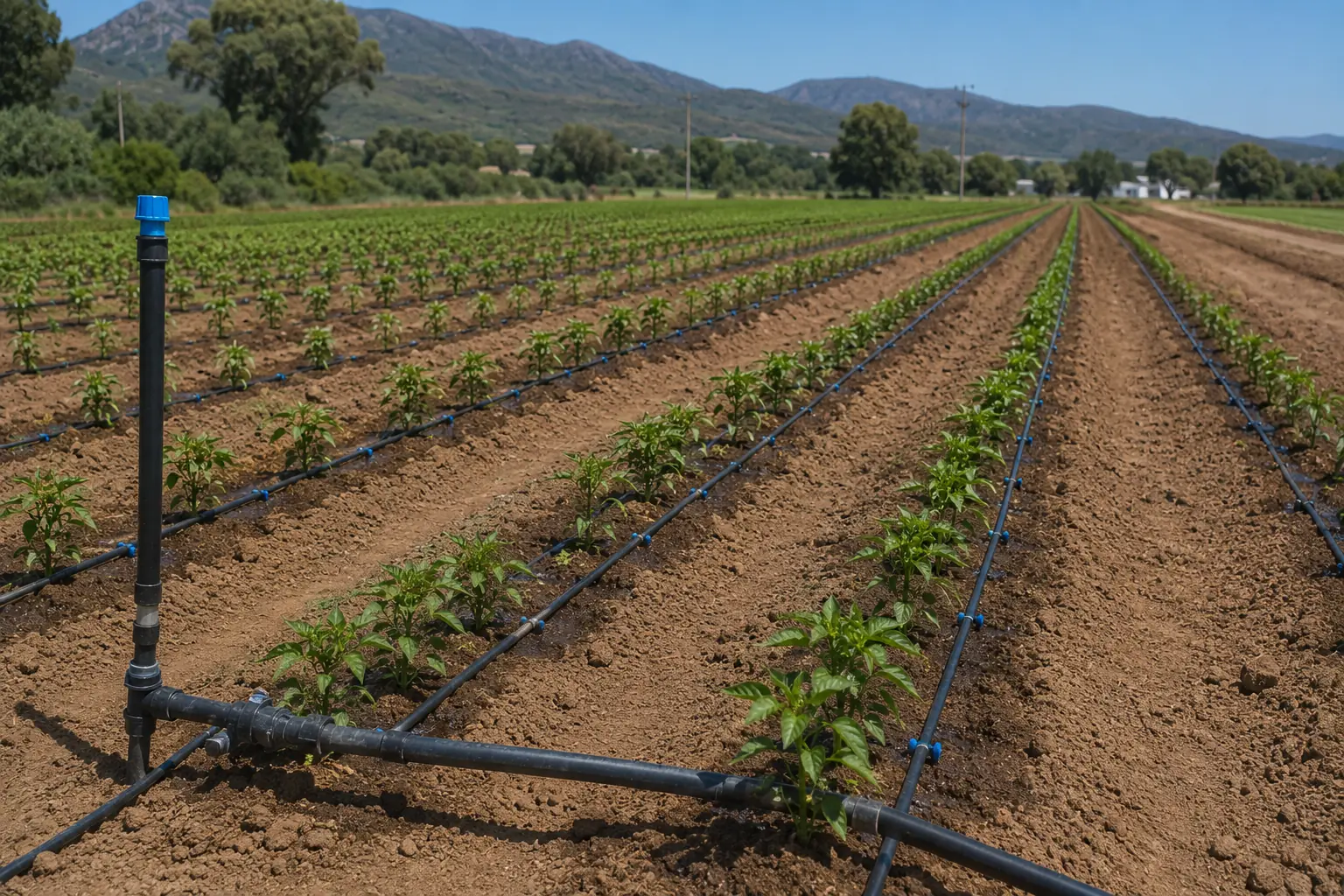
A complete drip irrigation system consists of several key components working together: a water source (borehole, dam, river, municipal supply); a pump and motor (sized to your flow rate and pressure requirements); a filtration system (screen, disc, or sand media filter, absolutely essential to prevent emitter clogging); a fertiliser injector or Venturi for fertigation; a pressure regulator to maintain consistent emitter performance; the mainline, submain, and lateral pipes; and the drip tape or emitters themselves.
Filter quality is the single most critical factor in drip system longevity in South Africa. SA borehole and river water often contains fine particles, algae, and mineral deposits that will rapidly clog emitters without adequate filtration. Investing in good filters and maintaining them with regular backwashing is far cheaper than replacing clogged drip tape prematurely.
Drip Tape vs Drip Line
Drip tape (thin-walled, flat when empty) is used for annual vegetable crops. It is low cost, easy to install and remove seasonally, and widely available from SA irrigation suppliers. Flow rates are typically 1–2 litres per emitter per hour. Drip line (thick-walled, round in section) is used for permanent orchards and vineyards, more durable, longer-lasting (10–20 years), and available with pressure-compensating emitters that maintain consistent flow on slopes.
Scheduling Irrigation with Drip
Correct irrigation scheduling (applying the right amount of water at the right time) is as important as the system hardware. Over-irrigation wastes water, leaches nutrients below the root zone, and encourages disease. Under-irrigation reduces yield and quality. South African farmers use several scheduling tools: tensiometers (measure soil moisture tension), soil moisture sensors, simple feel-and-dig soil tests, evapotranspiration tables published by the ARC for SA conditions, and increasingly, smartphone apps and cloud-based irrigation controllers.
Centre Pivot Irrigation in South Africa
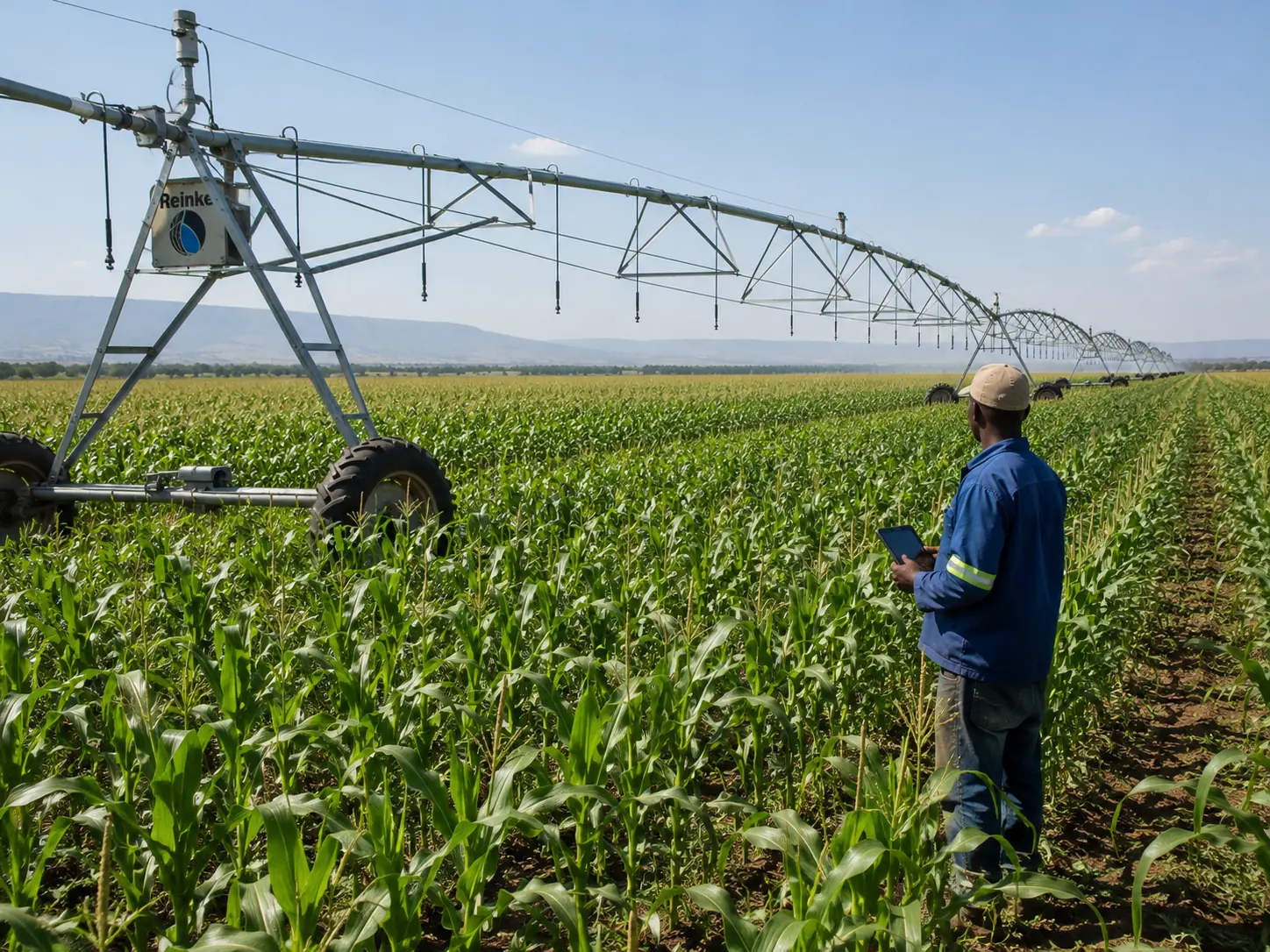
The centre pivot is the dominant irrigation technology for large-scale grain and potato farming in South Africa's Highveld, and the distinctive green circles visible in aerial photography of the Free State, North West, and Mpumalanga are almost entirely the product of centre pivot irrigation. SA has approximately 10 000 active centre pivots, making it one of the highest pivot-density agricultural countries in Africa.
A standard SA centre pivot covers approximately 50–130 hectares, depending on arm length. Modern SA pivots are GPS-guided, remotely monitored, and can be programmed to apply variable rates of water across the field based on soil type, slope, or crop need, a technology called variable rate irrigation (VRI). Fertigation through the pivot (applying liquid fertiliser through the water stream) is standard practice on SA maize and potato farms.
The main limitation of centre pivots is terrain, they require large, flat fields with no obstacles. Trees, power lines, farm buildings, and irregular boundaries all reduce pivot efficiency and create management headaches. SA farms acquiring land for centre pivot development must assess field shape, drainage, and obstacle clearance as primary site selection criteria.
Irrigation Water Quality: A SA-Specific Challenge
Water quality is a critical and often overlooked factor in SA irrigation management. Many SA borehole and river sources contain problematic levels of total dissolved solids (TDS), electrical conductivity (salinity), pH imbalance, iron, manganese, bicarbonates, or biological contamination, all of which can damage crops, clog emitters, or reduce yields if not managed.
Every SA farmer planning to install or expand an irrigation system should have their water source tested by an accredited laboratory for at least: EC (electrical conductivity/salinity), pH, sodium absorption ratio (SAR), total iron and manganese, bicarbonate/carbonate levels, and basic pathogen screening for food safety compliance. The ARC-ISCW (Agricultural Research Council) and accredited agricultural laboratories across SA offer water quality testing services. Water quality results directly inform your filter selection, emitter type, fertigation programme, and any pre-treatment requirements.
The global benchmark for drip-irrigated vegetables is a water productivity of 10–15 kg of produce per cubic metre of water applied. Many SA farmers achieve far below this, often because of poor scheduling, system leaks, or over-irrigation. Improving water productivity to near this benchmark is achievable through better scheduling tools, regular system maintenance, and soil moisture monitoring, delivering both water savings and yield improvements simultaneously.
Grants and Subsidies for Irrigation Infrastructure in SA
Several South African government programmes provide funding support for irrigation infrastructure for emerging and smallholder farmers. The CASP (Comprehensive Agricultural Support Programme) has funded borehole drilling, pump installation, drip systems, and water tanks for emerging farmers across all nine provinces. The Ilima/Letsema programme funds production inputs and can include irrigation infrastructure for food production projects. Provincial Departments of Agriculture have additional irrigation support programmes, particularly in the Western Cape (Casidra) and Eastern Cape.
The Water Research Commission (WRC) and the Department of Water and Sanitation also run farmer support programmes for water use efficiency improvement. See our complete Farming Grants Guide for full application details and eligibility criteria.