Pecan Nut Farming in South Africa, A High-Value, Long-Term Orchard Investment
Pecan nuts (Carya illinoinensis) are consistently among South Africa's most useful high-value agricultural investments. The country has become among the Southern Hemisphere's most significant pecan producing nations, with major orchards concentrated in the Northern Cape, Western Cape, and parts of the Eastern Cape and KwaZulu-Natal. Global demand for pecans is growing strongly, driven by the health food sector, the snack industry, and expanding middle-class consumption across Asia, particularly China, which has become the world's largest importer of pecan nuts and pays premium prices for quality in-shell and shelled product.
Pecan farming is fundamentally different from annual cropping. It is a long-term capital investment, trees take 5–7 years from planting to first meaningful commercial production, and only reach full bearing maturity at 12–15 years. But once a pecan orchard is established and in full production, it can generate significant income for 40–60 years with relatively low annual input costs compared to annual vegetable or grain crops. An established pecan orchard in South Africa producing 2,500–3,500 kg of in-shell nuts per hectare, sold at R30–R50 per kilogram, generates gross revenues of R75,000–R175,000 per hectare per year, figures that very few other agricultural enterprises can match on a sustained, multi-decade basis.
This guide takes you through the main production decisions to plan, plant, establish, and manage a pecan orchard in South Africa, from site selection and variety choice through the critical early establishment years, to mature orchard management, harvesting, post-harvest handling, and accessing South Africa's pecan market channels.
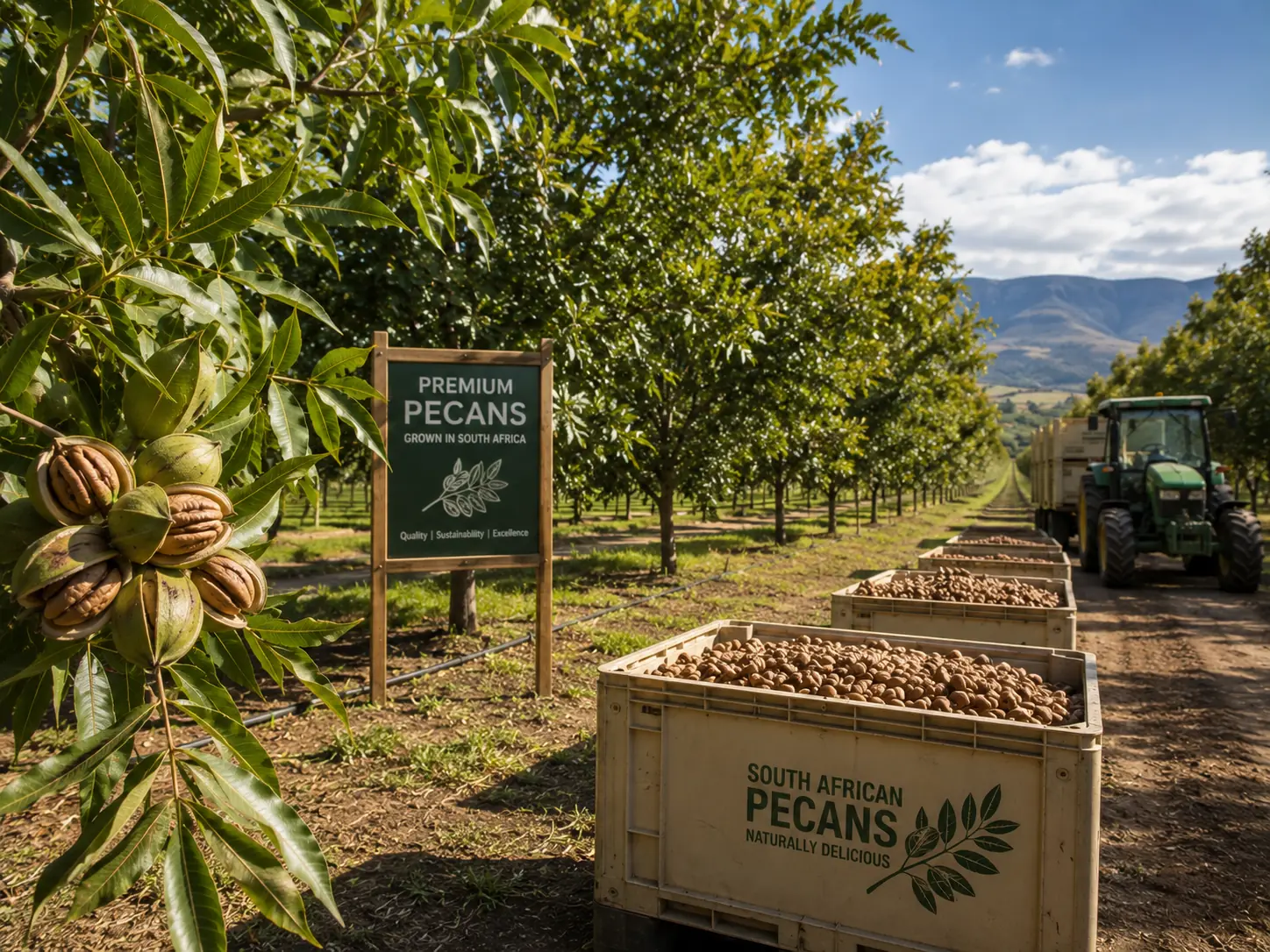
🌰 Industry snapshot: South Africa produces approximately 15,000–20,000 tonnes of pecan nuts per year, with production growing annually as young orchards planted in the early 2010s reach full bearing. The Northern Cape (particularly the Orange River valley and surrounds) accounts for the majority of production. South African pecans are exported primarily to markets in Europe and Asia. Domestic consumption is growing through retail nut sales, confectionery, and bakery sectors.
Best Pecan Varieties for South Africa
Pecan variety selection is among the most critical decisions you will make, you will live with it for 40+ years. South African pecan production uses a range of named varieties, with selection based on kernel fill, nut size, shell quality, disease resistance, bearing habit, and compatibility with cross-pollination partners.
Because pecans require cross-pollination between two different varieties (they are not self-fertile), every orchard must be planted with at least two compatible varieties. Pecan varieties are classified by their pollen shed and pistillate (female) receptivity timing into two types: Type I (protandrous), pollen sheds before the pistils are receptive, and Type II (protogynous), pistils are receptive before pollen sheds. A successful orchard requires a Type I and a Type II variety to be planted together.
| Variety | Type | Nut Size | Kernel % | Notes for SA |
|---|---|---|---|---|
| Wichita | Type II | Large | 58–62% | Most widely planted in SA. Excellent kernel quality, large attractive nut. Susceptible to scab in humid conditions. Best in dry Northern Cape. |
| Cheyenne | Type II | Medium-Large | 58–60% | Good flavour, early bearing. Popular secondary variety. |
| Western Schley | Type I | Medium | 55–60% | Classic pollinator for Wichita. Long-established in SA orchards. Alternate bearing tendency. |
| Mohawk | Type I | Large | 57–61% | Large nut, good kernel. Increasingly popular in SA as a primary or pollinator variety. |
| Pawnee | Type I | Large | 58–62% | Early season, very large attractive nut with excellent flavour. Good export quality. Strong demand from buyers. |
| Shoshoni | Type I | Medium-Large | 56–60% | Good scab resistance, reliable bearer. Useful in wetter production areas. |
| Ukulinga | Type II | Medium | 54–58% | South African-selected variety adapted to local conditions. Reliable producer. |
Work closely with a registered pecan nursery and an experienced pecan consultant when finalising your variety selection. The combination of Wichita (Type II) with either Western Schley or Mohawk (Type I) remains the most widely used and commercially proven pairing in South African conditions. Consult the South African Pecan Producers Association (SAPPA) for the latest variety performance data across different growing regions.
Climate and Site Requirements for Pecan Farming in South Africa
Pecans are native to the deep river valleys of the southern United States and Mexico, where they evolved in deep, fertile alluvial soils with hot summers and mild winters. South Africa's best pecan growing regions closely mirror these conditions.
Temperature and Chilling Requirements
Pecans require a defined period of winter cold, called chilling hours (hours below 7°C), to break dormancy and initiate uniform budbreak in spring. Most commercial varieties require 250–500 chilling hours per year. This makes pecans unsuitable for truly subtropical, frost-free coastal areas but well-suited to South Africa's inland river valleys and highland areas that experience cool winters. The Northern Cape's Orange River valley, parts of the Western Cape interior, and the Eastern Cape's river valleys typically accumulate sufficient chilling hours while still delivering the long, hot growing season pecans need to fill their nuts fully.
Frost
Pecans are relatively frost-hardy when dormant in winter but are extremely sensitive to late spring frosts that coincide with budbreak and catkin emergence. A single late frost event can destroy an entire crop in young developing orchards. Site selection should avoid frost pockets, low-lying areas where cold air drains and pools on cold nights. Elevated slopes with good cold air drainage are preferred. Sites with a known history of late spring frosts above 900m elevation in the Cape interior require careful consideration.
Soil Requirements
Pecans develop a deep taproot system that can penetrate 2–3 metres into the soil profile. This means soil depth is absolutely non-negotiable, a minimum of 1.5 metres of workable soil depth free of hardpan, rock, or impermeable clay layers is required for long-term productive pecan orchards. Deep alluvial soils along river systems (the Orange River, Fish River, Sundays River, and similar valley floors) are ideal. Sandy loam to clay loam texture with good drainage is preferred, waterlogged soils will kill pecan trees within a season or two from root rot. Soil pH should be between 6.0 and 7.0. Conduct a thorough soil survey including auger borings to at least 2 metres depth before committing to orchard establishment.
Establishing a Pecan Orchard, Step by Step
Site Survey and Soil Assessment (12–18 Months Before Planting)
Commission a detailed soil survey of your proposed orchard site, multiple auger borings on a grid pattern, soil profile pits, and laboratory analysis of pH, texture, nutrient status, and salinity (EC). Simultaneously assess your water source: volume, quality (EC, sodium absorption ratio), and reliability. Without confirmed water security, do not proceed with pecan establishment. Engage a pecan consultant at this stage, the cost of professional advice before planting is trivial compared to the cost of mistakes over a 40-year orchard life.
Land Preparation
Deep rip the orchard site to 80–100cm to break up any compaction layers or hardpan that would impede root development. In heavy clay soils, subsoil drainage may need to be installed. Apply lime to adjust pH if required, incorporate thoroughly via deep ripping before planting. Apply pre-plant organic matter (quality compost at 10–20 tonnes/ha) across the orchard floor and rip in. Mark tree positions and install the irrigation system before planting. See our land preparation guide and irrigation guide for more detail.
Planting Layout and Spacing
Standard commercial pecan planting densities in South Africa range from 100–156 trees per hectare at 8×8m to 10×10m spacing. High-density systems at 6×6m (278 trees/ha) are used by some producers, with the intention of thinning trees as canopies close. This requires careful management. The classic South African approach is a 10×10m grid with variety alternation: plant one row of Type I pollinator variety, one row of Type II main variety, alternating throughout the orchard. Every tree must have a cross-pollination partner within flight range of wind-carried pollen, typically no more than 40–50 metres.
Planting Young Trees
Plant certified, grafted nursery trees (not seedling trees, always use grafted trees of known, certified varieties). Plant in winter dormancy (June–August) to minimise transplant stress. Dig planting holes large enough to accommodate the root system without bending or circling roots. Plant at the same depth as in the nursery, do not bury the graft union. Firm soil well around roots to eliminate air pockets. Water thoroughly at planting. Apply a tree guard to protect the trunk from livestock, machinery, and sunscald. Stake young trees in windy sites.
First Three Years, Establishment Management
The establishment phase is critical. Young pecan trees need consistent irrigation, regular fertilisation (building towards full nutrition programmes as the tree canopy develops), weed control in the tree row (weeds compete severely with young trees for water and nutrients), and protection from pests and diseases. Annual formative pruning shapes the tree's scaffold structure. Zinc deficiency is extremely common in young pecans, foliar zinc sprays are typically applied multiple times per season. Do not allow any nut production in years 1–3 to avoid weakening the developing tree.
Irrigation Management for Pecan Orchards
Pecans are a high-water-use tree crop, a mature orchard in South Africa's hot inland conditions can use 1,000–1,400mm of water per year. Since most of South Africa's best pecan regions receive only 200–400mm of rainfall annually, full irrigation is essential for commercial pecan production. Micro-jet or mini-sprinkler irrigation under the canopy is the most common system used in South African pecan orchards, though drip irrigation (with multiple emitters per tree) is increasingly adopted in new plantings for water efficiency and fertigation capability.
Critical irrigation periods for pecans include:
- Budbreak to shoot elongation (September–October): Adequate moisture critical for shoot growth and catkin development.
- Pollination and initial nut set (October–November): Moisture stress during this phase causes nut drop and poor set.
- Kernel fill (January–March): The most water-critical phase. Moisture deficit during kernel fill directly reduces kernel weight, quality, and percentage. Do not stress trees at this stage.
- Shell hardening and maturation (March–May): Maintain adequate irrigation through to harvest. Reduce slightly in the final 2–3 weeks before harvest to harden shells.
Fertilisation of Pecan Orchards
Pecans are nutritionally demanding trees, with particular sensitivity to zinc, nitrogen, and potassium. The most widely recognised nutrient disorder in South African pecan orchards is zinc deficiency, which causes characteristic "little leaf" symptoms (small, distorted leaves with interveinal chlorosis), reduced shoot growth, and severely reduced yield. Zinc deficiency in pecans is extremely common in calcareous (high pH) and sandy soils, foliar zinc sprays (typically zinc sulphate or chelated zinc) applied 3–5 times per season are standard practice across virtually all South African pecan orchards.
A general annual nutrition framework for mature pecan orchards in South Africa includes:
- Nitrogen: Soil-applied or fertigated in split applications from budbreak through to midsummer (September–January). Typical rates: 80–150 kg N/ha/year for mature bearing orchards. Leaf nitrogen levels should be monitored by annual foliar analysis.
- Zinc: Multiple foliar sprays of zinc sulphate (0.3–0.5%) or chelated zinc from budbreak. Annual foliar analysis should confirm zinc status, target leaf zinc of 50–100 ppm.
- Potassium: Important for kernel development and quality. Apply based on soil and foliar test results. Often applied via fertigation in drip-irrigated orchards.
- Boron: Important for pollination and nut set. Foliar boron applications at pink bud stage improve nut set in some conditions.
Annual foliar (leaf) analysis is the best guide to pecan nutrition management, collect standardised leaflet samples in mid-summer (January–February) and submit to an accredited laboratory. Adjust your fertiliser programme based on results. See our fertilizer guide for SA-specific soil amendment guidance.
Pecan Pest and Disease Management in South Africa
Key Pests
- Pecan nut casebearer (Acrobasis nuxvorella): Not yet established in South Africa but a significant threat. Monitored at ports of entry. Biosecurity is critical, never import planting material or packaging that could carry this pest.
- Stink bugs (various Halyomorpha and native species): Feed on developing nuts causing black pit and kernel browning. Managed with timely insecticide applications at nut fill. Pheromone monitoring traps help time interventions.
- False codling moth (Thaumatotibia leucotreta): A major orchard pest across South Africa. Can damage pecan nuts in the husk. Managed with mating disruption systems, Cryptophlebia-specific pheromone traps, and registered chemical controls. See our pest control guide.
- Aphids (pecan aphid complex): Can cause honeydew and sooty mould on leaves and nuts, reducing photosynthesis. Natural predators (lacewings, ladybirds) provide significant control in undisturbed orchards. Avoid broad-spectrum insecticide use that disrupts beneficial insect populations.
- Pecan weevil: Not present in South Africa, but monitored as a potential invasive pest.
Key Diseases
- Pecan scab (Fusicladium effusum): The most economically damaging pecan disease globally. Causes black lesions on nuts and shucks, leading to premature nut drop and kernel staining. South Africa's dry production regions (Northern Cape) experience less scab pressure than wetter areas. Varieties like Wichita are susceptible, a regular fungicide spray programme is essential in higher-rainfall areas.
- Crown gall (Agrobacterium tumefaciens): Soil-borne bacterial disease causing galls at the root collar and roots. Introduced via infected planting material. Purchase certified, crown-gall-free nursery trees only.
- Phytophthora root rot: Occurs in poorly drained, waterlogged soils. Ensure excellent drainage at establishment, this disease is largely preventable through proper site selection and orchard design.
Harvesting and Post-Harvest Handling of Pecans
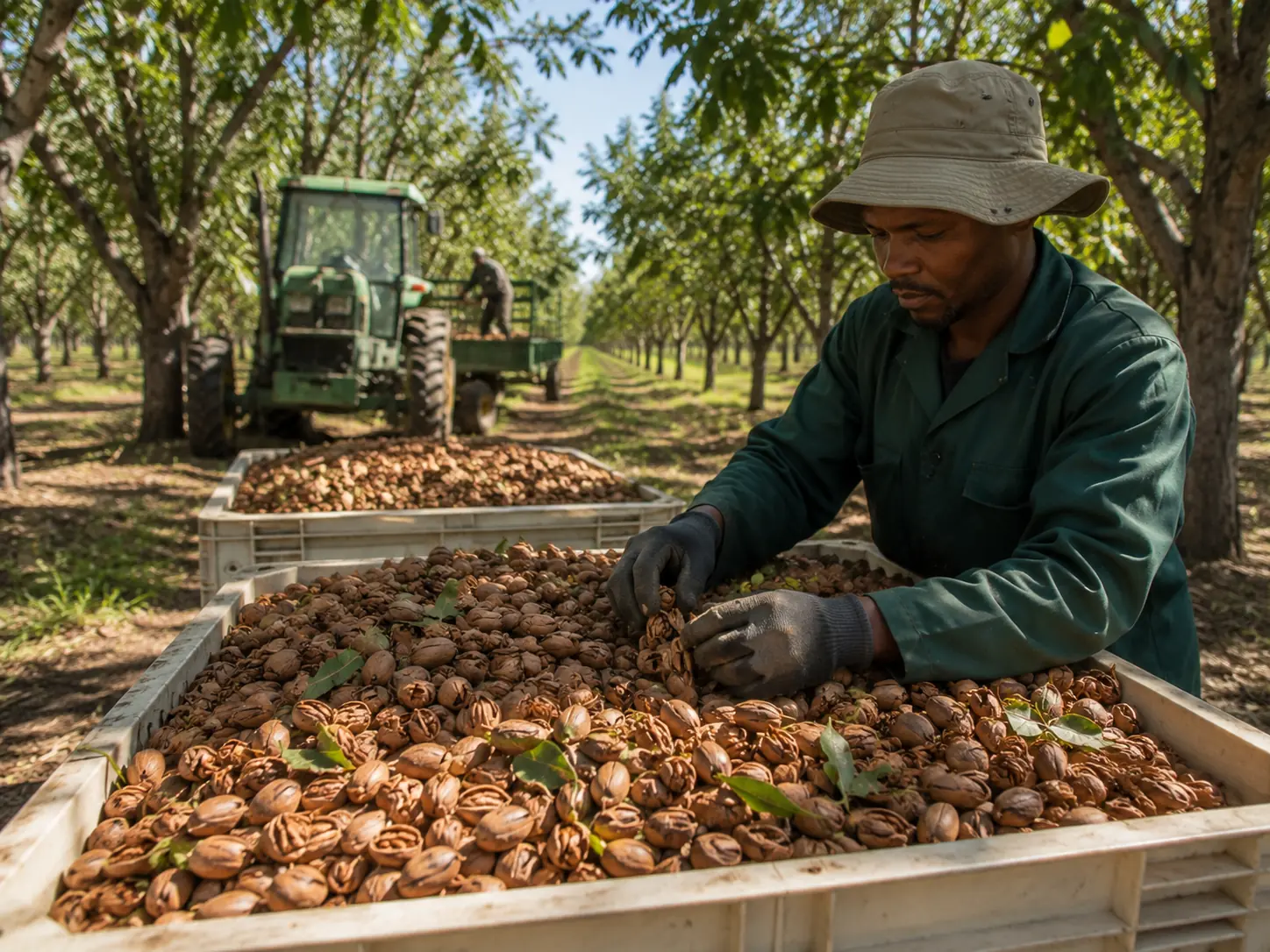
South African pecans are typically harvested from March to June, depending on variety and region. The Northern Cape's warmer conditions produce an earlier harvest (March–April) while the cooler Western Cape and Eastern Cape regions harvest from April to June. Nuts are ready to harvest when the outer green husk splits open naturally, exposing the tan-coloured shell underneath.
Commercial harvesting in South Africa uses:
- Mechanical trunk shakers to knock nuts to the orchard floor.
- Sweepers and windrow machines to gather nuts into rows for collection.
- Harvesting machines or trailers to pick up nuts from windrows.
After harvest, nuts must be dried immediately to prevent mould development. The target moisture content for safe storage is below 4% kernel moisture. Mechanical dryers operating at 35–40°C (not higher, as heat damages kernel quality) are standard on commercial South African pecan operations. Poorly dried pecans develop aflatoxin moulds, a critical quality and food safety issue that can render entire lots unsaleable.
Full-Bearing Yield
Mature commercial orchard (12–15+ years) under good management
2,500–4,000 kg/haIn-Shell Price (SA)
Average farmgate, good grade in-shell product
R30–R55/kgGross Revenue (Full Bearing)
Before input costs, mature orchard per hectare
R75,000–R220,000/haSelling Pecans, Market Channels in South Africa
South African pecan farmers have several routes to market, each with different price levels and requirements:
- Exporters and processing companies: The majority of South African commercial pecan production is sold through specialist pecan processors and exporters, who grade, process (crack, shell, sort), and package nuts for local retail or export markets. Prices are determined by grade (nut size, kernel percentage, quality). Contact the South African Pecan Producers Association (SAPPA) for a directory of registered buyers and processors.
- In-shell retail and direct sales: Smaller producers and those with good retail connections sell in-shell nuts directly to retailers, nut wholesalers, and direct to consumers at markets and online. Retail prices are significantly higher than bulk processor prices.
- Export markets: South African pecans are exported primarily to Europe and Asia. China is a growing and high-paying market for quality in-shell product. Export requires PPECB phytosanitary certification and compliance with destination-country food safety standards. See our export farming guide for details.
- Value-added products: Pecan halves and pieces for confectionery and bakery, pecan butter, flavoured pecans, and pecan oil are value-adding options for producers with processing capability. The health food and gift food markets offer strong margins for quality value-added pecan products.
Grants and Finance for Pecan Orchard Establishment
Pecan orchard establishment is capital-intensive, establishment costs for a commercial pecan orchard in South Africa typically range from R80,000–R200,000 per hectare depending on land preparation, tree costs, irrigation infrastructure, and fencing requirements. Government grants through DALRRD's CASP programme, the Land Bank's Agricultural term loans, and provincial agricultural support programmes can assist qualifying farmers with a portion of these costs. Visit our farming grants page for a breakdown of current programmes and application processes.