Macadamia Farming in South Africa, The international Most Expensive Nut and a Growing Export Industry
The macadamia nut (Macadamia integrifolia and M. tetraphylla) is native to Australia but has found an extraordinary second home in South Africa. The country is now the world's largest producer of macadamia nuts, overtaking Hawaii and Australia to account for approximately 25–30% of global production. The industry has expanded dramatically over the past two decades, from roughly 10,000 tonnes of nut-in-shell (NIS) in the early 2000s to over 60,000 tonnes per year by the mid-2020s, driven almost entirely by explosive demand from Chinese consumers, who pay premium prices for macadamias as a luxury health food and gift product.
South Africa's macadamia industry is concentrated in two main production regions: Limpopo (particularly the Tzaneen, Haenertsburg, and Magoebaskloof areas) and Mpumalanga (Mbombela/Nelspruit region, White River, and the Lowveld more broadly). Both regions offer the subtropical climate, high summer rainfall, and frost-free conditions that macadamias require. The KwaZulu-Natal North Coast has also seen significant new plantings.
Macadamia farming is a long-term capital investment, trees take 7–10 years to reach full commercial production, but once established. They are extraordinarily productive and long-lived. A well-managed macadamia orchard produces commercially for 40–50 years, making it one of the longest-lived commercial fruit or nut crops in South African agriculture. For landowners in the right climate zones who can commit capital for the establishment period, it represents among the most financially rewarding tree crops available.
🌰 Industry position: South Africa is the world's largest macadamia producer. The industry's export earnings exceed R5 billion per year, with China absorbing over 70% of SA's kernel exports. The Macadamia Association of South Africa (SAMAC) reports that the industry supports over 20,000 direct jobs in Limpopo and Mpumalanga. Global macadamia demand continues to grow at 5–8% annually, underpinned by rising middle-class consumption in China and growing health food demand in Europe and North America.
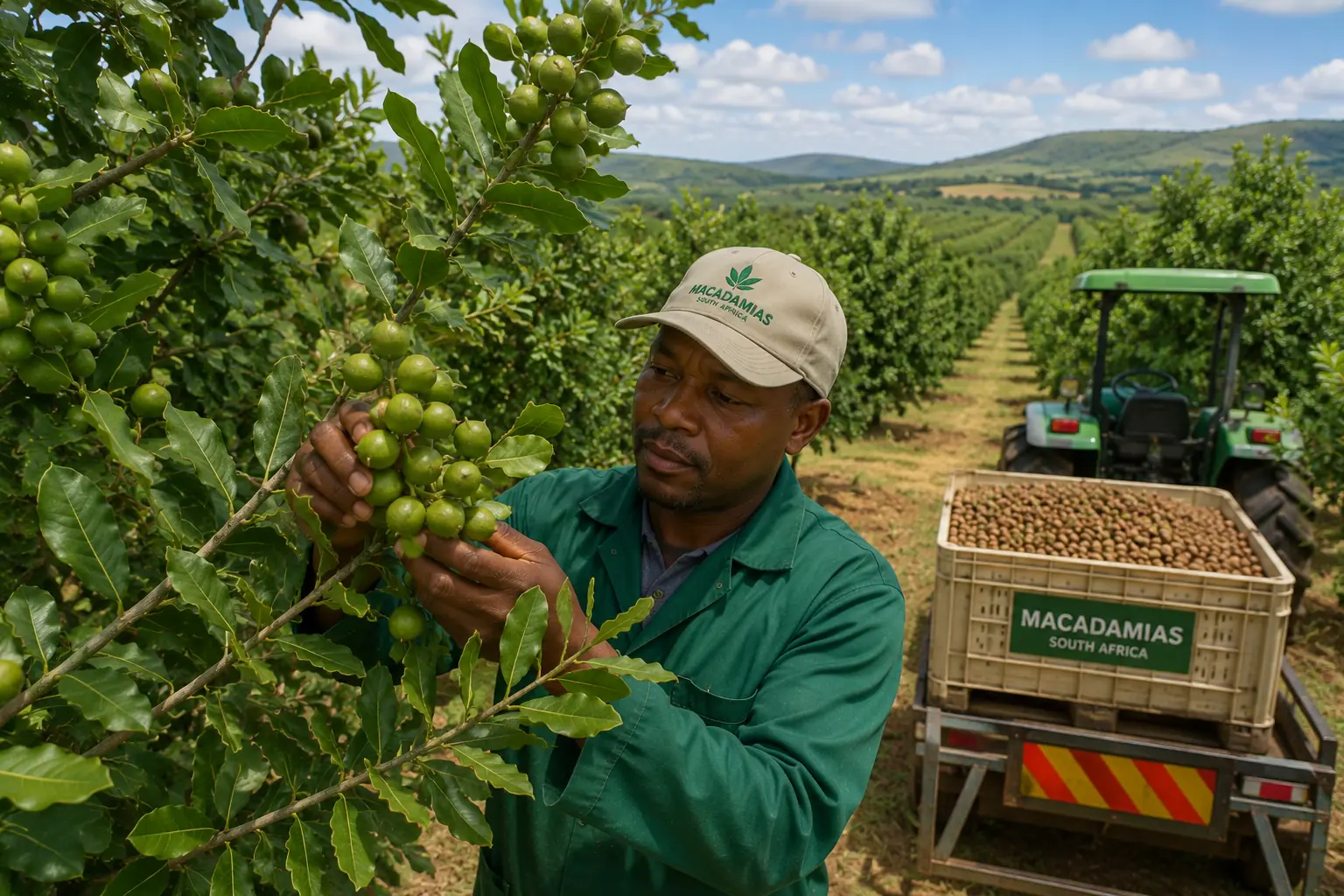
Choosing the Right Macadamia Variety for South Africa
Variety selection is consistently among the most critical decisions in establishing a macadamia orchard. The wrong variety for your specific microclimate, soil, and target market can cost you significantly in yield, kernel quality, and market access for the entire life of the orchard. South Africa's commercially planted varieties are mostly derived from the HAES (Hawaiian Agricultural Experiment Station) breeding programme, with several also released by the ARC (Agricultural Research Council) for specific SA conditions:
| Variety | Species | Kernel Recovery | Yield Potential | Best Region | Key Traits |
|---|---|---|---|---|---|
| HAES 814 (Keauhou) | M. integrifolia | 32–36% | High | Limpopo, Mpumalanga | Most widely planted in SA; consistent yield; good kernel quality |
| HAES 816 (Keaau) | M. integrifolia | 33–37% | High | Limpopo, KZN | Very high quality kernel; strong export grade performance |
| HAES 788 (Pahala) | M. integrifolia | 30–34% | Very high | Mpumalanga Lowveld | Highest yield of all commonly planted varieties; slightly lower recovery |
| HAES 741 (Mauka) | M. integrifolia | 32–36% | Moderate-high | Limpopo highlands | Good precocity (earlier bearing); suits cooler highland sites |
| HAES 842 (Wailua) | M. integrifolia | 34–38% | Moderate | Most regions | Very high kernel quality; premium market positioning |
| A4 (ARC release) | M. integrifolia | 32–36% | High | Limpopo, Mpumalanga | ARC-bred for SA conditions; good disease tolerance; consistent performer |
| HAES 246 (Kakea) | M. tetraphylla | 28–32% | Moderate | KZN, cooler sites | Rough-shelled species; better cold tolerance than integrifolia varieties |
Most South African commercial orchards are planted with a polliniser mix, typically two to four varieties planted in alternating rows or blocks to ensure cross-pollination and maximise nut set. HAES 814 and HAES 816 are the most common combination in Limpopo, while newer orchards increasingly include HAES 788 for its yield advantage. Consult with SAMAC or your regional ARC office before finalising variety selection for your specific site.
Climate and Site Requirements for Macadamia in South Africa
🌡️ Climate
Macadamias are subtropical trees with specific climate requirements. The ideal growing conditions in South Africa are:
- Temperature: Mean annual temperature of 18–28°C; frost-free environment. Even light frosts (−2°C) can damage young trees and flowers. Established trees have some frost tolerance but flower drop occurs at sub-zero temperatures.
- Rainfall: 1,000–2,500mm per year, well-distributed through the growing season (September–April). Macadamias are among the higher-water-requiring nut crops, supplementary irrigation is strongly recommended even in higher-rainfall areas to buffer against dry spells during critical periods.
- Humidity: Moderate to high relative humidity (60–80%) supports good flowering and nut set. The Limpopo and Mpumalanga Lowveld areas provide these conditions naturally during the summer growing season.
- Wind: Strong winds cause physical damage and reduce pollination. Windbreaks (typically Grevillea, Casuarina, or bamboo) are standard in commercial macadamia orchards in exposed areas.
Soil
Macadamias require deep, well-drained, slightly acidic to neutral soils with a pH of 5.0–6.5. They are highly sensitive to waterlogging, roots suffocate in poorly drained soil within days. The Limpopo and Mpumalanga production regions naturally offer deep red-brown loams and clay-loams derived from basalt and granite, ideal macadamia soils with good structure and natural drainage. Heavy, compacted, or shallow soils must be deeply ripped (600–800mm) before planting to remove any hard pan. Conduct a full soil analysis (including boron, copper, zinc, and manganese micronutrients) before planting, macadamias are sensitive to micronutrient deficiencies, particularly boron, which causes poor nut set and hollow kernels.
Macadamia Orchard Establishment, Year-by-Year Timeline
Macadamia farming requires patience. Unlike annual crops, you are investing in infrastructure that will not generate commercial returns for 7–10 years. Understanding this timeline is essential for financial planning:
Site Preparation and Planting
Deep rip to 800mm, subsoil analysis, install windbreaks (plant 6–12 months before orchard), apply lime and fertiliser to planting holes, install drip irrigation. Plant grafted trees at 8m × 5m or 8m × 4m spacing (250–312 trees/ha) during spring (September–November). First-year management focuses entirely on tree establishment, water, weed control, and staking. No income from the orchard in year 1.
Establishment Phase, Minimal Production
Trees develop their canopy framework. Light pruning to shape structure. Begin structured fertilisation programme with nitrogen, phosphorus, potassium, and micronutrients. Some trees may produce small quantities of nuts from year 3 onwards, these provide useful cash flow but are far below commercial levels. Annual costs per hectare in this phase: R15,000–R30,000. A cover crop between rows suppresses weeds and improves soil biology.
Increasing Production, First Commercial Harvests
Yields increase rapidly in this phase, typically 1–3 tonnes of nut-in-shell (NIS) per hectare. First meaningful commercial income begins. Trees need more intensive management: regular fertilisation, irrigation management, and the beginning of a structured pest and disease monitoring programme. At R15–R25 per kg NIS (current SA processor prices), 2 tonnes/ha generates R30,000–R50,000/ha gross. Costs still typically exceed income in most years at this stage.
Approaching Full Production
Yields reach 4–8 tonnes NIS/ha on well-managed orchards. At current processor prices, 6 tonnes/ha generates R90,000–R150,000/ha gross, now comfortably above annual operating costs (R40,000–R65,000/ha). The orchard begins generating meaningful returns on the establishment investment. Canopy management (selective pruning to prevent overcrowding and maintain light penetration) becomes increasingly important.
Full Production, Long-Term Returns
A fully mature, well-managed South African macadamia orchard produces 8–15 tonnes NIS/ha per year. At R15–R25/kg NIS, that is R120,000–R375,000 gross per hectare annually. Net margin after all costs (R50,000–R80,000/ha for fully producing orchard management) ranges from R70,000–R295,000/ha/year. The orchard continues at this level for 30–40 more years with good management, making macadamia one of the highest long-term return-per-hectare enterprises in South African agriculture.
Irrigation, Critical for SA Macadamia Production
While macadamias grow in areas with significant natural rainfall, supplementary drip irrigation is strongly recommended for all commercial South African orchards. The critical irrigation periods are:
- Flowering and nut set (August–October): Water stress at flowering causes flower drop and catastrophically reduces nut set, even a 7-day dry spell during peak bloom can reduce the season's yield by 30–50%.
- Kernel development (December–February): The kernel (the edible portion) fills with oil during this period. Water stress during kernel development causes shrivelled, low-oil kernels that are rejected by processors, directly reducing both yield and price per kg.
- Winter dormancy (June–August): Irrigation can be significantly reduced but should not be stopped entirely in drier years.
Micro-jet or drip irrigation systems with soil moisture monitoring (tensiometers or capacitance sensors) are standard in well-managed SA macadamia orchards. See our irrigation systems guide for specifications and costs.
Harvesting, Processing and the Export Market
🌰 Harvesting
Macadamia nuts are ready to harvest when the outer green husk begins to split and nuts start falling naturally. Unlike most tree fruits, macadamias are not picked from the tree. They are harvested from the orchard floor after natural or wind-assisted drop. Mechanical sweepers and vacuums collect nuts from the floor; manual raking and collection is used on smaller and steeper orchards. Harvest season in South Africa typically runs from March to August, peaking in April–June. Immediately after collection, nuts must be dehusked (outer husk removed) and dried to below 10% moisture content within 24–48 hours to prevent mould and quality deterioration.
🏭 Processing
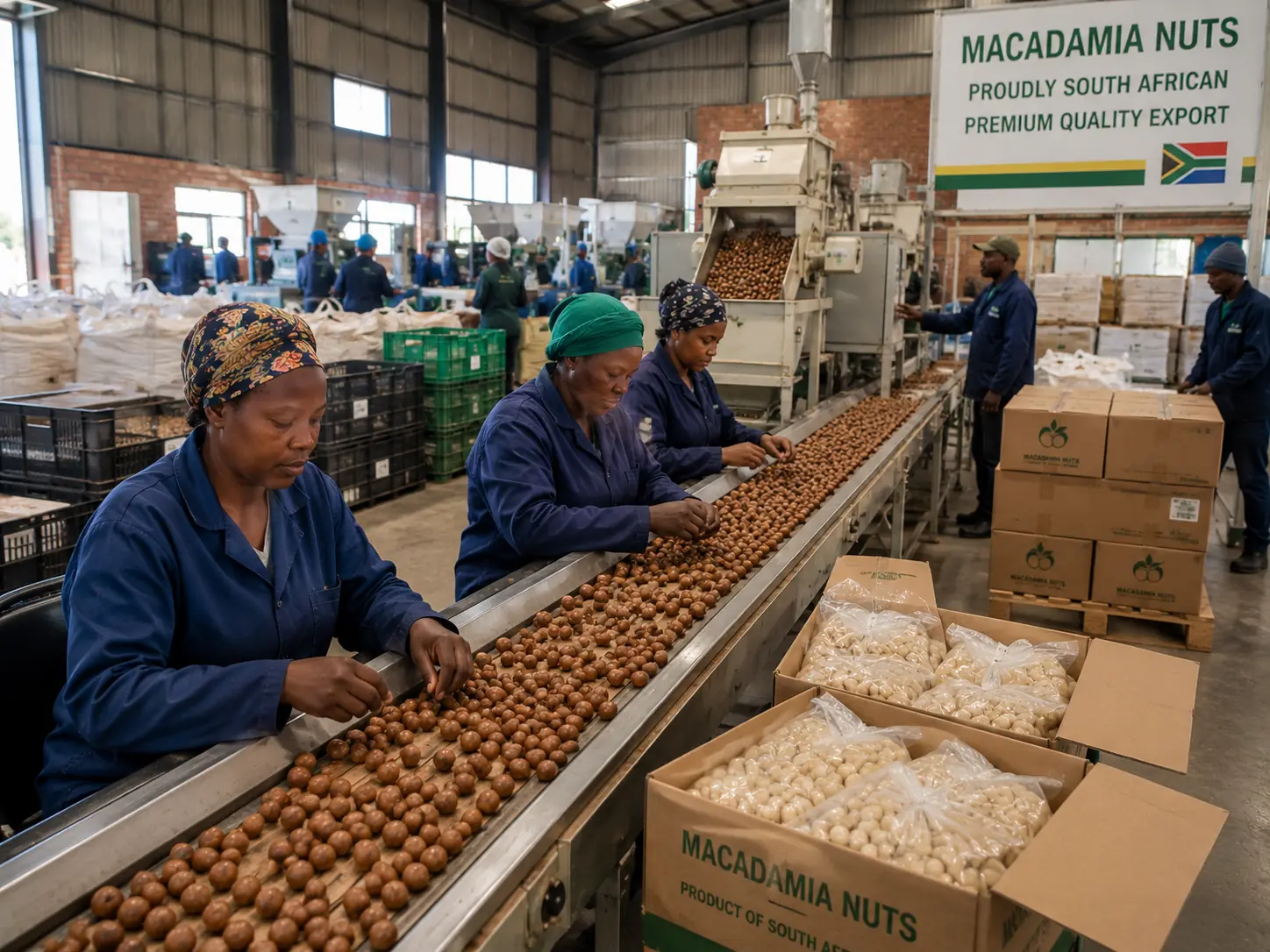
Most South African macadamia farmers sell their product as dried nut-in-shell (NIS) to commercial processors and crackers, the largest are Macadamia Processing Company (MPC), Mac-Mar, Afrimac, and several independent crackers. The processor cracks the extraordinarily hard shell (the hardest of any commercial nut, requiring 300–500 newtons of force), grades the kernel, and markets to export buyers. Farmgate NIS prices in 2024–2025 ranged from approximately R14–R28 per kg depending on moisture content, grade, and market conditions. Farmers who invest in their own cracking and processing equipment can access significantly higher prices by selling processed kernel directly, kernel prices range from R80–R180 per kg depending on grade and buyer.
🌍 Export Markets
China is South Africa's dominant macadamia export market, taking over 70% of kernel exports. The Chinese market predominantly purchases style 1 (whole kernel, highest grade) and style 2 at premium prices. The USA, Germany, Japan, and South Korea are secondary but important markets. See our export farming guide for GlobalGAP certification requirements and PPECB inspection requirements for nut exports.
⚠️ Husk Spot and Macadamia Felted Coccid: The two most damaging pests in South African macadamia orchards are Husk Spot (caused by Pseudoepicoccum cocos fungus, black spots on the outer husk that don't affect the kernel but reduce processor prices significantly) and the Macadamia Felted Coccid (Eriococcus ironsidei), a scale insect that can devastate yields if not managed. Both require proactive monitoring and timely intervention. Join SAMAC and subscribe to their pest and disease alerts for current management protocols.