Climate and Soil Requirements for Fig Farming in South Africa
Figs are among the most climate-tolerant fruit trees available to South African farmers, but they do have specific requirements that determine success or failure:
Climate
Figs require hot, dry summers for fruit development and ripening, and cool winters for dormancy and chilling accumulation. They need a minimum of 100–300 chilling hours (hours below 7°C) during winter dormancy depending on variety. Figs do not tolerate humid, wet summers well, the moisture encourages fungal disease and causes fruit to split and rot on the tree. This is why the Mediterranean-type climate of the Western Cape is ideal, while the subtropical humidity of KwaZulu-Natal's coast is generally unsuitable for commercial fig production.
The best SA provinces for commercial fig farming are the Western Cape (Boland, Breede River Valley, Little Karoo), the Northern Cape (Orange River irrigation areas, Namakwaland), and parts of the Eastern Cape (drier inland areas). Suitable niches also exist in the drier valleys of Limpopo and the North West.
Frost tolerance is reasonable in established trees but young trees and new growth are frost-sensitive. In the colder interior regions of the Free State and the Highveld, late spring frosts can damage new growth and reduce yields significantly, site selection in frost-protected positions is important in these areas.
Soil
Figs are tolerant of a wide range of soil types but perform best in deep, well-drained, fertile loamy soils with a pH of 6.0–7.5. They are notably tolerant of alkaline soils (pH up to 8.0) and relatively low-fertility soils, a major advantage in the lime-rich soils of the Western Cape and the sandy soils of the Northern Cape. The one non-negotiable is drainage: figs will not tolerate waterlogged soils, which cause root rot and tree decline. Avoid planting in low-lying areas, clay-heavy soils without drainage improvement, or any site where water stands after rain.
Best Fig Varieties for South African Conditions
Variety selection is important for commercial fig production in South Africa. Different varieties suit different climates, end markets (fresh vs. dried), and production systems. Here are the key varieties used across SA:
For most South African farmers establishing a commercial or semi-commercial fig orchard, Brown Turkey is the safest starting choice. It is proven across SA's diverse fig-growing regions, dual-purpose (fresh and dried), has reliable yields, and has the widest market acceptance among buyers, processors, and cooperatives.
Establishing Your Fig Orchard: Planting and Spacing
Fig trees can be established from cuttings (the most economical and reliable method), nursery-grown container trees, or bare-root transplants. Hardwood cuttings taken in late winter (June–August in SA) root easily under simple conditions. This is how most SA commercial fig farmers expand their orchards at minimal cost.
Planting Layout and Spacing
Standard commercial planting density for South African fig orchards is 5m × 5m (400 trees per hectare) to 6m × 6m (275 trees per hectare). Higher density plantings (4m × 4m or 4m × 6m) are possible with more intensive management and are used by some SA farmers targeting early production and higher yield per hectare. Wider spacing is preferred on more fertile soils where tree vigour is high, and in regions with higher rainfall where trees grow larger.
Row orientation should be north–south where possible, to maximise sunlight penetration into the canopy and improve fruit quality. On slopes, plant across the contour to reduce erosion and facilitate irrigation. Windbreaks are valuable in exposed sites, the Western Cape's notorious southeaster wind can damage developing fruit and young trees if unprotected.
Soil Preparation Before Planting
Deep ripping or subsoil ploughing (600–800mm depth) before planting breaks up any compaction layers that would restrict fig tree rooting and reduce long-term orchard longevity. Apply lime if soil pH is below 6.0 and incorporate well-composted organic matter into planting holes. A pre-plant soil analysis is strongly recommended, it defines your baseline fertility and identifies any mineral deficiencies (particularly phosphorus and potassium) that should be corrected before trees go in.
Irrigation for SA Fig Orchards
While figs are considerably more drought-tolerant than most other fruit trees, commercial production in South Africa's drier regions is almost universally irrigated. Deficit irrigation, providing less water than maximum evapotranspiration, is commonly practised in SA fig orchards to control vegetative growth, concentrate sugar in the fruit, and improve drying quality. The key irrigation periods are spring through early summer (fruit development) and late summer to harvest.
Drip irrigation is the standard system in SA commercial fig orchards. It reduces foliar wetting (important for fungal disease management), allows precise water application, and is highly efficient in the water-scarce regions where most SA figs are grown. A typical commercial SA fig orchard applies 4 000–6 000 m³ of water per hectare per season under drip irrigation, significantly less than most other fruit crops.
Pruning Fig Trees in South Africa
Annual pruning is essential for maintaining productive fig orchards. South African commercial fig orchards are typically pruned during the dormant winter period (June–August). The objectives of pruning are to maintain manageable tree height and canopy spread for efficient harvesting, remove dead and diseased wood, open the canopy for sunlight penetration and air circulation, and stimulate new growth which carries the main (breba) crop on previous season's wood.
Most SA fig orchards are trained to a modified open-vase or multi-leader shape, with 3–5 main scaffold branches forming the framework. Annual pruning removes approximately 20–30% of the previous season's growth, heavy pruning stimulates vigorous growth but delays fruiting; light pruning maintains production but leads to tall, unmanageable trees over time.
Harvesting, Drying, and Processing South African Figs
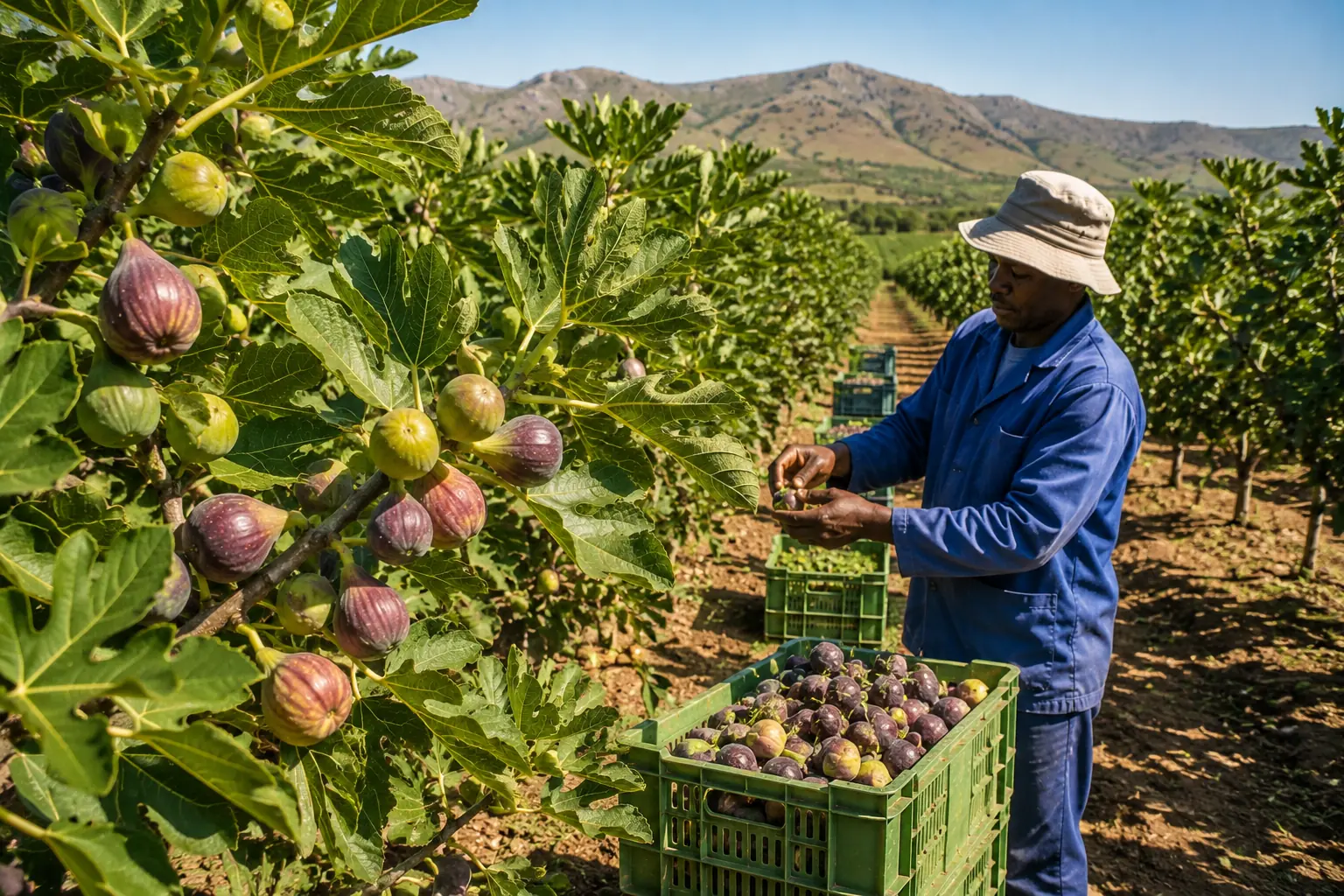
Figs do not ripen after harvest, they must be picked fully ripe, which creates both a quality advantage (naturally high sugar content) and a management challenge (ripe figs are perishable and must be handled quickly). The SA fig harvest runs from November through March, with peak harvest typically in January and February in the Western Cape.
Fresh market figs are hand-picked when fully ripe (the fruit softens, droops slightly on the stem, and the skin may begin to split at the base). They must be cooled immediately after picking and marketed within 3–5 days. The fresh SA fig market is growing rapidly, particularly in Cape Town and Johannesburg, where premium retailers and restaurants are willing to pay R60–R120 per kg for quality fresh figs during season.
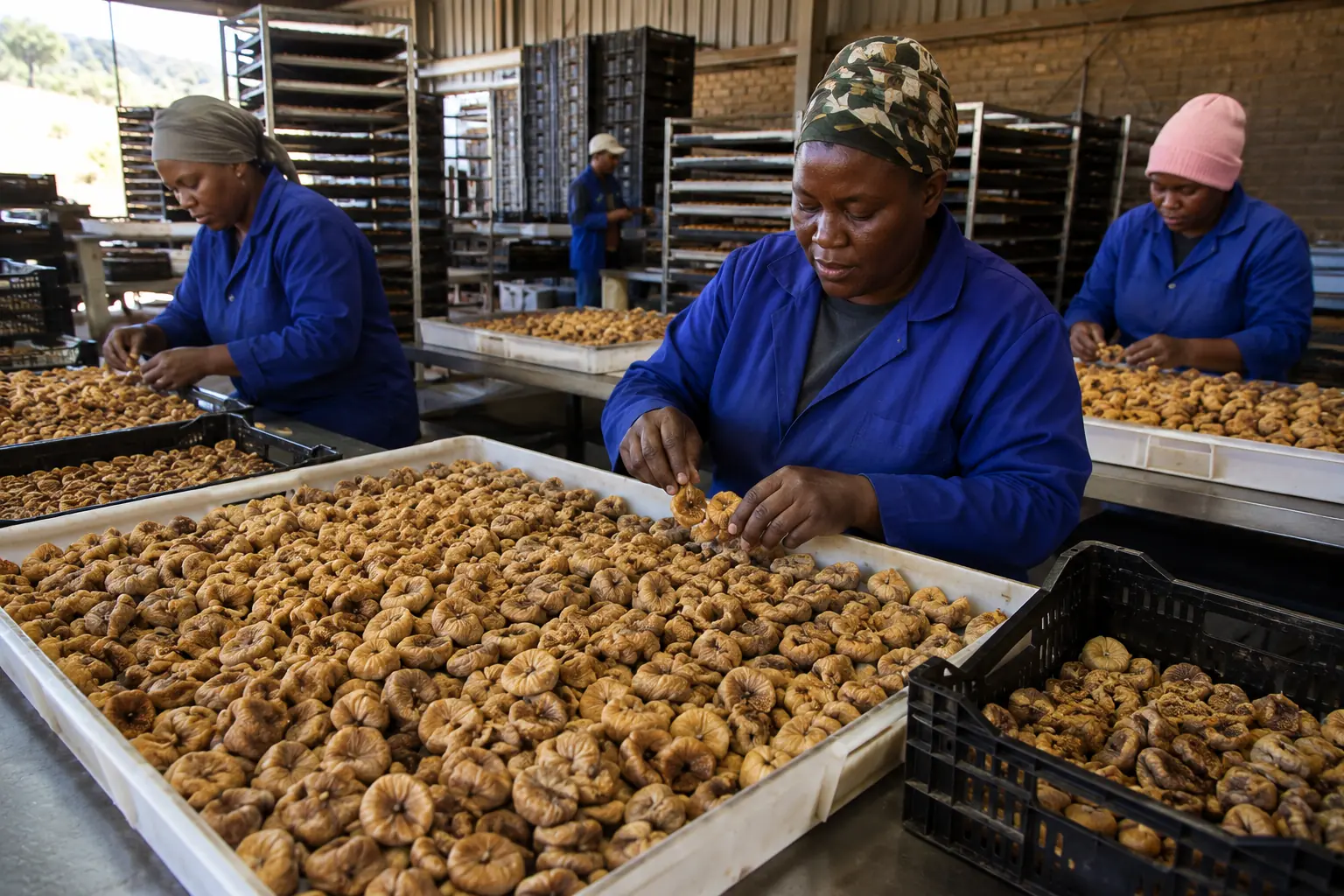
The majority of SA's commercial fig crop is processed as dried figs, either through natural sun-drying or mechanical dehydration. Traditional sun-drying on raised mesh racks is still widely practised on SA fig farms and produces excellent quality dried figs when conditions are right (hot, dry, low humidity). Figs are spread in a single layer and turned every 1–2 days. Drying takes 5–10 days depending on temperature and humidity. Finished dried figs have a moisture content of 18–22% for soft-dried, or down to 12–15% for export-grade dried figs.
Fig Markets and Pricing in South Africa
South African fig farmers have access to several distinct market channels, each with different volume requirements, price levels, and quality standards:
- Export dried figs: SA's commercial dried fig industry exports significant volumes to Europe (particularly the Netherlands, Germany, and the UK) and the Middle East. Export prices range from R55–R90 per kg for export-grade dried figs, with premiums for organic or GlobalGAP certified product. Export channels typically require supply agreements with exporters and must meet strict quality and food safety standards.
- Local processed food industry: Dried figs, fig paste, and fig jam are sold to food manufacturers, bakers, confectioners, and retailers. This market absorbs product that doesn't meet fresh or export standards and provides a reliable local outlet for large volumes.
- Fresh market (direct): Premium fresh figs sold directly at farmers markets, through box schemes, or to restaurants and specialty retailers command R60–R120 per kg in season. This market has grown strongly in SA's urban centres as local food awareness increases.
- Artisanal and value-added: Fig jam, fig preserve, dried fig-and-nut products, and fig-infused foods are high-margin products for SA farmers willing to develop direct-to-consumer and specialty retail channels. Small-scale fig jam operations operating from registered farm kitchens can achieve R80–R150 per jar, a significant markup on raw fruit value.
Yield: 8–15 tonnes per hectare at full production (years 5–7 onwards) | Dried fig price: R55–R90/kg export, R40–R60/kg local | Gross income: R320 000–R800 000/ha at full production | Input costs: relatively low vs. other tree fruits, R40 000–R80 000/ha/year | Break-even: typically year 5–6 post-establishment
Pests and Diseases in SA Fig Orchards
Fig trees are relatively hardy but do face several specific pest and disease challenges in South African conditions:
- Fig moth (Ephestia cautella): The most damaging post-harvest pest on SA dried figs. Larvae tunnel into drying and dried fruit. Good drying hygiene, mesh netting over drying racks, and cold storage of finished product are the primary control measures.
- Fig fly (Zaprionus indianus): An invasive fruit fly that has spread through SA fig orchards. Females lay eggs in ripening fruit, larvae damage the flesh. Monitoring with protein bait traps, early harvest, and removal of fallen fruit reduces pressure significantly.
- Botrytis (grey mould): A fungal disease that attacks ripe and ripening fruit, particularly in wet or humid conditions. Maintaining good air circulation through pruning and avoiding overhead irrigation during fruiting are the best preventative measures. Organic fungicide applications during critical periods may be warranted in high-risk seasons.
- Fig mosaic virus: A widespread virus in SA fig orchards causing yellow mosaic patterns on leaves and reduced vigour. Spread by the fig leaf rust mite. There is no cure, use certified virus-free planting material and control mite vectors.
- Root rot (Phytophthora): Occurs in poorly drained soils. Prevention through good site selection and drainage is far more effective than any chemical treatment.