Potato Farming in South Africa, The Country's Most Important Vegetable Crop by Volume
Potatoes (Solanum tuberosum) are South Africa's most important vegetable crop by both volume and economic value. The country produces approximately 2.2–2.5 million tonnes of potatoes per year, making it one of the largest potato producers on the African continent. Potatoes are a true staple in the South African diet, consumed daily across all income groups as chips, crisps, boiled, mashed, baked, and as the raw material for the country's enormous potato crisps and frozen chip processing industry.
South Africa's major potato production regions are concentrated in three areas: Limpopo (particularly the Lephalale, Mokopane, and Marble Hall areas) which produces primarily under irrigation and accounts for the largest share of national production; the Free State (particularly the Sandveld, Clocolan, and Ficksburg areas); and the Western Cape (Ceres, Villiersdorp, and the Boland) which produces excellent quality potatoes for the fresh premium market. Other significant production regions include parts of KwaZulu-Natal, the Mpumalanga highveld, and the Northern Cape.
Potato farming is technically demanding and capital-intensive compared to many other vegetable crops. It requires certified seed potatoes (not supermarket potatoes), rigorous disease management (particularly for late blight), significant irrigation, and high fertiliser inputs. However, it also offers some of the highest per-hectare gross revenue of any field vegetable crop in South Africa, with well-managed commercial hectares regularly generating R100,000–R300,000+ in gross sales, and multiple crops possible per year on irrigated land in Limpopo. This page covers the main production decisions to produce potatoes profitably in South Africa.
🥔 Market snapshot: Potatoes trade at the Johannesburg, Tshwane, Cape Town, and Durban fresh produce markets year-round. Average farmgate prices range from R2,000–R6,000+ per tonne depending on variety, grade, season, and supply levels. During winter scarcity windows or after late blight epidemic years, prices spike sharply. A well-managed commercial hectare of potatoes under irrigation in Limpopo can yield 40–70 tonnes per hectare.
Certified Seed Potatoes, Why You Must Never Use Supermarket Potatoes for Planting
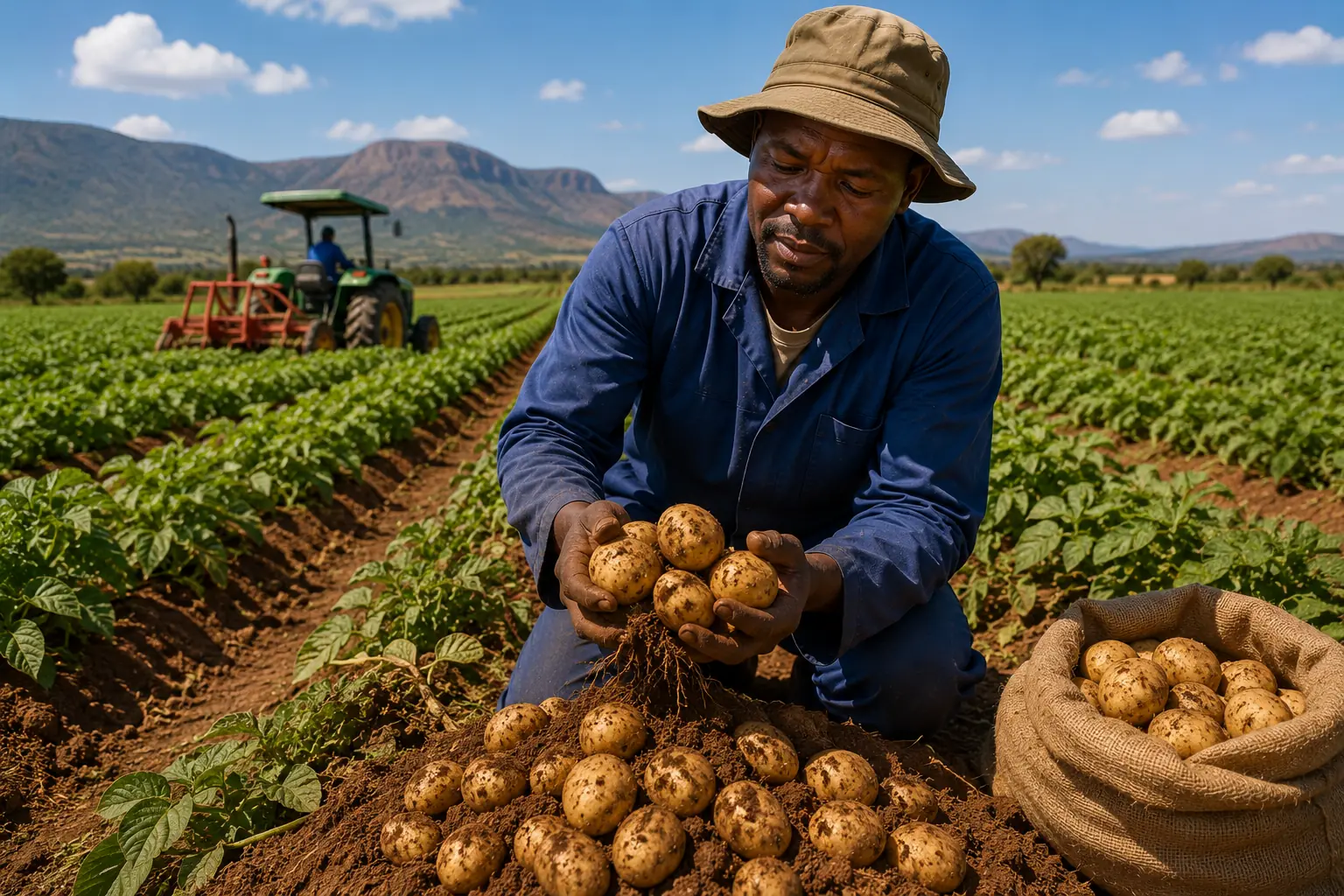
The single most important rule in potato farming is to always plant certified seed potatoes, never supermarket potatoes, kitchen leftovers, or saved tubers from your own previous crop. This is not merely a recommendation. It is the foundation of successful potato production.
Certified seed potatoes in South Africa are produced under the strict regulatory oversight of the Potato Certification Service (PCS), a DALRRD-accredited scheme that inspects seed potato crops through multiple generations to ensure they are:
- Free from regulated diseases, particularly Potato Virus Y (PVY), Potato Leafroll Virus (PLRV), bacterial wilt (Ralstonia solanacearum), and ring rot.
- True to variety, exactly the variety stated on the label, with no contamination by other varieties.
- Produced from inspected, registered seed potato farms in approved seed production areas.
- Correctly stored and physiologically conditioned for planting.
Planting uncertified potatoes introduces virus diseases that reduce yield by 30–80%, bacterial diseases that can wipe out an entire planting and persist in the soil for years, and variety uncertainty that undermines your market planning. Always buy seed potatoes from registered PCS-certified seed potato merchants. Potatoesprosa (the South African potato industry association) publishes a list of registered seed potato producers on their website.
Best Potato Varieties for South Africa
South Africa has an extensive variety list, with different varieties suited to different growing regions, seasons, and market channels (fresh market, processing/crisps, frozen chips). Key commercial varieties include:
| Variety | Skin/Flesh | Market Use | Key SA Traits |
|---|---|---|---|
| Mondial | Yellow skin / yellow flesh | Fresh market, export | Most widely grown in SA. Excellent yield, good skin finish, popular with consumers. Moderate late blight resistance. |
| Sifra | Yellow / yellow | Fresh market | Good yield, attractive appearance, strong performer in Limpopo conditions. |
| Innovator | White skin / white flesh | Processing (chips/frozen) | High dry matter, excellent for French fries and crisp processing. Grown under contract for processors. |
| Desiree | Red skin / yellow flesh | Fresh market | Popular smallholder variety. Good disease tolerance. Well-known to consumers. Widely available seed. |
| BP1 | White / white | Fresh market, smallholder | South African-bred variety. Good heat tolerance for warmer growing areas. Popular in Limpopo. |
| Fianna | White / white | Fresh market, processing | Good yield, versatile. High dry matter, suitable for both table and processing markets. |
| Lanorma | Yellow / yellow | Fresh market | Excellent storage ability. Good late blight field tolerance. Suited to Western Cape conditions. |
Work with your seed merchant and the relevant provincial extension office when choosing varieties for your specific growing area and market channel. Processing contracts (for crisps and frozen chips) specify exact varieties, never plant a processing variety without a confirmed contract in place.
Climate and Regional Planting Calendar for South African Potato Farming
Potatoes grow best at cool to moderate temperatures, ideal soil temperature for tuber formation is 15–20°C. High soil temperatures (above 25°C) reduce tuber set and cause misshapen, knobbly tubers. This means that planting timing must be carefully managed in South Africa's warm interior regions to make sure the critical tuber formation phase coincides with cooler conditions.
- Limpopo (irrigated, warm lowveld): Main planting seasons are February–March (for a June–July harvest, avoiding the hottest summer months) and July–August (for an October–November harvest). Experienced irrigated farmers may achieve three crops per year on the same land. Careful timing to avoid extreme summer heat during tuber formation is critical.
- Free State: Spring planting (August–October) for a December–February harvest is the primary season. Some areas support a second autumn planting (February–March) for July–August harvest. Late frosts in spring require careful management of early plantings.
- Western Cape: Planting from August to November for harvest from December to March. Cooler temperatures and lower humidity in the Ceres and Villiersdorp areas produce excellent quality table potatoes with lower late blight pressure than warmer regions.
- KwaZulu-Natal Midlands: Spring planting (August–October) in cooler midlands areas. Year-round potential in elevated areas above 1,200m altitude.
- Mpumalanga Highveld: Spring–summer planting (September–November) under dryland or supplemental irrigation. Disease pressure from late blight is high due to summer rainfall patterns, rigorous spray programme essential.
Soil Preparation for Potato Farming
Potatoes require deeply prepared, loose, well-drained, fertile soil for maximum tuber development. Tubers form in the soil and expand into the surrounding growing medium, any compaction, hardpan, or waterlogging directly restricts tuber size, shape, and uniformity. Soil pH of 5.5–6.5 is ideal, potatoes are one of the few major crops that tolerate and actually prefer a slightly acidic soil pH, partly because common scab (Streptomyces scabies) is suppressed at lower pH values.
Soil Testing and pH Adjustment
Test soil pH and nutrients 6–8 weeks before planting. If pH exceeds 6.5, do not apply lime before potatoes, common scab is significantly more severe at higher pH. If soil pH is below 5.0, apply a modest lime application but target 5.5–6.0, not higher. Correct nutrient deficiencies based on soil test results. See our fertilizer and soil health guide for SA-specific soil amendment guidance and accredited testing laboratories.
Deep Ripping and Primary Tillage
Rip to 50–70cm depth to break up any hardpan or compaction layer that would restrict root development and tuber expansion. Follow with subsoiler, plough, and disc harrow passes to create a deeply loosened, friable seedbed. Apply and incorporate compost (5–10 tonnes/ha) on lighter soils to improve water retention and soil biology. Leave the prepared soil to weather for 2–4 weeks before final bed preparation if time allows, this improves soil structure and allows weed seeds to germinate and be destroyed before planting.
Basal Fertiliser Application
Potatoes are heavy feeders with particularly high requirements for nitrogen, potassium, and phosphorus. Apply basal fertiliser (typically a compound containing P and K with some N) and incorporate thoroughly into the top 20–30cm before bed formation. Phosphorus must be incorporated, surface application is largely ineffective. A typical basal application for potatoes in South Africa supplies 80–120 kg P₂O₅/ha and 100–150 kg K₂O/ha depending on soil test results.
Bed Formation and Row Layout
Form raised beds (ridges) 30–35cm high at a row spacing of 75–90cm for commercial production. Raised ridges allow good drainage away from the developing tubers (reducing diseases like Phytophthora and bacterial soft rots), provide loose growing medium for tuber expansion, and facilitate mechanical hilling-up during the growing season. Install drip tape at the base of the ridge or use sprinkler irrigation systems. Most commercial SA operations use centre pivot or long-line irrigation, see our irrigation guide for specifications and costs.
Seed Potato Preparation and Planting
Plant whole small seed tubers (40–80g) or cut pieces from larger tubers at 25–35cm within-row spacing. If cutting seed, use a clean, sterilised blade (dip in bleach solution between cuts), allow cut surfaces to suberize (dry and form a wound barrier) for 24–48 hours before planting, and treat cut surfaces with a registered fungicide/bactericide dust. Plant seed pieces with the dominant eye (sprout) facing upward, at 8–12cm depth. Plant population: 35,000–50,000 plants per hectare for most commercial varieties. Planting with a mechanical potato planter significantly improves spacing uniformity and reduces labour costs.
Irrigation Management for Potatoes
Potatoes have a shallow root system (80% of roots in the top 30cm) and are highly sensitive to both drought stress and waterlogging. Consistent moisture throughout the growing season is essential for uniform tuber set, size, and quality. Irregular moisture supply, alternating wet and dry periods, is a primary cause of internal quality defects including hollow heart, internal brown spot, and growth cracking. Critical irrigation stages:
- Emergence (weeks 1–3): Maintain adequate moisture for uniform sprouting. Light, frequent irrigation.
- Vegetative growth (weeks 3–6): Consistent moisture for canopy development. Avoid waterlogging.
- Tuber initiation and bulking (weeks 6–10): The most water-critical phase. Maintain consistent soil moisture at 60–75% field capacity. Drought stress during tuber initiation reduces tuber number; stress during bulking reduces tuber size. Do not allow any moisture stress during this phase.
- Maturation (2 weeks before harvest): Reduce irrigation progressively to allow skin set (skin hardening that improves storage quality and reduces mechanical damage at harvest). Stop irrigation 7–10 days before lifting.
Pest and Disease Management, The Critical Challenge in SA Potato Farming
Disease management, particularly late blight, is the defining challenge of potato farming in South Africa. A single late blight outbreak in a susceptible variety without an adequate fungicide programme can destroy an entire crop within 7–14 days under favourable weather conditions.
Late Blight (Phytophthora infestans)
Late blight is the most devastating potato disease worldwide, the same pathogen caused the Irish Potato Famine of the 1840s. In South Africa, it is most severe in the Mpumalanga highveld, KwaZulu-Natal, and Western Cape during rainy, cool (15–20°C) weather. Modern strains (A2 mating type) are significantly more aggressive than older strains. Management requires a preventive fungicide spray programme starting before symptoms appear, typically on a 5–10 day interval during high-risk periods, using registered protectant (mancozeb, chlorothalonil) and systemic fungicides (metalaxyl, dimethomorph, cyazofamid) in strict rotation to avoid resistance development. See our pest control guide for resistance management principles.
Common Scab (Streptomyces scabies)
Causes raised, scabby lesions on the tuber surface, reducing marketability and cosmetic quality significantly. Worst in alkaline soils (pH above 6.5) and in dry soil conditions during tuber initiation. Management: maintain soil pH at 5.5–6.0; avoid lime applications before potatoes in the rotation; ensure consistent soil moisture during tuber initiation; choose less-susceptible varieties. See our crop rotation guide for break crop strategies that reduce scab levels.
Bacterial Wilt (Ralstonia solanacearum)
Devastating soilborne bacterial disease that causes sudden wilting and death of plants. Once in the soil, it can persist for many years. No effective chemical control, prevention is everything. Purchase certified, wilt-free seed; never plant in fields with a known history of bacterial wilt; avoid moving soil or water from infected areas; implement long rotations away from susceptible crops (tomatoes, peppers, potatoes) in affected fields.
Potato Tuber Moth (Phthorimaea operculella)
Major pest in warm, dry conditions and in storage. Larvae mine into tubers, causing serious damage and rendering product unmarketable. Management: avoid cracking soil in the ridge that exposes tubers; hill up ridges to maintain tuber cover; apply registered insecticides during the growing season when adults are monitoring above threshold; cool store harvested tubers promptly; do not leave harvested potatoes in the field overnight.
Harvesting and Grading South African Potatoes
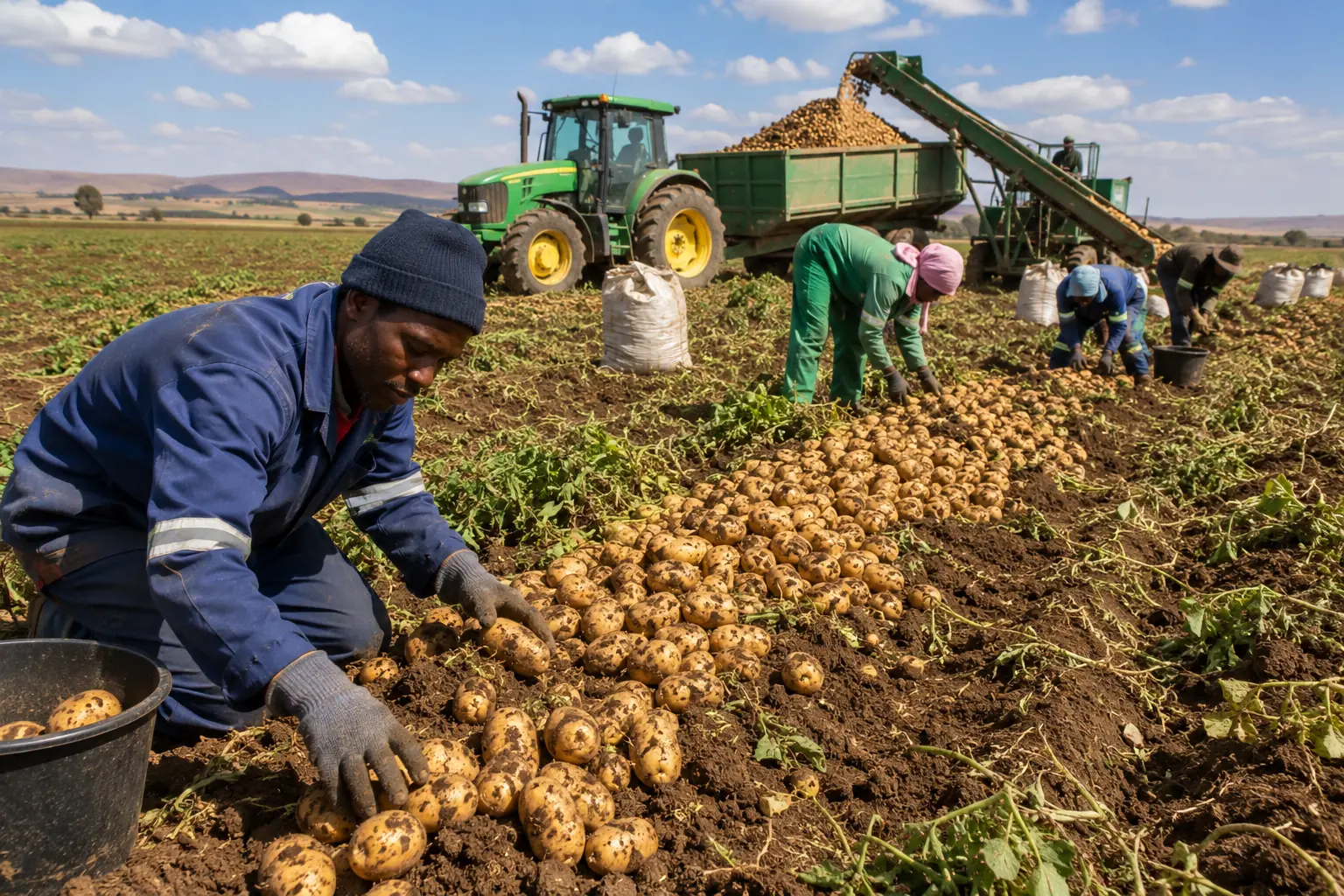
Potatoes are ready to harvest when the haulm (above-ground foliage) has died down naturally or been mechanically killed (desiccated) 10–14 days before lifting to allow skin set. Test skin set by rubbing your thumb firmly across the tuber surface, if the skin slides off, the potato is not ready for harvest. A properly set skin is firmly attached and resists rubbing.
South African fresh potato grades for market trade are regulated under the Agricultural Produce Standards Act and broadly follow these size grades: Extra Large (>90mm), Large (70–90mm), Medium (50–70mm), and Small (40–50mm). Large and medium grades command the best fresh market prices. Processing grades (for crisps and chips) have specific dry matter and reducing sugar requirements alongside size. Undersized, greened, damaged, or diseased tubers are graded out and sold at significant discounts or rejected.
Commercial Yield (Irrigated)
Well-managed irrigated crop, Limpopo or Free State conditions
40–70 t/haAverage Farmgate Price
Fresh produce market average, medium-large grade
R2,500–R5,500/tGross Revenue (per ha)
Before input costs (seed, fertiliser, irrigation, labour)
R100,000–R385,000Storage of Harvested Potatoes
Proper storage dramatically extends marketable life and protects against price volatility. Potatoes destined for cold storage should be cooled rapidly to 7–10°C (fresh market) or 4–6°C (processing) at high relative humidity (92–96%) to minimise moisture loss and dormancy break. A wound-healing (curing) period of 10–14 days at 15–18°C and high humidity allows cut or bruised surfaces to suberise and form a protective barrier before cold storage. Commercially stored potatoes in South Africa remain marketable for 4–8 months under optimised cold store conditions.
Selling Potatoes, Market Channels in South Africa
- Fresh Produce Markets: Johannesburg, Tshwane, Cape Town, Durban, and Port Elizabeth FPMs are the primary trade routes for fresh potatoes. Commission agents (7.5–10% fee) facilitate daily trading. Price transparency is published daily on FPM websites. See our agri markets guide.
- Direct retail: Supply to major retail chains requires consistent volume, grading, packaging, and often food safety certification (GlobalGAP). Entry requires a formal supplier agreement with the retailer's buying team.
- Processing industry: Supply to crisps manufacturers (Simba, Lay's, Willards), frozen chip processors, and dehydration plants. Processing contracts specify variety (dry matter %, reducing sugar content), size, and delivery schedule. Processing prices are typically lower than fresh market prices but offtake is consistent and quality standards are more tolerant of cosmetic defects. Contact Potatoes SA for a list of registered processors.
- Informal and local market: Small-scale producers selling at farmgates, informal markets, and to local traders. Viable for smallholders close to urban centres.