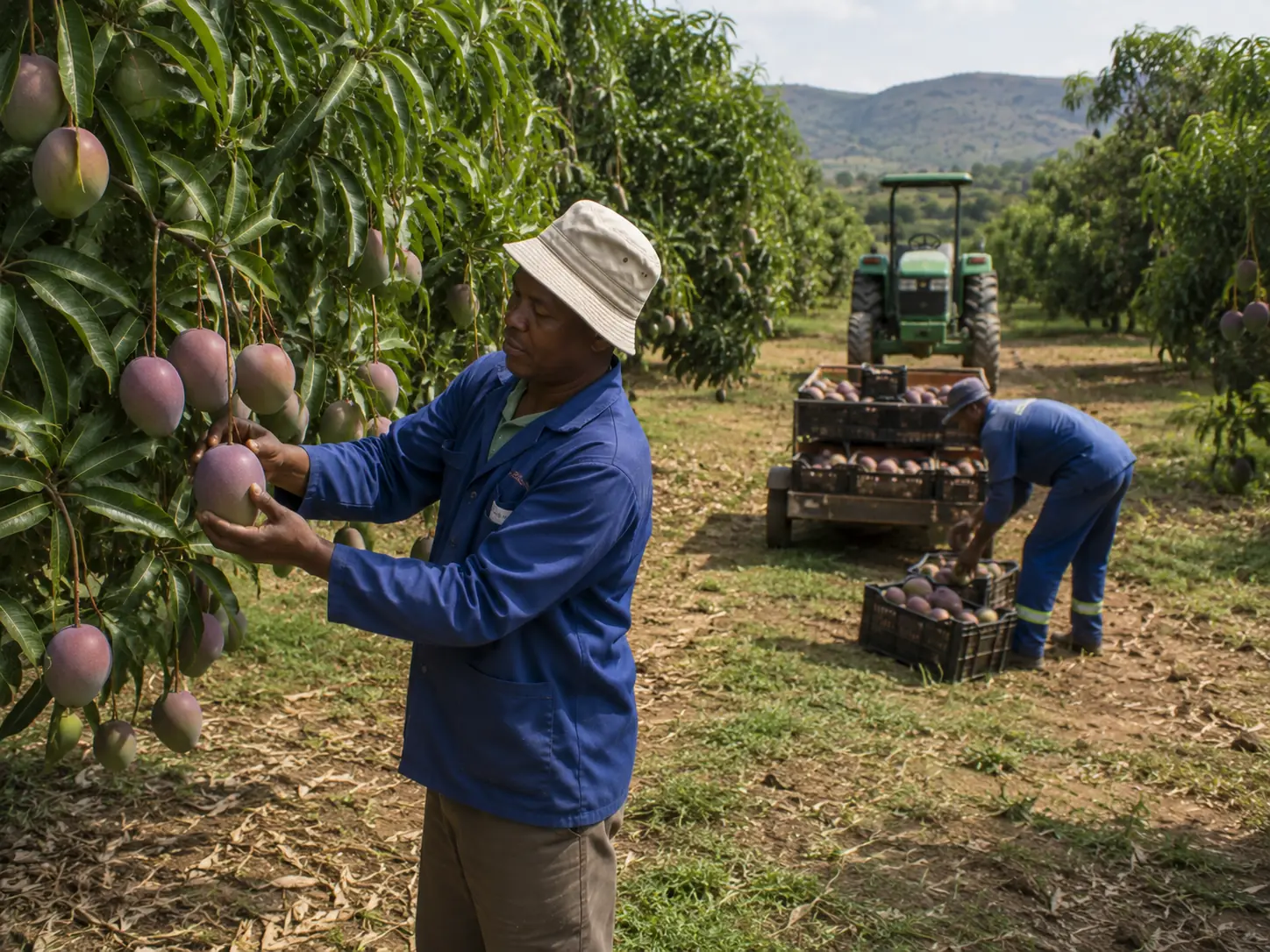
Climate and Soil Requirements for SA Mango Production
Mangoes are a tropical to subtropical fruit that requires specific climatic conditions to produce commercially viable yields in South Africa:
- Temperature: Mangoes require hot summers (optimal 25–35°C during fruit development) and a dry, relatively cool winter (15–20°C at night) to trigger reliable flower induction. A distinct dry season (even a month or two of below-average rainfall) is critically important for mango flowering in SA. Without this dry, cool period, trees may not flower reliably, leading to poor crops.
- Frost: Mangoes are frost-sensitive at any stage, even light frost (-1°C) kills young leaves, flowers, and developing fruit. Site selection in frost-free areas is non-negotiable for commercial mango production. In Limpopo, the lower-altitude areas below 900m are generally frost-safe; higher-altitude sites require careful assessment of frost hollow risk.
- Rainfall: Mangoes tolerate and prefer a distinct dry season (winter/flowering season) followed by summer rainfall during fruit development. The Limpopo lowveld's 350–600mm annual rainfall, concentrated in summer, is ideal. Consistent high humidity during flowering promotes anthracnose disease, orchards in high-rainfall areas require more aggressive disease management.
- Soil: Deep (1.5m+), well-drained, sandy loam to loam soils with a pH of 5.5–7.0 are ideal. Mangoes are sensitive to waterlogging, even brief flooding can kill established trees. The lateritic red soils of Limpopo are well-suited to mango production. Avoid shallow, rocky soils that restrict root development and compacted subsoils that cause water logging.
Mango Varieties Suited to South African Conditions
Variety selection shapes every aspect of your mango business, harvest timing, market access, disease susceptibility, tree vigour, and price. The SA mango industry uses both traditional and modern varieties, with a strong trend toward export-preferred varieties with attractive colour and long shelf life.
Establishing a Mango Orchard in South Africa
Mango orchard establishment is a long-term investment that requires careful planning from the outset. Decisions made during establishment, site selection, land preparation, variety choice, rootstock, planting density, and irrigation system, determine the productivity and profitability of the orchard for decades.
Rootstocks and Propagation
Commercial SA mango trees are vegetatively propagated, grafted or budded onto seedling rootstocks. Grafting ensures that the scion variety's characteristics (fruit quality, colour, shelf life) are exactly replicated in every tree. Common SA mango rootstocks include the local Sabre (preferred in most SA growing regions for vigour and disease resistance) and Turpentine. Trees should be sourced from accredited SA nurseries that can certify varietal identity, phytosanitary status, and rootstock/scion combination.
Planting material for SA commercial mango orchards is typically grafted trees 60–90cm tall at planting, nursery-grown in bags and transplanted to the field during the warm, moist season (October–December in Limpopo). Bare-root transplanting is rarely used for mango.
Planting Density and Layout
Traditional SA mango orchards used wide spacing (10m × 10m or 10m × 8m = 100–125 trees/ha) to accommodate the large, spreading canopies of mature trees. Modern SA mango production increasingly uses higher-density systems (6m × 5m or 7m × 4m = 286–333 trees/ha) with hedgerow training and regular pruning to control tree size, improve light distribution, facilitate spraying, and accelerate the onset of commercial production.
Land Preparation
Deep ripping along tree rows (600–800mm depth) before planting is strongly recommended to break compaction layers and improve drainage, critical in Limpopo's red clay subsoils that can become restrictive at depth. Apply lime if pH is below 5.5 and incorporate well-composted organic matter into planting holes. Individual planting holes should be dug 60cm × 60cm × 60cm and backfilled with enriched soil containing superphosphate and compost.
Irrigation Management for Mango Orchards
Although mangoes are relatively drought-tolerant once established, irrigation is standard on all commercial SA mango farms, particularly in Limpopo's dry lowveld where the annual rainfall of 400–600mm is insufficient for reliable commercial yields without supplementary water.
Micro-sprinkler or drip irrigation is used on most SA commercial mango farms. Micro-sprinklers (operating at 50–100 litres/hour at 1–2 emitters per tree) are preferred for their flexibility and the additional cooling and frost protection they can provide. A commercial Limpopo mango orchard applies approximately 3 000–6 000 m³ of water per hectare per season depending on tree size, variety, and rainfall.
Irrigation management during the flowering and fruit set period (May–September in Limpopo) is particularly critical. This is the dry season, and maintaining correct soil moisture during flower development (without over-irrigating to the point of promoting vegetative growth rather than flowering) is among the most technically demanding aspects of SA mango production. Many SA mango producers use the technique of deliberately withholding irrigation for 6–8 weeks before the expected flowering period to stress-induce flower initiation, then resuming irrigation at flower emergence.
Pruning and Canopy Management in SA Mango Orchards
Pruning is essential for maintaining mango orchard productivity over time. Without regular pruning, mango trees become very tall (8–15m), the fruiting zone moves progressively to the outer canopy periphery where spray coverage and harvest access deteriorate, and inter-tree shading reduces light penetration and fruit quality.
Post-harvest pruning (conducted immediately after harvest while the season is still warm) is the primary SA mango pruning approach. This post-harvest pruning removes up to 30% of last season's growth, stimulates fresh vegetative flushes from which next season's flowers will develop, and keeps tree height manageable. Pruning in SA is particularly important for Tommy Atkins which is prone to alternate bearing, heavy pruning after a good crop year stimulates even new growth and more consistent flowering.
In modern high-density SA mango orchards, annual hedging with mechanical slashers is increasingly used to maintain row width and tree height, similar to citrus mechanised pruning practices. This reduces the cost and time of annual pruning and maintains the orchard architecture needed for efficient spraying and harvesting in narrow-row, intensive systems.
Key Pests and Diseases of SA Mangoes
Mango is affected by several significant pests and diseases in South African conditions that require active management programmes:
- Mango seed weevil (Sternochetus mangiferae): The most serious quarantine pest affecting SA mango exports. Larvae develop inside the seed, causing no external damage, making infested fruit invisible at packing. Countries including Australia, New Zealand, Japan, and some EU markets require treatment (hot water or vapour heat treatment) or origin guarantees for weevil-free status. SA's mango weevil status limits access to some export markets.
- Anthracnose (Colletotrichum gloeosporioides): The most economically significant disease in SA mango production. Causes black lesions on ripe fruit (particularly during or after rain) and blossom blight during flowering in humid conditions. Managed through copper-based fungicide applications from pre-flowering through fruit development, and post-harvest hot water treatment.
- Bacterial black spot (Xanthomonas campestris): Causes black lesions on fruit skin and leaves, reducing fruit grade and export quality, particularly on Tommy Atkins. Managed through copper sprays and resistant variety selection.
- Mango hoppers (Idioscopus spp.): Insects that feed on young leaf and flower flushes, causing distortion and honeydew deposits that promote sooty mould. Most damaging during the flowering period, timely insecticide applications at flower emergence are standard.
- Fruit flies (Ceratitis spp.): Mediterranean and natal fruit flies infest ripening mangoes, making them unmarketable. Managed through protein bait stations, cover sprays, and orchard hygiene (remove fallen fruit).
Harvesting and Post-Harvest Management of SA Mangoes
Mango must be harvested at the correct physiological maturity, before it is ripe (mangoes ripen off the tree) but after it has reached sufficient dry matter content to ripen correctly. In SA, maturity is assessed by dry matter (measured with a NIR meter, 13% DM minimum for most export varieties), Brix (total soluble solids), and visual indicators (ground colour change, skin lenticels, shoulder development).
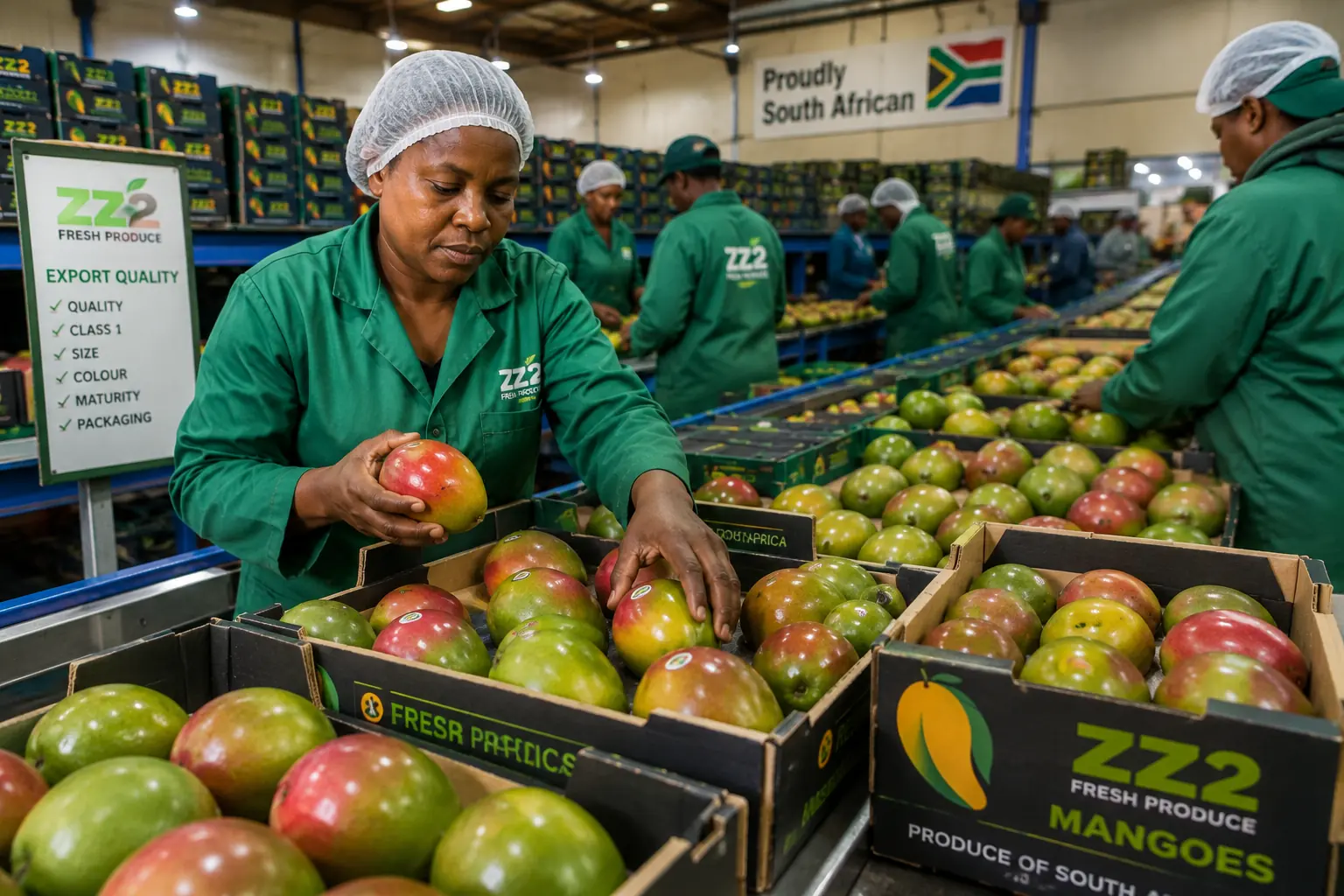
SA mango harvest is manual, pickers use telescoping poles with a cutting knife and catching net to remove individual fruit without bruising or latex burn. Latex from the cut pedicel burns the fruit skin and must be washed off immediately after harvest at a field-side washing station. All export-grade SA mangoes undergo post-harvest hot water treatment (HWT, 46.1°C for 75–90 minutes depending on variety and weight) to control anthracnose and, where required, mango weevil. Following HWT, mangoes are dried, waxed, sorted, graded, and packed in controlled-atmosphere cold rooms for export.
Full production yield: 15–35 tonnes/ha (variety and management dependent) | Export grade price: R8–R14/kg | Local fresh market: R5–R10/kg | Processing grade: R2.50–R5/kg | Input costs: R30 000–R80 000/ha/year (irrigation, fertiliser, crop protection, labour, packing) | Break-even: typically year 7–10 post-establishment