The 3 Core Ethics of Permaculture
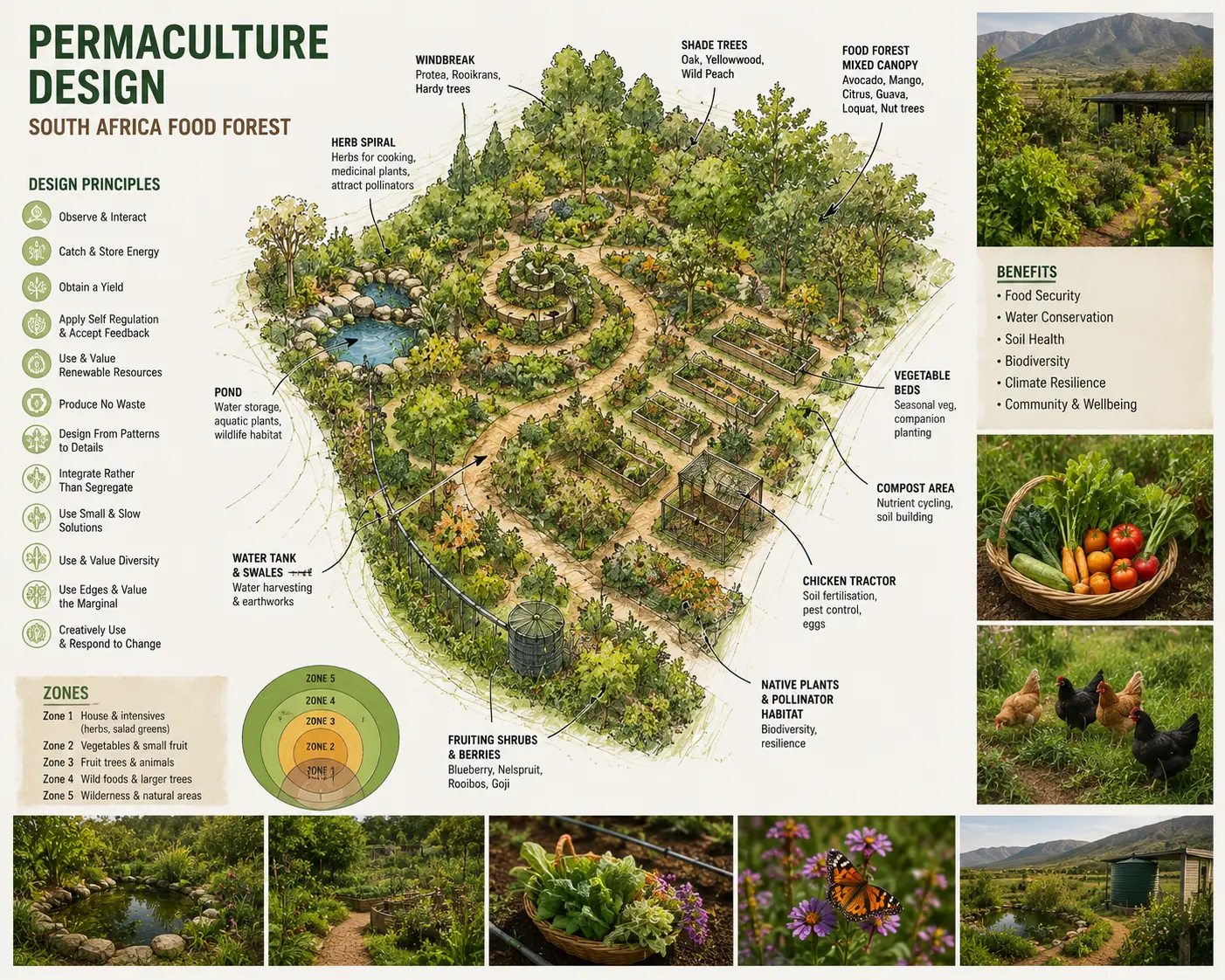
Every permaculture design starts with three foundational ethics. These are not abstract philosophy. They are practical decision-making filters that shape how you manage land, resources, and relationships on your farm:
- Earth Care, Treat the land, water, air, and living organisms as the foundation of everything. Every decision asks: does this action build or deplete the natural systems I depend on?
- People Care, make sure people's basic needs are met (food, shelter, water, community) in ways that don't exploit others or concentrate resources unfairly. In the SA context this includes food sovereignty and community food gardens.
- Fair Share (Return of Surplus), Take only what you need and return surplus (whether food, water, energy, or knowledge) to support Earth Care and People Care. Practically: compost your waste, share seed, bank your rainwater.
The 12 Permaculture Design Principles
David Holmgren's 12 design principles provide specific guidance for observation, planning, and management of any permaculture system. Here's how they apply in a South African farming context:
Water Harvesting, Critical for South African Farms
South Africa is a water-stressed country. The average annual rainfall of roughly 450mm is well below the global average of 860mm, and much of the country receives far less, the Northern Cape, Karoo, and Free State regularly receive under 300mm per year. Climate change is intensifying the variability between wet and dry cycles. Water harvesting is therefore the single most important permaculture intervention available to SA farmers, and the one that pays back fastest in drought-prone regions.
Swales
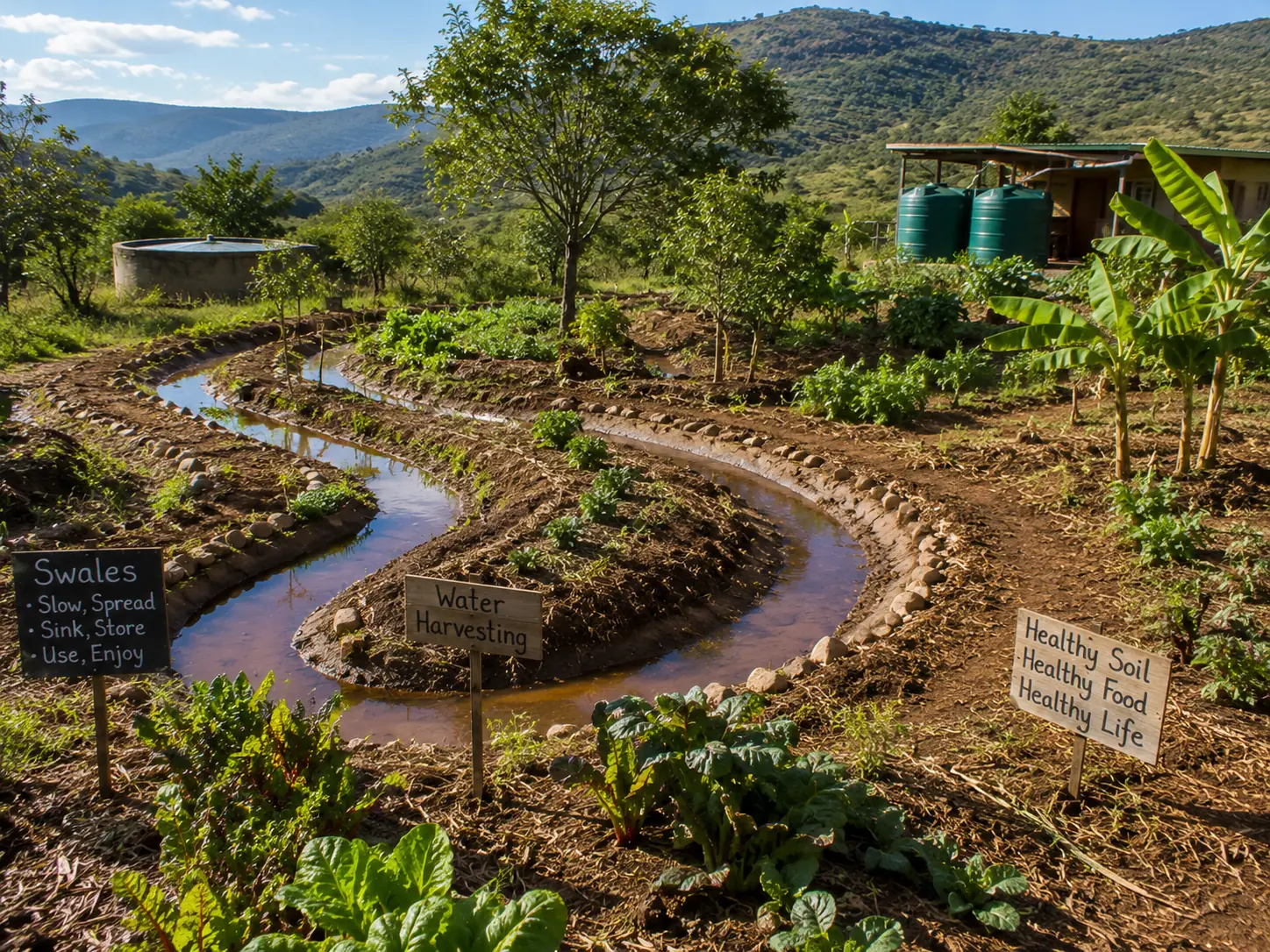
A swale is an on-contour ditch, a trench dug exactly along a level contour line on a slope, designed to intercept and hold rainwater, allowing it to percolate slowly into the soil rather than running off and eroding the hillside. The excavated soil forms a berm on the downhill side of the trench, which can be planted with deep-rooted perennials, fruit trees, or fodder crops that benefit from the stored moisture. Swales are transformative on sloped land in summer rainfall regions like KwaZulu-Natal, Mpumalanga, and the Eastern Cape. A properly contoured swale system on a 5-hectare slope can capture the equivalent of several large water tanks' worth of rainfall from a single moderate storm. See our irrigation systems guide for how swales complement drip and sprinkler systems.
Earthworks, Dams & Ponds
On-farm dams and ponds are a cornerstone of water-resilient permaculture design in SA. A well-placed farm dam, positioned high in the landscape and fed by natural drainage lines, can irrigate an entire market garden by gravity, eliminating electricity costs for pumping. The dam also creates an edge habitat that attracts beneficial insects, frogs (natural pest control agents), and birds. When sizing a dam, the rule of thumb is: 1 000 litres of stored water per m² of intensively cultivated garden during the dry season. In the organic farming context, a farm dam stocked with tilapia or catfish adds a protein production dimension to a water storage structure, the definition of a permaculture element with multiple functions.
Rainwater Tanks & Roof Catchment
Every farm building with a roof is a potential rain catchment surface. A standard 200m² roof sheds approximately 180 000 litres of water during a year with 900mm of rain, more than enough for a productive urban food garden or small-scale nursery. Roof catchment systems linked to 5 000–10 000 litre storage tanks are low-cost, immediate, and have no regulatory hurdles in most SA municipalities. Combine with mulched vegetable beds and drip irrigation for a near-autonomous small-scale food production system.
Food Forests, Permanent Productivity in SA's Climate
A food forest is a designed, multi-storey planting that mimics the structure of a natural forest while maximising edible and useful yield from every layer. Instead of a flat vegetable garden that requires annual replanting, tillage, and constant irrigation, a food forest is a self-sustaining system that becomes more productive with age as the trees establish and the soil biology builds. For South African smallholders, a food forest is one of the most practical long-term investments in land, particularly in areas with reliable summer rainfall.
A typical SA food forest has seven layers:
- Canopy layer, Tall fruit and nut trees: avocado, macadamia, mango (in subtropical areas), fig, and nitrogen-fixing trees like Acacia species.
- Sub-canopy layer, Smaller fruit trees: citrus, apple, pecan, mulberry, guava.
- Shrub layer, Fruiting shrubs: roses (hips), rosemary, blueberries (in cooler, acidic zones), indigenous Agapanthus as pest deterrent, bee-attracting flowering shrubs.
- Herbaceous layer, Perennial vegetables: Swiss chard, sorrel, comfrey (dynamic accumulator), lemongrass, chives, yarrow.
- Ground cover layer, Living mulches: sweet potato, nasturtium, clover (nitrogen fixer), creeping thyme.
- Rhizosphere (root layer), Root vegetables and fungi: garlic, ginger, turmeric, Jerusalem artichoke, inoculated mushroom logs.
- Vertical/climber layer, Grapes, granadilla (passionfruit), peas, beans climbing through shrubs.
Companion Planting for South African Conditions
Companion planting (growing specific plants together for mutual benefit) is among the most accessible and immediately applicable permaculture practices for SA vegetable and fruit farmers. It is particularly powerful for integrated pest management and reducing dependence on synthetic chemicals.
Tomatoes + Basil, Basil repels aphids and thrips from tomatoes and improves fruit flavour. Also deters Helicoverpa armigera (bollworm). | Maize + Beans + Squash (Three Sisters), The indigenous African polyculture: maize provides a trellis for beans; beans fix nitrogen for maize; squash leaves shade the soil, suppressing weeds and retaining moisture. | Cabbage + Nasturtium, Nasturtiums act as a trap crop, drawing aphids away from brassicas. | Carrots + Onions, Onion scent deters carrot fly; carrot scent deters onion fly. | Roses + Garlic, Garlic planted around rose bushes suppresses black spot and aphids.
Building Soil, The Foundation of All Permaculture
Healthy soil is the engine of a permaculture farm. Unlike conventional agriculture which often treats soil as an inert growing medium for applied nutrients, permaculture works to build a living, self-fertilising soil ecosystem. The key practices for SA farmers are:
- No-dig / No-till beds, Minimise soil disturbance to protect fungal networks and soil structure. See our no-till farming guide for implementation steps.
- Mulching, A 10–15cm layer of organic mulch (straw, wood chips, dry grass) on all beds reduces evaporation by up to 70%, suppresses weeds, and feeds soil organisms as it decomposes. Critical for SA's dry seasons.
- Composting, Converting on-farm organic waste into high-value compost eliminates the need for most purchased fertilisers. See the composting guide for the full method.
- Green manures & cover crops, Legume cover crops (cowpeas, lablab, vetch) fix atmospheric nitrogen into the soil and produce large amounts of biomass for incorporation or surface mulching. Our cover crops guide lists the best species for each SA region and season.
- Compost teas & worm leachate, Liquid extracts from worm farms or compost bins provide immediately available microbial inoculants and nutrients for seedlings and transplants.
Permaculture for South African Urban & Township Farmers
Permaculture is not limited to rural land. Some of the most innovative SA permaculture projects are operating in townships, community gardens, school grounds, and urban backyards in Johannesburg, Cape Town, Durban, and smaller towns. The principles of maximising yield from small spaces, harvesting rainwater from rooftops, composting kitchen waste, and growing perennial food plants apply perfectly to the urban farming and community gardens context.
Township-scale food gardens using permaculture design have demonstrated the ability to produce 20–30% of a household's vegetable needs from a 50m² plot when well-managed, reducing food expenditure and improving nutrition significantly. The SEED (Social, Environmental and Ecological Development) network and various NGOs across SA offer free permaculture training for community groups and emerging farmers. Many municipalities also provide compost and materials to registered community food gardens.
Getting Started: Your Permaculture Design Process
The biggest mistake new permaculture designers make is starting to build before completing the design. A proper permaculture design process follows these stages:
- Site survey, Map your land's topography, water flows, sun angles, wind patterns, existing vegetation, soil types, and infrastructure. Walk your land at different times of day and in different weather conditions.
- Needs and resources analysis, What does your household or farming operation need to produce? What resources do you currently have? What resources are available but unused (runoff water, organic waste, existing trees)?
- Zone and sector planning, Map your zones 0–5 (see below) and identify sectors, external energies that cross your land (sun, wind, fire risk, flooding, views, noise). This shapes where to place each element.
- Element selection and placement, Choose plants, animals, structures, and water features that meet your needs, using each zone's analysis to determine placement.
- Implementation in phases, Start with water (earthworks and tanks), then soil building, then Zone 1, then expand outward. Don't try to implement everything at once.
For professional support, the Permaculture Association of Southern Africa (PASA) maintains a directory of certified permaculture designers and offers Permaculture Design Certificate (PDC) courses across SA. A PDC is a 72-hour course that provides a thorough foundation in all aspects of permaculture design.