Cotton farming has a long and significant history in South Africa, and while the industry has contracted considerably since its peak decades of the 1980s and 1990s, it remains an important cash crop for commercial and emerging farmers in the hot, summer-rainfall regions of Limpopo and Mpumalanga. The global demand for natural fibre, growing interest in African cotton in international textile supply chains, and renewed government focus on revitalising the South African cotton value chain have created fresh opportunities for farmers willing to commit to the crop's specific management requirements.
Cotton is not a crop for the uncommitted or underprepared. It is biologically demanding, pest-prone, highly weather-sensitive, and requires reliable access to a gin facility for processing. But for farmers in the right regions with suitable soils, irrigation access, and a grasp of integrated crop management, cotton can deliver strong gross margins, particularly when Bt (genetically modified, insect-resistant) varieties are used that significantly reduce the cost and complexity of caterpillar pest management.
Below, we cover the main production decisions about growing cotton in South Africa, from choosing the right region and cultivar, through planting, canopy management, irrigation, integrated pest management, defoliation, and harvesting, to understanding the ginning and marketing process.
South Africa's Cotton Industry: Context and Opportunity
At its peak in the 1980s, South Africa produced over 100,000 tonnes of seed cotton annually, supporting a significant local textile and spinning industry. Production has since declined sharply due to competition from cheap imported textiles, rising input costs, and the collapse of several ginning operations. By the mid-2020s, annual seed cotton production had fallen to a fraction of historical levels, with South African ginners and textile manufacturers supplementing local supply with imported raw cotton.
This structural deficit between domestic production and mill demand represents a genuine opportunity for South African cotton farmers. Several ginning operations remain active (particularly in Limpopo's Levubu area and in parts of Mpumalanga) and actively seek reliable local raw cotton supply. The government's Industrial Development Corporation (IDC) and DTIC have both identified cotton revitalisation as a priority for textile value chain development in South Africa, making the crop eligible for targeted support programmes.
The adoption of Bt cotton technology, genetically modified varieties expressing Bacillus thuringiensis proteins that are toxic to lepidopteran pests including bollworms, has been a major factor in making cotton more economically viable for South African growers by dramatically reducing insecticide applications for caterpillar control. Bt cotton varieties are the dominant technology used in commercial South African cotton production today.
Where to Grow Cotton in South Africa
Cotton is a warm-season crop that requires a long frost-free growing season of at least 180–200 days, sustained summer temperatures above 25°C for boll development, and relatively low humidity during the boll opening and harvesting period to minimise fibre quality deterioration. These requirements confine commercial cotton production to specific areas of South Africa's northern provinces.
Limpopo Province
The Limpopo lowveld, including the Levubu valley, the Tzaneen area, the Lephalale district, and parts of the Limpopo River basin, has historically been the heartland of South African cotton production. The region's hot, frost-free summers, deep alluvial soils in the river valleys, and availability of irrigation water from rivers and dams make it well-suited to cotton production. The Levubu area in particular has established ginning infrastructure that provides a market access point for farmers in the broader region.
Mpumalanga Province
The Mpumalanga lowveld, particularly the areas around Komatipoort, Malelane, and the Nkomazi district adjacent to the Mozambican border, has suitable conditions for cotton production and has hosted both commercial and smallholder cotton projects. The area's hot summer temperatures and access to irrigation from the Komati and Crocodile river systems support the crop's requirements.
Other Potential Areas
Parts of the Northern Cape's Orange River basin (around Upington and Kakamas) have seen limited cotton trials under irrigation, and KwaZulu-Natal's northern coastal areas have historically had small cotton production zones. However, commercial-scale cotton outside Limpopo and Mpumalanga remains limited in South Africa.
Soil Requirements for Cotton
Cotton is moderately flexible in its soil requirements but performs best on deep, well-structured soils with good drainage and a moderate to high water-holding capacity. The key soil parameters for successful cotton production in South Africa are:
- Soil depth: Cotton has a deep taproot system that can penetrate to 1.5–2 m in suitable soils. Deep soils (at least 60–80 cm effective rooting depth) enable the plant to access stored moisture during dry spells and maximise nutrient uptake. Shallow soils over hardpan or rock are unsuitable.
- Texture: Sandy loam to clay loam soils are ideal. Heavy clay soils can be productive if drainage is managed, but waterlogging is extremely damaging to cotton, a single waterlogging event during early growth can cause severe root damage and crop loss.
- pH: Cotton grows best in a soil pH (KCl) of 5.5–7.0. Highly acidic soils require lime application before establishment. Very alkaline soils can cause micronutrient deficiencies, particularly iron and manganese.
- Drainage: Free drainage throughout the profile is essential. Cotton absolutely cannot tolerate waterlogged or poorly drained conditions for extended periods.
Before establishing cotton on a new field, conduct a thorough soil analysis including pH, macronutrients (N, P, K, Ca, Mg, S), micronutrients (particularly zinc and boron), and a physical assessment of subsoil compaction. Deep ripping to 60–80 cm on compacted soils before first planting can significantly improve rooting depth and water use efficiency in subsequent seasons.
Cotton Cultivar Selection
The choice of cotton cultivar is consistently among the most consequential decisions a South African cotton farmer makes. Variety selection should balance yield potential, fibre quality, maturity class suited to your production area, and technology package (conventional vs Bt insect resistance).
Bt Cotton Technology
Bt cotton varieties contain genes from the soil bacterium Bacillus thuringiensis that produce proteins toxic to lepidopteran larvae, the caterpillar pests (bollworms) that are historically the most damaging and costly to manage in South African cotton. Commercial Bt cotton varieties available in South Africa are stacked with multiple Bt genes (Bt Cry proteins) providing protection against the American bollworm (Helicoverpa armigera), spiny bollworm (Earias insulana), and African bollworm. Bt cotton farmers are required to plant a structured refuge of non-Bt cotton or maize to maintain susceptible pest populations and delay the development of Bt resistance, the standard requirement is a 20% refuge.
Variety Selection Criteria
When selecting cotton varieties for South African conditions, prioritise the following characteristics:
- Maturity class: Choose varieties with a maturity class matched to your frost-free season length. In Limpopo's long season areas, full-season varieties (160–180 days to maturity) can be used for maximum yield. In shorter-season or later-planting situations, medium-early varieties (140–160 days) reduce exposure to early-season rains at harvest.
- Fibre quality: Upper Half Mean (UHM) length, fibre strength (grams/tex), and micronaire value determine the price premium or discount your cotton receives at the gin. Longer, stronger fibre of appropriate fineness commands higher prices from spinners.
- Yield potential: Seed cotton yield under South African irrigated conditions ranges from 3.5 to 6 tonnes per hectare for well-managed Bt varieties. Dryland yields range from 1.0 to 2.5 tonnes per hectare depending on rainfall.
Consult the ARC Industrial Crops (at Rustenburg) or the Cotton SA variety trial results published annually for up-to-date performance data on varieties in your specific production region.
Planting Cotton
Correct planting timing is critical, cotton planted too early in cool soil germinates poorly and is vulnerable to seedling diseases, while delayed planting shortens the growing season and risks frost damage before the crop can be harvested.
Planting Time
In Limpopo and Mpumalanga's cotton belt, planting should occur when soil temperature at 10 cm depth is consistently above 18°C, typically from mid-October to mid-November in most areas. Earlier planting is risky due to cool soil temperatures. Later than mid-November progressively shortens the effective growing season and increases the risk of bolls still open at the onset of cooler autumn weather.
Planting Rate and Row Spacing
Standard commercial cotton row spacing in South Africa is 90–100 cm between rows, with a within-row plant spacing targeting 8–12 plants per metre. Seeding rate depends on seed germination percentage, typically 10–15 kg/ha of delinted seed. Seeds are planted at 3–5 cm depth into moist, warm soil. Cotton establishment is sensitive to cold, wet soils, planting into a seedbed with good moisture but without waterlogging gives the best emergence.
Cotton Growth Stages and Crop Management
Emergence
Days 5–10 after planting. Scout for seedling diseases (damping off) and soil pests. Ensure even stand.
Squaring
~35–45 days. First flower buds (squares) appear. Begin scouting for bollworm egg masses and thrips.
Flowering
~55–65 days. First white flowers open and turn pink. Peak water and nutrient demand begins.
Boll Set
~65–90 days. Green bolls form and expand. Critical period for irrigation and boll weevil monitoring.
Boll Opening
~120–150 days. Bolls crack open exposing white lint. Defoliation triggered at 60% open bolls.
Harvest
~150–180 days. Mechanical or manual harvest of fully open, dry bolls. Moisture below 12% for ginning.
Irrigation Management
Cotton can be grown under both dryland (rainfed) and irrigated conditions in South Africa, with irrigated production achieving significantly higher and more reliable yields. Total water requirement for a cotton crop in South Africa is approximately 600–900 mm over the growing season, depending on climate, cultivar, and management intensity.
The most critical irrigation periods are during squaring (flower bud formation), early flowering, and the first 6 weeks of boll set, water stress during any of these stages causes permanent yield reduction through square and boll shed. Conversely, excessive irrigation after boll opening promotes vegetative regrowth (rank growth), delays maturity, and creates conditions for boll rot.
Furrow irrigation remains common in South African cotton production, particularly along river flat areas. Centre pivot and drip irrigation systems are used on larger commercial operations and offer better water use efficiency and more uniform application. For dryland production, adequate seasonal rainfall (minimum 500–600 mm distributed across the growing season) and deep, water-retentive soils are prerequisites for economic yields.
Fertilization Programme
Cotton is a demanding crop in terms of nitrogen, a seed cotton yield of 4 tonnes per hectare removes approximately 100–130 kg N/ha from the field. Phosphorus and potassium requirements are also significant, and zinc deficiency is a commonly encountered micronutrient problem in South African cotton soils that causes characteristic stunting and mottled yellowing of young leaves.
A typical commercial cotton fertilization programme in South Africa includes a basal application of phosphate and potassium at planting, followed by split nitrogen applications: approximately one-third at planting, one-third at squaring (35–45 days after emergence), and the final third at first flower. Applications beyond first flower are rarely justified on most soils. Zinc foliar sprays at the 4–6 leaf stage correct deficiencies that appear on young growth. Always base your programme on soil analysis results, over-application of nitrogen promotes excessive vegetative growth (rank growth) at the expense of boll production and fibre quality.
Integrated Pest Management (IPM) in Cotton
Pest management represents the most technically complex aspect of cotton production and historically the largest variable cost in non-Bt cotton production systems. South African cotton faces a diverse pest complex that requires an integrated management approach combining cultural, biological, and chemical control methods.
Key Cotton Pests in South Africa
- American bollworm (Helicoverpa armigera): The most economically important cotton pest in South Africa. Larvae feed on squares, flowers, and bolls, causing direct yield loss. Bt cotton with stacked Cry proteins provides excellent control, dramatically reducing insecticide applications needed. In non-Bt systems, scouting-based spray programmes targeting egg masses and early instar larvae are essential.
- Spiny bollworm (Earias insulana): A secondary bollworm species also controlled by Bt technology. Larvae bore into young bolls and shoot tips, causing characteristic tip-wilting.
- Cotton aphid (Aphis gossypii): Colonies on undersides of leaves cause leaf curl and honeydew deposition that stains lint. Aphid outbreaks are often triggered by excessive nitrogen application or disruption of natural enemy populations by broad-spectrum insecticide applications.
- Thrips (Thrips tabaci and Frankliniella schultzei): Seedling and early-season thrips feeding causes leaf silvering and distortion. Seed treatment insecticides provide early-season protection.
- Red spider mite (Tetranychus urticae): Can cause severe defoliation in hot, dry conditions, often a secondary outbreak following the disruption of natural mite predators by broad-spectrum insecticide applications.
- Stink bugs and shield bugs: Feed on developing bolls, causing internal boll damage and seed quality loss. Monitor from mid-season and treat at threshold populations.
IPM Principles
Effective IPM in cotton relies on regular scouting (at least twice weekly during peak pest periods), action thresholds rather than calendar-based spraying, preservation of natural enemies (predatory insects and spiders that suppress pest populations), selective insecticide choices that minimise natural enemy disruption, and the rotational use of insecticide chemical groups to delay resistance development. Bt cotton is a cornerstone technology in South African cotton IPM because it eliminates most of the bollworm spraying that historically disrupted natural enemies and triggered secondary pest outbreaks.
Defoliation and Harvest
Defoliation (the application of chemical defoliants to cause premature leaf drop) is a critical step in preparing cotton for mechanical harvesting. Leaves left on the plant contaminate the harvested lint with green leaf fragments (green matter contamination) that are extremely difficult to remove in ginning and severely penalize the cotton's market value.
Defoliation is triggered when approximately 60% of bolls are open and the uppermost harvestable boll (UHWB) is mature. Commonly used defoliants in South Africa include ethephon (ethylene-releasing ripener/defoliant) applied alone or in combination with thidiazuron or tribufos. Correct timing, rate, and application conditions (temperature above 18°C, no rain expected for 48 hours) are critical for effective defoliation.
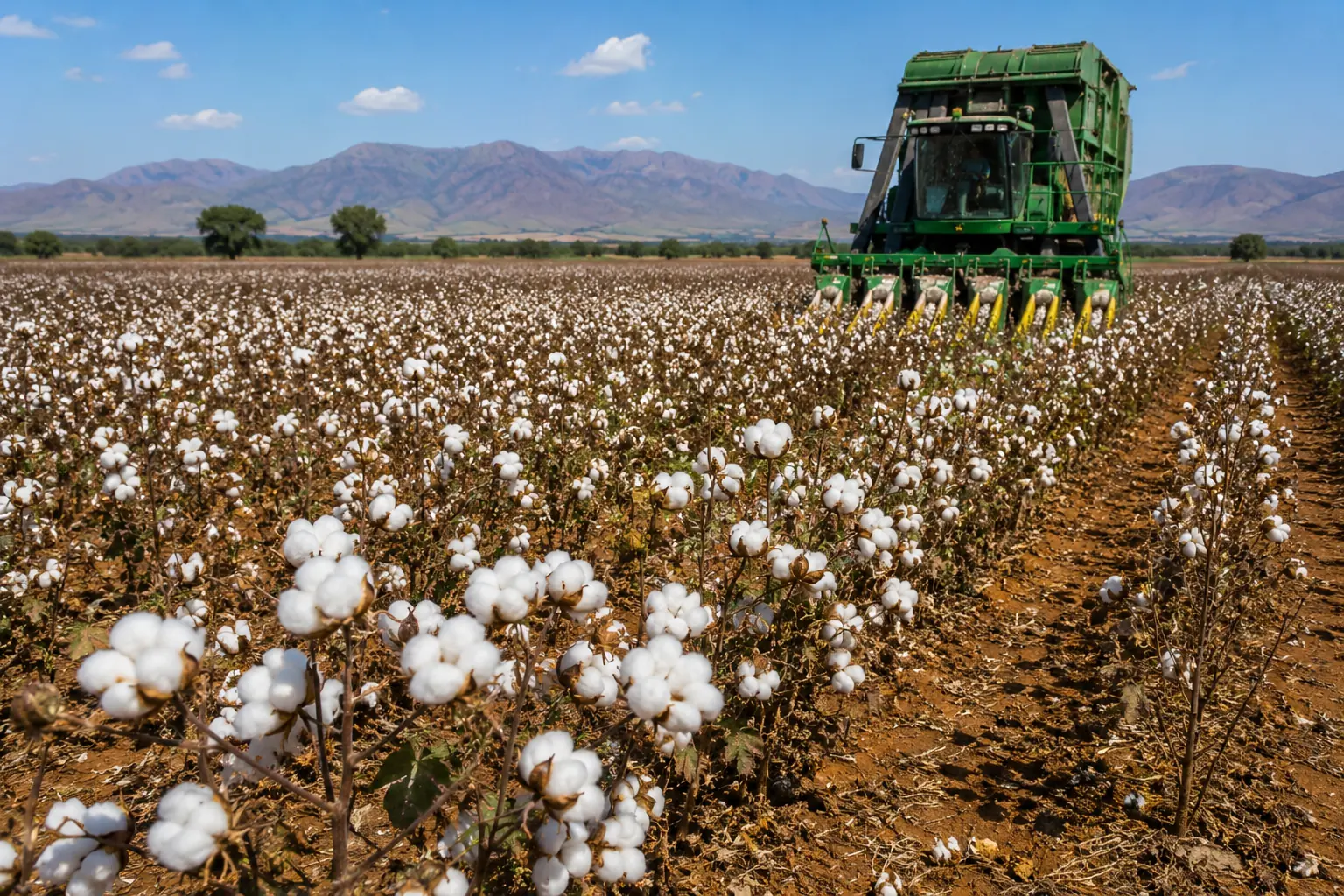
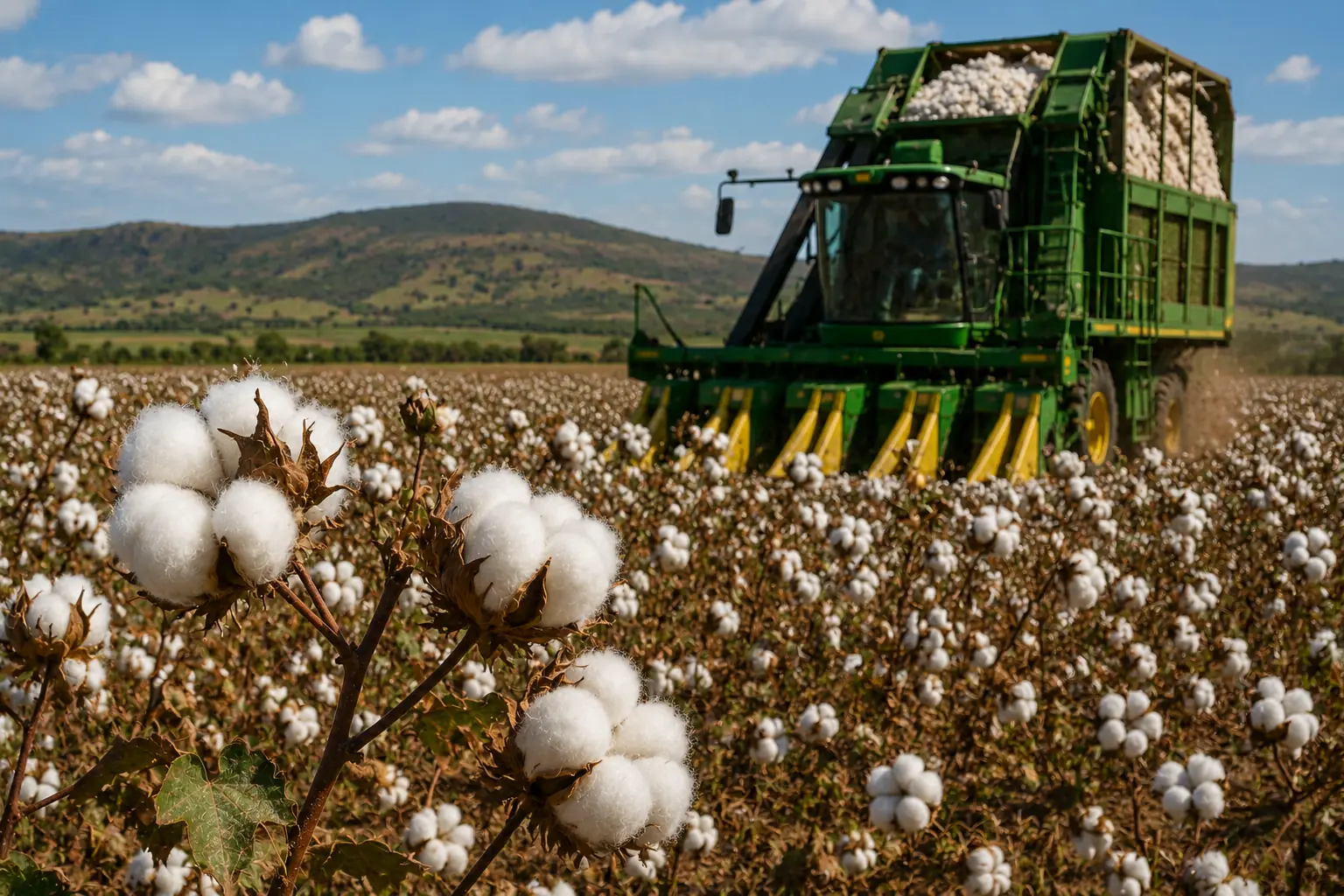
After defoliation and boll desiccation, cotton can be harvested mechanically using a spindle picker or stripper harvester, or manually picked by hand. Manual harvesting remains practiced on smallholder operations in Limpopo and Mpumalanga, producing cleaner lint than machine harvesting but at significantly higher labour cost. Harvested seed cotton should be delivered to the gin at a moisture content below 12%, wet cotton in the gin causes fibre damage and quality loss.
Ginning, Grading, and Marketing
Unlike most agricultural commodities, cotton cannot be sold directly to end users from the farm, it must first be processed through a gin, which separates the lint fibre from the seed, removes trash and foreign matter, and bales the lint for transport and sale. Active gin facilities in South Africa include operations in Limpopo's Levubu area and select Mpumalanga locations.
Cotton price in South Africa is based on the A-Index (Cotlook A Index) international benchmark, adjusted for local ginning differentials, fibre quality (length, strength, micronaire), and moisture content. Longer, stronger fibre commands a premium. Contaminated, wet, or short-fibre cotton attracts significant price penalties. Seed cotton is sold to the gin, which retains cottonseed for oil and meal processing and pays the farmer for lint value less ginning costs.
Cotton SA (the industry body representing South African cotton farmers, ginners, and traders) is the primary source of market information, variety trial data, and producer support for South African cotton growers. New and emerging cotton farmers are strongly encouraged to engage Cotton SA before establishing their first crop to access market linkages, production support, and up-to-date variety recommendations.
🌿 Top Tips for South African Cotton Farmers
- Use Bt cotton varieties, they dramatically reduce bollworm management costs and simplify your pest programme while protecting natural enemy populations.
- Plant at the right soil temperature (above 18°C at 10 cm), cool soil germination leads to poor stands and seedling disease problems that compromise the entire crop.
- Never over-apply nitrogen, excessive vegetative growth (rank growth) delays maturity, attracts pests, and reduces boll production. Follow soil-test based recommendations.
- Time your defoliation precisely, too early reduces yield, too late increases green matter contamination that penalizes your cotton at the gin.
- Scout twice weekly during squaring and flowering, most pest decisions in cotton must be made quickly before the economic threshold is crossed and damage becomes irreversible.
- Register with Cotton SA before planting, they can connect you to gin facilities, variety trials, and market information essential for a new cotton operation.
Government Support for Cotton Farmers
- Cotton SA: Industry body providing technical support, variety trials, market information, and smallholder development programmes for South African cotton producers. Contact Cotton SA at cottonsa.org.za for information on current support programmes and gin facility contacts.
- ARC Industrial Crops: The Agricultural Research Council's industrial crops unit at Rustenburg conducts cotton variety trials and provides technical extension services to commercial and emerging cotton farmers.
- CASP and Ilima/Letsema: Capital grants (CASP) and production input support (Ilima/Letsema) are available through provincial agriculture departments for qualifying emerging cotton farmers.
- IDC Agro-Processing Fund: The Industrial Development Corporation funds agro-processing projects including cotton value chain development. Farmers and ginning operations can explore IDC financing for infrastructure development.
⚠️ Disclaimer
This guide is for general educational purposes. Cotton variety registration, Bt refuge requirements, and insecticide registrations change regularly. Always verify current variety performance data with Cotton SA or the ARC, and consult a registered agronomist for pest management advice specific to your region and season. GMO (Bt cotton) cultivation requires compliance with relevant biosafety regulations, consult Cotton SA for guidance on compliance requirements for your province.