Hydroponics in South Africa, Growing More Food with Less Water, Less Land, Less Risk
Hydroponics is the science and practice of growing plants in a nutrient-enriched water solution, without the need for soil. Plants roots access water, oxygen, and dissolved mineral nutrients directly, achieving faster growth rates, higher yields per square metre, and dramatically lower water consumption than equivalent soil-based production. In a country facing water scarcity, unreliable rainfall, deteriorating soil health, and growing urban food demand, hydroponics is not a novelty. It is increasingly a practical, commercially viable farming system for South Africans at every scale.
South Africa's hydroponics industry has grown significantly over the past decade. From rooftop greenhouses in Cape Town and Johannesburg to commercial lettuce and herb operations supplying major retailers, and township food gardens building food security through simple bucket systems, hydroponics is reshaping how South Africans think about food production. The country's year-round sunshine, growing premium fresh food market, and critical water challenges make it an ideal environment for soilless farming to thrive.
Here, we cover everything you need to start or scale a hydroponic operation in South Africa, from choosing the right system for your budget and space, through to nutrient management, pest control in a soilless environment, load-shedding solutions, and the potentially profitable crops and sales channels for the South African market.
💧 Water efficiency: Hydroponic systems use up to 90% less water than equivalent soil-based production for the same crop yield. In a closed recirculating system, the only water lost is through plant transpiration and evaporation, there is no runoff, no deep drainage, and no irrigation inefficiency. For South Africa's water-scarce provinces, this makes hydroponics among the most resource-efficient food production methods available.
The Four Main Hydroponic Systems for South African Farmers
Choosing the right hydroponic system is the most important technical decision for a new grower. Each system has different capital costs, management requirements, crop suitability, and failure modes. Here is an honest comparison of the four systems most used by South African commercial and smallholder growers:
NFT, Nutrient Film Technique
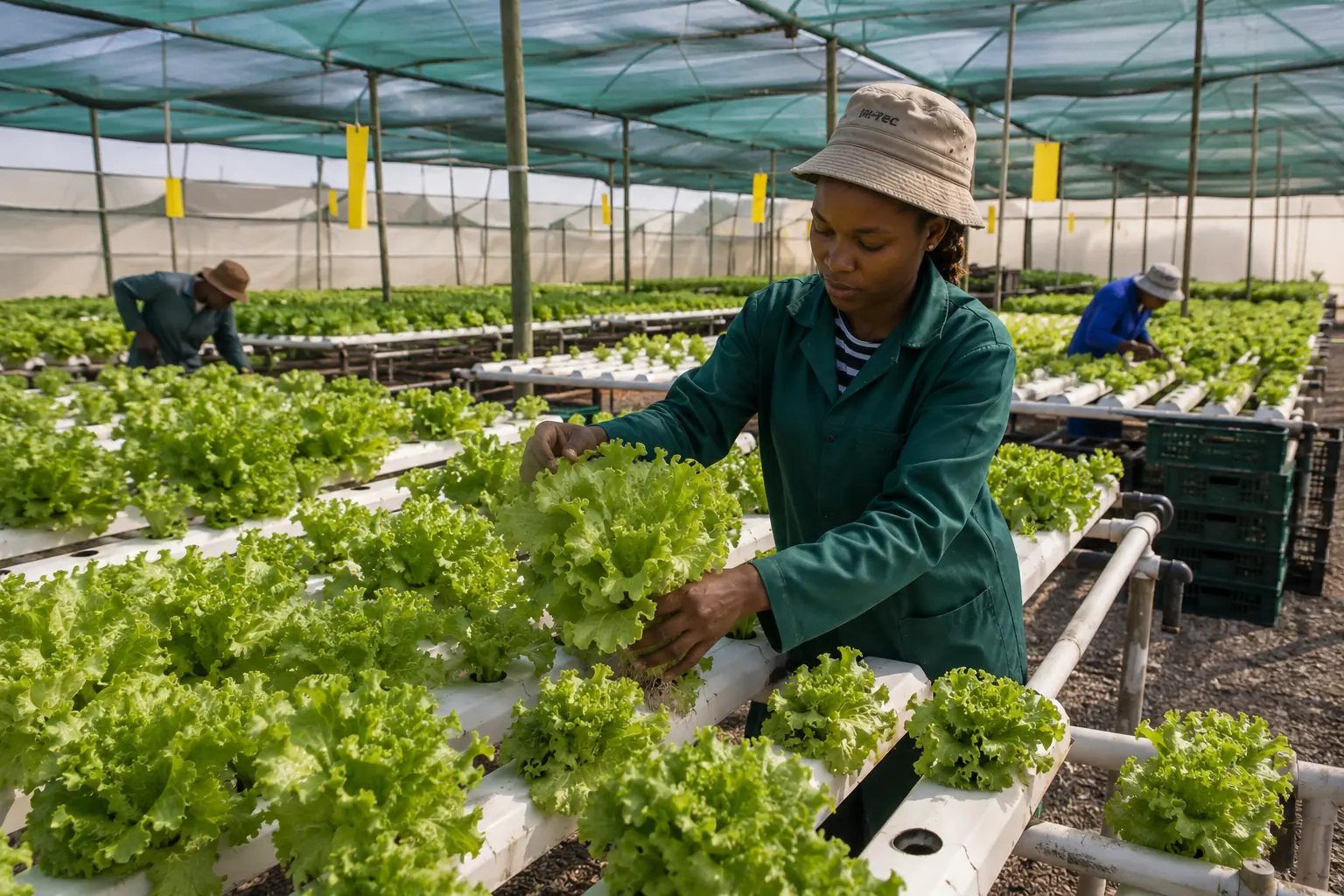
A thin film of nutrient solution flows continuously through sloped channels, bathing bare plant roots. Plants are held in small plastic cups in holes along the channel top. NFT is ideal for fast-growing, lightweight crops, lettuce, spinach, herbs, and baby leaf greens. It is the most widely used system in South African commercial hydroponic operations because of its low water volume, fast crop turnover, and straightforward cleaning between cycles. Capital cost for a 100m² NFT system (fully equipped, greenhouse included) is approximately R80,000–R180,000. The main risk is pump failure, without water flow, roots dry out within 30–60 minutes.
DWC, Deep Water Culture
Plants are suspended in net pots over a reservoir of continuously oxygenated nutrient solution, with roots submerged in the water. DWC is the simplest and most affordable system to set up, a basic 20-plant DWC system can be built for R500–R2,000 using food-grade buckets and a small air pump. Growth rates are excellent for lettuce and leafy greens. The main risks are root disease (Pythium) in warm water, and aeration failure. A good starting point for urban food gardens, schools, and smallholder farmers learning hydroponics.
Dutch Bucket (Bato Bucket) System
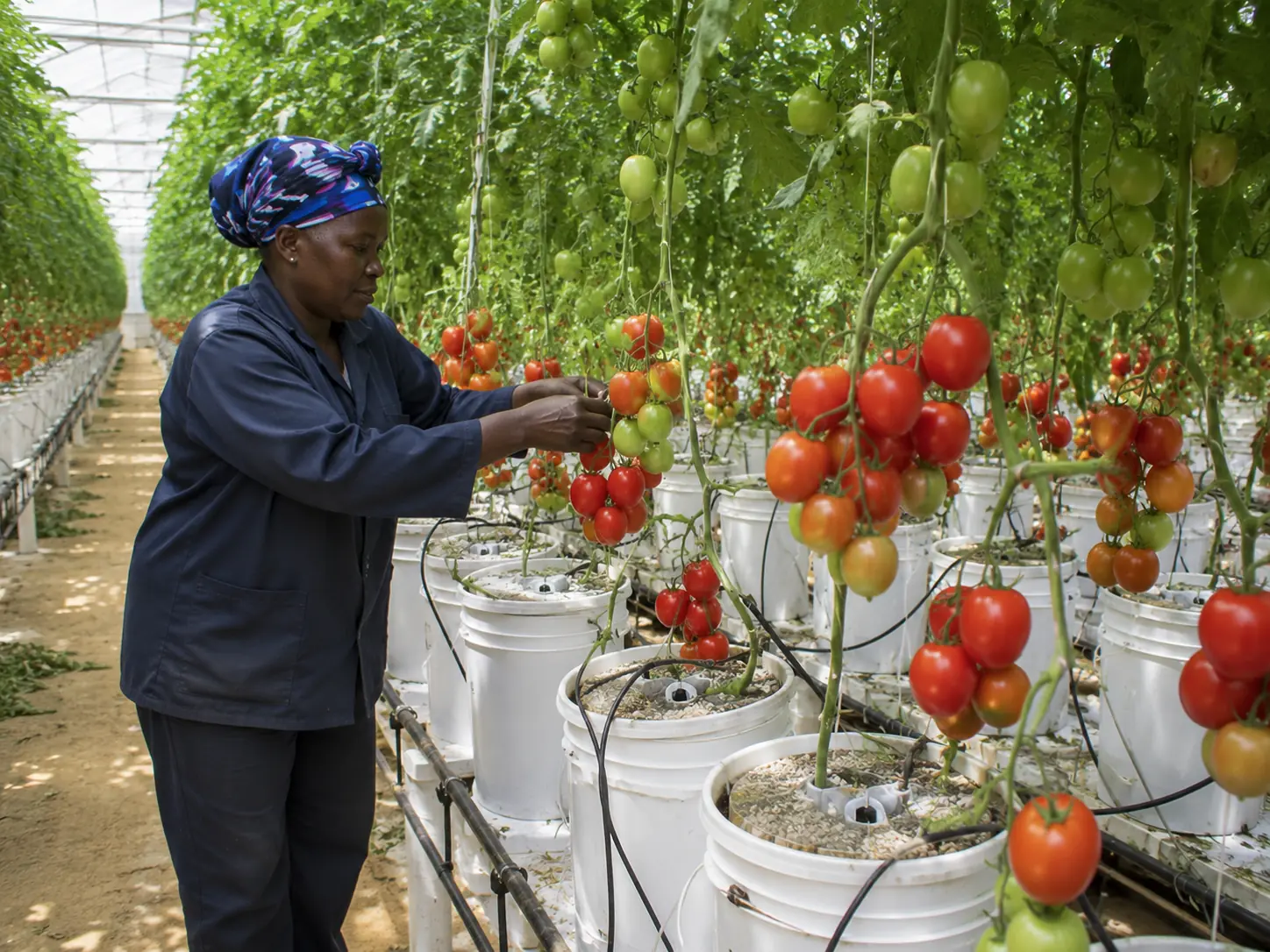
Individual buckets or containers filled with an inert growing medium (perlite, coco coir, or rockwool) are connected by a drip irrigation line delivering nutrient solution. Excess drains back to a reservoir for recirculation. Dutch buckets are ideal for large, vining crops, tomatoes, peppers, cucumbers, aubergines, and strawberries. This is the most widely used system for commercial greenhouse vegetable production in South Africa. A 100-plant Dutch bucket tomato system costs R40,000–R120,000 to set up excluding the greenhouse structure.
Media Bed / Flood & Drain
Grow beds filled with an inert medium (expanded clay, perlite, or coarse gravel) are flooded with nutrient solution periodically, then drained. The medium holds moisture between flood cycles while providing excellent root oxygenation. Media beds support the widest range of crops, from leafy greens and herbs to root vegetables like carrots and radishes, and fruiting crops. Popular in aquaponics systems where fish waste provides nutrients. Higher capital cost than DWC but more forgiving of management errors.
The Best Crops to Grow Hydroponically in South Africa
Not all crops are equally suited to hydroponic production, and choosing the right crop for your system, market, and management capacity is critical to profitability. Here are the top hydroponic crops for the South African market:
| Crop | Best System | Days to Harvest | Yield (100m²) | Market Price | Difficulty |
|---|---|---|---|---|---|
| Lettuce (butterhead, cos, oakleaf) | NFT, DWC | 28–35 days | 300–500 heads/cycle | R12–R25/head | Easy ✅ |
| Basil & herbs (cilantro, parsley) | NFT, DWC | 21–35 days | High per m² | R20–R60/bunch | Easy ✅ |
| Baby spinach & leaf greens | NFT, Media bed | 25–35 days | High continuous harvest | R8–R18/100g | Easy ✅ |
| Tomatoes (cherry & truss) | Dutch bucket, Media bed | 70–90 days to first fruit | 30–60kg/plant/season | R25–R50/kg | Moderate ⚡ |
| Cucumbers | Dutch bucket | 55–65 days to first fruit | 20–40kg/plant/season | R15–R30/kg | Moderate ⚡ |
| Peppers (bell & chilli) | Dutch bucket | 90–120 days to first fruit | 8–20kg/plant/season | R20–R60/kg | Moderate ⚡ |
| Strawberries | NFT, Dutch bucket | 90 days (runners) | 300–600g/plant | R60–R120/kg | Advanced 🔬 |
| Microgreens | Media trays (not recirculating) | 7–14 days | Very high per m² | R150–R400/kg | Easy ✅ |
For new hydroponic growers in South Africa, lettuce and leafy herbs on an NFT system are the recommended entry point. The crop cycle is short (28–35 days), the plants are forgiving, the system is clean and simple to manage, and the market in South African cities is large and accessible. Once you have mastered lettuce and herbs, you can expand into higher-value fruiting crops like cherry tomatoes on a Dutch bucket system alongside your leafy green production.
Nutrients, Water Quality and pH Management
Nutrition management is the core technical skill of hydroponic farming. Unlike soil, which has a natural nutrient buffering capacity, hydroponic systems are entirely dependent on the nutrient solution you mix and maintain. Getting this right is what separates profitable hydroponic operations from failing ones.
🧪 Nutrient Solutions
All essential plant nutrients must be dissolved in the water: nitrogen, phosphorus, potassium (the primary nutrients), plus calcium, magnesium, sulphur, and all the micro-nutrients (iron, manganese, zinc, copper, boron, molybdenum). In South Africa, commercial hydroponic nutrient concentrates are available from several suppliers including Nutrifeed, Hygrotech, and Culterra. These are pre-formulated for specific crop types and growth stages, eliminating the need to calculate individual salt additions. A good two-part concentrate (Part A and Part B, mixed separately to avoid precipitation) is the most practical option for most South African growers. Nutrient solution strength is measured in EC (Electrical Conductivity), target 1.2–2.0 mS/cm for leafy greens and 2.5–4.0 mS/cm for fruiting crops.
Water Quality in South Africa
South Africa's municipal water quality varies significantly by region and is often high in carbonates, calcium, or chlorine, all of which can interfere with nutrient availability and pH stability. Always test your source water before designing your nutrient programme. A basic water quality test (measuring EC, pH, and key ion concentrations) costs R200–R500 from an agricultural laboratory. Many South African hydroponic growers use reverse osmosis (RO) filtration to purify their water to a near-zero baseline, giving full control over the nutrient solution composition. For rainwater harvesting as a water source, ensure the collection surface is clean and store in UV-resistant tanks.
⚗️ pH Management
Solution pH determines which nutrients are available to plant roots, the ideal range for most hydroponic crops is pH 5.5–6.5. Below pH 5.5, iron and manganese become toxic; above pH 6.5, iron, manganese, and zinc become unavailable, causing deficiency symptoms. Test pH daily with a calibrated pH meter (invest in a quality meter, cheap pH pens are inaccurate and frequently mislead growers). Adjust down with pH Down (phosphoric acid) and up with pH Up (potassium hydroxide). Check EC and pH at the same time every day in a commercial system.
Managing Load Shedding in a South African Hydroponic Farm
Load shedding is among South Africa's most significant operational challenges for hydroponic farmers in South Africa. NFT and DWC systems depend on continuous pump operation, power cuts of 2–4 hours several times per day can kill an entire crop of lettuce or damage fruiting plants irreversibly.
The most effective solutions used by South African hydroponic growers are:
- Battery-backed UPS systems: For smaller operations (up to 500W of pump load), a quality UPS with deep-cycle batteries can bridge power outages of 2–4 hours. Budget R8,000–R25,000 for a system sized for a small commercial NFT operation.
- Solar PV with battery storage: The gold standard for off-grid or load-shedding-resilient hydroponic farms. A solar system sized for a 200m² greenhouse operation (lighting, pumps, fans) costs R60,000–R150,000 installed but eliminates dependence on Eskom entirely. South Africa's solar irradiance is among the best in the world, solar makes exceptional sense for hydroponic greenhouse operations.
- Generator backup: A petrol or diesel generator as emergency backup for power outages above UPS capacity. Less elegant than solar but reliable and immediately available. Budget R8,000–R20,000 for a quality generator sized to your operation.
- System design adaptation: For DWC systems, simply increasing reservoir depth (more water volume per plant) provides a longer buffer before oxygen depletion becomes critical during power cuts. Media bed systems (flood and drain) are the most load-shedding resilient, the growing medium retains moisture for hours without active irrigation.
Selling Your Hydroponic Produce in South Africa
The market for locally grown, fresh, pesticide-reduced hydroponic produce in South Africa is strong and growing. The key sales channels available to South African hydroponic growers are:
🛒 Premium Retail and Supermarkets
Woolworths, Pick n Pay, Checkers, and SPAR all stock hydroponic lettuce, herbs, and leafy greens, typically labelled as "hydroponically grown" or "greenhouse grown" to distinguish them from field produce. Getting listed as a supplier to major retail chains requires consistent volume, packaging that meets retailer specifications, food safety compliance, and a relationship with their procurement team. This is more realistic for operations above 500m² of growing area with the ability to supply weekly volumes of 200+ units.
🥗 Restaurants and Food Service
Premium restaurants, hotel kitchens, school catering, and food service companies are excellent direct buyers for hydroponic lettuce, herbs, microgreens, and specialty greens. These buyers value freshness, consistency, and local provenance, all strong selling points for hydroponic growers. Direct delivery relationships with five to fifteen restaurants can absorb the full production of a 100–200m² hydroponic operation and deliver significantly better prices than wholesale channels. Approach chef-driven restaurants with a free product sample and a clear weekly supply offer.
🏪 Farmers Markets and Direct-to-Consumer
Cape Town's Oranjezicht City Farm Market, Neighbourgoods Market, the Johannesburg Market on Main, and hundreds of smaller community markets across South Africa represent excellent direct-sales channels for hydroponic growers. Retail prices at farmers markets (R20–R30 per lettuce head, R40–R60 per bunch of premium herbs) are 50–100% above wholesale. Building a direct customer base through a market stall or community food box scheme is the fastest route to profitability for small-scale hydroponic operations.
🌐 Online and Subscription Sales
Weekly produce subscription boxes delivered directly to households have grown significantly since 2020. Several South African hydroponic growers supply premium box schemes (Faithful to Nature, Orchard Box, and similar) with herbs, baby greens, and specialty salad items. Starting your own WhatsApp-based delivery round in your neighbourhood is an accessible, low-cost entry point to direct online sales.
⚠️ Common beginner mistakes in SA hydroponics: The three most common failures for new South African hydroponic growers are (1) neglecting daily pH and EC monitoring, problems compound quickly in recirculating systems; (2) underestimating load-shedding impact on NFT and DWC systems without backup power; and (3) growing crops nobody local wants to buy. Always match your crop selection to your local market demand before investing in infrastructure.