Why Garlic Ranks Among South Africa's Best High-Value Small-Land Crops
Garlic (Allium sativum) is consistently one of the highest-value vegetables per square metre that a South African farmer can grow. A well-managed hectare of garlic can yield between 6 and 12 tonnes of dry bulbs at retail prices ranging from R25 to R80 per kilogram, generating gross revenues of R150,000 to R600,000 per hectare per season depending on yield, variety, and market channel. No other common vegetable in South Africa matches this return on such a compact footprint.
South Africa imports a significant portion of its garlic consumption (historically from China, Argentina, and other producing countries) which means there is a consistent and growing domestic market opportunity for locally grown garlic. Local product commands premium prices over imported product because it is fresher, has stronger flavour, and is increasingly preferred by health-conscious consumers and premium food service buyers.
Garlic is particularly well-suited to smallholder and emerging farmers in South Africa's cooler highland regions, the Western Cape (Cederberg, Swartland, Overberg), the Free State (especially higher-lying areas), parts of the Eastern Cape, and the KwaZulu-Natal midlands. It requires relatively little land, can be managed with modest equipment, responds well to organic production methods, and has a long shelf life after curing that allows flexible selling across the season.
🧄 Market opportunity: South Africa imports tens of thousands of tonnes of garlic annually. Most of this imported product is from China and is considered inferior in flavour and shelf life to locally produced garlic. South African-grown garlic, particularly from the Western Cape, consistently achieves 30–50% price premiums over imported product at fresh produce markets, delis, restaurants, and health food stores.
Best Garlic Varieties for South African Conditions
Garlic varieties are divided into two main groups: hardneck (producing a central flowering stalk called a scape) and softneck (no central stalk, longer shelf life, better for braiding and longer storage). In South Africa, softneck varieties dominate commercial production because of their superior shelf life and market acceptance. Key varieties recommended for South African conditions include:
| Variety | Type | Best Province | Yield Potential | Shelf Life | Notes |
|---|---|---|---|---|---|
| Printanor | Softneck | Western Cape, Free State | 8–12 t/ha | 8–10 months | Most widely grown commercial variety in SA |
| Blanc de Lomagne | Softneck | Western Cape | 7–10 t/ha | 8–10 months | Large bulbs, excellent market acceptance |
| Early Italian Red | Softneck | Free State, KZN midlands | 6–9 t/ha | 6–8 months | Good for cooler, higher-altitude areas |
| Harlington Wight | Hardneck | Western Cape (colder areas) | 5–8 t/ha | 4–6 months | Premium flavour; specialty and restaurant market |
| Elephant Garlic | Hardneck | Western Cape, Eastern Cape | 4–7 t/ha | 4–5 months | Very large bulbs; milder flavour; niche market |
For most South African commercial garlic farmers, Printanor is the industry standard starting point. It is widely available as certified planting stock, has consistent yields across different production regions, and is well-accepted by fresh produce markets. Source certified disease-free planting cloves from reputable seed suppliers or the ARC (Agricultural Research Council) rather than replanting from your own previous crop, which can accumulate viruses over successive seasons.
Soil, Climate and Site Requirements for Garlic in South Africa
🌡️ Climate
Garlic is a cool-season crop that requires a period of cold temperatures (vernalisation) to initiate bulb development. In South Africa, this means garlic is predominantly grown as a winter crop in the Western Cape and as a late-autumn to early-winter planted crop in the higher-rainfall summer regions (Free State highlands, Eastern Cape, KZN midlands). Optimal growing temperatures are 12–24°C. Temperatures above 30°C during the growing season cause premature maturation and small, poorly-formed bulbs. Frost during establishment can damage young seedlings, protect with light irrigation or mulch during cold snaps.
Soil
Garlic performs best in deep, well-drained, fertile sandy loam or loam soils with a pH of 6.0–7.0. Waterlogged or compacted soils are lethal to garlic, white rot (Sclerotium cepivorum) and basal plate rot spread rapidly in wet, poorly drained conditions and can devastate an entire crop. Before planting, conduct a soil test and address any pH issues with agricultural lime. Incorporate compost or well-rotted manure at 20–30 tonnes per hectare to improve both drainage and nutrient availability. See our soil and fertilizer guide for soil preparation best practices.
Irrigation
Garlic has a moderate but consistent water requirement throughout the growing season, with highest demand during bulb swelling (approximately 8–10 weeks before harvest). Drip irrigation is the preferred method for garlic in South Africa, it delivers water directly to the root zone, keeps foliage dry (reducing foliar disease pressure), and uses significantly less water than overhead sprinklers. Soil moisture should be maintained consistently at 70–80% of field capacity from planting through to two weeks before harvest, at which point irrigation is suspended to allow the outer skins to dry and the plant to naturally senesce. See our irrigation systems guide for drip system specifications.
Step-by-Step Garlic Production Guide for South African Farmers
Land Preparation (4–6 weeks before planting)
Deep plough or rip to 400mm, especially on compacted soils. Apply agricultural lime if soil pH is below 6.0, then disc in. Incorporate 20–30 t/ha of well-rotted compost or kraal manure plus a balanced base fertiliser (typically 500–700kg/ha of 2:3:2 or similar) and incorporate before bed formation. Raised beds (20–25cm high, 1–1.2m wide) improve drainage and are strongly recommended in all but the most freely draining sandy soils.
Clove Selection and Preparation
Select large, firm, disease-free cloves for planting, clove size directly determines bulb size at harvest. Cloves from the outer positions of the bulb are preferred as they produce the largest daughter bulbs. Treat planting cloves with a registered fungicide dip (thiram or captan-based) to reduce white rot and Fusarium risk. Allow to dry for 24 hours before planting. Certified planting stock is available from ARC Infruitec-Nietvoorbij and several registered seed suppliers in the Western Cape.
Planting
Plant cloves pointed-end upward at a depth of 3–5cm (approximately the height of the clove itself below the soil surface) and 10–15cm apart within rows, with rows 25–30cm apart. This equates to approximately 300,000–400,000 cloves per hectare, requiring roughly 1,000–1,500kg of planting stock per hectare. Press soil firmly around each clove. In the Western Cape, planting typically occurs between late March and late May. In the Free State and highveld, April to May is standard. Mulching with straw after planting conserves moisture, moderates soil temperature, and suppresses weeds.
Fertilisation Programme
Garlic is a relatively heavy nitrogen feeder. After the base application at planting, apply nitrogen (LAN or urea) as a top dressing at 4–5 weeks after emergence (50kg N/ha) and again at 10–12 weeks (50kg N/ha). Potassium is critical for bulb size and quality, apply potassium nitrate via fertigation (drip) at bulbing stage. Stop all nitrogen applications 6 weeks before anticipated harvest or you risk delayed maturation and poor curing. Foliar applications of micro-nutrients (boron, zinc, manganese) at critical growth stages can significantly improve bulb quality.
Pest and Disease Management
The most serious disease threats to South African garlic are white rot (Sclerotium cepivorum), which is soil-borne and has no cure once established, and Fusarium basal rot. Prevention through planting clean stock, crop rotation (never plant Alliums in the same ground more than once every four years), good drainage, and pre-plant fungicide treatment is essential. Key insect pests include thrips (Thrips tabaci) which transmit viruses and cause direct feeding damage, and the onion fly (Delia antiqua). Registered insecticides are available for thrips control, consult your local agri rep or pest control guide for current registrations.
Harvesting
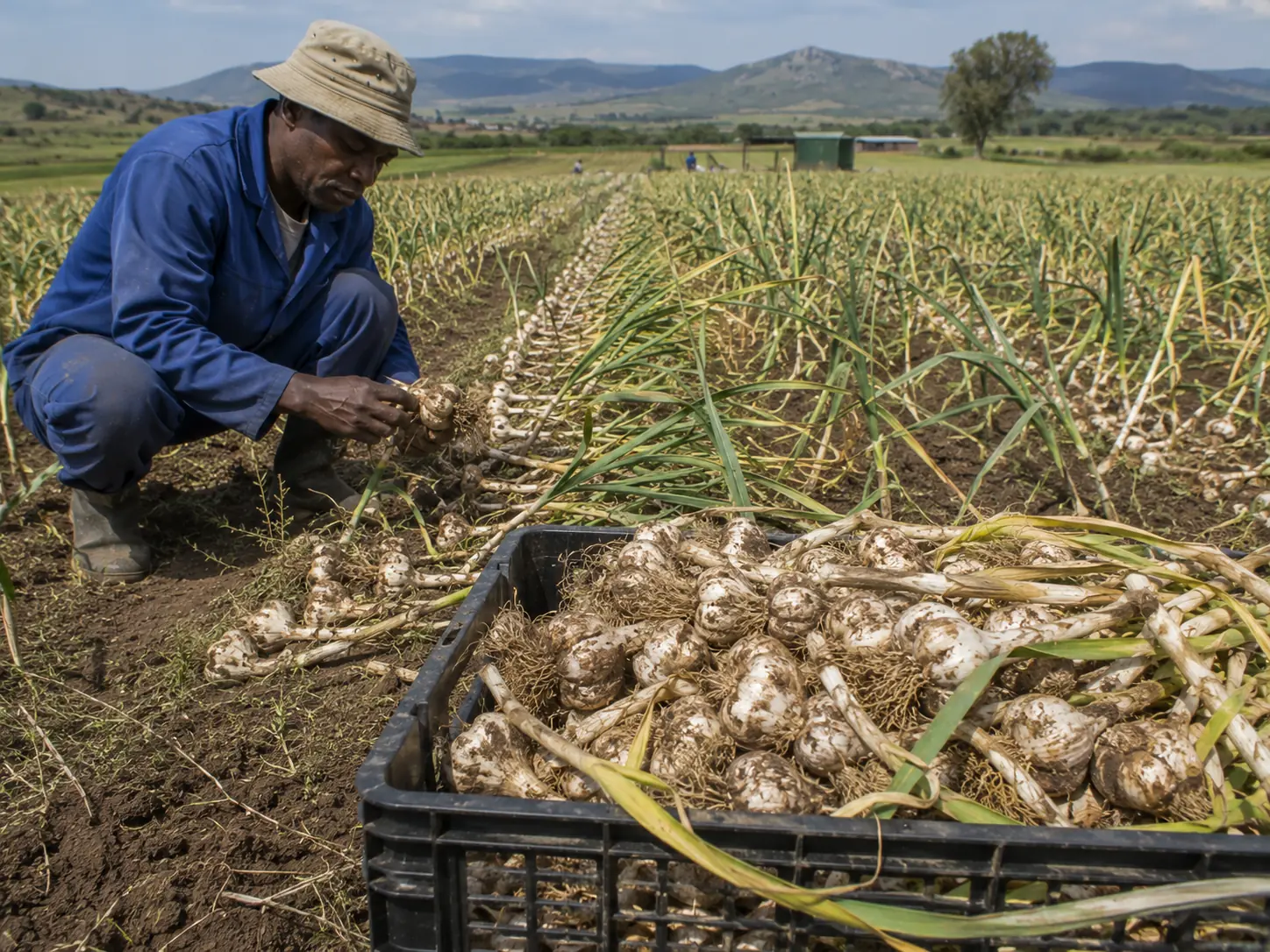
Garlic is ready to harvest when approximately 50–60% of the leaves have yellowed and dried down, typically 120–180 days after planting depending on variety and conditions. Do not wait until all leaves are dead, the outer wrapper skins need to still be intact and fleshy for proper curing. Harvest by undercutting with a fork, spade, or mechanical lifter. Handle bulbs gently, bruising and damage dramatically reduce shelf life and market value. Never harvest in wet conditions; always harvest into dry, shaded conditions.
Curing and Storage
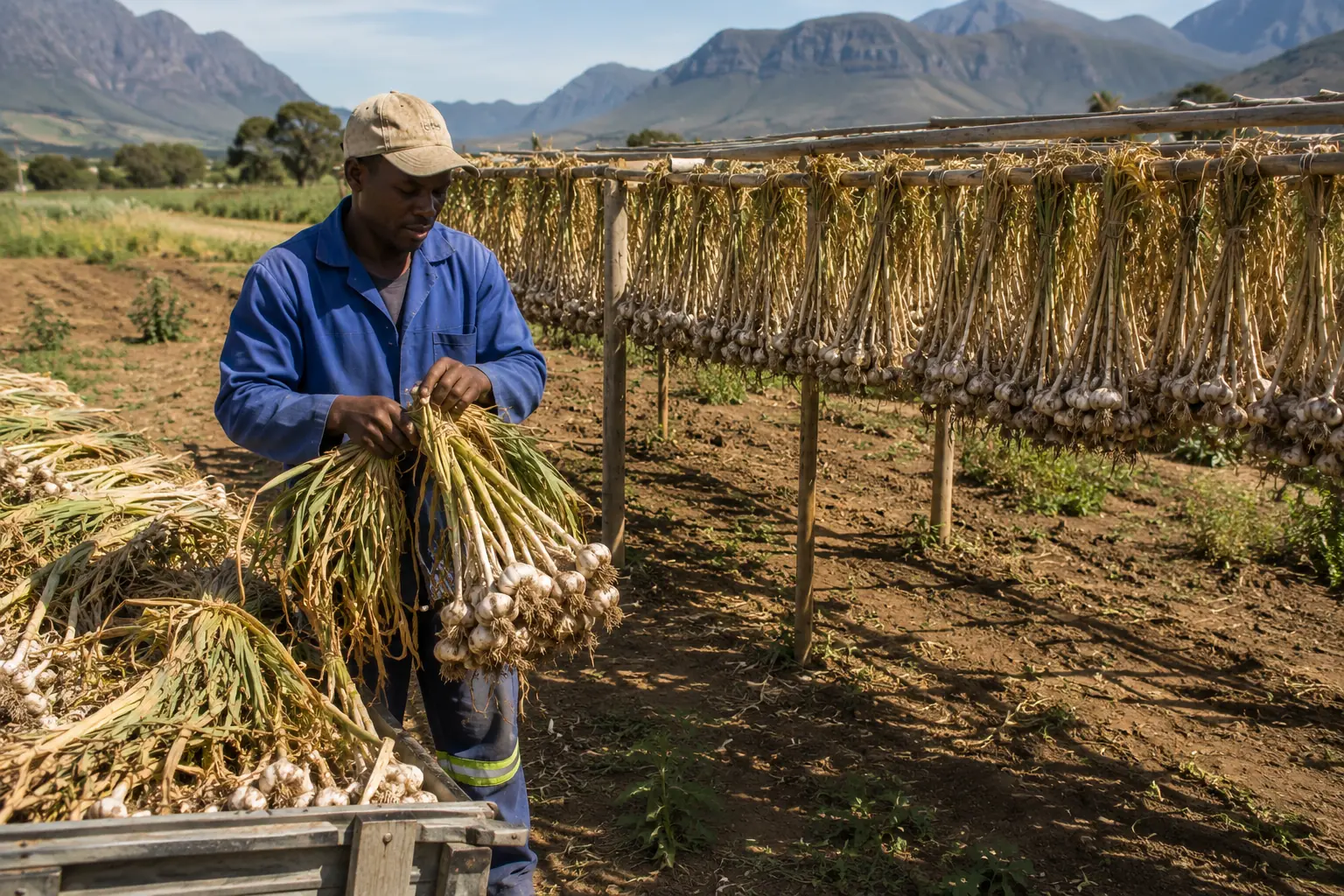
Curing is the most critical post-harvest step for garlic. Spread harvested bulbs in a single layer (or hang in bunches) in a warm (25–35°C), dry, well-ventilated shade structure for 3–6 weeks. This dries the outer skins, seals the neck of the bulb, and dramatically extends shelf life to 8–10 months for softneck varieties. Properly cured garlic can be stored at ambient temperature in a cool, dry, dark location or in refrigerated storage at 0°C and 65–70% relative humidity for maximum shelf life. Never store garlic in humid conditions, moulds and sprouting will quickly destroy your crop.
Garlic Planting Calendar for South Africa
| Region | Jan | Feb | Mar | Apr | May | Jun | Jul | Aug | Sep | Oct | Nov | Dec |
|---|---|---|---|---|---|---|---|---|---|---|---|---|
| Western Cape | — | — | Plant | Plant | Plant | Grow | Grow | Grow | Harvest | Harvest | — | — |
| Free State Highlands | — | — | — | Plant | Plant | Grow | Grow | Grow | Grow | Harvest | Harvest | — |
| KZN Midlands | — | — | — | Plant | Plant | Grow | Grow | Grow | Grow | Harvest | — | — |
| Eastern Cape (highland) | — | — | — | Plant | Plant | Grow | Grow | Grow | Grow | Harvest | — | — |
Where to Sell Garlic in South Africa
The garlic market in South Africa is diverse and accessible at multiple price points. Here are the main sales channels available to South African garlic farmers:
🏪 Fresh Produce Markets
The National Fresh Produce Markets (Johannesburg, Cape Town, Durban, Tshwane, Port Elizabeth) are the primary wholesale channel for commercially produced garlic. Prices fluctuate seasonally, garlic is most valuable from December to March when imported stocks thin out and local new-season garlic is scarce. See our agri markets guide for registered market agent contacts. Quality grading and presentation are critical for market acceptance, bulbs must be properly cured, sized, and packed in standard net bags.
🛒 Supermarkets and Retail Chains
Woolworths, Pick n Pay, Checkers, and SPAR all sell garlic, though most of their volume comes through established supplier relationships. For individual farmers, supplying through a consolidated marketing agent or packhouse that aggregates product from multiple growers is the most realistic route into retail. Organic certified garlic commands significant retail price premiums and is increasingly listed by premium retailers.
🥗 Restaurants and Food Service
Premium restaurants, deli's, speciality food stores, and food service companies are excellent direct-sales targets for high-quality local garlic. These buyers pay significantly above market prices for consistent quality, reliable delivery, and local provenance. Building five to ten direct restaurant relationships can absorb a significant portion of a small farm's production at excellent margins. Elephant garlic and hardneck varieties are particularly popular with chefs for their distinctive flavour profiles.
🌐 Online Direct Sales
Farmers markets, Instagram-based direct sales, Agrofoods, and local food delivery platforms have created a growing direct-to-consumer channel for premium garlic in South Africa. Selling braided garlic, smoked garlic, black garlic (fermented), or garlic powder and flakes as value-added products generates the highest possible margins on your raw material.
⚠️ Chinese import competition: Cheap imported garlic from China periodically floods the South African market, driving fresh produce market prices down to R8–R12/kg. South African producers compete by targeting quality-conscious buyers (premium retail, restaurants, organic buyers) who will consistently pay R35–R80/kg for local product, rather than trying to compete on price with mass-imported commodity garlic.