Pepper & Chilli Farming in South Africa, High-Value Crops with Year-Round Market Demand
Peppers and chillies (Capsicum annuum and related species) are among South Africa's most commercially useful vegetable crops. Bell peppers (sweet peppers), particularly the coloured grades (red, yellow, orange), command some of the highest per-kilogram prices of any fresh vegetable sold through South African fresh produce markets and major retailers. Chillies, meanwhile, serve a completely different but equally higher-value market: fresh chillies for the retail and catering trade, dried chillies for spice producers, chilli sauces and condiments, and export to regional African markets and specialist food manufacturers.
South Africa's pepper production spans a wide range of systems, from large-scale open-field production in Limpopo, Mpumalanga, and the Western Cape, to sophisticated high-tunnel and glass greenhouse operations producing premium coloured bell peppers year-round for major retailers. Understanding which system and which market you are targeting is the single most important strategic decision in setting up a pepper farming enterprise, the production system, variety selection, capital requirements, and market channel are all intimately connected.
Peppers are warm-season crops with a long growing period, typically 90–150 days from transplanting to first harvest, depending on variety and temperature. They are more sensitive to cold than tomatoes and more demanding in terms of nutrition and pest management. However, their per-hectare revenue potential (particularly for premium coloured bell peppers grown under protected structures) is exceptionally high, making them a staple of high-value vegetable farming operations across South Africa.
🌶️ Market insight: Premium coloured bell peppers (red, yellow, orange) sell at South African fresh produce markets at R12–R35 per kilogram depending on season and grade. Green bell peppers trade at lower prices (R5–R15/kg). Under tunnel production, a well-managed crop of coloured bell peppers can yield 60–100 tonnes per hectare per season, generating gross revenues of R720,000–R3,500,000/ha, among the highest of any SA vegetable enterprise.
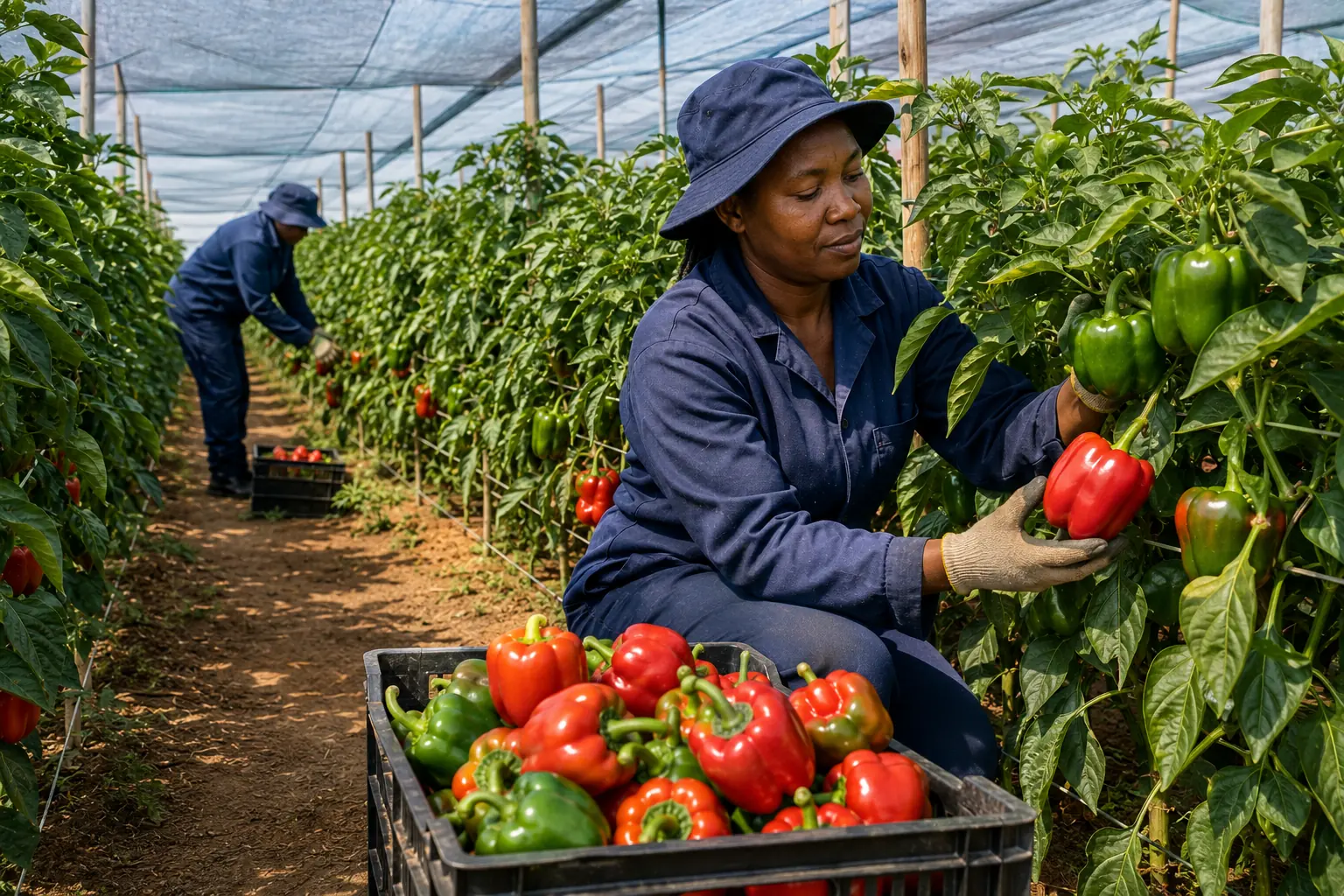
Bell Peppers vs Chillies, Two Very Different Markets
Before choosing varieties and a production system, you need to be clear on which market segment you are targeting, because the two are fundamentally different enterprises:
| Factor | Bell Peppers (Sweet) | Chillies (Hot) |
|---|---|---|
| Market | Fresh produce markets, retail, export | Fresh markets, spice processors, sauce manufacturers, export |
| Price per kg | R5–R35/kg (green to premium coloured) | R8–R80/kg (fresh); R80–R200/kg (dried) |
| Production system | Tunnel or open-field | Primarily open-field, some tunnel |
| Capital required | High (tunnel) to moderate (open-field) | Low to moderate |
| Skill required | High, exacting variety and quality standards | Moderate, more forgiving, robust crops |
| Risk | Moderate-High, price volatile; disease pressure high | Moderate, niche market but stable demand |
| Best for | Commercial farmers with capital and market access | Smallholders and commercial growers with processing links |
Choosing the Right Pepper and Chilli Varieties for South Africa
Bell Pepper Varieties
South African commercial bell pepper production is dominated by F1 hybrid varieties from seed companies including Rijk Zwaan, Enza Zaden, Hazera, and Syngenta. The key characteristics buyers demand are: blocky 4-lobed fruit shape, thick flesh, uniform colour and size, disease resistance (particularly to Tobacco Mosaic Virus and Phytophthora), and strong shelf life. Popular varieties in South Africa include:
- Coloured bell peppers (red/yellow/orange): Midas (yellow), Aruba (red), Vedrano (orange), Staccato (red), Fiesta (yellow). These command premium prices at retail and export. They are all green at immature stage and colour up on the plant. Require longer growing period than green peppers.
- Green bell peppers: Aristotle, Karisma, Yolo Wonder improved hybrids. Harvested at green stage for fresh market. Lower price than coloured but faster turnover.
- Lamuyo-type (blocky, elongated): Popular for processing and some fresh markets. Good yield per plant.
Chilli Varieties for South African Conditions
The chilli market is diverse, from mild paprika-type chillies for dried spice production to extremely hot varieties for the gourmet hot sauce market. Key production categories in South Africa include:
- Cayenne chillies: The workhorse of commercial chilli production in South Africa. Long, red, moderately hot (30,000–50,000 Scoville). Sold fresh, dried, or for sauce manufacture. Varieties include Large Red Thick Cayenne, Ring of Fire, and hybrid cayennes.
- Bird's eye chillies (Capsicum frutescens): Small, very hot (100,000–225,000 SHU). Widely used in African cooking and exported to regional markets. Prolific producers, a single plant can bear hundreds of fruits. Popular with smallholder farmers across Limpopo and Mpumalanga.
- Jalapeño: Growing South African market for fresh jalapeños in retail. Moderate heat (2,500–8,000 SHU), thick flesh. Used in fresh salsa, pickling, and Mexican-style food service sector.
- Paprika types: Large, sweet-to-mildly-hot thick-fleshed peppers dried and ground for paprika spice. Contract production for local spice manufacturers is an established route to market.
- Habanero / scotch bonnet: Extremely hot (100,000–350,000 SHU). Niche but growing market through specialty food retailers, hot sauce producers, and West African food communities in South African cities.
Climate and Province Guide for Pepper Farming in South Africa
Peppers are a warm-season crop with very specific temperature requirements. They grow best at day temperatures of 22–28°C and night temperatures above 15°C. Temperatures below 10°C cause chilling injury, leaves become water-soaked, growth stops, and flower and fruit drop occurs. Temperatures above 35°C also cause flower drop and reduce fruit set. This makes South Africa's temperate, frost-free regions ideal for open-field pepper production, while northern inland areas require careful seasonal management to avoid cold stress.
- Limpopo: South Africa's largest pepper and chilli producing province. The Tzaneen, Phalaborwa, Makhado, and broader Limpopo lowveld areas offer excellent warm, humid conditions for peppers. Multiple seasons possible with irrigation. Bird's eye chilli and cayenne production is well-established among both commercial and smallholder farmers here.
- Mpumalanga: Lowveld areas (Malelane, Komatipoort, White River) produce peppers year-round under irrigation. Highveld areas require protected structures for winter production.
- Western Cape: Under tunnels/greenhouses, coloured bell peppers are produced commercially year-round in the Hex River valley, Paarl, and Stellenbosch areas. Open-field production in summer months.
- Gauteng and surrounds: High-tunnel production viable year-round. Open-field production from September to April. Major market proximity (Johannesburg FPM) is a significant advantage.
- KwaZulu-Natal coast: Subtropical coastal conditions suit pepper production well. Year-round potential in frost-free coastal areas.
Open Field vs Tunnel vs Greenhouse Production
The production system you choose determines your yield potential, capital requirements, market channel, and risk profile:
Open-Field Pepper Production
Lower establishment cost (R80,000–R200,000/ha including irrigation and fencing). More exposed to weather, pests, and disease. Primarily produces green bell peppers and chillies for fresh produce markets and processing. Typical yields: 25–50 tonnes/ha for bell peppers; 5–20 tonnes/ha for chillies depending on variety and management. Drip irrigation is standard. Best suited to warm, low-humidity areas (Limpopo lowveld, Northern Cape, Mpumalanga lowveld) where open-field disease pressure is lower.
High-Tunnel (Polytunnel) Production
The dominant system for premium coloured bell pepper production in South Africa. Tunnels provide temperature buffering (warmer at night, cooler on very hot days), reduced wind and rain damage, and significantly reduced disease (particularly bacterial spot and Phytophthora) compared to open-field. Establishment cost: R400,000–R900,000/ha including tunnel structure, drip irrigation, and trellising. Yield under good management: 60–120 tonnes/ha per crop cycle. Premium coloured bell peppers from tunnels command the highest market prices and are the product retailers and exporters prefer. See our irrigation guide for drip system specifications for tunnels.
Glass Greenhouse Production
High-technology systems with climate control, CO₂ enrichment, hydroponic growing systems, and computer-managed irrigation and fertigation. Establishment costs of R2,000,000–R5,000,000+/ha. Yields of 150–300+ tonnes/ha/year with multiple crops. Reserved for large commercial operators with major retail or export contracts and sophisticated management capability. See our hydroponics guide for more on substrate-based growing systems used in these environments.
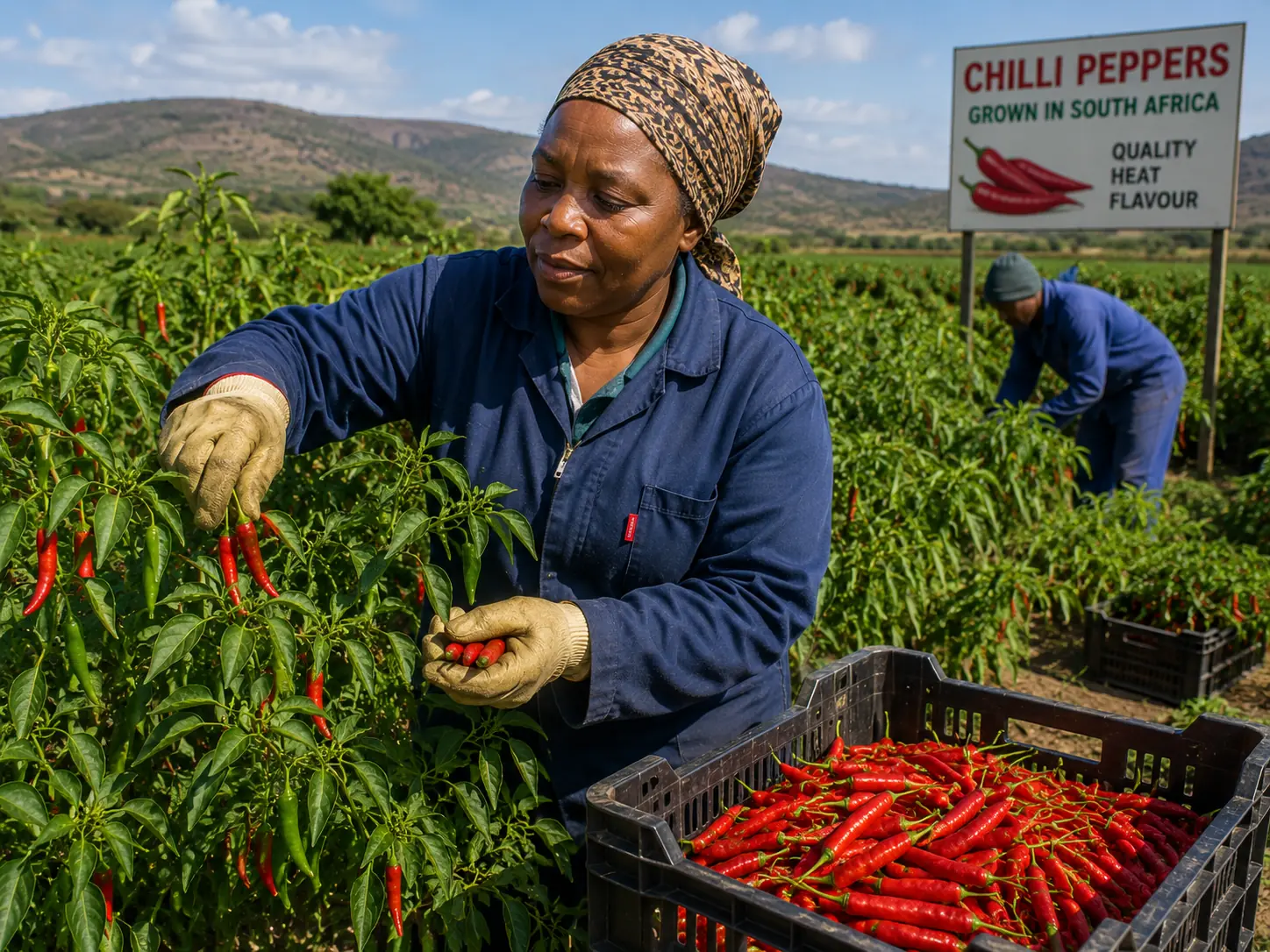
Soil Preparation and Transplanting Peppers
Peppers prefer well-drained, fertile loam soils with a pH of 6.0–6.8. They do not tolerate waterlogging, even a few hours of saturated soil can trigger Phytophthora root and crown rot, which can wipe out an entire planting in days. Raised beds (15–30cm height) are strongly recommended for both open-field and tunnel production to ensure rapid surface drainage.
Seedling Production (5–7 Weeks Before Transplanting)
Peppers are almost always started in a seedling nursery (either on-farm in a seedling tunnel or purchased from a professional plug plant nursery) rather than direct seeded into the field. Sow seeds into 104-cell or 200-cell plug trays using a sterilised seedling medium. Germination temperature: 25–28°C. Transplanting happens when seedlings are 15–20cm tall with 4–6 true leaves. Purchase seedlings from a reputable nursery using certified, treated seed to avoid introducing soilborne diseases like Fusarium and Phytophthora through contaminated growing media.
Soil Preparation and Bed Formation
Deep rip to 50–60cm. Apply basal fertiliser based on soil test, peppers have moderate-high phosphorus requirements at establishment. Incorporate quality compost (5–8 tonnes/ha) to improve water retention and soil biology. Form raised beds 80–120cm wide. Install drip tape (one line per bed row) before planting. Consider soil solarisation (covering moist soil with clear plastic for 4–6 weeks in summer) to reduce soilborne pathogen and weed seed pressure before planting, especially in tunnels. See our land preparation guide.
Transplanting
Plant spacing for bell peppers: 30–40cm within-row × 60–80cm between rows for open-field; 30×40cm in tunnels (2 plants per hole in twin-row beds is common in high-production tunnel systems). Plant at the same depth as in the plug tray, do not bury the stem above the soil line as this promotes crown diseases. Water immediately and thoroughly after transplanting. Apply a starter fertiliser drench (phosphorus and seaweed extract) at transplanting to encourage rapid root establishment. Protect transplants from direct sun and wind for the first 5–7 days.
Trellising and Training (Bell Peppers)
Commercial bell pepper production under tunnels uses a string trellis system, vertical strings or wire clips support the main stem and branches as the plant grows. Without support, heavy fruiting branches collapse and break. Install strong horizontal support wires at 30cm intervals up to 2m height along the crop rows before plants are large enough to need them. Train plants to a V-shape (two main leaders) or single-stem depending on variety and spacing. Regular side-shoot removal (de-leafing) maintains airflow and reduces disease.
Irrigation and Fertigation for Peppers
Peppers have moderate water requirements but are very sensitive to irregular moisture, alternating wet and dry cycles cause blossom-end rot (calcium deficiency), fruit cracking, and irregular fruit size. Drip irrigation maintaining consistent soil moisture is the standard. Critical stages for water management:
- Transplanting to first flower: Consistent moisture for establishment. Irrigate 2–3 times per week on lighter soils. Avoid overwatering, moist but never saturated.
- Flowering and fruit set: Moisture stress at this stage causes flower and young fruit drop. Maintain 65–75% field capacity consistently.
- Fruit development and colour change: High demand period. Adequate potassium supply critical for cell wall strength and fruit quality.
Fertigation (delivering soluble fertilisers through the drip system) is standard practice for tunnel bell pepper production. A typical fertigation programme covers all macro and micronutrients, nitrogen split across many applications, phosphorus front-loaded, potassium increased during fruit development, calcium and magnesium applied regularly to prevent blossom-end rot and fruit quality issues. See our fertilizer guide for specific formulations and application rates.
Pest and Disease Management in South African Pepper Farming
Key Pests
- Aphids (Myzus persicae, green peach aphid): Vectors of numerous pepper viruses (Cucumber Mosaic Virus, Potato Virus Y). Colonies on growing tips and undersides of leaves. Monitor weekly with yellow sticky traps. Manage with biological controls (parasitic wasps, Aphidoletes predators) and targeted applications of registered aphicides. See our pest control guide.
- Whitefly (Bemisia tabaci, Trialeurodes vaporariorum): Major pest under tunnels and in warm outdoor conditions. Vectors of Tomato Yellow Leaf Curl Virus (TYLCV). Honeydew production leads to sooty mould. Manage with yellow sticky trap monitoring, biological control (Encarsia, Eretmocerus parasitic wasps), and registered chemistry on rotation.
- Thrips (Frankliniella occidentalis): Western Flower Thrips is a serious pest, feeds on flowers causing fruit scarring and vectoring Tomato Spotted Wilt Virus (TSWV). Blue sticky traps for monitoring. Manage with predatory mites (Amblyseius cucumeris, A. swirskii), spinosad-based bioinsecticides, and registered chemistry in rotation.
- Red spider mite: Common in hot, dry conditions. Stippling on leaves, bronzing, and webbing. Predatory mites (Phytoseiidae) provide effective biological control, avoid broad-spectrum miticides that destroy the predator population.
- False codling moth: Can damage pepper fruit. Mating disruption and monitoring traps are valuable management tools.
Key Diseases
- Phytophthora root and crown rot (Phytophthora capsici): Firmly among the most devastating pepper diseases in South Africa. Causes rapid wilting and death of plants, entire beds can collapse within days of infection. Absolutely requires well-drained beds and careful irrigation management. No cure once established, prevention through drainage, resistant varieties, and avoiding soil contamination is essential.
- Bacterial spot (Xanthomonas euvesicatoria): Causes water-soaked spots on leaves and fruit that turn brown and necrotic, reducing marketability significantly. Spreads rapidly in warm, wet, or humid conditions. Use copper-based bactericides on a preventive spray programme in open-field conditions. Tunnel production with overhead protection dramatically reduces bacterial spot pressure.
- Botrytis grey mould: Common under tunnels in cool, humid conditions. Causes grey mould on stems, leaves, and fruit. Manage with good airflow, avoid excess humidity, and apply registered fungicides on a preventive basis.
- Viruses (CMV, PVY, TSWV, TYLCV): Multiple viruses affect pepper production in South Africa, vectored by aphids, thrips, and whitefly. No cure for infected plants, management focuses entirely on vector control and roguing (removing) infected plants immediately. Use virus-resistant varieties where available. A strong vector management programme is essential.
Harvesting Bell Peppers and Chillies
Harvest timing depends on variety, market, and system:
- Green bell peppers: Harvested at full size but before colour change. Typically 75–90 days from transplanting. Firm, blocky, and bright green. Several harvests per planting over a 3–6 month bearing period.
- Coloured bell peppers (red/yellow/orange): Left on the plant until the variety-specific colour fully develops. Add 3–5 weeks beyond green harvest stage for full colour. The wait for colour development is why coloured peppers command a premium, longer crop time means higher production cost but a significantly higher market price.
- Chillies (fresh market): Harvested at desired stage, green (immature) or red/fully ripe depending on market preference. Bird's eye chillies are typically harvested red.
- Dried chillies: Harvested at full red maturity and either field-dried (in low-humidity areas) or mechanically dried. Target moisture content below 10% for safe storage and grinding.
Tunnel Bell Pepper Yield
Coloured bell peppers under high tunnel, good management
60–120 t/ha/cropColoured Pepper Price
Red/yellow/orange bell peppers, fresh produce market
R15–R35/kgChilli Price (Dried)
Dried cayenne or bird's eye chilli to processors
R80–R200/kgSelling Peppers and Chillies in South Africa
- Fresh Produce Markets: Johannesburg, Cape Town, Tshwane, Durban, and Port Elizabeth FPMs handle the bulk of commercially traded fresh peppers. Commission agents (7.5–10% fee) facilitate sales. Daily price transparency is available on the NAMC and FPM websites. See our agri markets guide for how to register and access these markets.
- Direct retail supply: Major retailers (Woolworths, Pick n Pay, Checkers, Spar) buy directly from large growers and pack houses supplying consistent volume, quality, and compliance (GlobalGAP, food safety certification). Entry requires scale, quality management, and formal supplier agreements.
- Chilli processors and spice companies: Dried chilli supply to spice manufacturers, sauce companies (many artisan hot sauce businesses are seeking local supply), and food processors. Contract production arrangements are common, negotiate price, volume, variety, and quality specifications in advance.
- Export markets: Bell peppers and chillies are both exportable commodities. PPECB phytosanitary inspection is required. South African peppers have been exported to the UK, EU, and Middle East. See our export farming guide.
- Farmers markets and direct sales: Premium organic and sustainably grown peppers and chillies sell at strong premiums at urban farmers markets. Suitable for small-scale producers. Consider adding value, pickled chillies, dried chilli flakes, chilli powder, or fresh salsas can multiply the value of raw product significantly.