Olive Farming in South Africa, A Premium Long-Term Investment in the Right Climate
The olive tree (Olea europaea) has been cultivated for over 6,000 years and is considered among the most economically resilient tree crops in the world. Once established, olive trees are extraordinarily long-lived, some Mediterranean groves contain trees over 1,000 years old and still producing commercially. In South Africa, olive cultivation has grown into a serious, high-value agricultural sector, concentrated primarily in the Western Cape but with significant emerging production in the Northern Cape's Olifants River Valley, the Klein Karoo, and parts of the Eastern Cape.
South Africa's domestic olive oil market is compelling for local producers. The country imports the overwhelming majority of its olive oil (primarily from Spain, Italy, Greece, and Portugal) representing a clear import-substitution opportunity for South African growers. Premium South African extra virgin olive oil commands retail prices of R120–R280 per 500ml bottle in South Africa, compared to R45–R80 for imported blended oils. The quality of Western Cape and Northern Cape olive oil has been internationally recognised, with multiple South African producers winning prestigious awards at international competitions including the Los Angeles International Olive Oil Competition and the Terraolivo competition in Israel.
🫒 SA olive industry: South Africa has approximately 3,000–4,000 hectares under olive cultivation, with around 600–700 registered olive farmers. The industry produces approximately 3,000–5,000 tonnes of olive oil annually, a fraction of domestic demand. SA Olive (the industry organisation) is actively supporting expansion and quality improvement. South African extra virgin olive oil certified under SA Olive's quality programme is a well-regarded premium product in both the domestic and export market.
Best Olive Varieties for South African Conditions
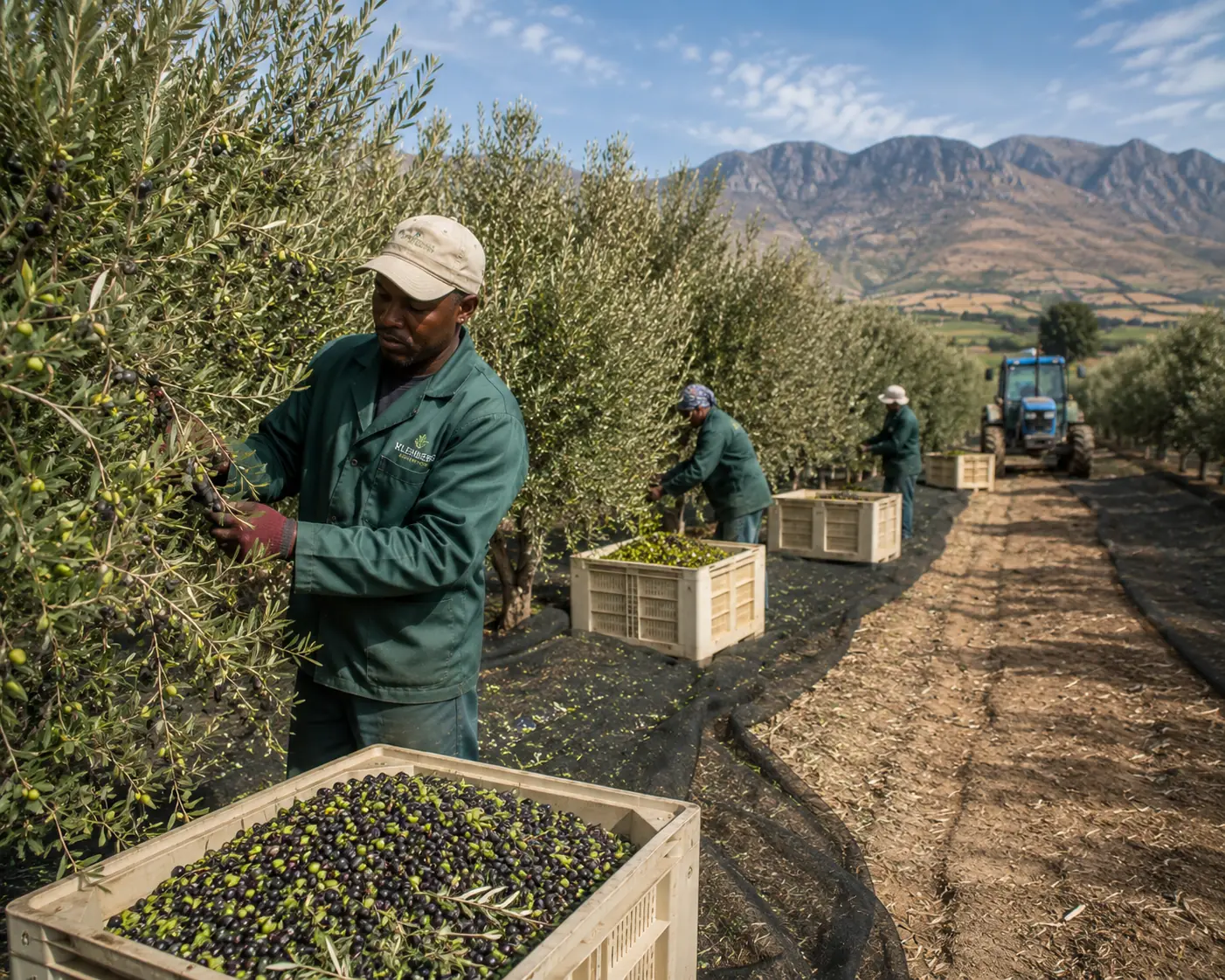
Olive variety selection determines whether your orchard is primarily for oil production or table olives, these markets have different variety requirements, harvest timing, and processing infrastructure. Many South African farmers run mixed variety orchards targeting both markets, using dual-purpose varieties that can be harvested green for table olives and then left to ripen for oil.
| Variety | Origin | Primary Use | Oil Content | SA Region | Notes |
|---|---|---|---|---|---|
| Frantoio | Italy (Tuscany) | Oil | High (18–25%) | Western Cape, Northern Cape | Most widely planted SA oil variety; high polyphenol content; excellent quality oil |
| Leccino | Italy | Oil / Table | Moderate (14–18%) | Western Cape, Eastern Cape | Mild, buttery oil; good polliniser for Frantoio; earlier ripening |
| Mission | California (USA) | Oil / Table | Moderate–high (16–22%) | Most SA regions; drought tolerant | Most widely planted variety historically in SA; robust; heat tolerant; dual purpose |
| Kalamata | Greece | Table (premium) | Low (10–14%) | Western Cape, Klein Karoo | Most valuable table olive; distinctive almond shape; commands highest table olive prices |
| Manzanilla | Spain | Table (green) | Low–moderate (12–16%) | Western Cape, Northern Cape | Most popular green table olive globally; firm flesh; stuffing variety |
| Coratina | Italy (Puglia) | Oil (premium) | Very high (20–27%) | Western Cape highlands | Highest polyphenol content; peppery, robust oil; premium market positioning |
| Arbequina | Spain (Catalonia) | Oil | Moderate (16–20%) | Most SA regions | Self-fertile; excellent for high-density orchards; mild, fruity oil |
For new South African olive farmers, a Frantoio + Leccino pairing is the most widely recommended oil production combination, with Manzanilla or Kalamata added if you want a table olive revenue stream. Arbequina is increasingly popular for super-high-density (SHD) plantings, a mechanised production system rapidly gaining popularity in SA that allows mechanical harvesting and greatly reduces labour costs.
Climate and Soil Requirements for South African Olive Farming
🌡️ Climate, The Most Critical Factor
Olive trees require a specific climate to produce commercially: hot, dry summers combined with cool winters that provide a vernalisation (chilling) period to trigger flowering. This Mediterranean-type climate (hot dry season + cool wet season) is exactly what the Western Cape provides. The key climate parameters are:
- Chilling hours: Most varieties require 200–600 chilling hours (temperatures below 7°C) per year to flower adequately. Insufficient chilling results in poor fruit set and reduced yields. The Western Cape's Swartland, Breede River Valley, Olifants River Valley, and Klein Karoo all provide adequate chilling. Lower-altitude coastal areas (Cape Peninsula, Garden Route coast) are borderline.
- Summer heat: Olives need warm to hot dry summers (25–35°C) for good fruit development and oil accumulation. South Africa's summer olive-growing regions meet this requirement easily.
- Frost: Established olive trees are moderately frost-tolerant (can withstand −7 to −10°C for short periods), but young trees in their first 2–3 years must be protected from hard frost. Flower buds in spring are frost-sensitive.
- Wind: Strong, drying summer winds reduce yields. Windbreaks are standard in the more exposed production areas of the Northern Cape and Breede River Valley.
Soil
Olives are tolerant of poor, shallow, rocky, and saline soils, in fact, they often produce their finest oil from stressed, low-fertility conditions (similar to wine grapes). However, they are absolutely intolerant of waterlogging. The ideal olive soil is well-drained, sandy to loamy, with a pH of 5.5–8.5. Deep, fertile, moist soils promote excessive vegetative growth at the expense of fruit production and oil quality. Many of the best South African olive oil orchards are planted on hillside or mountain footslope positions with shallow, stony soils and excellent natural drainage.
Establishing Your Olive Orchard
📐 Planting Density, Traditional vs High Density vs Super High Density
South African olive farmers choose from three main planting systems, each with fundamentally different economics and management requirements:
| System | Spacing | Trees/ha | Harvesting Method | Capital Cost | First Full Production |
|---|---|---|---|---|---|
| Traditional | 7m × 7m or wider | 100–200 | Manual or mechanical shaking | Low | 8–12 years |
| High Density (HD) | 5m × 3m or 6m × 4m | 400–700 | Straddle harvester or manual | Moderate | 5–7 years |
| Super High Density (SHD) | 4m × 1.5m or 3.5m × 1.5m | 1,500–2,500 | Grape-harvester mechanical | Very high | 3–4 years |
Super high density (SHD) olive orchards (pioneered in Spain and now widely adopted in South Africa, Australia, Chile, and Argentina) allow fully mechanised harvesting, dramatically lower labour costs, and faster payback on the establishment investment. The trade-off is high establishment cost (R60,000–R120,000/ha for SHD versus R15,000–R30,000/ha for traditional) and the fact that SHD systems require specific varieties suited to the hedge-row architecture (Arbequina, Arbosana, Koroneiki) and specific mechanical harvesters. In South Africa, SHD adoption has accelerated significantly in the Olifants River Valley and Breede River Valley regions where labour costs and availability are key operational constraints.
Olive Orchard Management in South Africa
Irrigation
While olives are drought-tolerant once established, supplementary drip irrigation is strongly recommended for commercial South African orchards. Unirrigated olives produce lower and more variable yields, particularly in the Western Cape's dry summers and in the Northern Cape. Critical irrigation periods are: flowering and fruit set (October–November), pit hardening (January), and oil accumulation (February–April). Total seasonal water requirement for a commercial oil olive orchard under South African conditions is typically 400–700mm per year. Deficit irrigation (applying less than full crop water requirement while avoiding severe stress) is a widely used approach that saves water while maintaining oil quality. See our irrigation systems guide for drip system specifications.
✂️ Pruning
Olive pruning has two objectives: maintaining tree size and shape for harvesting efficiency, and ensuring consistent annual bearing. Olives bear fruit on the previous year's growth. This means removing a portion of fruited wood after each harvest encourages strong new shoot development that will bear next year's crop. Annual or biennial pruning is standard in South African commercial orchards. In SHD systems, mechanical "hedging" with a tractor-mounted cutter bar replaces hand pruning, dramatically reducing labour. Traditional orchards are hand-pruned between May and July (post-harvest, pre-spring flush).
Cover Crops and Weed Management
Floor management in South African olive orchards typically involves a combination of permanent grass or legume cover crops in the drive rows (inter-rows) and herbicide or mechanical control in the under-tree area. Cover crops reduce erosion, improve soil organic matter, and moderate soil temperatures. Weed control under the tree canopy prevents competition for water and nutrients, particularly important in the establishment phase when young trees have limited root systems.
Olive Oil and Table Olive Processing
🫒 Extra Virgin Olive Oil Production
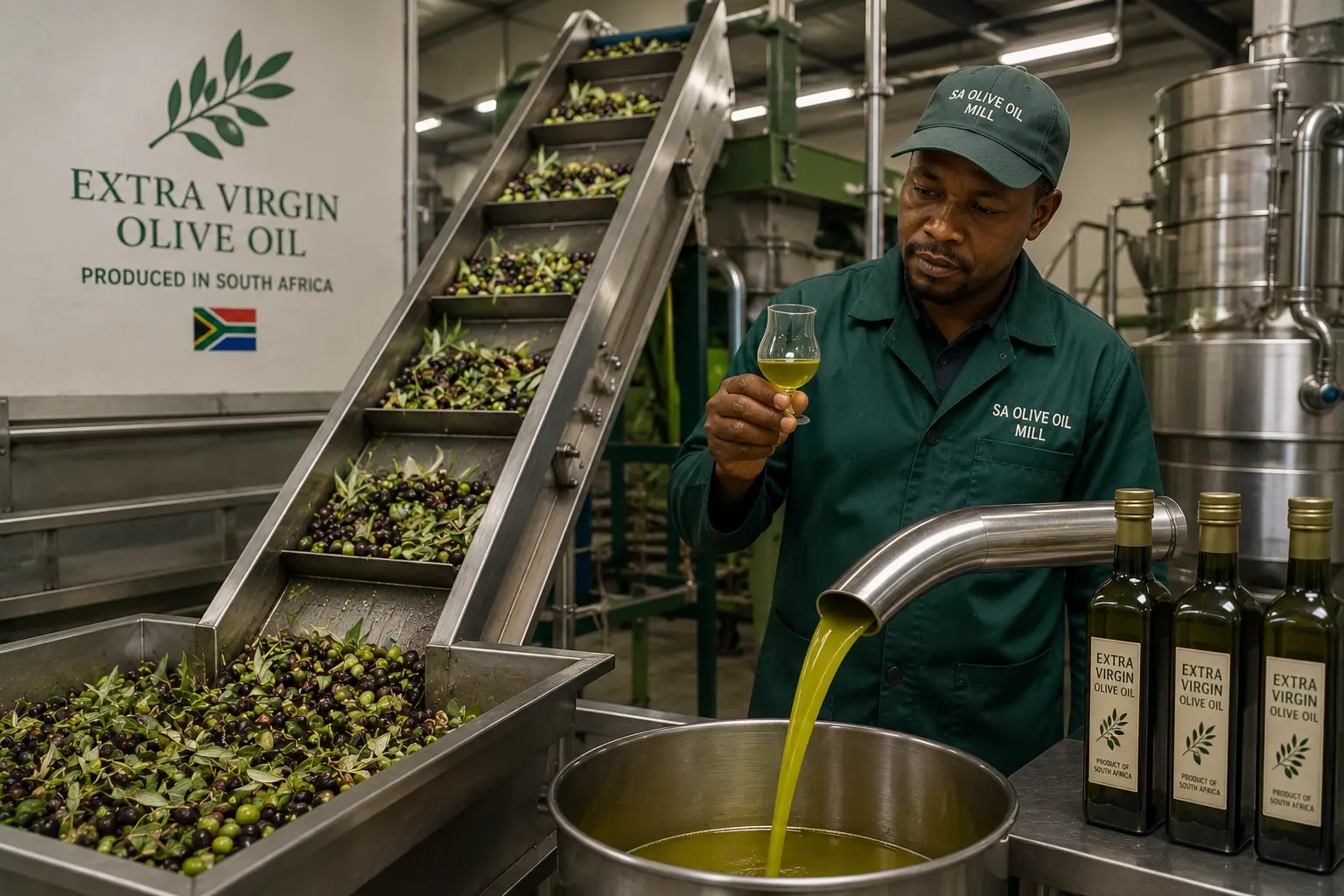
Extra virgin olive oil (EVOO) is produced by cold-pressing or centrifugal extraction of freshly harvested olives without heat or chemical processing. The critical quality determinants are:
- Time from harvest to milling: Olives must reach the mill within 24 hours of harvest, ideally within 6–8 hours. Every hour of delay increases free fatty acid content and reduces oil quality. This means having a mill either on-farm or within close proximity.
- Harvest timing: The ideal harvest window for premium EVOO is when olives are transitioning from green to purple-black ("turning"), at this stage, oil content is near maximum while polyphenol content (which determines flavour intensity and health properties) is still high. Early harvest (fully green olives) gives robust, peppery, high-polyphenol oil; late harvest (fully black) gives milder, fruitier oil with lower polyphenol content but higher oil volume.
- Processing temperature: Cold extraction (below 27°C) preserves volatile aroma compounds and polyphenols. Any heat above 27°C disqualifies the oil from EVOO certification.
South African olive oil mills range from small estate mills processing 500kg–5 tonnes per day to commercial central mills handling multiple farms' production. A small two-phase decanter mill (centrifugal extraction) capable of processing 1 tonne of olives per hour costs R350,000–R700,000. Many smaller SA producers use toll-milling arrangements at commercial mills to avoid this capital investment initially.
🫙 Table Olive Processing
Fresh olives are intensely bitter due to oleuropein and cannot be eaten directly from the tree. Table olive processing removes this bitterness through one of three methods widely used in SA:
- Lye (sodium hydroxide) curing: The fastest method, olives are soaked in dilute lye solution which breaks down oleuropein, then washed and brined. Produces the classic "Spanish green" style olive.
- Water curing: Olives are soaked in water, changed daily for 2–6 weeks until bitterness reduces. Natural, slow process popular among artisan and organic producers.
- Brine fermentation: Olives are placed directly into brine (salt water solution) where natural lactic acid fermentation over 3–12 months removes bitterness. Produces complex, fermented flavours typical of Kalamata-style olives. Most popular in SA for premium artisan production.
⚠️ Alternation (biennial bearing): Olive trees naturally tend towards alternate-year bearing, a heavy crop one year followed by a light crop the next. This is among the most challenging management issues in South African olive farming. Heavy pruning after a bumper year, strategic irrigation management to avoid excessive fruit load, and nutrition management are all used to moderate alternation and achieve more consistent annual production. Discuss a management strategy with an olive agronomist before your first harvest season.