Where Can Hops Be Grown in South Africa?
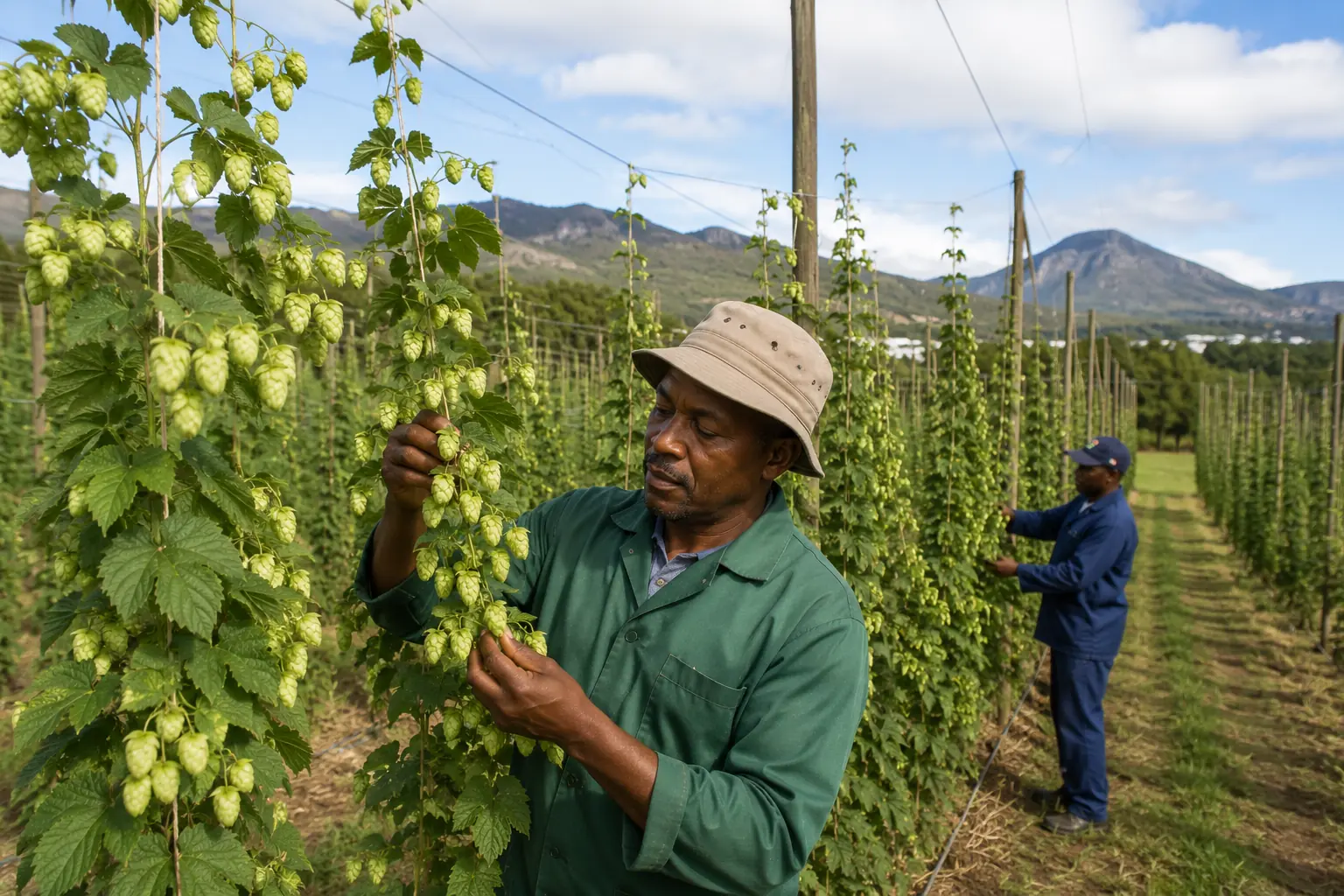
Hops are a temperate-climate crop with specific requirements that limit where they can be successfully grown in South Africa. Understanding these requirements before investing in a hop yard is essential.
Chilling Requirement
Hops require 1 000–1 500 chilling hours (hours below 7°C) during winter dormancy to break bud dormancy and produce vigorous spring growth. In South Africa, only the cooler, higher-rainfall regions of the Western Cape (George, Mossel Bay hinterland, Swartberg foothills) and the KwaZulu-Natal Midlands (above 1 000m altitude, Nottingham Road, Underberg, Mooi River) consistently provide adequate winter chilling for hops.
The Highveld (Gauteng, Free State) receives adequate winter chilling in most years but the harsh frost, hot dry summers, and limited rainfall are challenging for hops. The George region remains the most reliable SA hop production area because it combines adequate chilling with mild summers and reliable rainfall from the Outeniqua Mountains.
Summer Requirements
Hops are photoperiod-sensitive, they begin cone formation in response to decreasing day length, typically initiating around the summer solstice in South Africa (December in the Southern Hemisphere). They require warm but not excessively hot summers for vegetative growth and cone development. Temperatures consistently above 35°C during cone filling reduce quality and yield. The George area's moderated coastal climate keeps summer temperatures in the ideal 18–28°C range for most of the growing season.
In the Southern Hemisphere, SA hop bines are planted in spring (September–October), grow vigorously through summer (November–March), and cone development peaks in February–March. Harvest occurs in February–March, which is significantly earlier than Northern Hemisphere harvest (August–September), giving SA-grown hops a unique early market access window in the global trade.
SA Hop Varieties: What Grows Well Locally
Variety selection for South African hops must balance climate adaptation, alpha acid content (bitterness), aroma profile, and market demand from the SA craft brewing community. Both Northern Hemisphere varieties adapted to local conditions and emerging SA-developed varieties are in production:
Hop Yard Infrastructure: The Biggest Investment in SA Hops
The dominant cost and commitment in establishing a hop yard is the trellis infrastructure, and it is substantial. Hops grow as annual bines (climbing stems) on a permanent perennial root system, and they need tall, strong trellising to support their vigorous growth of 6–8 metres in a single season.
Standard Trellis System
The industry standard for hop yards in South Africa (and globally) is the high-wire trellis: treated wooden poles or steel posts set 5.5–6m high at 6m × 2.7m spacing, with a grid of horizontal galvanised wires strung between the pole tops. From this overhead wire grid, individual coir or sisal strings are hung to each planting position for bines to climb. After harvest, the strings are removed and replaced the following spring.
Establishing a hop yard trellis in South Africa costs approximately R150 000–R280 000 per hectare for poles, wires, and installation, before any rhizomes, irrigation, or other inputs. This is the primary reason hop farming is not suitable for farmers without significant capital or access to agricultural finance. Amortised over the 20+ year productive life of a well-managed hop yard, however, the per-year trellis cost is quite modest.
Row orientation in SA hop yards should be north–south to maximise solar exposure on both sides of the bine rows throughout the growing season. Row spacing of 2.7m with in-row plant spacing of 0.9–1.1m is standard for most varieties, giving approximately 4 000 plants per hectare.
Irrigation
Drip irrigation is standard in SA commercial hop yards. Although the George area receives significant annual rainfall (700–900mm), it is not uniformly distributed across the hop season, and supplementary irrigation during dry spells in the growing season is essential for consistent yield and quality. Hop roots extend deep (1.5–2m) but the feeder roots are shallow, maintaining consistent soil moisture in the top 600mm is the primary irrigation management objective.
Growing and Managing Hops Through the SA Season
Hop farming in South Africa follows a distinct seasonal cycle driven by photoperiod and temperature. Understanding this cycle is essential for managing bine training, nutrition, disease, and harvest timing correctly.
Spring: Bud Break and Training (September–October)
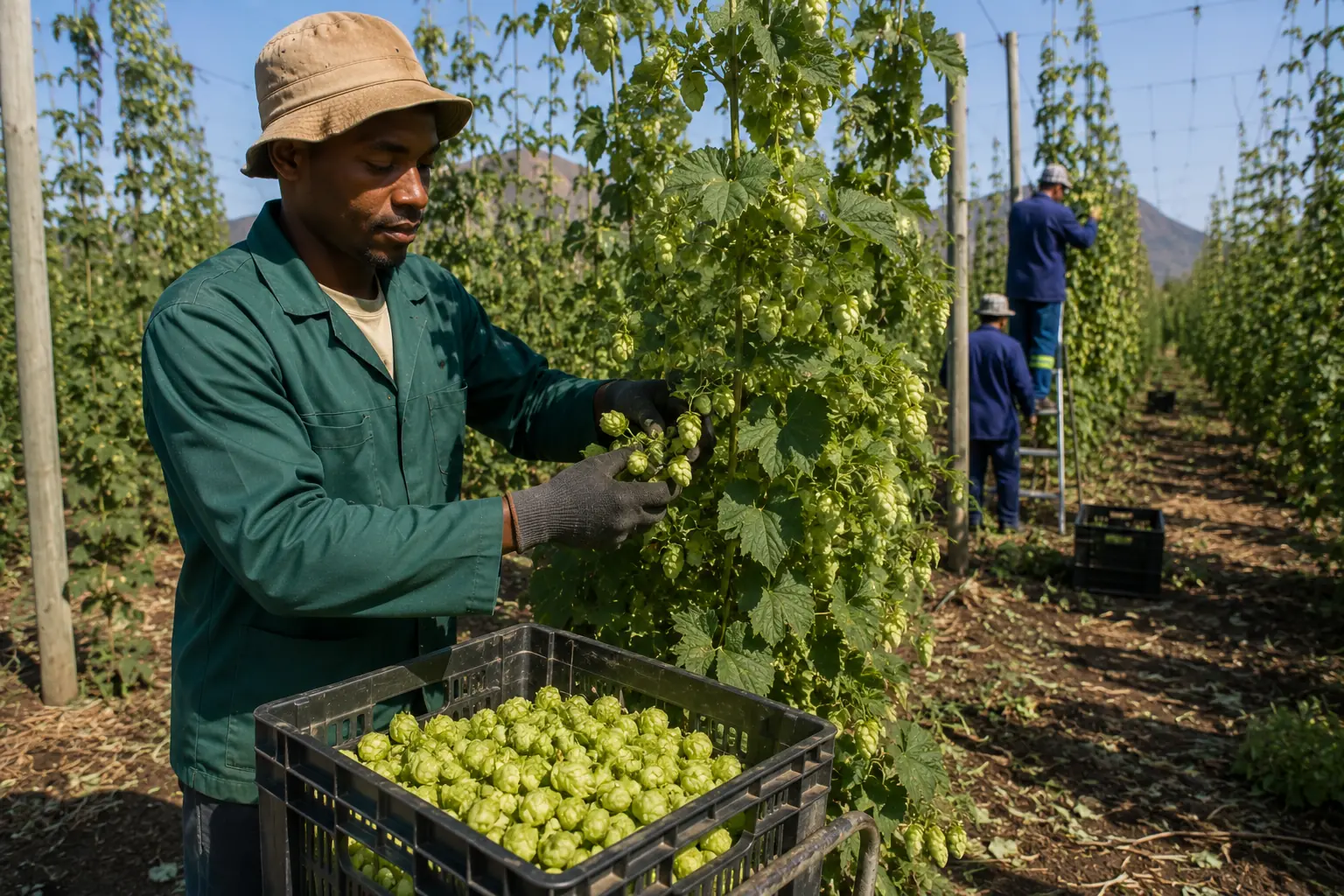
As soil temperatures rise in spring, hop crowns break dormancy and send up multiple shoots. The grower selects 2–3 strongest shoots per plant and trains them upward onto the hanging coir strings by hand, among South Africa's most labour-intensive tasks in hop production. Shoots not selected for training are removed (rubbed off) to concentrate the plant's energy. This training process typically takes 2–3 passes through the hop yard over 3–4 weeks as bines begin climbing.
Summer: Vegetative Growth and Cone Initiation (November–January)
Hops grow explosively in SA summer, a well-nourished bine can extend by 20–30cm per day in peak growth conditions, reaching the top wire within 6–8 weeks of training. Nutrition management during this phase is critical: nitrogen drives vegetative growth, while balanced potassium and phosphorus support subsequent cone development. Irrigation management during summer dry spells prevents stress that can trigger early senescence and reduced cone quality.
Cone initiation begins around the December solstice as day length starts decreasing. By January, small burr clusters (the precursor to hop cones) are visible in the leaf axils throughout the bine. This is a critical time, any stress (water deficit, nutrient deficiency, disease) during cone initiation reduces the final cone count and yield potential.
Harvest (February–March)
SA hop harvest is consistently among the most time-sensitive and labour-intensive periods in specialty crop farming. Hops must be harvested at peak maturity, when lupulin (the yellow aromatic powder in the cone base) is fully developed and alpha acid content is at maximum, but before cones begin to deteriorate, brown, or shatter. The harvest window is typically just 10–14 days per variety.
Commercial SA hop farms use mechanical harvesters, specialist machines that strip the cones from the bine. The bines are cut at the base and top, fed into the harvester, and cones are separated from leaves and bine material. Freshly harvested cones contain 75–80% moisture and must be kiln-dried to 8–10% moisture within 24 hours of harvest to preserve alpha acids, aroma, and prevent mould. A hop kiln is therefore essential infrastructure for commercial SA hop production.
The SA Craft Beer Market: Selling Your Hops
South Africa's craft beer sector has grown from fewer than 50 breweries in 2010 to over 1 500 registered craft producers by 2025–2026, making it one of the rapidly growing craft beer markets in Africa. This growth directly benefits SA hop farmers, craft brewers increasingly seek locally grown, fresh, distinctive hops that can differentiate their beers and connect them to SA's agricultural heritage.
The primary market opportunities for SA hop farmers are:
- Fresh wet hop sales: Freshly harvested (undried) hops sold directly to breweries within 24–48 hours of harvest. Wet hops deliver unique fresh aromas impossible to replicate with dried hops and are highly prized by craft brewers for seasonal "fresh hop" beers. Premium prices, but a very narrow time window and requires proximity to breweries.
- Dried whole hops: Kiln-dried and baled hops sold to breweries, homebrew shops, and hop merchants. The standard commercial product. Can be stored in sealed, cold storage for 12–18 months. Most SA commercial and craft breweries use dried whole hops.
- Pelletised hops: Dried hops milled and compressed into pel— more stable, easier to store, and more consistent in use. Requires pelletising equipment (usually contracted out) and a consistent quality supply. Used by larger SA craft and commercial brewers.
- Homebrew retail: Small quantities of dried hops sold to the large and growing SA homebrewing community through homebrew shops, online stores, and direct sales. Higher margin per kg than commercial sales but lower volumes.
Yield: 1 200–2 500 kg of dried hops per hectare (variety and season dependent) | Price: R180–R350/kg dried for craft market; R120–R200/kg wholesale | Gross income: R216 000–R875 000/ha at full production | Main input costs: labour (training, harvest), irrigation, fertiliser, crop protection, kiln energy | Trellis establishment: R150 000–R280 000/ha (amortised over 20+ years) | Break-even: typically year 3–4 post-establishment
Pests and Diseases in South African Hop Yards
Hops are susceptible to several specific pests and diseases that require active management in SA conditions:
- Downy mildew (Pseudoperonospora humuli): The most serious fungal disease in SA hop production. Causes systemic infection from infected crowns and sporadic foliar infections. Infected crowns produce stunted, distorted "spike" shoots. Managed through removal of infected material, fungicide programmes from bud break, and selection of resistant varieties.
- Powdery mildew (Podosphaera macularis): Causes white powdery growth on leaves and cones, reducing cone quality and yield. Managed through fungicide rotations, good canopy ventilation, and resistant varieties.
- Two-spotted spider mite (Tetranychus urticae): A serious pest in warm SA summers. Heavy infestations cause bronzing and defoliation, reducing yield and cone quality. Acaricide applications and biological controls (predatory mites) are used. Mite populations can build explosively in hot dry conditions.
- Hop aphid (Phorodon humuli): Colonises bines and can transmit viruses. Managed through aphicide applications at early infestation and monitoring for virus symptoms. Hop aphid pressure in SA is generally lower than in Northern Hemisphere hop regions.