Where Can You Grow Sugarcane in South Africa?
Sugarcane requires a warm, humid climate with high rainfall or reliable irrigation. It is primarily grown in two main production zones in South Africa:
- KwaZulu-Natal (KZN): The North Coast (Eshowe, Empangeni, Richards Bay area), South Coast (Umkomaas, Umzinto, Sezela), Midlands (Midmar, Eston) and Zululand (Pongola, Hluhluwe) produce the bulk of South Africa's cane. KZN accounts for roughly 85% of national production.
- Mpumalanga Lowveld: The Komatipoort, Malelane, Nkomazi and Piet Retief areas in Mpumalanga also support significant sugarcane production under irrigated conditions, with the Malalane and Komati mills processing this cane.
Outside of these two zones, small-scale sugarcane is also grown in parts of Limpopo and the Eastern Cape, though these are not commercially milled in most cases.
Climate & Soil Requirements
Climate
Sugarcane thrives in conditions that match the KZN coastal belt: warm temperatures between 22°C and 38°C, annual rainfall of 1,000–1,500mm (well-distributed or supplemented with irrigation), and a frost-free environment. The crop requires a dry, cooler ripening period prior to harvest to maximise sucrose content, which is why the subtropical coastal and midland zones of KZN are ideal.
In the Mpumalanga lowveld, irrigation compensates for seasonal dryness, enabling year-round production under controlled conditions. Frost is the most significant climate risk for sugarcane; even a light frost can damage or kill young shoots (ratoons), which is why production is limited to frost-free zones.
Soil Requirements
Sugarcane performs well in a wide range of soils, but ideal conditions include:
- Deep, well-drained soils with at least 1.2m depth to support the root system
- pH (KCl) between 5.0 and 6.5, slightly acidic to near-neutral
- Good water-holding capacity, loam or clay-loam soils are preferred
- Adequate organic matter, sugarcane improves soil organic matter over time when trash (leaf mulch) is retained after harvest
Sandy soils require more frequent irrigation and fertilisation. Waterlogged soils can cause root rot and should be drained before planting. A soil analysis from a certified lab is highly recommended before planting for the first time, contact our fertilizer guide for information on soil testing in South Africa.
💡 Key Point: Soil pH
If your soil pH (KCl) is below 5.0, apply agricultural lime at least 6 months before planting. Sugarcane is sensitive to aluminium toxicity in very acidic soils, which limits root development and nutrient uptake. Your nearest SASA extension officer can advise on lime rates for your specific soil type.
Sugarcane Varieties in South Africa
Variety selection is critical for yield, disease resistance, and sucrose content. South Africa uses varieties developed by the South African Sugarcane Research Institute (SASRI), labelled with the prefix N (for Natal) followed by numbers. Below are the most widely planted varieties across different production zones:
Always consult the SASRI variety recommendation maps for your specific area before purchasing seed cane, different zones have different optimal varieties. Seed cane (billets) can be purchased from registered nurseries, other growers, or through SASA's smallholder support programmes.
Land Preparation for Sugarcane
Proper land preparation is foundational to a successful sugarcane crop. This is especially true for plant crops (first planting), as the deep root system requires uncompacted, well-structured soil. Steps include:
- Clear the land, Remove existing vegetation, stumps and rocks. On previously cultivated fields, remove old ratoon stools.
- Deep rip or subsoil, Use a subsoiler or deep ripper to break hardpan layers at 0.6–0.9m depth. This is critical for root penetration.
- Lime application, If soil pH is below 5.0, apply agricultural lime and incorporate by ploughing. Do this at least 3–6 months before planting.
- Primary tillage, Mouldboard ploughing or heavy discing to incorporate lime and organic matter.
- Secondary tillage, Fine the seedbed with additional discing or cultivation to achieve a fine, firm tilth.
- Lay out furrows, Furrows are typically 1.5m apart (row spacing), at a depth of 30–40cm. Row direction should follow the land contour to minimise erosion on sloping land.
For smallholder plots without access to large machinery, labour-intensive manual preparation with hand tools and rented tillage equipment is common. SASA and the Department of Agriculture have machinery hire schemes for qualifying smallholder growers, see our farming grants and support page for more details.
Planting Sugarcane
Timing
In KZN, the main planting window is August to November (spring to early summer), when soil temperatures are rising and moisture is adequate. A second window exists in March to April (autumn) in some areas. Avoid planting during peak summer (December–January) heat or during dry spells without irrigation.
In Mpumalanga, planting is typically done from September to November under irrigation.
Planting Method
Sugarcane is propagated vegetatively using seed cane billets, sections of mature stalks with viable buds (nodes). Each billet is 3–4 nodes long (approximately 30–40cm). The planting process:
- Cut seed cane into bilof 3–4 nodes using a sharp panga or mechanical cutter.
- Place bilin the furrow end-to-end or in a single layer, overlapping slightly.
- Cover with 5–8cm of soil, do not bury too deep, as emergence is slowed.
- In dry conditions, irrigate immediately after planting to ensure soil-to-billet contact and moisture for germination.
Planting rate is typically 8–10 tonnes of seed cane per hectare. Ratoon crops (subsequent harvests from the original root system) are managed differently and do not require replanting, see the harvesting section below.
⚠️ Disease Caution: Seed Cane Health
Always use certified, disease-free seed cane. Ratoon stunting disease (RSD) and sugarcane smut are spread through infected cane. Hot water treatment of seed cane (50°C for 2 hours) is recommended if the source is uncertain. Ask your SASA extension officer for advice.
Fertilisation & Nutrition
Sugarcane is a heavy feeder, particularly of nitrogen (N), phosphorus (P), and potassium (K). A soil and leaf analysis programme, coordinated through SASRI or private agronomy services, will give you the most accurate recommendations for your specific plot. General guidelines for plant crops:
| Nutrient | Plant Crop Rate (kg/ha) | Ratoon Rate (kg/ha) | Application Timing |
|---|
| Nitrogen (N) | 120–160 | 100–140 | Split: 1/3 at planting, 2/3 at 3 months |
| Phosphorus (P) | 30–60 | 20–30 | All at planting (in-furrow) |
| Potassium (K) | 100–150 | 80–120 | Split applications |
| Silicon (Si) | As per soil analysis | As per analysis | Slag or wollastonite; KZN specific |
Apply fertiliser in bands alongside (not on) the row to avoid root burn. Filter cake (a byproduct from sugar mills) is an excellent organic amendment for sugarcane, providing nitrogen, organic matter and improving soil structure. Most KZN mills offer filter cake to registered growers at low or no cost. Explore our soil and fertilizer guide for additional options.
Irrigation for Sugarcane
In the high-rainfall coastal belt of KZN (above 1,000mm/year), sugarcane can be grown as a dryland crop. However, in the midlands, Zululand, and all of Mpumalanga, irrigation is essential. Common irrigation systems used in SA sugarcane:
- Overhead sprinklers: Most common in KZN smallholder and midlands blocks. Lower capital cost but higher water use.
- Drip irrigation: Highly efficient; increasingly used in Mpumalanga and on water-scarce farms. Higher setup cost but significant water savings.
- Dragline systems: Mobile overhead systems used on larger commercial farms in Zululand.
Sugarcane requires approximately 1,200–1,500mm of water per season (rainfall + irrigation combined). Water scheduling based on evapotranspiration data is recommended. The SASRI and ARC have free scheduling tools for registered growers. Visit our irrigation systems guide for more detail on system selection and setup costs in South Africa.
Weed, Pest & Disease Management
Weeds
Weed control is critical in the first 4 months after planting before canopy closure. Both pre-emergent herbicides (applied at planting) and post-emergent selective herbicides are used. The most problematic weeds in SA sugarcane include guinea grass (Megathyrsus maximus), nutgrass (Cyperus rotundus), and lantana. Retaining harvest trash (leaf mulch) is a effective cultural weed control method for ratoon crops.
Key Pests
- Eldana (Eldana saccharina): South Africa's most economically destructive sugarcane borer. Larvae bore into stalks, reducing sucrose content and causing stalk breakage. Managed through SASRI's Eldana management programme.
- African sugarcane borer (Sesamia calamistis): Attacks young shoots and causes dead hearts. More common in certain coastal areas.
- Termites: Destroy seed cane and plant crop stools, particularly in dry Mpumalanga conditions. Chemical treatment at planting recommended.
- Nematodes: Root-feeding nematodes reduce plant vigour. Soil sampling before planting will indicate nematode pressure levels.
Key Diseases
- Sugarcane smut (Sporisorium scitamineum): Produces a black whip from the growing point. Plant smut-resistant varieties and remove infected plants immediately.
- Ratoon stunting disease (RSD): Bacterial disease spread through infected seed cane and unsterilised cutting equipment. Use hot water treated seed and sterilise tools between rows.
- Yellow leaf disease: Phytoplasma disease causing yellowing. Spread by aphids. Plant resistant varieties where available.
Visit our full pest control guide for integrated pest management strategies applicable to sugarcane and other crops.
Harvesting Sugarcane in South Africa
When to Harvest
Plant crops (first season) typically mature in 12–18 months after planting. Ratoon crops (subsequent crops from the same root system) mature in 10–14 months after the previous harvest. The optimal harvest time is determined by sucrose content (measured as Recoverable Value or RV), which peaks during the dry season and cool nights, typically May to November in KZN.
Your mill will issue a harvest schedule based on RV sampling from your block. Cutting before your scheduled window reduces your RV, and therefore your payment. Cutting too late risks field fires, pest damage, and over-ripening losses.
Harvesting Methods
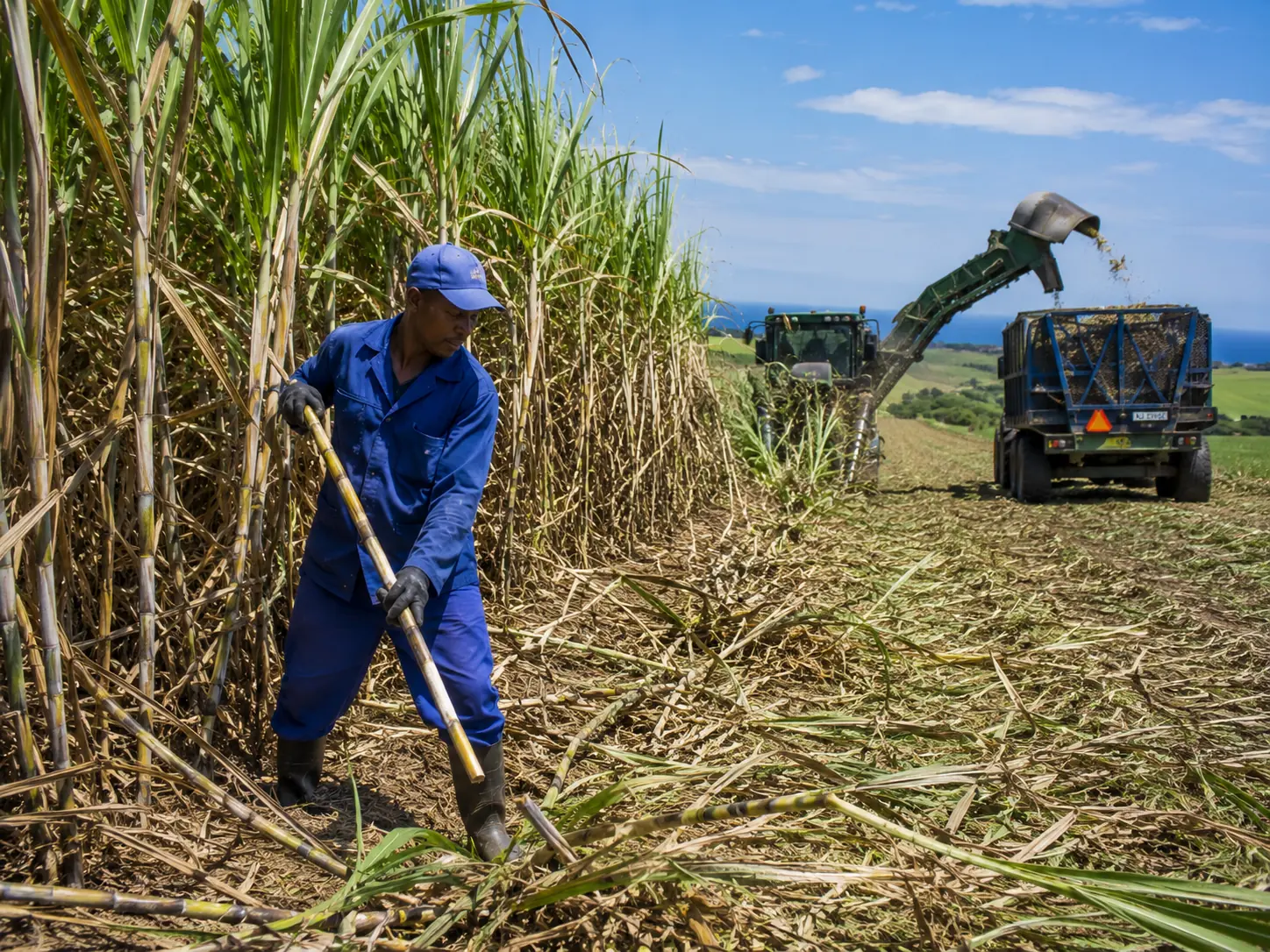
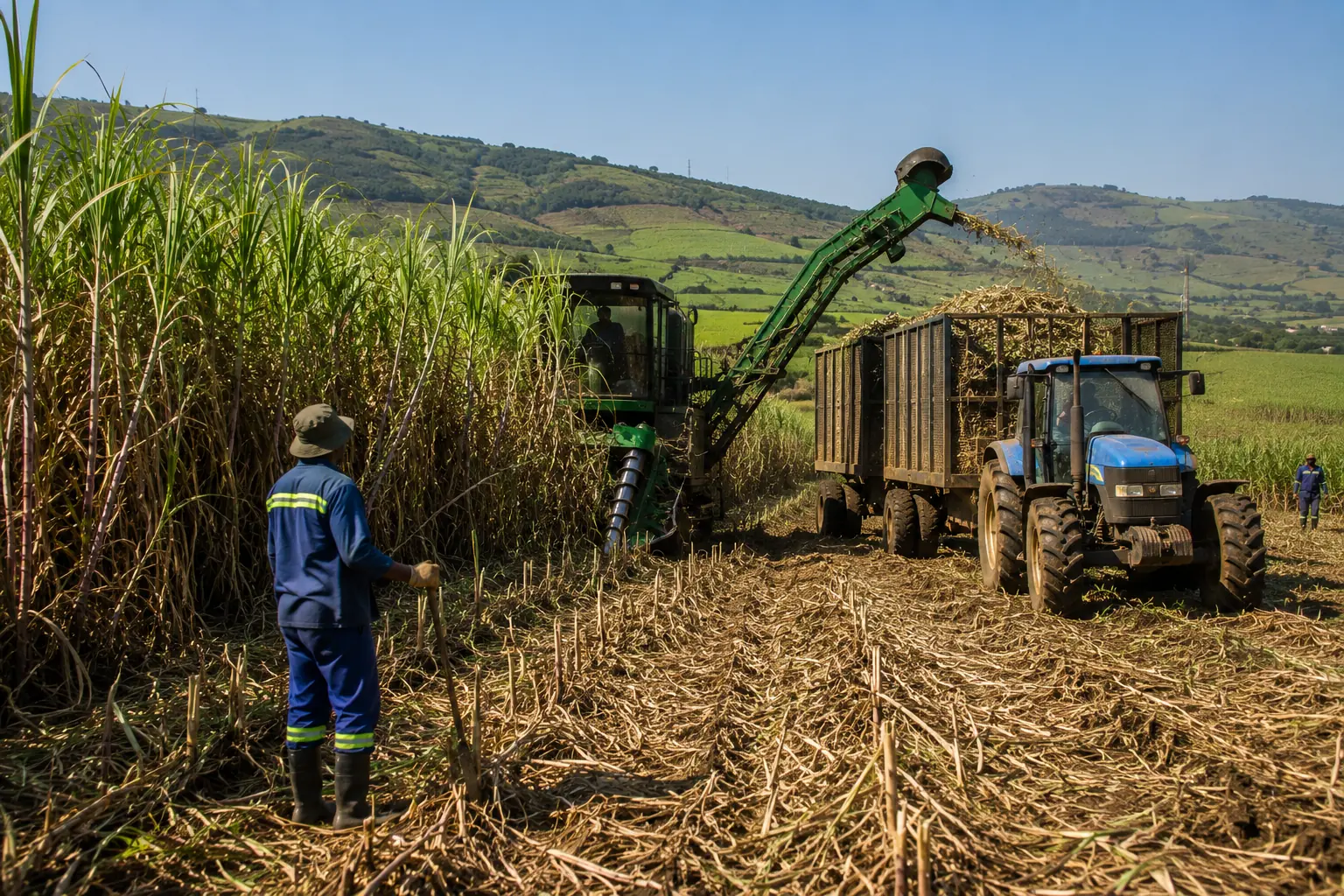
- Manual harvesting (green cane): Used by most smallholders. Pangas are used to cut stalks at ground level. Labour-intensive but lower capital cost. Green cane harvesting retains trash for mulch.
- Burning before harvest: Traditionally used to reduce trash and make manual cutting easier. This practice is increasingly restricted due to air quality regulations and loss of organic matter. Check your local municipality's regulations.
- Mechanical harvesting: Chopper harvesters cut, chop and load cane into trailers in one pass. Standard on commercial farms above 50 hectares. Available on a contract basis for smaller growers through mill-linked contractors.
Ratooning
After the first harvest, the root stools remain in the ground and produce the next crop. This is called a ratoon crop. Well-managed ratoon crops can continue for 5–7 years (5–7 ratoons) before replanting is required. Ratoon management involves:
- Trash management, retain or chop harvest residue for mulch
- Ratoon cultivation, mechanical or chemical control of weeds in the inter-row
- Stool blasting or splitting, where ratoons become too wide
- Fertilisation adjustments, ratoon crops have different nitrogen demands than plant crops
Selling Sugarcane, Market Access in South Africa
All commercial sugarcane in South Africa is sold to one of 14 sugar mills operating under the South African Sugar Association (SASA) framework. Mills are linked to specific growing areas, you must register with the mill closest to your farm. The main mills include Tongaat Hulett (north and south KZN coast), Illovo Sugar (midlands and Mpumalanga), and UCL Company in the midlands.
Pricing is based on the Recoverable Value (RV) system, a measurement of the sucrose and fibre in your cane at delivery. The RV price per tonne is published by SASA on a seasonal basis. Payments are typically made monthly throughout the season, with a final payment at season end.
Smallholder registration: To sell to a mill, you must register with SASA as a grower. Smallholder growers may qualify for support through the SASA Smallholder Development Programme, which provides access to inputs, extension services, and transport assistance. Check farming grants for details on CASP and other government support available to sugarcane growers.
📊 Profitability Snapshot
At average yields of 60–80 tonnes per hectare and an RV price of around R200–R280 per tonne RV (approximate 2025 values), a well-managed hectare of sugarcane in KZN can generate R12,000–R22,000 gross per season, with input costs typically R6,000–R10,000/ha depending on irrigation and labour intensity. Always budget conservatively and consult current SASA pricing before making investment decisions.
Sugarcane as a Smallholder Enterprise
For smallholder farmers in KZN and Mpumalanga, sugarcane offers a unique combination of advantages: it is a perennial crop (reducing replanting costs), it has a guaranteed buyer (your mill), and it generates predictable income through the SASA pricing system. The crop also improves soil health through trash mulching and root biomass over time.
Key success factors for smallholder sugarcane farming include access to irrigation, good soil management, timely fertilisation, and strong extension support. The government's Comprehensive Agricultural Support Programme (CASP) and Ilima/Letsema programme have funded numerous smallholder sugarcane projects in KZN. Contact your local Department of Agriculture, Land Reform and Rural Development (DALRRD) office or SASA directly for registration information.