Carrots are among the most widely consumed vegetables in South Africa and among South Africa's most rewarding crops for farmers who get the soil preparation right. Unlike many vegetables that can be grown in a range of soil types, carrots are highly specific in their soil requirements, and understanding this is the single biggest factor that separates profitable carrot farmers from those who struggle with forked, stunted, or misshapen roots.
South Africa's carrot industry is substantial and growing. The Hartswater area in the Northern Cape is the country's single largest carrot-producing region, supplying fresh produce markets across the country throughout the year thanks to its ideal sandy loam soils and reliable irrigation from the Vaal-Hartz irrigation scheme. Other significant production areas include the Sandveld in the Western Cape, and parts of the Free State, Gauteng, and Mpumalanga where suitable sandy soils and irrigation infrastructure exist.
We cover everything you need to start or improve your carrot farming operation in South Africa, from selecting the right land and preparing the seedbed, through to harvesting, packing, and selling at fresh produce markets.
Why Grow Carrots in South Africa?
Carrots are a consistent performer in South Africa's fresh produce market. Consumer demand is year-round and stable, carrots are a staple ingredient in South African cooking across all income groups and cultures. Retail, catering, and processing (juice and frozen vegetable) demand all provide market avenues for carrot farmers at different quality and price points.
On the production side, carrots offer several attractive features for commercial farmers. They have a relatively short crop cycle of 100 to 130 days from seeding to harvest, enabling multiple crops per year on irrigated land. They are mechanically harvested with relative ease on suitable soils, keeping labour costs manageable at scale. And when managed well, carrots can return gross revenues of R40,000 to R80,000 per hectare per crop, depending on yields, quality, and prevailing market prices.
For smallholder and peri-urban farmers, baby carrots and niche organic carrot production for upmarket retailers and direct sales represent additional premium-price opportunities that require less land area but more intensive management.
Ideal Conditions for Carrot Farming
Temperature and Climate
Carrots are a cool-season vegetable. They grow best when daytime temperatures are between 16°C and 21°C and nighttime temperatures stay above 7°C. Root quality (particularly sweetness, colour intensity, and core size) is significantly improved by cool growing conditions. Hot temperatures above 28°C can cause pale or yellowish roots with large cores, and may promote bolting (premature flowering) in some cultivars. In South Africa's summer rainfall regions, this means carrot production is best timed from mid-summer into autumn and winter.
Soil Requirements
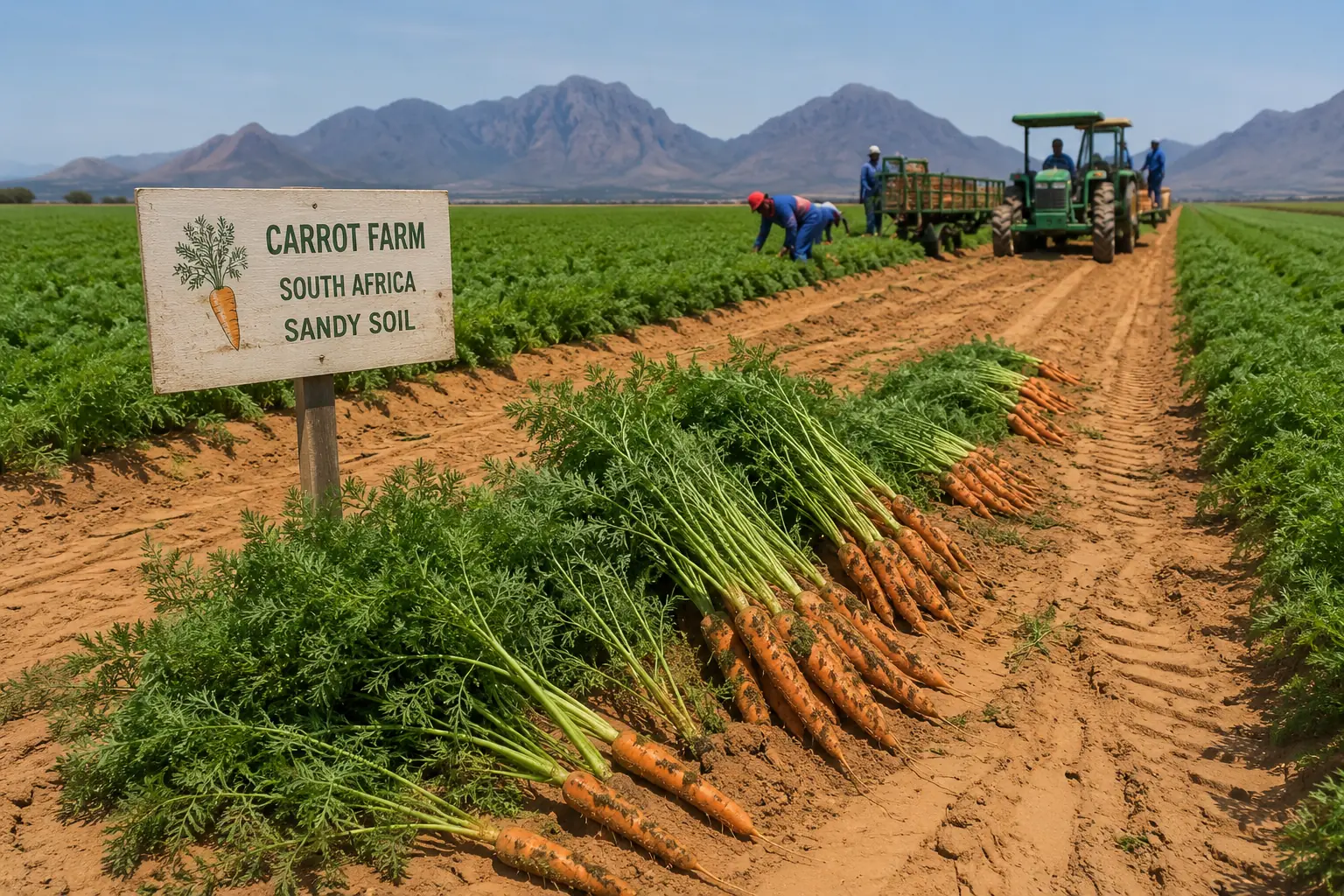
This is the critical point: carrots absolutely require deep, stone-free, loose sandy or sandy loam soils. The developing taproot grows downward through the soil profile, anything that physically impedes this growth causes forking, stunting, and unmarketable roots. Even a single stone or a shallow compaction layer can ruin root quality across an entire bed.
Ideal carrot soil has the following characteristics:
- Texture: Sandy loam to loamy sand, well-draining but moisture-retentive enough to sustain the crop between irrigations.
- Depth: At least 40–50 cm of loose, stone-free soil for standard carrot cultivars. For Nantes and Chantenay types, 30–40 cm is adequate. For long Imperator types, 50+ cm is required.
- pH: Slightly acidic to neutral, a soil pH of 6.0 to 6.8 is ideal.
- Organic matter: Moderate levels help with moisture retention and soil structure, but avoid fresh manure, which can cause root forking and hairy roots.
Clay soils, rocky soils, or soils with a tillage pan within 30 cm of the surface are poor choices for carrots. If your land has a clay subsoil, deep ripping before bed formation can help, but results are often disappointing compared to naturally sandy land.
Major Carrot Growing Regions in South Africa
Hartswater & Jan Kempdorp, Northern Cape
The Vaal-Hartz irrigation scheme in the Northern Cape is the cornerstone of South African commercial carrot production. The deep, alluvial sandy loam soils of the Harts River valley are almost perfectly suited to carrot production, and the reliable irrigation water supply from the scheme allows year-round production. The area's moderate climate and relatively low pest and disease pressure make it highly productive. Many of the large commercial carrot packhouses and cold storage facilities serving national retailers are based in or near Hartswater.
Sandveld, Western Cape
The Sandveld area of the Western Cape, encompassing towns like Vredenburg, Velddrif, and Piketberg, has deep coastal sandy soils well-suited to carrot production. The area benefits from the Western Cape's Mediterranean climate and access to irrigation water. Production here typically occurs in the cooler months from autumn through spring.
Other Regions
Localized carrot production also occurs in parts of the Eastern Cape, Free State (particularly around Petrus Steyn and Reitz), KwaZulu-Natal highlands, and in sandy areas of Mpumalanga near the escarpment. Farming in these areas is often focused on supplying local and regional fresh produce markets rather than national retail supply chains.
Cultivar Selection
South Africa's carrot market is dominated by Nantes-type cultivars, which produce cylindrical, blunt-tipped roots of 15–20 cm length that are preferred by consumers and pack well into retail bags. However, the right cultivar depends on your soil depth, target market, and production season.
Nantes Types
Nantes cultivars such as Nantes 2, Nantes Coreless, and several Dutch hybrid Nantes types are the workhorse of South African carrot production. They produce smooth, uniform, coreless roots with excellent eating quality. They are suited to most sandy soils with adequate depth and are widely accepted by fresh produce markets and retail buyers.
Chantenay Types
Chantenay carrots are shorter and broader than Nantes types, making them better suited to shallower or heavier soils where full Nantes development is difficult. They are used predominantly for processing (dicing, juicing) and baby carrot production.
Hybrid Cultivars
Modern F1 hybrid carrot cultivars from Dutch breeding companies (Bejo, Vilmorin, Clause) offer improved uniformity, disease tolerance (particularly resistance to Alternaria leaf blight), and yield potential over traditional open-pollinated varieties. Premium hybrids are standard practice in commercial production and are available through national seed suppliers.
Seedbed Preparation
Carrot seedbed preparation is among South Africa's most labour and machinery-intensive aspects of carrot farming, and among the most critical. The bed must be completely stone-free, deeply loosened, and have a fine, crumbly tilth at the surface for optimal germination and root development.
- Deep ripping or subsoiling: If compaction exists below 30 cm, rip to 50–60 cm depth before bed formation. This is particularly important on land that has been cultivated for many years.
- Primary tillage: Plough or rotary cultivate to 30–35 cm depth to turn soil and break up clods.
- Stone removal: On rocky soils, a stone separator (destoner) should be used to remove stones from the planting zone. Commercial carrot farmers in rocky areas consider a destoner essential equipment.
- Bed formation: Form raised planting beds 1–1.2 m wide with furrows between for irrigation and drainage. Raised beds improve drainage and make harvesting easier.
- Final tilth: Use a rotary hoe or bed former to create a fine, stone-free surface to a depth of 20–25 cm immediately before planting.
Planting Carrots
Carrot seeds are tiny and must be planted at a precise, shallow depth into a firm, moist seedbed. Erratic establishment is the most common cause of poor yields in smallholder carrot production, most often caused by poor seedbed preparation, incorrect seeding depth, or inadequate moisture during germination.
Seeding Rate and Spacing
Target a final plant population of 80–100 plants per square metre for fresh market Nantes types. This typically requires a seeding rate of 2–4 kg/ha of naked seed, or 1–1.5 kg/ha of pelleted seed (which is easier to place accurately). Seed is planted in rows 15–20 cm apart within the bed, at a within-row spacing of 5–6 cm, at a depth of 5–10 mm.
Germination
Carrot germination is slow and somewhat erratic compared to most vegetables, expect 10–21 days to full emergence depending on soil temperature. Germination is best at soil temperatures of 16–21°C. At higher or lower temperatures, germination rate drops significantly. The soil must be kept consistently moist (but not waterlogged) throughout the germination and early establishment period, allowing the seedbed to dry out before emergence is firmly among the most common causes of poor stands.
Light irrigation (sprinkler or drip) every 1–2 days during the germination period is standard practice on commercial operations.
Irrigation Management
Carrots require consistent, even soil moisture throughout their growing cycle. Both water deficit and waterlogging are harmful, water stress causes stunted, bitter, cracked, or poorly coloured roots, while waterlogging promotes root rots and off-flavours. Getting irrigation management right is a key factor in achieving premium quality and yields.
Drip irrigation is increasingly popular for commercial carrot production in South Africa. Sub-surface drip or surface drip tapes deliver water directly to the root zone, reduce disease pressure compared to overhead irrigation, and improve water use efficiency, critical in water-scarce South Africa. Sprinkler irrigation is commonly used for the germination and early establishment period before switching to drip for the growing season.
Total water requirement for a carrot crop in South Africa ranges from approximately 400–600 mm over the crop cycle, depending on season, location, and evapotranspiration rates. Consult your local Agri SA extension officer or irrigation specialist for a crop water requirement schedule suited to your specific area.
Fertilization
Carrots have moderate fertility requirements compared to some vegetables. Excessive nitrogen, particularly before root filling, promotes excessive leaf growth at the expense of root development and can cause forking and hairy roots. Potassium is very important for root quality, sugar accumulation, and colour intensity.
A typical carrot fertilization programme for South African commercial production (per hectare) would include:
- Basal application at planting: 300–400 kg/ha of a balanced compound fertilizer such as 2:3:4 (30) applied in the bed before seeding, incorporated to 15 cm depth.
- Nitrogen top-dressing: 50–70 kg N/ha in split applications at 4 weeks and 8 weeks after emergence, using LAN or urea.
- Potassium: If soil K levels are low, supplement with additional potassium chloride (KCl) at root filling (approximately 10–12 weeks after emergence).
Always base fertilizer applications on soil analysis results. High-sodium soils common in some irrigation areas can cause root quality problems and should be managed with appropriate calcium amendments.
Weed Control
Weed management is particularly challenging in carrots because the crop germinates slowly and competes poorly with weeds in its early stages. Dense weed competition in the first 6 weeks after germination can devastate carrot stand density and cause significant yield losses.
Pre-emergence herbicide applications are the primary weed control tool in commercial carrot production. Registered herbicides for use in carrots in South Africa include linuron and metolachlor-based products applied before crop emergence. Always confirm current registration status with your agrochemical supplier before applying any herbicide, as registrations change. Mechanical inter-row cultivation and hand weeding between plants are also used to supplement chemical weed control, particularly in smaller operations.
Pest and Disease Management
Alternaria Leaf Blight
Alternaria dauci is the most common and economically significant fungal disease of carrots in South Africa, causing dark brown leaf lesions and premature defoliation. Severe infection weakens the plant and reduces root size at harvest. Management includes using resistant or tolerant hybrid cultivars, avoiding overhead irrigation where possible, and applying registered fungicides (typically mancozeb or azoxystrobin-based products) at first signs of infection.
Root-Knot Nematodes
Meloidogyne species (root-knot nematodes) are a significant problem in sandy soils where carrot production is concentrated. Infested roots develop galls, become forked, and are unmarketable. Management requires nematicide soil treatments before planting, crop rotation with non-host crops (particularly cereals), and biofumigation using brassica cover crops. Nematode soil counts should be taken on new fields before the first carrot crop.
Carrot Fly (Psila rosae)
The carrot fly is less of a problem in South Africa than in cooler European climates but can cause rust-coloured tunneling damage to roots in the Western Cape. Monitoring with yellow sticky traps and timely planting can reduce exposure to the fly's main flight periods.
Cavity Spot
Cavity spot, caused by Pythium and Phytophthora species, produces characteristic oval depressions on the root surface. It is associated with poorly drained soils, compaction, and imbalanced calcium nutrition. Improving drainage, correcting soil calcium levels, and avoiding waterlogging are the primary management strategies.
Harvesting Carrots
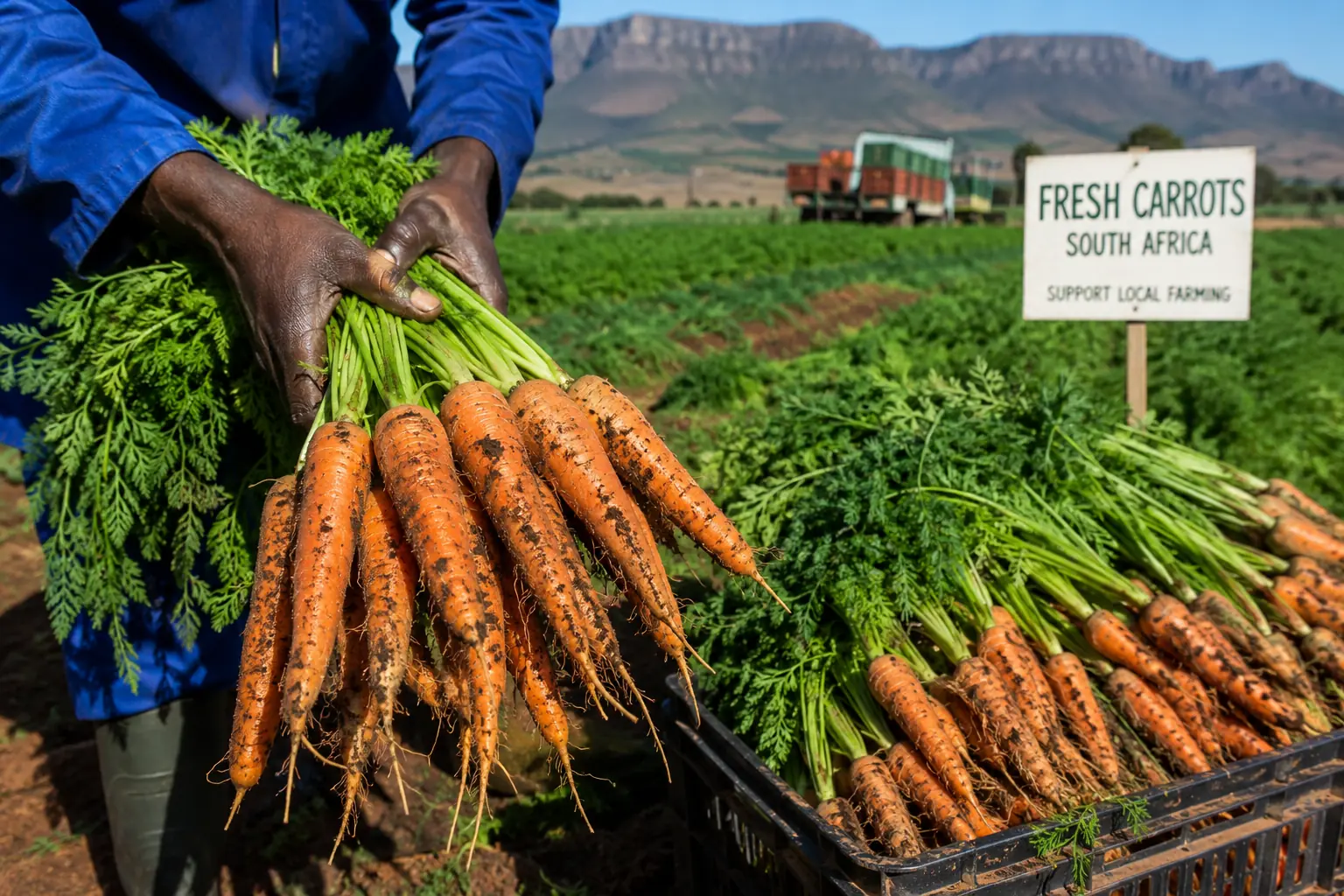
Carrots reach harvest maturity 100 to 130 days after seeding, depending on the cultivar and growing conditions. Signs of harvest readiness include roots reaching the target diameter (typically 25–35 mm for Nantes-type fresh market carrots), shoulders at or just below soil level, and foliage beginning to show signs of senescence.
Commercial carrot harvesting is mechanized on most medium and large operations. A carrot lifter or harvester grips the foliage and lifts the roots mechanically, topping them before loading into bins. On smaller operations, manual harvesting with a fork or specialized carrot lifting bar followed by hand topping is common but labour-intensive.
After harvesting, carrots must be washed, graded, and cooled as quickly as possible. Cooling to 4–6°C within 4–6 hours of harvest significantly extends shelf life, which is critical for meeting fresh produce market and retail buyer quality requirements.
Grading, Packing, and Selling
South Africa's fresh produce markets operate on a grading system that directly affects price. Well-shaped, uniformly sized, clean, smooth-skinned Nantes-type roots in the 150–250g range command the best prices. Undersized, forked, cracked, or pale-coloured roots are downgraded to lower price brackets or rejected entirely.
Primary sales channels for South African carrot farmers include:
- National Fresh Produce Markets: Johannesburg, Cape Town, Pretoria, Durban, and Port Elizabeth markets accept carrots year-round. Commission agents at these markets sell on your behalf for a 7.5% commission.
- Retail chain direct supply: Large supermarket groups (Pick n Pay, Woolworths, Checkers, Shoprite) source direct from accredited packhouses. This requires GLOBALG.A.P. certification, consistent supply volumes, and specific packhouse facilities.
- Processing buyers: Frozen vegetable processors, juice manufacturers, and baby food producers buy lower-grade carrots that do not meet fresh market standards.
- Local market and roadside sales: For smaller producers, local informal markets, community vegetable stalls, and farm stalls offer direct consumer sales with no intermediary costs.
🥕 Top Tips for Commercial Carrot Success
- Never plant on land with stones, heavy clay, or compaction layers within 40 cm of the surface, invest in proper soil preparation before spending on seed and inputs.
- Keep soil moisture even throughout germination, allowing the seedbed to dry out at any point before emergence destroys your plant population.
- Avoid fresh manure or over-application of nitrogen, both cause forking, hairy roots, and poor root quality.
- Scout regularly for nematodes in sandy soils, a nematode infestation can ruin an entire crop and persist for years.
- Harvest at the right time and cool quickly, delayed harvest or inadequate post-harvest cooling reduces marketable shelf life significantly.
⚠️ Disclaimer
This guide is for general educational purposes. Agronomy recommendations and market conditions vary by region and season. Consult a registered agronomist and verify current input registrations with your local agri-retailer before making production decisions.