Chicken farming is the most accessible and rapidly growing entry point into livestock production in South Africa. From large commercial integrators processing millions of birds annually, to backyard layer operations supplying eggs to local spaza shops, the poultry sector is the single largest agricultural commodity in the country by value, and demand continues to outpace domestic supply in both the broiler (meat) and layer (egg) segments.
For a new or smallholder farmer, the appeal of chicken farming is clear: the initial capital requirement is lower than for cattle or pigs, the production cycle is short (42 days from day-old chick to market-weight broiler, or eggs every 25–28 hours from a laying hen), and the market is everywhere, from informal township traders to formal retail chains, restaurants, and school feeding schemes. Getting it right, however, requires understanding the specific management demands of poultry, particularly around housing, biosecurity, vaccination, and feed management.
Here, we cover the main production decisions to start and run a profitable chicken farm in South Africa, for aiming at broiler meat production, commercial egg laying, free-range production, or a small mixed backyard flock for household food security.
Broilers vs Layers: Choosing Your Production Type
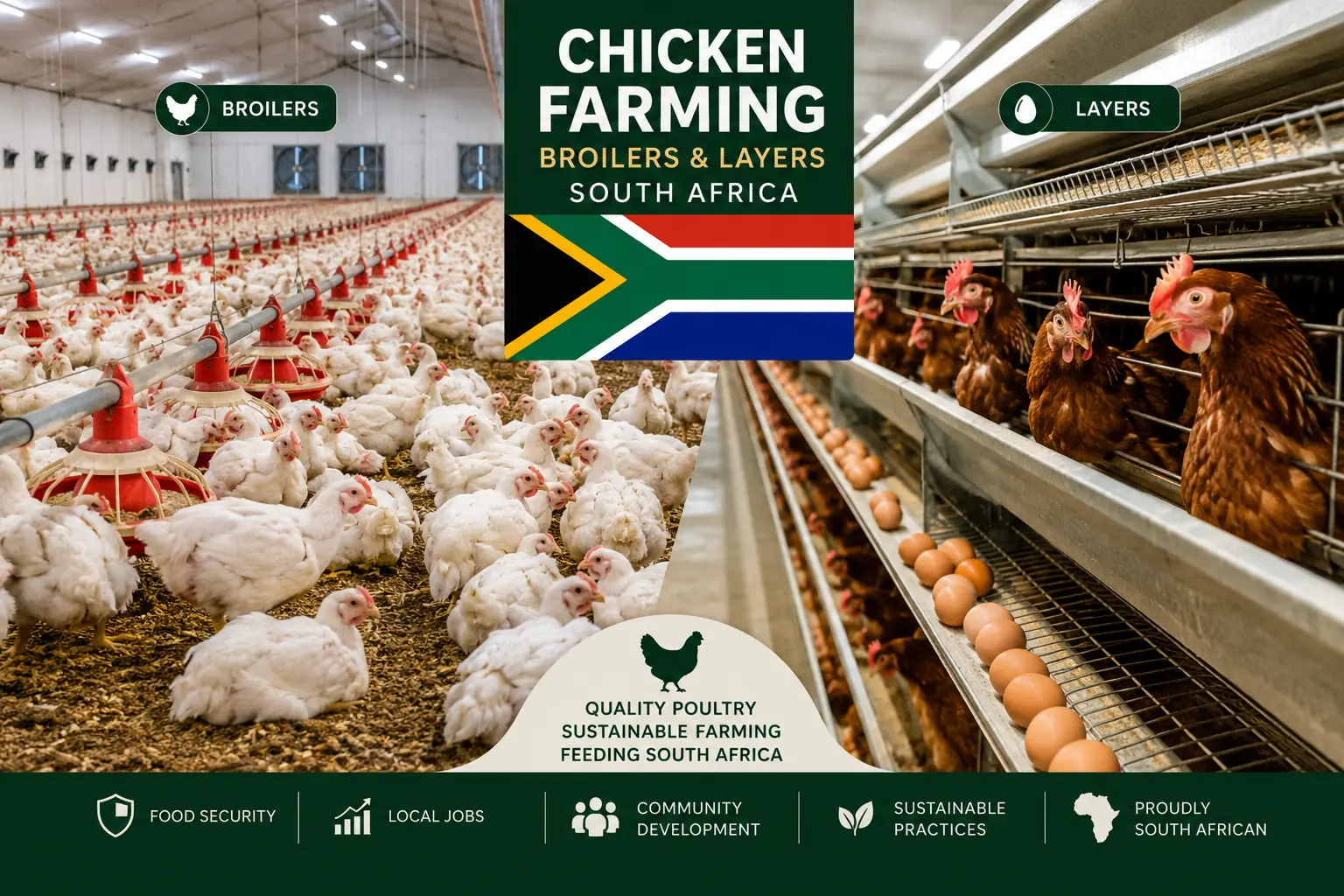
The first decision every aspiring chicken farmer must make is whether to produce broilers (meat chickens) or layers (egg-producing hens). These are fundamentally different enterprises with different breeds, infrastructure, production cycles, cash flow profiles, and market channels.
| Factor | 🍗 Broilers | 🥚 Layers |
|---|---|---|
| Production cycle | 38–42 days to slaughter | 18-month laying cycle |
| Cash flow | Short cycles, faster returns | Daily egg income once in lay |
| Capital needed | Moderate, clean out each cycle | Higher, long-term infrastructure |
| Main market | Abattoirs, traders, direct sales | Egg distributors, retail, direct |
| Management intensity | Moderate | Consistent daily management |
| Typical SA entry scale | 500–1,000 birds per cycle | 500–2,000 hens |
Many South African smallholders start with a small layer flock because daily egg income creates predictable cash flow and eggs require no abattoir to sell. Broiler production suits farmers who have reliable chick supply relationships (often through an integrator contract), secure market access, and the operational discipline to manage intensive 42-day cycles back-to-back.
Chicken Breeds Used in South Africa
Broiler Breeds
Commercial broiler production in South Africa is dominated by fast-growing hybrid breeds developed specifically for meat production. The Ross 308 and Cobb 500 are the two most widely used commercial broiler lines, supplied as day-old chicks by integrated hatcheries including Rainbow Chicken, Astral Foods, and Country Bird Holdings. These breeds grow from hatching to a live weight of 2.0–2.5 kg in just 38–42 days under optimal management, a rate impossible in any traditional breed.
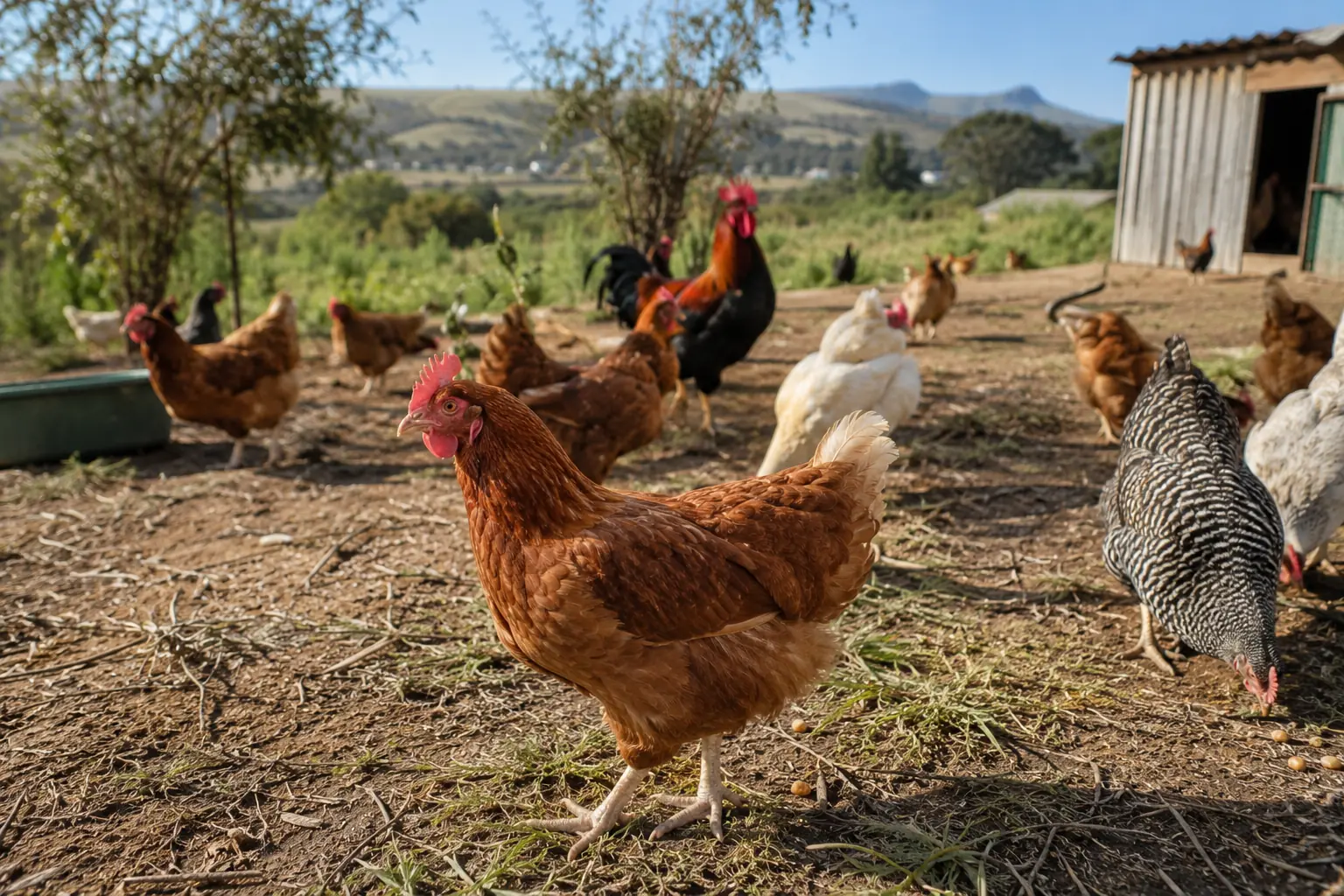
For farmers interested in slower-growing, free-range, or village chicken production, breeds like the Potchefstroom Koekoek, Naked Neck, and Ovambo are indigenous or locally adapted breeds that perform far better in low-input, outdoor conditions. They grow more slowly (reaching slaughter weight at 70–90 days) but are significantly more heat-tolerant, disease-resistant, and better at foraging than commercial hybrids, and they command premium prices from consumers who prefer the taste and firmer texture of free-range and indigenous-breed chicken.
Layer Breeds
Commercial egg production in South Africa is dominated by two hybrid lines: the Lohmann Brown and the Hy-Line Brown. These are prolific layers capable of producing 300–320 eggs per hen over an 18-month laying cycle under good management, beginning to lay at approximately 18 weeks of age. They are available as point-of-lay (POL) pulfrom commercial hatcheries, saving the farmer the complexity of rearing chicks through the brooding phase.
Housing and Infrastructure
Appropriate housing is the foundation of profitable chicken farming. South Africa's climate varies enormously, from the hot, humid KwaZulu-Natal coast to the cold, frosty Highveld winters of the Free State and Mpumalanga escarpment, and your housing design must reflect your specific climate zone and production system.
Broiler House Design
A standard commercial broiler house in South Africa is a long, rectangular structure oriented east-west (to minimize direct sun exposure on the long sidewalls), with open sides fitted with adjustable curtains for ventilation management. Key design parameters include:
- Floor space: 0.05–0.07 m² per bird (35–45 birds/m²) for standard commercial density. For welfare-certified or free-range production, a maximum of 30 birds/m² indoors.
- Ventilation: Cross-ventilation is critical. In hot climates (Limpopo, Northern Cape lowveld), tunnel ventilation (fans at one end drawing air through the full length of the house) is increasingly standard for climate control in high-density houses.
- Litter: Cover the floor with 5–8 cm of wood shavings, rice hulls, or sugar bagasse. Keeping litter dry and friable is critical for ammonia control, foot health, and bird welfare.
- Heating for brooding: Day-old chicks require a house temperature of 33–35°C at chick level in week one, reducing by approximately 3°C per week until the ambient temperature is reached. Gas brooders or electric radiant panels are standard. Getting brooding temperature management right in the first 7 days is the single biggest determinant of flock performance.
- Drinkers and feeders: Nipple drinker lines and pan or tube feeders are standard in commercial broiler houses. Allow one nipple drinker per 10 birds and adequate feeder space to avoid competition.
Layer House Design
Layer houses can be designed for cage housing (battery or enriched colony cages), barn (free floor-housing without cages), or free-range production. Battery cage systems, while historically common in South Africa, are increasingly being phased out or restricted by major retailers under animal welfare commitments, always check your target market's requirements before investing in a housing system. Barn and free-range systems require more floor area but command premium egg prices that justify the additional infrastructure cost in the right market.
Feed and Nutrition
Feed accounts for approximately 65–75% of total production costs in both broiler and layer operations. Getting your feed programme right (the correct ration, at the right feeding phase, in the right quantities) is the most direct lever you have over your profitability and FCR performance.
Broiler Feed Phases
Commercial broiler feed is supplied in three phases matched to the bird's growth stage:
- Starter (Day 1–14): High-protein crumble (22–23% crude protein, CP). Critical for early muscle development and immune system priming.
- Grower (Day 15–28): Moderate protein pellet (20–21% CP). Supports rapid frame growth and skeletal development.
- Finisher (Day 29–slaughter): Lower protein, higher energy pellet (18–19% CP). Optimised for final muscle deposition and achieving target live weight efficiently.
A well-managed Ross 308 flock consuming correctly formulated commercial feed should achieve a feed conversion ratio (FCR) of approximately 1.65–1.80, meaning 1.65 to 1.80 kg of feed consumed for every kilogram of live weight gained. An FCR consistently above 2.0 signals a management, health, or feed quality problem requiring urgent investigation.
Layer Feed and Calcium Management
Layer hens have different nutritional needs across their production life. The key stages include a grower ration during pullet rearing (0–17 weeks), a pre-lay calcium-loading ration in week 17–18, and a production layer ration from first lay. Calcium is the nutrient most commonly deficient in home-mixed layer rations, deficiency leads directly to thin-shelled eggs, increased cracking and breakage, and reduced egg revenue. Always use a commercially formulated layer pellet or supplement generously with limestone grit or oyster shell for hens on mixed rations.
Vaccination and Disease Management
Disease is where most small-scale chicken farmers in South Africa lose money, and sometimes lose their entire flock. Newcastle Disease (NCD) alone is responsible for catastrophic flock losses in unvaccinated and under-vaccinated South African townships and rural areas every year. A complete vaccination programme is not optional. It is the single most important investment you will make in your birds.
Core Vaccination Schedule
- Newcastle Disease (NCD): Vaccinate at Day 1 (hatchery spray), repeat at Day 10–14 (eye drop or drinking water), and boost with an inactivated oil-emulsion vaccine at 18–21 days in broilers. For layers, maintain ongoing NCD vaccination every 8–12 weeks throughout the laying cycle. An unvaccinated flock exposed to virulent NCD can lose 80–100% of birds within 5–7 days.
- Infectious Bursal Disease, Gumboro (IBD): A devastating immunosuppressive disease of young chicks. Vaccinate with a live intermediate-plus IBD vaccine at Day 14 and repeat at Day 24–28. IBD damage to the bursa of Fabricius permanently compromises immune function, making birds susceptible to a cascade of secondary bacterial and viral infections for the rest of their lives.
- Infectious Bronchitis (IB): Respiratory and kidney disease causing production drops in layers and respiratory signs in broilers. Include in your programme from Day 1 with combined NCD/IB live sprays.
- Marek's Disease: A herpesvirus causing tumours and paralysis in layer pullets. Most commercial hatcheries vaccinate at hatch as standard, confirm Marek's vaccination status when sourcing pullets.
Biosecurity Essentials
Biosecurity, keeping disease out of your farm, is as important as vaccination. The most important biosecurity practices for South African poultry farmers are:
- All-in, all-out production, never mix birds of different ages in the same house or airspace.
- Control access, visitors, vehicles, and equipment are major disease vectors. Footbaths and farm-dedicated overalls are minimum requirements for anyone entering bird housing areas.
- Full cleanout and disinfection between flocks, remove all litter, wash all surfaces, apply an approved disinfectant, and observe a minimum downtime of 10–14 days before restocking.
- Prevent contact with wild birds and rodents, both are major vectors for NCD and Avian Influenza. Net open house sides in areas with high wild bird pressure.
- Source chicks and pulonly from accredited hatcheries with documented health programme compliance.
Manure and Litter as a By-Product
Chicken litter is among the most nutrient-rich organic fertilizers available in South Africa and is in strong demand from crop and vegetable farmers. Broiler litter removed after each production cycle contains significant quantities of nitrogen, phosphorus, and potassium alongside beneficial organic matter. Composted poultry litter can be sold directly to farmers at R400–R800 per cubic metre in many areas, or used on your own land to reduce synthetic fertilizer costs. Fresh high-ammonia litter must always be composted or aged before soil application to prevent crop burn and pathogen risks.
Selling Your Chickens and Eggs
Identifying and securing your market before you stock birds is consistently among the most critical decisions in chicken farming. South African broiler and egg market channels include:
- Integrator contracts (broilers): Companies like Rainbow Chicken and Astral Foods supply day-old chicks, feed, and vet support and buy finished birds at a contracted price. This reduces market risk but limits your profit margin and requires strict compliance with the integrator's programme.
- Independent abattoirs: Sell live birds by live weight to a local abattoir. More flexible pricing but no guaranteed offtake.
- Direct and informal market sales: Selling live birds or dressed carcasses directly to township traders, butcheries, restaurants, and consumers. Typically achieves the best per-bird price but requires consistent supply and active marketing.
- Eggs, spaza and local retail: Daily or weekly egg sales to local spaza shops, tuck shops, and neighbours provide predictable income at the best per-dozen price for small-scale producers.
- Eggs, formal retail: Supplying major retail chains (Shoprite, Pick n Pay, Woolworths) requires volume consistency, barn or free-range certification, HACCP compliance, and a registered egg grading facility.
🐔 Top Tips for South African Chicken Farmers
- Never skip Newcastle Disease vaccination, a single virulent NCD outbreak in an unvaccinated flock means total loss within a week. Vaccinate every flock, every cycle, without exception.
- Get brooding temperature right in week one, more broiler performance is lost in the first 7 days than at any other stage of production.
- Source chicks and pulfrom reputable, accredited hatcheries only, cheap chicks from unverified sources are usually the most expensive in the long run.
- Keep records, track feed intake, mortality, live weight, and egg production weekly. Records identify problems early and build the evidence base lenders and buyers need to trust your operation.
- Manage litter moisture in broiler houses, wet litter causes footpad dermatitis, ammonia damage, and respiratory disease faster than any other management failure.
- Know your market before you stock, confirm who will buy, at what price, and in what format (live, dressed, eggs) before spending money on day-old chicks.
Government Support for Poultry Farmers
- CASP (Comprehensive Agricultural Support Programme): Capital grants for poultry infrastructure (houses, water systems, feed storage) for qualifying emerging farmers through provincial agriculture departments.
- Ilima/Letsema: Production input support (chicks, feed) for smallholder poultry producers through DAFF's seasonal support programme.
- ARC Animal Production (Irene): Technical training in poultry management, indigenous breed development, and production systems for South African conditions.
- SA Poultry Association (SAPA): Industry body providing production data, market information, and training resources for commercial and emerging poultry producers across South Africa.
⚠️ Regulatory Note
Chicken farming in South Africa is subject to the Animal Diseases Act, Meat Safety Act, and relevant provincial bylaws. Any suspected outbreak of Newcastle Disease, Avian Influenza, or Infectious Bursal Disease must be reported to your nearest State Veterinarian immediately. Always consult a registered poultry veterinarian or extension officer for vaccination and treatment advice specific to your region and flock size.