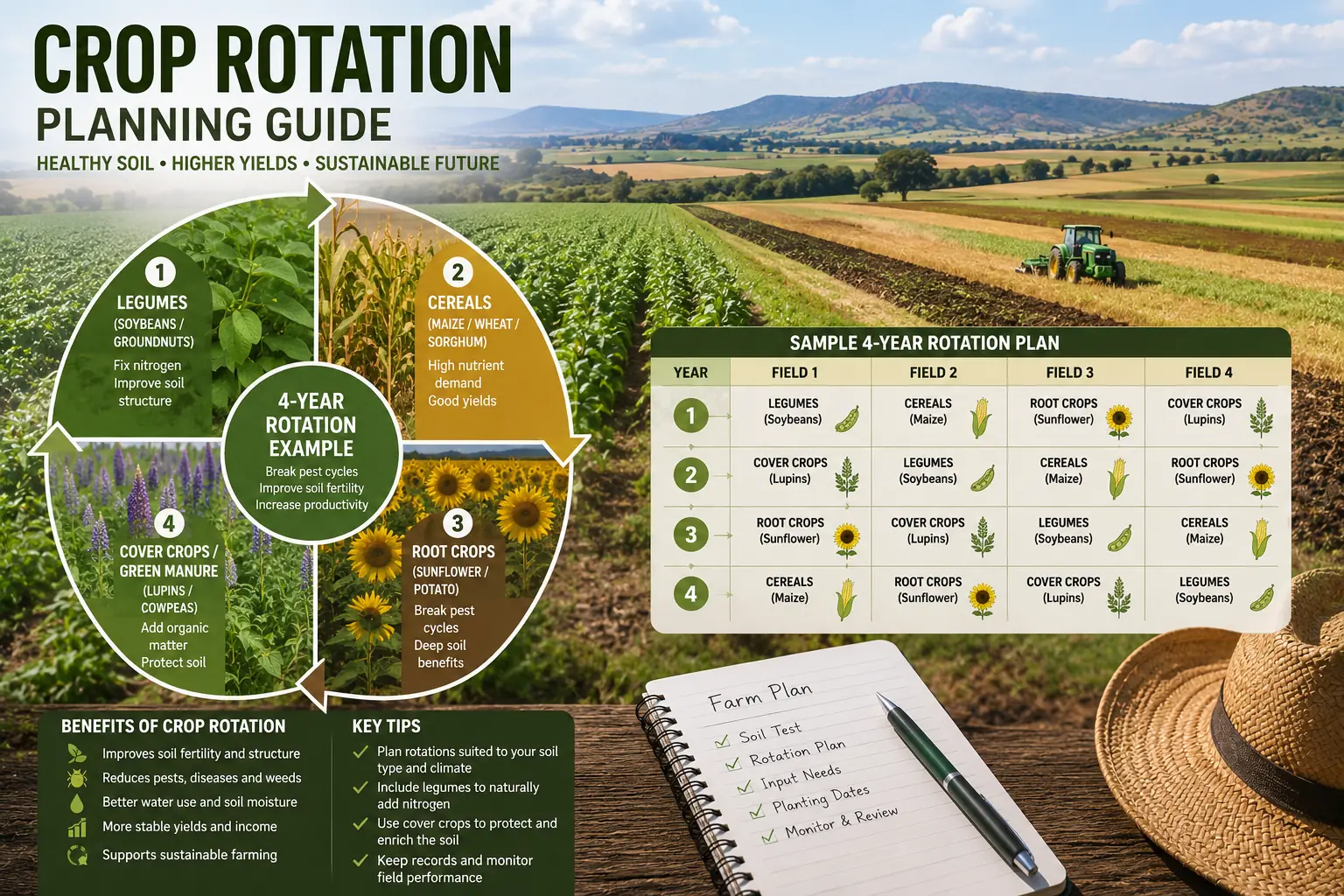
What Is Crop Rotation and How Does It Work?
At its core, crop rotation works because different crops make different demands on the soil and leave different things behind. Grains like maize and wheat are heavy feeders, they extract large amounts of nitrogen and other nutrients from the soil. Legumes like soybeans, cowpeas, and groundnuts do the opposite, they host nitrogen-fixing bacteria in their roots that actually add nitrogen back to the soil, reducing or eliminating the need for nitrogen fertiliser in the following season.
By planning a deliberate sequence, a heavy feeder followed by a legume, followed by a different crop family, followed perhaps by a rest or cover crop, you create a naturally self-sustaining cycle that keeps the soil biologically active and nutritionally balanced without relying solely on synthetic inputs.
The principles behind crop rotation address four interconnected farming problems simultaneously:
- Soil fertility: Legumes restore nitrogen; deep-rooted crops break up compaction; organic matter from root residues feeds soil microbes.
- Pest and disease management: Pests and pathogens that build up in soil when the same crop is grown repeatedly are starved out when the host crop is removed for a season or two.
- Weed control: Different crops shade weeds differently and respond differently to herbicides, making it much harder for specific weed species to dominate.
- Risk management: Growing different crops in different seasons reduces your exposure to single-crop price crashes, weather events, and market failures.
The Four Crop Groups: Building Your Rotation Around Families
Effective crop rotation is built on understanding plant families and grouping them correctly. Crops from the same family share common pests, diseases, and nutrient requirements, so they should never follow each other in rotation. The four fundamental groups used in South African rotation planning are:
- Group 1, Legumes (Nitrogen Fixers): Soybeans, cowpeas, groundnuts, dry beans, green beans, lentils, lucerne. These are your soil restorers. Always use legumes as a transition crop after a heavy-feeding grain or vegetable season.
- Group 2, Cereals and Grasses (Heavy Feeders): Maize, wheat, sorghum, oats, barley, sugarcane. These extract the most nutrients and should follow a legume phase whenever possible to benefit from residual nitrogen.
- Group 3, Brassicas: Cabbage, broccoli, cauliflower, canola, turnips, mustard. Highly susceptible to clubroot and other soil-borne diseases, never grow brassicas in the same plot two seasons in a row. A 3–4 year break from brassicas is recommended on disease-prone soils.
- Group 4, Root Crops and Solanums: Potatoes, tomatoes, peppers, onions, carrots, butternut. Susceptible to nematodes and various soil-borne pathogens. Require the longest rotation breaks, ideally 3 years between potato or tomato crops on the same land.
Cover Crops: The Fifth Element in Your Rotation
Many advanced South African farmers now add a fifth rotation element: cover crops. A cover crop phase (planted during an off-season or fallow period) is not harvested for sale but instead provides multiple soil benefits: it protects bare soil from erosion, suppresses weeds, adds organic matter when terminated and incorporated, and can provide additional nitrogen fixing if a legume species is used.
Popular cover crop choices for SA conditions include oats, forage sorghum, cowpeas, vetch, lablab, and mixed species blends. Cover crops are particularly valuable in the Western Cape (winter rainfall), the Free State (protecting soil during summer fallow), and Limpopo (managing erosion in high-rainfall periods). See our dedicated Cover Crops Guide for full details on species selection and termination methods.
The single most important rule in crop rotation is never to plant the same crop family in the same block in consecutive seasons. Even one season's break makes a measurable difference. Two or three seasons away from the same family dramatically reduces soil-borne disease pressure and restores soil biology.
SA Rotation Plans: Practical Schedules for Common Farming Systems
Here are four practical rotation schedules commonly used across South African farming systems. These can be adapted to your specific crops, seasons, and province:
Rotation Plan 1: Commercial Grain Farmer (Free State / North West / Mpumalanga)
| Year | Block A | Block B | Block C | Block D |
|---|---|---|---|---|
| Year 1 | Maize | Soybeans | Sunflower | Cover Crop |
| Year 2 | Cover Crop | Maize | Soybeans | Sunflower |
| Year 3 | Sunflower | Cover Crop | Maize | Soybeans |
| Year 4 | Soybeans | Sunflower | Cover Crop | Maize |
Rotation Plan 2: Smallholder Vegetable Farmer (3-Bed System)
| Season | Bed 1 | Bed 2 | Bed 3 |
|---|---|---|---|
| Season 1 | Tomatoes / Peppers (Solanums) | Beans / Cowpeas (Legumes) | Cabbage / Spinach (Brassicas/Leaves) |
| Season 2 | Cabbage / Spinach | Tomatoes / Peppers | Beans / Cowpeas |
| Season 3 | Beans / Cowpeas | Cabbage / Spinach | Tomatoes / Peppers |
Rotation Plan 3: Mixed Crop Farmer (KZN / Limpopo / Eastern Cape)
| Year | Block A | Block B |
|---|---|---|
| Year 1 | Maize (summer) | Cowpeas / Dry Beans (summer) |
| Year 2 | Groundnuts (summer) | Sorghum (summer) |
| Year 3 | Maize (summer) + Oats cover (winter) | Soybeans (summer) |
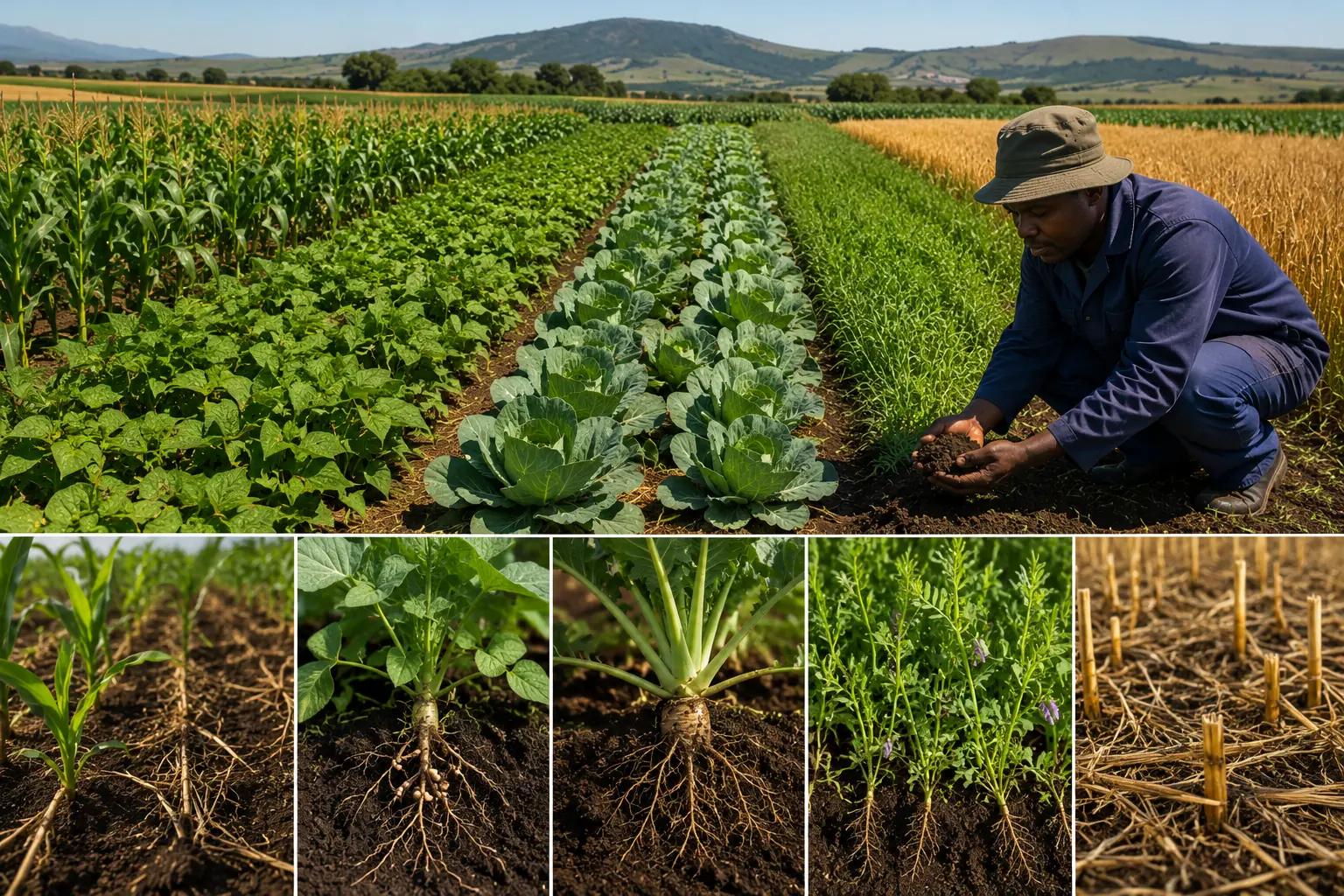
Province-by-Province Crop Rotation Guidance
South Africa's nine provinces have dramatically different climates, rainfall patterns, and dominant crop types. Effective rotation planning must account for these differences. Below is a summary of recommended rotation approaches by province:
Crop Rotation and Pest & Disease Management in South Africa
South African farmers face a range of soil-borne pests and diseases that are most effectively managed through strategic rotation. The following are the most significant rotation-responsive threats in the SA farming context:
- Maize streak virus and grey leaf spot: Both build up when maize is grown continuously on the same land. A single season of soybeans or another non-host crop breaks the cycle effectively.
- Root-knot nematodes (Meloidogyne spp.): Among South Africa's most damaging soil pests for tomatoes, potatoes, and carrots in Limpopo and KZN. Resistant varieties help but rotation with non-host crops (cereals, brassicas, marigolds as a biofumigant) is the most effective long-term management strategy.
- Potato and tomato early blight and late blight: Inoculum overwinters in soil on infected plant debris. A 3-year break from solanums (tomatoes, potatoes, peppers) dramatically reduces disease levels.
- Clubroot of brassicas: A serious problem in high-rainfall areas of the Western Cape and KZN. Can persist in soil for up to 20 years. Prevention through rotation (keeping brassicas on minimum 4-year breaks) is far more cost-effective than remediation.
- Striga (witchweed): A parasitic weed that attacks sorghum and maize roots, particularly in Limpopo and the Eastern Cape. Rotation with non-host crops (sunflower, soybeans, cotton) combined with cover crops starves the Striga seed bank over time.
Crop Rotation and Fertiliser Savings in South Africa
With commercial fertiliser prices in South Africa remaining high and volatile due to import dependency and the rand exchange rate, the nitrogen-fixing value of legumes in rotation is increasingly financially significant. Research conducted at agricultural institutions including the ARC (Agricultural Research Council) consistently shows that soybeans in rotation with maize can supply the equivalent of 30–60 kg of nitrogen per hectare to the following maize crop, a saving of R400–R800 per hectare at current urea prices.
For smallholder farmers with limited access to credit and cash for inputs, this nitrogen benefit can be transformational, reducing the biggest single input cost on most SA farms while simultaneously improving soil health. Legume crops also typically have positive market prices in their own right, meaning the rotation year is a productive income year, not just a sacrifice season.
A maize farmer in the Free State rotating half their land to soybeans annually saves an estimated R400–R800/ha in nitrogen fertiliser on the following maize crop, while earning soybean income from the rotation year. For a 50-hectare operation, this represents R20 000–R40 000 in annual input savings, every year.
Common Crop Rotation Mistakes to Avoid
Even farmers who understand rotation in principle sometimes make avoidable mistakes in practice. The most common errors on South African farms include:
- Rotating within the same crop family: Rotating tomatoes with potatoes, or cabbage with broccoli, provides no benefit, both crops are hosts to the same pests and diseases. Always rotate between different plant families.
- Skipping the legume phase: Many SA farmers view the legume year as a lower-income compromise. In reality, soybean and groundnut prices are strong, and the nitrogen benefit to the following crop more than compensates for any yield difference.
- Not keeping rotation records: Without clear records of what was planted where and when, rotation planning becomes guesswork. Keep a simple seasonal map, even a hand-drawn plot diagram, showing each block's crop history.
- Too-short rotation intervals for high-risk crops: Potatoes every two years instead of three, or brassicas every year, is common on SA smallholdings under market pressure. This creates compounding disease pressure that eventually requires expensive remediation.
- Ignoring root residue: Crop rotation benefits are maximised when the residues of the previous crop are incorporated into the soil rather than burned. Residue incorporation feeds soil microbes and accelerates nutrient cycling for the next crop.