Cover crops are consistently among the most powerful tools in a South African farmer's soil management toolkit, and firmly among the most consistently underused. A cover crop is any plant grown primarily to benefit the soil and farming system rather than for direct harvest and sale: it covers and protects the soil surface, feeds soil biology, fixes atmospheric nitrogen, suppresses weeds, breaks pest and disease cycles, and contributes organic matter that builds long-term soil fertility.
For South African farmers facing the twin pressures of rising synthetic fertilizer costs and declining soil organic matter on intensively cropped land, cover crops offer a proven, practical path to lower input costs and higher long-term productivity. Research from the ARC and from commercial farms across the Highveld, Western Cape, and KwaZulu-Natal consistently shows that well-chosen cover crops can contribute 50–180 kg of nitrogen per hectare per season, suppress problem weeds by 60–80%, reduce soil erosion by over 90% on sloping land, and increase soil organic carbon measurably within 3–5 seasons of consistent use.
This guide explains how cover crops work, what benefits they deliver in South African farming systems, which species to choose for different provinces and production systems, how to establish them successfully, and how to terminate them effectively before the next main crop.
Why Cover Crops Matter in South Africa
South Africa's agricultural soils face serious long-term degradation challenges. Decades of bare fallows between crops, intensive tillage, stubble burning, and heavy synthetic fertilizer use have depleted organic matter levels, particularly on Highveld maize and dryland grain soils, which now commonly test at below 1% soil organic carbon in many areas. Soils with low organic matter hold less water, are more prone to crusting and erosion, support less biological activity, and require ever-increasing synthetic fertilizer inputs to maintain yields.
Cover crops directly address all of these problems simultaneously. They are the foundation of conservation agriculture and regenerative farming systems, and they complement no-till and minimum tillage practices by providing the soil cover and biological activity that makes reduced tillage sustainable over time.
Nitrogen Fixation
Legume cover crops fix 50–180 kg N/ha from the atmosphere, reducing purchased fertilizer requirements for the following main crop.
Soil Biology
Living roots feed soil microorganisms and mycorrhizal fungi continuously, building the biological infrastructure that drives nutrient cycling.
Water Retention
Organic matter built by cover crops increases soil water-holding capacity, critical for drought resilience in South Africa's variable rainfall regions.
Erosion Control
A dense cover crop canopy and mulch layer prevents water and wind erosion on bare soils, reducing topsoil losses that cost yield and money every season.
Weed Suppression
Dense cover crop growth shades out weeds and, when terminated and left as mulch, physically suppresses germination of weed seeds.
Pest & Disease Breaks
Non-host cover crops break pest and disease cycles that build up under continuous monoculture, reducing pathogen pressure on subsequent main crops.
Types of Cover Crops: Legumes, Grasses, and Brassicas
Cover crop species fall into three broad functional groups, each offering different primary benefits. The most effective cover crop programmes use mixtures of two or more groups, called polyculture or cocktail cover crops, to deliver a broader range of soil benefits than any single species can provide.
Legumes, The Nitrogen Fixers
Legumes form symbiotic relationships with soil bacteria (Rhizobium species) that live in root nodules and fix atmospheric nitrogen gas into plant-available ammonium. When the legume is terminated and incorporated or left as mulch, this fixed nitrogen is gradually released to the following main crop, reducing or replacing purchased nitrogen fertilizer. Legume cover crops are the most economically impactful species for most South African grain and vegetable farmers for this reason.
Key legume cover crop species for South Africa include:
- Hairy vetch (Vicia villosa): Genuinely among the best winter legume cover crops for summer-rainfall areas sown after maize or soybean harvest. Extremely cold-hardy on the Highveld, producing large biomass. Can fix 80–130 kg N/ha. Terminates easily with herbicide.
- Common vetch (Vicia sativa): Less cold-hardy than hairy vetch but fast-establishing. Used in winter rainfall areas of the Western Cape as a winter cover crop before summer vegetables. Fixes 60–110 kg N/ha.
- Cowpea (Vigna unguiculata): An outstanding summer legume cover crop across all warm summer-rainfall provinces. Extremely heat and drought tolerant, fast-growing, and fixes 80–160 kg N/ha. Dual purpose, can be grazed by livestock or left as mulch.
- Lablab (Lablab purpureus): A high-biomass summer legume ideal for the warm, humid KwaZulu-Natal and Limpopo lowveld regions. Very deep-rooted (2+ metres), drought-tolerant, and fixes up to 180 kg N/ha. Also valuable as livestock feed.
- Sunn hemp (Crotalaria juncea): A fast-growing summer legume producing exceptional biomass (up to 10 tonnes dry matter per hectare) in warm conditions. Excellent nematode-suppressing properties, particularly valuable in vegetable production rotations where root-knot nematodes are a problem.
- Crimson clover (Trifolium incarnatum): A winter annual legume suited to the Western Cape. Provides good ground cover, fixes 60–100 kg N/ha, and produces a striking red flower attractive to pollinators. Used extensively in Western Cape vineyard and orchard floor management.
- Lucerne (Medicago sativa): Used as a long-term cover/pasture in orchards and vineyards in the Western Cape. Deep-rooted, high N-fixer, and soil structure improver over multiple seasons.
Grasses and Cereals, The Biomass Builders
Grass and cereal cover crops do not fix nitrogen, but they produce large volumes of carbon-rich biomass that builds soil organic matter, feeds soil biology, and provides durable surface mulch that persists into the following season. They have deep, fibrous root systems that penetrate compacted subsoils, improve drainage, and leave extensive root channels for subsequent main crop roots to follow.
- Oats (Avena sativa): The most widely used winter cover crop in South Africa. Fast-establishing, cold-tolerant, produces excellent ground cover, and provides a thick mulch layer after termination. Used extensively as a winter cover on the Highveld and in the Western Cape grain belt after harvest.
- Grazing rye (Secale cereale): More cold-hardy than oats, with a more extensive root system. Excellent choice for cover on the cold Highveld and Free State winters. Allelopathic properties suppress certain weed species in the following season.
- Sorghum-sudan hybrid: A summer grass cover crop producing enormous biomass (8–15 tonnes dry matter/ha) in warm conditions. Roots penetrate deep hardpan layers, and the high C:N biomass feeds soil organisms for months after termination. Popular in the Limpopo and Mpumalanga cotton and maize rotations.
- Barley (Hordeum vulgare): Used in the Western Cape Swartland as a winter cover crop with moderate cold tolerance, faster maturity than rye, and dual-purpose grazing or cover potential.
Brassicas, The Biofumigants and Subsoil Breakers
Brassica cover crops (mustards, radishes, turnips) serve more specialised functions. Daikon or tillage radish varieties produce extremely large, deep taproots (up to 60 cm) that physically break through compaction layers, create deep root channels, and scavenge nitrates from deep in the profile that would otherwise leach to groundwater. When the radish roots die and decompose over winter, they leave biopores that improve drainage and aeration for the following main crop.
- Tillage radish / Daikon radish (Raphanus sativus): Produces a massive taproot that penetrates compaction, scavenges leachable nitrogen, and decomposes over winter. Used on the Highveld and in KwaZulu-Natal in maize/soybean rotations. Best planted in February–March after maize harvest for winter soil management.
- Brown mustard (Brassica juncea): A warm to cool-season brassica with biofumigant properties, glucosinolate compounds released when the crop is incorporated suppress nematodes and soil-borne fungal pathogens. Very effective in vegetable production rotations following solanaceous crops (tomatoes, potatoes, peppers).
- Canola / rapeseed (Brassica napus): Used as a cover crop in rotation with cereals in the Western Cape, with the double benefit of providing soil cover and breaking cereal disease cycles (particularly take-all root rot).
Cover Crop Mixtures: Cocktail Covers
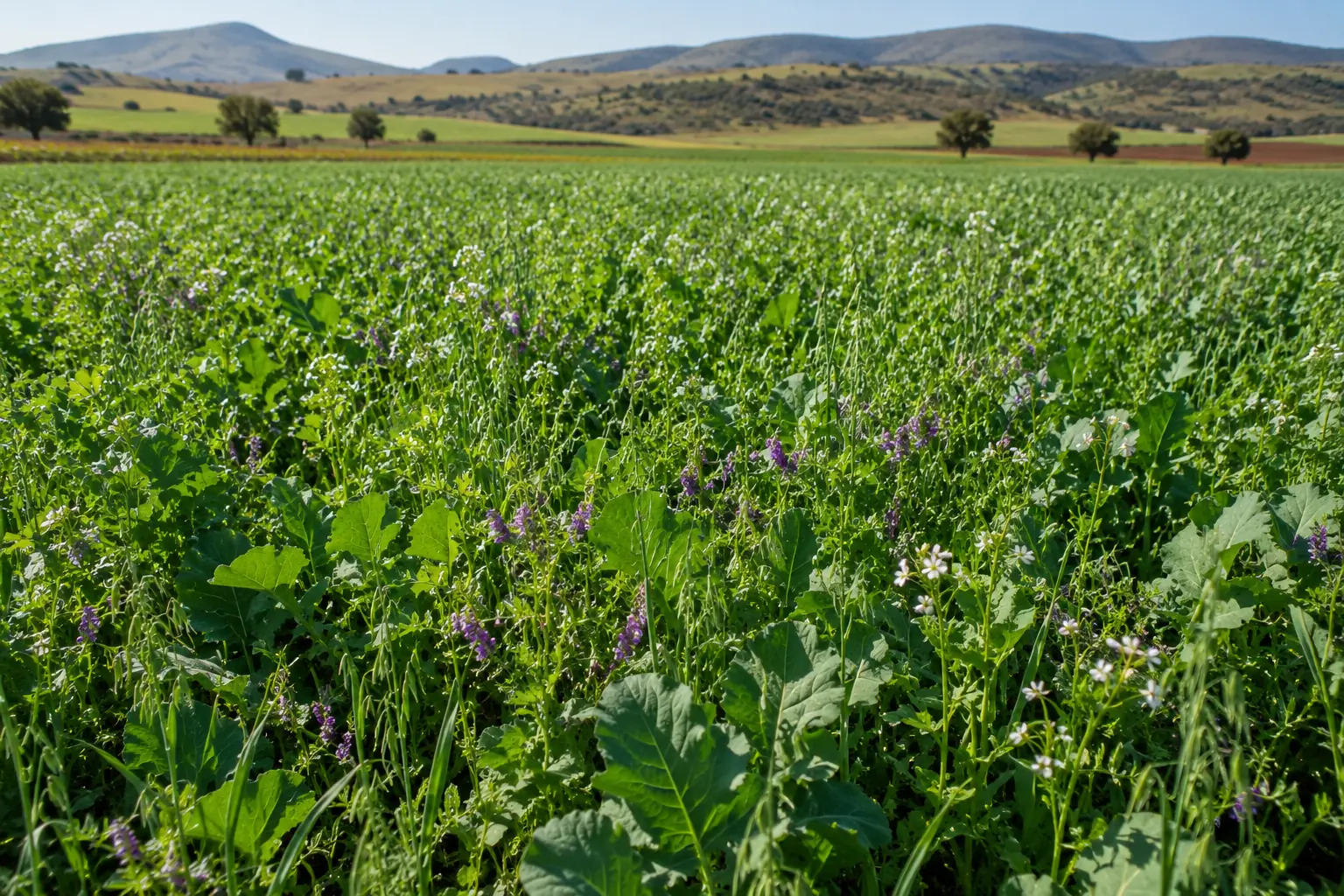
Planting mixtures of two, three, or more cover crop species (commonly called cocktail cover crops or polycultures) delivers more comprehensive soil benefits than any single species can provide alone. A well-designed cocktail cover crop simultaneously fixes nitrogen (legume component), builds biomass (grass component), suppresses weeds, feeds multiple functional groups of soil organisms, and provides diverse root architectures that improve soil structure at multiple depths.
Cocktail cover crop mixtures for South African conditions should balance the following functional groups:
- At least one nitrogen-fixing legume (20–40% of seeding mix by species proportion)
- At least one high-biomass grass or cereal (30–50% of mix)
- Optionally a brassica for biofumigation or compaction-busting if these are priority needs
Example Highveld winter cocktail: hairy vetch (30%) + oats (50%) + tillage radish (20%). This combination provides N-fixation, large biomass for organic matter, deep compaction-busting roots, and excellent erosion protection through the Highveld winter.
Example KwaZulu-Natal summer cocktail: cowpea (30%) + sorghum-sudan (40%) + sunn hemp (20%) + brown mustard (10%). This warm-season mix fixes nitrogen aggressively, produces enormous biomass, and biofumigates against the nematode pressure common in KZN vegetable soils.
Cover Crop Species by Province
🏔️ Highveld (Gauteng, Free State, NW)
- Winter: Hairy vetch, oats, grazing rye, tillage radish
- Summer: Cowpea, lablab, sorghum-sudan hybrid
- Note: Cold winters limit winter legume options, hairy vetch and grazing rye are most cold-hardy
🌊 KwaZulu-Natal
- Summer: Cowpea, lablab, sunn hemp, sorghum-sudan
- Winter/Midlands: Oats, common vetch, hairy vetch
- Note: High nematode pressure makes sunn hemp and brown mustard especially valuable
🌿 Western Cape
- Winter (main season): Common vetch, crimson clover, oats, barley, grazing rye, canola
- Summer (dry season): Cowpea (irrigated), lablab (irrigated)
- Note: Winter-rainfall pattern means legume covers grown in winter before summer cash crops
🌡️ Limpopo & Mpumalanga
- Summer: Cowpea, lablab, sunn hemp, sorghum-sudan
- Winter (irrigated areas): Oats, hairy vetch, common vetch
- Note: Hot conditions favour high-biomass tropical species; cotton rotations benefit from sunn hemp nematode suppression
Establishing Cover Crops Successfully
Successful cover crop establishment follows the same principles as establishing any crop: good seedbed, adequate moisture, correct seeding depth, and timely planting. In South Africa's variable climate, timing is often the most critical factor, getting seed in the ground as quickly as possible after main crop harvest maximises the growing window available before the next main crop planting date.
Seeding Methods
Cover crops can be established by several methods depending on your equipment and system:
- Direct drilling: Seeding directly into crop residues with a no-till drill is the gold standard for conservation agriculture systems. Soil disturbance is minimised and existing soil structure is preserved.
- Broadcast seeding: Spreading seed by hand, spinner spreader, or aircraft over standing or recently harvested crops, followed by light incorporation. Useful for large-area establishment but requires rainfall or irrigation for germination.
- Aerial seeding: Aircraft broadcasting of cover crop seed into standing maize or sorghum crops before harvest. The cover crop germinates and establishes in the damp soil under the main crop canopy, providing immediate establishment after harvest. Used in large-scale grain farming operations in the Free State and North West.
- Conventional seedbed: Prepared seedbed before planting. Less ideal for conservation agriculture systems but acceptable where tillage is already being used for other purposes.
Seeding Rates and Depths
Seeding depth varies by species: small-seeded legumes (clovers, vetch) are planted at 1–2 cm; medium-seeded cereals (oats, rye) at 3–4 cm; large-seeded legumes (cowpea, lablab) at 3–5 cm. Seeding rates for cover crops are typically lower than for grain production because establishment density rather than yield per plant is the target. Always follow species-specific seeding rate recommendations, and reduce individual rates proportionally when planting mixtures.
Cover Crop Termination Methods
Terminating the cover crop at the right time and by the right method is as important as establishing it. Terminating too late risks the cover crop setting seed (creating a weed problem) or drying out the soil ahead of the main crop planting season. Terminating too early reduces biomass accumulation and nitrogen fixation. For most systems, termination should occur at flowering or just before, when biomass is maximised but before significant seed set.
Chemical Termination (Herbicide)
Glyphosate is the most widely used cover crop termination herbicide in South African no-till systems. It provides broad-spectrum control of most cover crop species and can be applied 2–3 weeks before main crop planting to allow sufficient breakdown time. Selective herbicides can also be used to terminate grass components while leaving legume residues, or vice versa, in specific situations. Always observe withholding periods and check for herbicide carryover risks on sensitive subsequent crops.
Mechanical Termination (Roller-Crimper)
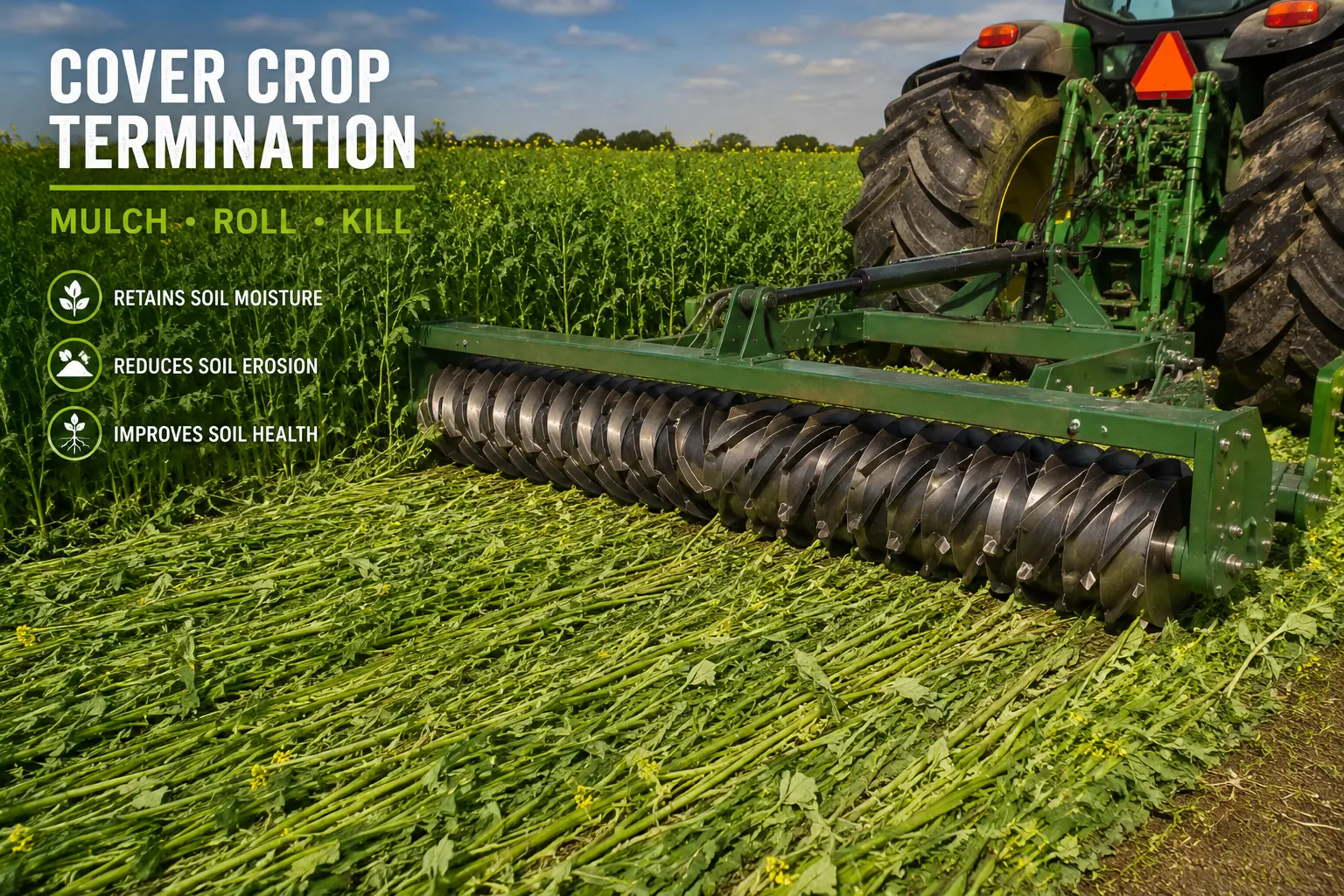
A roller-crimper is a drum fitted with chevron-shaped blades that rolls over the cover crop, crimping stems and killing the plant without herbicide. The crimped cover falls flat, creating a dense mulch layer that suppresses weeds and retains soil moisture. Roller-crimping is growing in adoption among South African conservation agriculture and organic farmers as a chemical-free alternative to herbicide termination. It works best on cover crops at full flowering stage when stems are most susceptible to crimping.
Incorporation (Tillage)
Cover crops can be incorporated into the soil by ploughing or discing, which accelerates decomposition and nutrient release. However, this approach is inconsistent with no-till systems and causes significant soil disturbance. Incorporation is most appropriate in situations where rapid nitrogen release to the following main crop is the priority, or in conventional tillage systems where soil structure benefits of cover crop residues at the surface are less of a concern.
Cover Crops and Livestock Grazing
Integrating cover crops with livestock grazing is among the most economically compelling aspects of cover cropping in South African farming systems. Many South African grain farmers face the challenge of justifying the cost of cover crop seed and establishment against the delayed soil health benefits, cover crop grazing by sheep or cattle provides an immediate economic return that can fully offset establishment costs and even generate profit in the same season.
Cover crops including oats, hairy vetch, cowpea, and lablab produce high-quality, palatable forage. Managed correctly, with adequate rest periods between grazing events and animals removed before the cover crop is grazed to bare ground, grazing does not prevent the cover crop from delivering its soil health benefits, and the manure deposited during grazing adds an additional fertility input. This crop-livestock integration model is increasingly practiced by progressive South African farmers in the Highveld and Western Cape grain belts.
Cover Crops in No-Till and Conservation Agriculture
Cover crops are the third pillar of conservation agriculture alongside minimum soil disturbance (no-till or minimum tillage) and permanent soil cover. They are not just complementary to no-till. They are what makes no-till sustainable long-term. Without cover crops providing soil cover, feeding biology, and building organic matter, no-till systems can struggle with compaction, poor soil biology, and declining yields over time.
South African farmers transitioning to no-till should consider cover crops an integral part of the system from day one rather than an optional add-on. The ARC, Grain SA's Farmer Development programme, and No-Till Club South Africa all provide guidance on integrating cover crops into South African no-till systems.
🌱 Cover Crop Success Tips for SA Farmers
- Start with a single proven species before attempting mixtures, hairy vetch in winter on the Highveld, or cowpea in summer across most provinces, are reliable, affordable starting points.
- Inoculate legume seed with the correct Rhizobium strain before planting if the species has not been grown on that field before, uninoculated legumes cannot fix nitrogen effectively in new soils.
- Plant as soon as possible after main crop harvest, every week of delay reduces the cover crop's growing window and biomass accumulation.
- Terminate at flowering for maximum biomass and N-fixation, most cover crops reach peak nitrogen fixation at full flower, just before pod formation.
- Consider integrating grazing into your cover crop system, it provides immediate income while the long-term soil health benefits accumulate.
- Test your soil regularly, track organic carbon, pH, and phosphorus over time to measure the cumulative impact of cover crops on your soil health.
⚠️ Disclaimer
Cover crop performance varies significantly between regions, soil types, seasons, and management systems. Always consult your local ARC extension officer, agronomist, or Grain SA representative for species and variety recommendations specific to your province and farming system. Herbicide termination options and registrations may change, always verify current registrations before application.