Cattle farming is the backbone of South African agriculture. From the vast Karoo rangelands to the lush KwaZulu-Natal midlands and the mixed bushveld of Limpopo, beef cattle are raised across all nine provinces, making South Africa among Africa's most significant beef-producing nations. The country carries an estimated national herd of approximately 13–14 million cattle, supporting a beef industry worth tens of billions of rands annually and providing livelihoods for hundreds of thousands of commercial and smallholder farmers.
For farmers who are a first-generation farmer starting with a handful of cattle on communal land, an emerging farmer transitioning from subsistence to commercial production, or an established producer looking to optimise your herd performance, this guide takes you through the fundamentals of successful cattle farming in South African conditions, from breed selection and veld management to disease control, reproduction, and getting the best price for your animals at auction or abattoir.
Why Cattle Farming in South Africa?
Beef remains among South Africa's most popular proteins in South Africa across all demographic groups and income levels. Formal retail, informal butcheries, and traditional meat consumption at cultural events all contribute to consistent year-round demand. The formal beef value chain, from farm through abattoir to retail, is well-developed, giving commercial producers reliable market access. For smallholder and communal farmers, cattle also serve as a store of wealth, a source of draught power for crop production, and a key part of cultural practice, particularly in Zulu, Xhosa, Sotho, and Ndebele communities.
From a production perspective, beef cattle are well-suited to South African conditions because many parts of the country (particularly the semi-arid regions of the Karoo, Northern Cape, and Limpopo bushveld) are unsuitable for crop production but capable of supporting cattle on natural veld. Converting low-quality rangeland into marketable beef protein is among cattle farming's most powerful economic arguments. Additionally, improvements in livestock genetics, reproductive technology, and feedlot efficiency have significantly increased the productivity potential available to South African beef producers at all scales.
Major Cattle Farming Regions in South Africa
Limpopo Province
Limpopo is South Africa's largest cattle province by herd numbers, with the Waterberg and Bushveld regions being major production areas. The mixed bushveld, including Mopane and Acacia veld, supports large commercial game and cattle farming operations. Brahman and Bonsmara cattle dominate in this subtropical region due to their heat tolerance and tick resistance.
KwaZulu-Natal
The KZN midlands and coastal regions carry significant cattle numbers, particularly among smallholder and communal farmers in the Zulu heartland. The region's higher rainfall supports productive sour and mixed bushveld grazing, and the Beefmaster and Nguni breeds are widely used here.
Free State and Northern Cape
The mixed bushveld and Karoo biomes of these provinces support extensive beef operations where stocking rates are lower but animal quality and carcass output can be very high. Afrikaner, Hereford, and Angus breeds are common in the more temperate southern regions.
Eastern Cape
The Eastern Cape is the heartland of the indigenous Nguni breed, a hardy, adaptable cattle type with strong cultural significance and growing commercial demand for pure Nguni beef. The Transkei and former homeland areas carry large communal cattle herds alongside established commercial farms in the Albany and Border regions.
Choosing the Right Cattle Breed
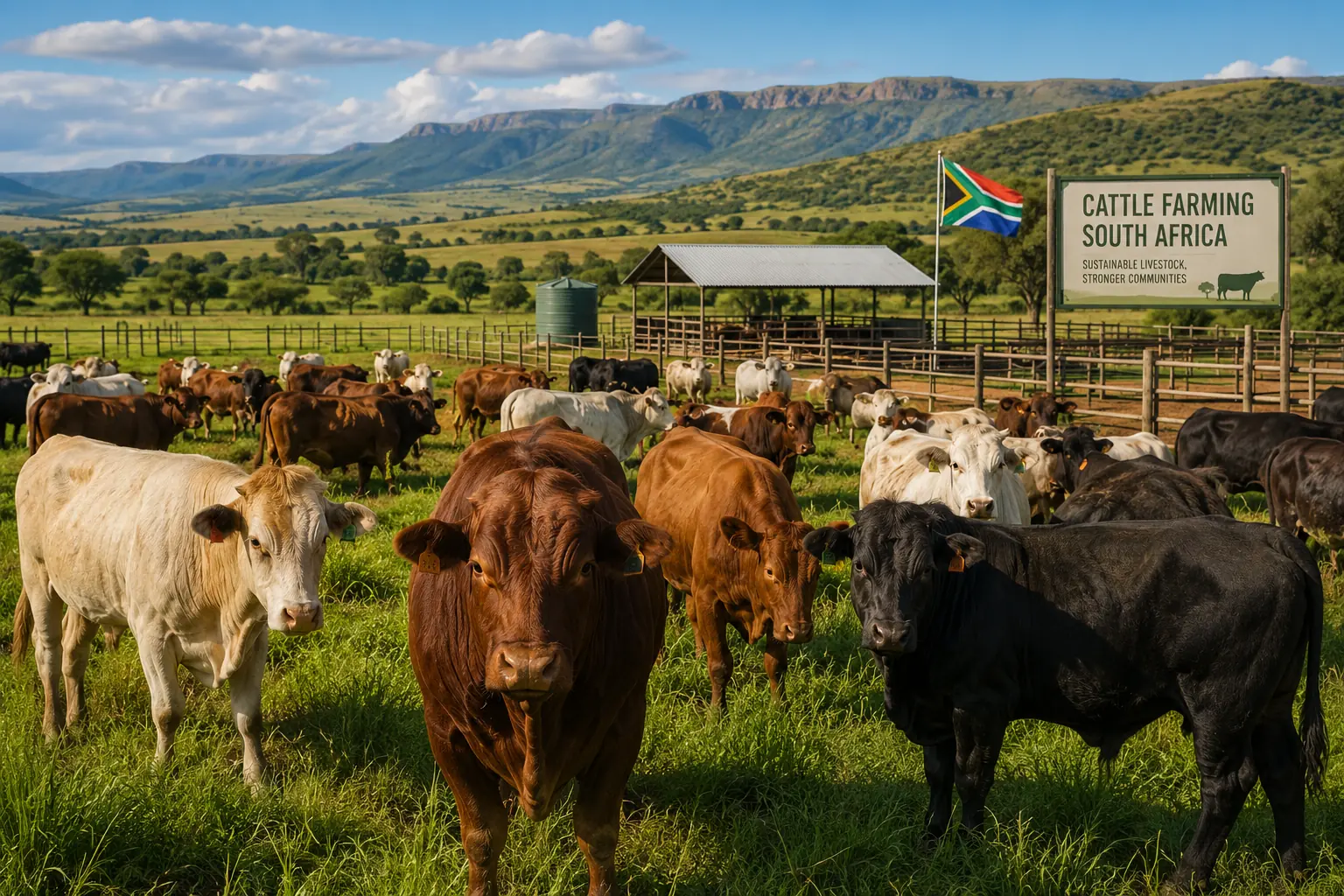
Breed selection is among the most important decisions a South African cattle farmer makes. The wrong breed for your region, climate, and management system leads to high mortality, poor reproduction rates, and disappointing carcass weights. South Africa's diverse climates (from subtropical lowveld to semi-arid Karoo to temperate highveld) demand different breed characteristics.
Bonsmara
The Bonsmara is South Africa's most successful indigenous composite breed, developed specifically for South African conditions. It carries approximately 37.5% Hereford, 37.5% Shorthorn, and 25% Brahman genetics. The result is a medium-framed, heat-tolerant, tick-resistant beef animal with excellent fertility and good carcass quality. The Bonsmara is suitable for most of South Africa outside the extreme semi-arid Karoo and is the default choice for many commercial producers in Limpopo, Mpumalanga, and the Free State.
Brahman
The Brahman (Bos indicus) thrives in the hot, humid subtropical conditions of the Limpopo lowveld and KZN coast better than any European breed. Its tick resistance, heat tolerance, and ability to maintain condition on low-quality roughage make it well-suited to extensive grazing systems. Its primary limitation is a slightly lower carcass yield and less tender beef compared to European-derived breeds, though crossbreeding with Angus or Simmentaler addresses this effectively.
Nguni
The Nguni is South Africa's indigenous Sanga-type cattle, carrying centuries of natural selection for local disease resistance, heat tolerance, and survival on sparse veld. Nguni cows have exceptional maternal instincts, good fertility even under harsh conditions, and produce beef with growing market recognition under the Nguni Beef brand. For smallholder and emerging farmers with limited inputs, the Nguni offers a resilient, low-cost production option. Pure Nguni beef commands premium prices in niche markets and agri-tourism settings.
Angus and Hereford
British breeds like the Angus and Hereford are valued for high-quality carcasses with excellent marbling, making them preferred breeds for premium beef markets and branded beef schemes. They are best suited to the cooler, higher-rainfall regions of the Eastern Cape, Western Cape, and parts of the Free State and KZN highlands. Heat stress limits their performance in the lowveld and subtropical regions.
Simmentaler
The Simmentaler is a large-framed dual-purpose breed (beef and dairy characteristics) popular in South Africa for its growth rate and carcass weight. It is widely used as a crossbreeding sire to improve carcass weight on indigenous breed cows. Simmentalers perform well in higher-rainfall mixed farming regions.
Veld and Grazing Management
In South Africa's extensive cattle farming systems, the natural veld is the primary feed resource. Sustainable veld management is therefore not just an environmental consideration. It is a direct determinant of farm profitability. Overgrazed veld loses productivity rapidly, leading to a downward spiral of lower carrying capacity, reduced cattle weights, and reduced income. Properly managed veld, in contrast, improves in productivity over time and supports higher stocking rates sustainably.
Stocking Rate
Getting the stocking rate right for your specific veld type is fundamental. The appropriate stocking rate varies enormously across South Africa's biomes, from as low as one large stock unit (LSU) per 20–30 hectares in the arid Nama Karoo to as high as one LSU per 3–5 hectares in the moist Highveld grassland. Consult your provincial Department of Agriculture or a veld management specialist to determine the appropriate stocking rate for your specific farm and veld type.
Rotational Grazing
Rotational grazing (moving cattle between several camps in a planned rotation) significantly outperforms continuous grazing in most South African veld types. It allows adequate recovery time for grazed plants, prevents selective overgrazing of preferred species, and maintains a more diverse and productive plant community over time. A basic four-camp rotational system, with cattle in each camp for no more than 20–30 days, is a practical starting point for farmers transitioning from continuous grazing.
Bush Encroachment
Bush encroachment (the invasion of productive grassland and savanna by dense thicket or woody shrubs) is consistently among the most serious veld degradation problems in South African cattle farming, particularly in Limpopo, Mpumalanga, and KwaZulu-Natal. Regular planned burning, mechanical clearing, and appropriate stocking rates are the primary tools for controlling encroachment and maintaining productive grazing land.
Supplementary Feeding
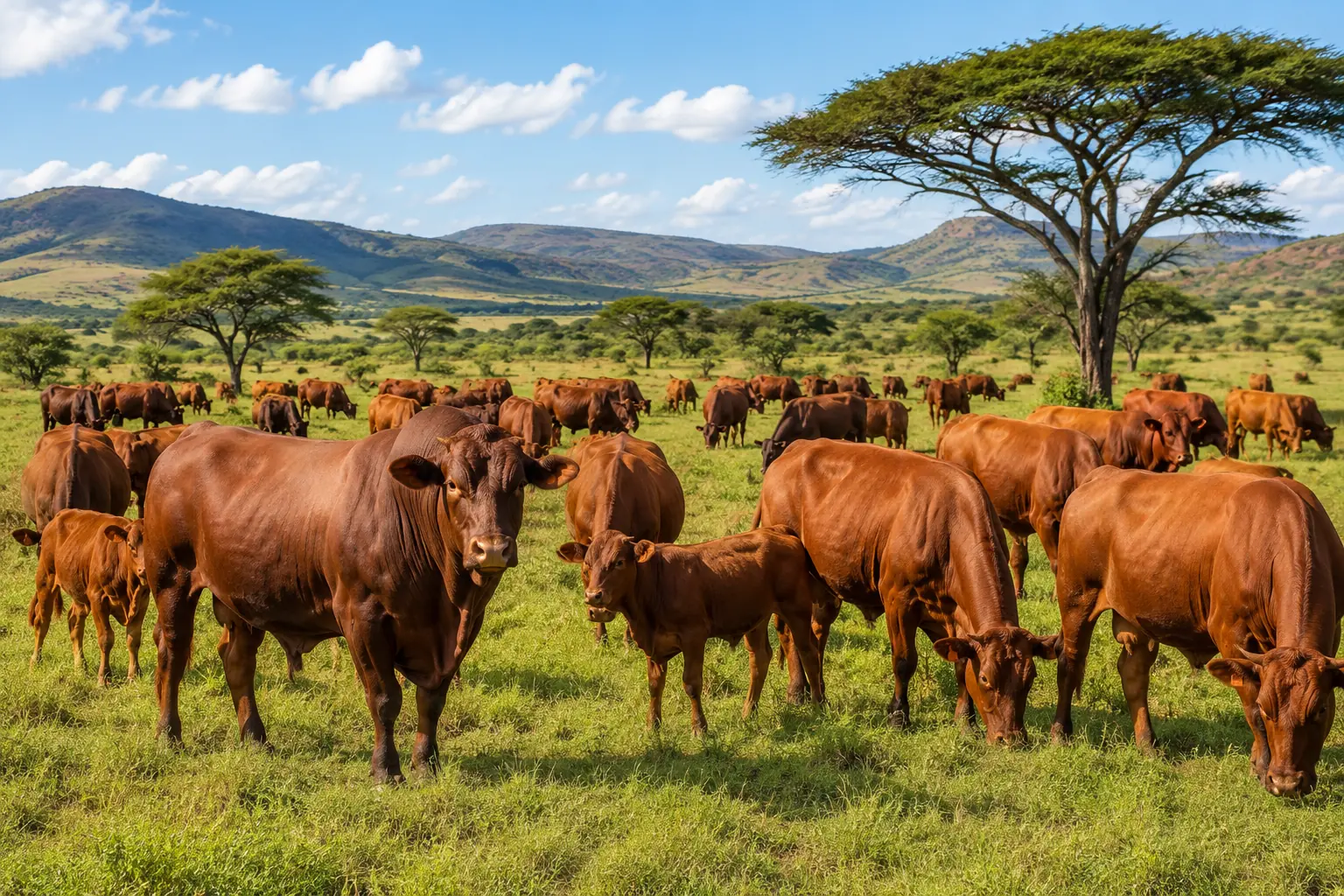
Natural veld alone is rarely sufficient to maintain optimal cattle condition and production performance year-round in South Africa. The dry season (typically May to October in summer-rainfall regions) sees veld quality drop sharply as grasses dry out and lose their nutritional value. Supplementary feeding bridges this nutritional gap and prevents excessive condition loss, particularly in pregnant and lactating cows.
Key supplementary feeding strategies include:
- Phosphorus licks: Phosphorus deficiency is the single most common and economically significant mineral deficiency in South African cattle. It causes reduced growth, poor fertility, and in severe cases, pica (bone chewing). Year-round phosphorus supplementation via lick blocks or loose licks is standard practice on most South African cattle farms.
- Protein licks: In the dry season, when veld grass is low in crude protein (often below 5%), protein lick supplementation significantly improves rumen function, voluntary feed intake, and body condition maintenance. Non-protein nitrogen (NPN) licks using urea are widely used in South Africa as a cost-effective dry-season protein source.
- Energy supplementation: In severe dry seasons or drought conditions, energy supplementation with grain (maize, grain sorghum) or roughage (hay, silage) may be necessary to prevent excessive weight loss and reproductive failure.
- Salt and trace minerals: Year-round access to salt and trace mineral licks is inexpensive and supports general cattle health and immune function.
Reproduction and Herd Management
Reproductive efficiency is the primary driver of cattle farm profitability. A cow that fails to calve every 12–14 months is among South Africa's most costly unproductive assets in any farming operation. Improving calving rate from 65% (common in poorly managed herds) to 85–90% dramatically increases annual calf crop numbers without any increase in cow numbers or land area.
Bull Management
A bull-to-cow ratio of 1:25 to 1:35 is standard for natural service in South African beef herds. Bulls should be fit-for-service tested (FST) by a veterinarian or AI technician annually before the breeding season to confirm semen quality, physical soundness, and libido. Introducing sub-fertile or lame bulls into a herd is a silent cause of low calving rates that often goes undiagnosed for an entire season.
Controlled Mating Seasons
A defined mating season of 60–90 days, rather than year-round breeding, concentrates calving in a defined period, improves the uniformity of the calf crop for weaning and marketing, and enables the farmer to identify and cull cows that fail to fall pregnant. Controlled mating is standard practice on well-managed commercial farms.
Artificial Insemination and Synchronisation
AI technology, combined with oestrus synchronisation protocols, allows smallholder and commercial farmers to access superior genetics at a fraction of the cost of buying a top sire. Several South African AI companies and veterinary practices provide synchronisation and AI services. Frozen semen from South Africa's top Bonsmara, Nguni, Angus, and Brahman bulls is available through Stud Africa and other semen suppliers.
Health and Disease Management
Disease control is a major operating cost and risk management priority in South African cattle farming. A structured preventive health programme (rather than reactive treatment of sick animals) is far more cost-effective and protects production performance year-round.
Tick-Borne Diseases
Ticks and tick-borne diseases (East Coast fever, heartwater, anaplasmosis, and babesiosis/redwater) are the most significant disease challenge in South African cattle farming, particularly in the subtropical eastern half of the country. A strategic tick control programme using dipping, pour-on, or injectable acaricides, combined with appropriate vaccine use where available, is essential. The timing and frequency of tick treatments must be calibrated to your specific region's tick species and infestation patterns.
Foot-and-Mouth Disease (FMD)
FMD is endemic in parts of northern South Africa, particularly in the Limpopo FMD control zone near the Kruger National Park. Farmers in control zones are required to vaccinate cattle biannually. Movement controls apply to cattle from FMD-affected zones. Always confirm your farm's FMD zone status with the Department of Agriculture before purchasing or moving cattle.
Annual Vaccination Programme
A basic annual vaccination programme should include coverage for blackquarter (Clostridium chauvoei), botulism (particularly in phosphorus-deficient areas), and bovine viral diarrhoea (BVD). Lumpy skin disease vaccination is increasingly important in South Africa following its spread southward in recent years. Consult your veterinarian for a programme tailored to your region's specific disease risks.
Internal and External Parasites
Strategic deworming of calves and young stock against roundworms (particularly Cooperia, Haemonchus, and Ostertagia species) is important on sourveld and in higher-rainfall regions. Resistance to benzimidazole dewormers is well-documented in South African cattle nematodes, use combination treatments and rotate chemical classes based on faecal egg count monitoring.
Feedlotting and Finishing
Many South African commercial beef operations involve a finishing phase in a feedlot before slaughter, whether on-farm or through commercial feedlot operators. Feedlotting allows producers to increase carcass weights, improve fat cover, and achieve the A-grade carcass classification that commands the best prices at abattoir. South Africa's formal feedlot industry processes approximately 4–5 million cattle per year, with major feedlots concentrated in the Free State, North West, and Limpopo.
For farmers considering on-farm feedlotting, a minimum slaughter weight of 450–520 kg live weight is typically required to achieve A-grade carcass classification at South African abattoirs. Concentrate diets based on maize, cottonseed cake, and silage are standard in South African feedlots, with typical daily feed intakes of 8–11 kg dry matter per animal and average daily gains of 1.4–2.0 kg/day under good management.
Marketing and Selling Cattle in South Africa
South African beef producers have several market channels available, each with different price dynamics, requirements, and logistics:
- Livestock Auctions: Agricultural auctions through companies like Senwes, NWK, Afgri, and regional livestock auctioneers are the primary sales channel for commercial cattle in South Africa. Prices are publicly determined and transparent. Quality, condition score, and breed type significantly affect auction prices. Consignment fees typically range from 3–5%.
- Abattoir Direct: Selling directly to an approved abattoir on a per-kilogram carcass weight basis allows producers to capture value from well-finished animals. Carcass classification (A, AB, B) and fat cover score directly determine price. Benchmark your carcass performance data against current RMAA (Red Meat Abattoir Association) price schedules.
- Branded Beef Schemes: Premium branded beef programmes (Nguni Beef, Cape Grim, various retailer-linked programmes) pay premiums for specific breed, age, or welfare standards. Access typically requires certification and volume commitments.
- Informal Market: For smallholder and communal farmers, local informal butcheries and direct sales at cultural events represent important market channels without formal certification requirements.
🐄 Key Success Factors for SA Cattle Farming
- Match your breed to your climate and veld type, a Friesland cow in the Limpopo bushveld will struggle; an Nguni or Brahman will thrive.
- Supplement phosphorus year-round without fail. It is the most commonly deficient mineral in South African grazing systems.
- Implement a controlled mating season and test bulls for fertility before each breeding season.
- Monitor and manage your veld condition. It is your most valuable production asset.
- Vaccinate against blackquarter, lumpy skin disease, and region-specific diseases annually.
⚠️ Disclaimer
This guide is for general educational purposes. Breed performance, disease risks, and market conditions vary by province and season. Consult a registered veterinarian for health programmes and a certified animal scientist or agricultural extension officer for production advice specific to your farm.