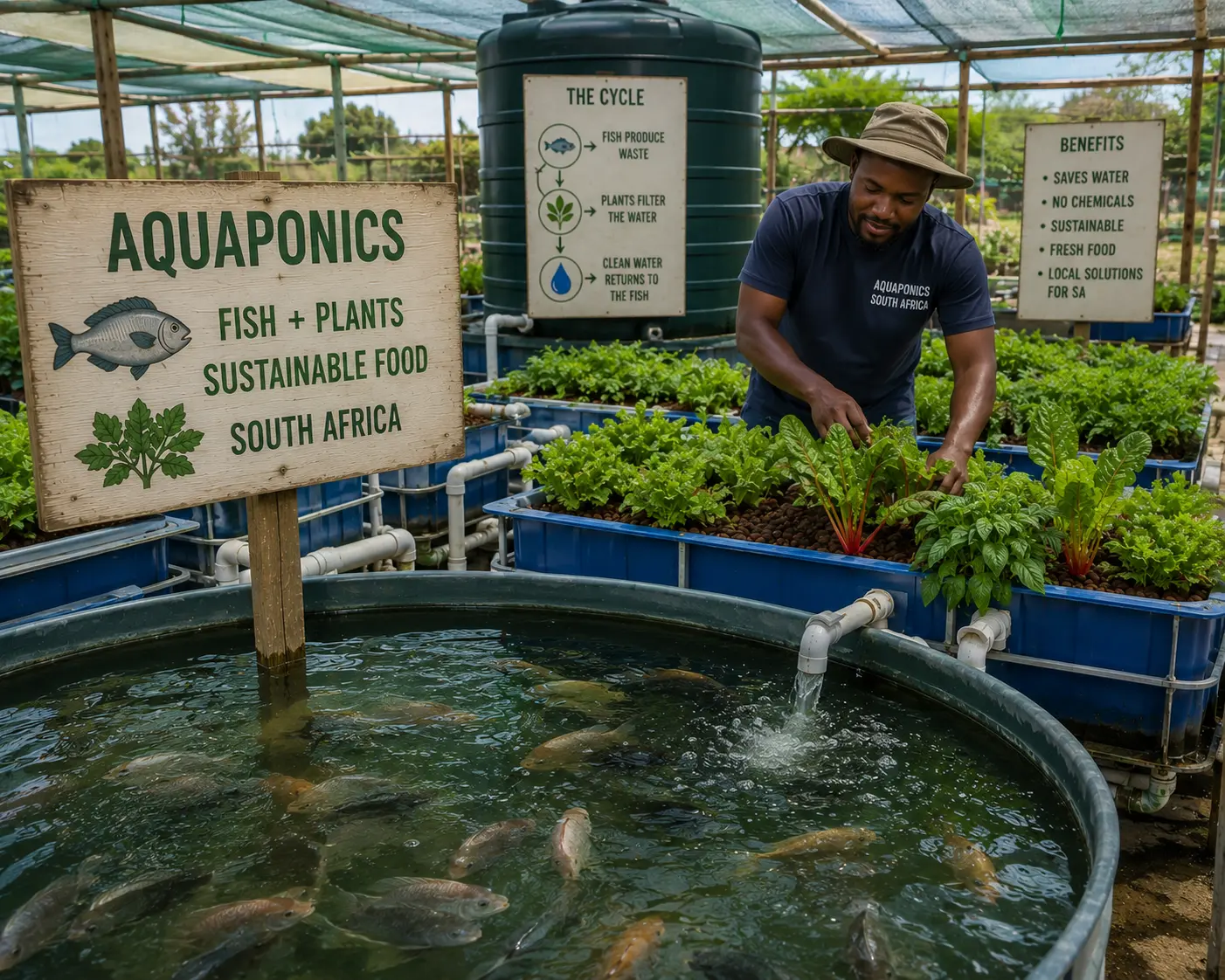
How Aquaponics Works: The Science in Plain Language
The aquaponics cycle works in three stages. First, fish eat feed and produce ammonia-rich waste in the water. Second, beneficial bacteria (naturally colonising in the gravel or grow media of the plant beds) convert that ammonia into nitrites and then nitrates, the nutrients plants need to grow. Third, the plant roots absorb those nitrates, cleaning the water, which is then pumped back to the fish tank ready for another cycle. This process is called the nitrogen cycle and it is the biological engine at the heart of every aquaponics system.
Because the bacteria do the heavy work of nutrient conversion, there is no need for synthetic fertilisers. The vegetables grow faster than in soil because nutrients are delivered directly to the roots, dissolved in water. Many SA aquaponics farmers report that lettuce and spinach grown in their systems reach harvest size 30–50% faster than the same crops grown outdoors in soil.
🌱 SA Tip: Pair Tilapia with Spinach
For first-time aquaponics farmers in South Africa, the winning combination is Mozambique tilapia (Oreochromis mossambicus) paired with spinach or Swiss chard. Tilapia are hardy, eat cheaply, grow fast, and are well-suited to SA temperatures. Spinach is South Africa's most-searched vegetable and sells easily at markets, taxi ranks, and spaza shops.
Best Fish Species for South African Aquaponics
Not all fish are equally suited to aquaponics. The ideal species must be hardy, tolerant of the nitrogen cycle fluctuations that occur during system start-up, capable of growing on affordable commercial feed, and marketable to local consumers. In South Africa, the following species are most commonly used:
| Fish Species | Ideal Temp (°C) | Time to Harvest | Best Region |
|---|---|---|---|
| Mozambique Tilapia | 22–30°C | 6–8 months | KZN, Limpopo, Mpumalanga |
| Blue Tilapia | 18–28°C | 7–9 months | Gauteng, North West |
| Catfish (Clarias) | 22–28°C | 8–10 months | Limpopo, Mpumalanga |
| Rainbow Trout | 12–18°C | 10–14 months | Western Cape, Drakensberg |
| Goldfish / Koi | 10–25°C | N/A (ornamental) | All provinces |
| Common Carp | 15–25°C | 12–18 months | Free State, Northern Cape |
Tilapia remains the top choice for the majority of South African aquaponics operations. They are indigenous to much of sub-Saharan Africa, which means they tolerate local pathogens and temperature fluctuations better than exotic species. Importantly, tilapia is widely eaten across all communities in SA, ensuring a ready local market.
If you are located in the cooler regions of the Western Cape or the Drakensberg foothills, rainbow trout is an excellent alternative that commands a premium price in restaurants and at fresh produce markets. However, trout require precise water temperature management and are less forgiving of system fluctuations. They are better suited to intermediate or experienced aquaponics operators.
Best Plants to Grow in an SA Aquaponics System
Almost any vegetable can be grown in an aquaponics system, but leafy greens and herbs are the most productive and the fastest to market. Plants with high nitrogen demand perform particularly well, since the fish waste provides an abundant supply of nitrates.
The top-performing plants for South African aquaponics systems include:
- Spinach and Swiss chard, fastest growing, highest demand, easiest to sell
- Lettuce (all varieties), 28–35 days to harvest, excellent for restaurant and retail supply
- Basil and coriander, high-value herbs, quick turnover, popular in urban markets
- Kale and morogo, strong demand in township food markets and health stores
- Tomatoes and cucumbers, higher nutrient demand, suitable for mature systems with high fish density
- Peppers, good income potential, slower growth than leafy greens
- Chillies, excellent market value, particularly for spice processors and informal traders
For beginners, it is strongly recommended to focus on two or three leafy greens initially. They are forgiving, quick to harvest, and help you understand the water chemistry of your system before introducing more demanding fruiting plants. See our guide on spinach farming in South Africa for more on this versatile crop.
How to Set Up an Aquaponics System in South Africa
Setting up your first aquaponics system does not require a large capital investment or advanced technical knowledge. A functional backyard system can be built for as little as R3,000–R8,000 using locally available materials. A commercial-scale greenhouse operation typically requires between R80,000 and R300,000 depending on size and automation level.
System Types Available in South Africa
There are three main aquaponics system designs, each with different advantages for South African conditions:
- Media Bed (Flood & Drain): The most beginner-friendly system. Fish tank water floods the plant grow beds (filled with gravel or clay pebbles) on a timer, then drains back. Excellent for leafy greens and herbs. Most common in SA backyard and community setups.
- NFT (Nutrient Film Technique): Plants grow in angled PVC pipes with a thin film of fish water continuously flowing past the roots. Fast growing, space-efficient, but requires more precision. Suited to experienced operators growing lettuce and herbs at volume.
- Deep Water Culture (DWC) / Raft System: Plants float on polystyrene rafts in long channels filled with fish water. Highly productive at scale, popular in commercial SA operations targeting supermarket supply.
Essential Equipment List
- Fish tank (IBC tote, fibreglass tank, or lined concrete, 1,000L minimum for a productive system)
- Grow beds (same volume as fish tank as a starting ratio)
- Submersible water pump (sized for your tank volume, typically 1,500–3,000 L/hr)
- Air pump and air stones (for fish tank oxygenation)
- Grow media (expanded clay pebbles or washed gravel, 10–20mm size)
- PVC pipes and fittings for plumbing
- Bell siphon or timer for flood & drain cycle
- Water test kit (ammonia, nitrite, nitrate, pH)
- Fish feed (tilapia pelavailable from most SA agri co-ops and feed suppliers)
- Fingerlings, sourced from licensed SA fish hatcheries
⚠️ Important: System Cycling
Before adding fish, your new aquaponics system must go through a nitrogen cycling period of 4–6 weeks. During this time, beneficial bacteria establish in the grow media. Adding fish to an uncycled system will cause ammonia spikes that kill your fish. Test water daily during cycling and only add fish once ammonia and nitrite readings are at zero.
Water Quality: The Key to Aquaponics Success
Unlike soil farming, aquaponics success is almost entirely determined by water quality management. There are five critical parameters that SA aquaponics farmers must monitor regularly:
- pH: Ideal range is 6.8–7.2. Tilapia prefer slightly alkaline water; most plants prefer slightly acidic. The compromise zone of 6.8–7.2 suits both. SA tap water is often alkaline, you may need to adjust downward with pH-down solution or dilute vinegar.
- Ammonia (NH3): Should be 0–0.5 ppm in a cycled system. Spikes above 2 ppm are toxic to fish and indicate overfeeding or insufficient biological filtration.
- Nitrite (NO2): Should be 0 ppm in a mature system. Elevated nitrites indicate incomplete nitrogen cycling.
- Nitrate (NO3): Your target nutrient for plants, maintain 20–150 ppm for good plant growth.
- Dissolved Oxygen (DO): Fish need at least 5 mg/L. In South African summer heat, oxygen drops, ensure good aeration with air stones and surface agitation.
Aquaponics in South African Provinces: What Works Where
South Africa's diverse climate means aquaponics looks different across the country. In KwaZulu-Natal and Limpopo, the warm subtropical climate is ideal for tilapia and means greenhouse heating is rarely needed, reducing operating costs. In Gauteng, the moderate highveld climate suits most species but winters can be cold enough to slow growth, simple greenhouse covering or heating during June and July is advisable.
In the Western Cape, the Mediterranean climate means warm dry summers and cool wet winters. Trout aquaponics thrives here in winter, while tilapia systems need insulation or heating. Cape Town has a particularly strong market for premium organic produce, an aquaponics operation supplying restaurants and organic markets in the Cape can command excellent prices. In the Northern Cape and Free State, water scarcity makes aquaponics especially attractive, the 90% water saving compared to field crops is a compelling economic argument in these arid provinces.
Business Model: What Can You Earn from Aquaponics in SA?
A small home-scale system (1,000L fish tank, 1,000L grow bed) producing tilapia and spinach can generate a meaningful supplementary income. A 1,000L system stocked at appropriate density can produce approximately 30–50 kg of tilapia per cycle (6–8 months) and continuous weekly harvests of leafy greens worth R500–R1,500 per week depending on what you grow and your local market.
Commercial operations in South Africa targeting restaurants, retail, and fresh produce markets typically operate 10,000L+ systems with multiple grow channels and dedicated greenhouse infrastructure. These operations can generate R40,000–R120,000 per month in revenue at full capacity. Many successful SA aquaponics entrepreneurs have started small and reinvested profits to scale their systems over 2–3 years.
Key markets for SA aquaponics produce include: fresh produce markets, restaurant supply (especially in Cape Town, Johannesburg, and Durban), organic food retailers, community food boxes (CSA schemes), schools, and hospitals. See our export farming guide if you plan to scale to export markets.
Grants and Support for Aquaponics Farmers
South African aquaponics farmers can access several government and private funding streams. The Department of Agriculture, Forestry and Fisheries (DAFF) and its successor the DALRRD have supported aquaculture and aquaponics development under various programmes. The CASP (Comprehensive Agricultural Support Programme) and Ilima/Letsema conditional grants can fund infrastructure including tanks, pumps, and greenhouse structures. Visit our dedicated farming grants page for a full breakdown of what's available and how to apply. The Industrial Development Corporation (IDC) also provides loans for commercial aquaponics operations with a proven business plan.