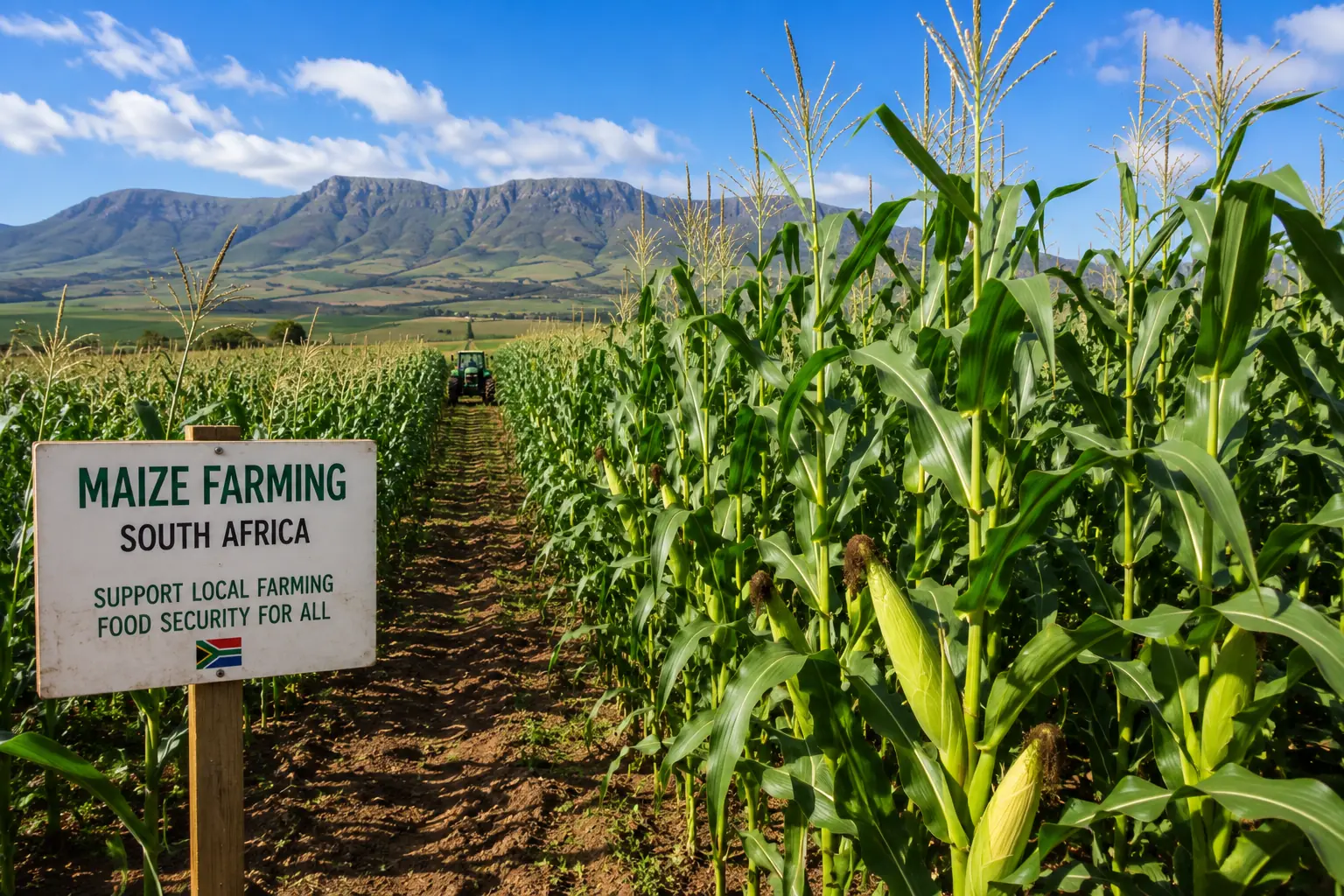
Maize Production Regions and Planting Dates in South Africa
South Africa's maize production is concentrated in the summer-rainfall regions of the central and northern interior. Climate, rainfall, frost dates, and growing degree days vary significantly across provinces and determine planting windows, variety selection, and yield potential.
Maize Varieties: Choosing the Right Hybrid for SA Conditions
Variety selection is the most important single decision in SA maize production. Modern hybrid maize seed costs R2 500–R8 000 per bag (planted per hectare), so choosing correctly matters both agronomically and financially. Key selection criteria are:
- Relative maturity (RM): SA maize hybrids are classified as early (±100 days), medium (105–115 days), or full-season (115–130 days). Match your variety's RM to your planting date, available growing season, and frost risk. Later-planted maize should use shorter-season varieties to ensure maturity before autumn frosts.
- Colour: White maize for human consumption (higher market demand and historically price premium in SA). Yellow maize for animal feed and export. Some SA farmers grow both to access multiple markets.
- Disease resistance: Grey leaf spot resistance is critical in high-humidity zones (Mpumalanga, KZN, Eastern Limpopo). Streak virus resistance is important in KZN and Eastern Cape. Stalk rot resistance improves harvestability and reduces standability losses.
- Drought tolerance: Increasingly important across all SA maize regions as rainfall becomes more erratic. Certified drought-tolerant hybrids can maintain yields 15–25% higher than conventional hybrids in moderate drought years.
- GMO vs non-GMO: SA permits the cultivation of GM (herbicide-tolerant and insect-resistant) maize hybrids under the GMO Act. Bt maize (insect-resistant) provides effective protection against African maize stalk borer (Busseola fusca) and is widely used on commercial SA farms. Herbicide-tolerant (HT) maize simplifies weed control. Non-GMO varieties are preferred by some niche markets and for export to certain countries.
Major SA maize seed suppliers include Pannar Seed, Pioneer (Corteva), Dekalb (Bayer), Nuseed, Klein Karoo Saad, and Sensako. Local co-ops and agri-stores carry regional variety trials data, always consult local yield trial results rather than relying solely on company promotion material.
Soil Preparation and Planting Maize in South Africa
Maize performs best in deep, well-drained, fertile soils with a pH of 5.5–6.5. On most SA maize soils, annual disc harrowing and periodic deep ripping (every 3–5 years to break tillage pans) are standard. Conservation tillage and no-till planting systems are increasingly adopted on SA commercial maize farms to reduce costs, improve water infiltration, and preserve soil health.
Planting population in South Africa varies by rainfall zone and variety: 20 000–25 000 plants/ha in the low-rainfall Northern Cape and North West; 25 000–35 000 plants/ha in the medium-rainfall Free State and Gauteng; and 35 000–45 000 plants/ha in high-rainfall irrigated production. Row spacing is typically 0.9m for dryland and 0.75m or 0.9m for irrigated maize.
Planting depth should be 5–6cm in sandy soils and 3–5cm in clay soils, into adequate moisture. SA farmers using planters with seed press wheels ensure good seed-to-soil contact, which is critical for uniform germination. Planting into dry soil (dry planting) is practised in some dryland areas, the seed is placed into the profile and waits for the first rain to germinate.
In South African dryland maize, timely planting is the most important management decision. Delayed planting (even by 2–3 weeks past the optimal window) consistently reduces yield potential by 10–30% due to reduced growing season length, heat stress during pollination, and increased disease pressure. When the conditions are right, plant immediately, don't wait for perfect.
Fertilisation of Maize in South Africa
Maize is a heavy feeder. A 10-tonne-per-hectare maize crop removes approximately 170 kg of nitrogen (N), 70 kg of phosphorus pentoxide (P₂O₅), and 150 kg of potassium oxide (K₂O) from the soil. Fertilising to replace these nutrients is essential for maintaining soil productivity over successive seasons.
Nitrogen Management
Nitrogen is the most critical and most expensive nutrient in SA maize production. The recommended nitrogen programme for most SA maize regions is split application: 30–40 kg N/ha as a basal application at planting (incorporated or banded), followed by 80–120 kg N/ha as a top-dress application at the V4–V6 stage (4–6 leaf stage, approximately 3–4 weeks after emergence). Total nitrogen typically ranges from 80–160 kg N/ha depending on yield target, soil type, and previous crop history.
Urea (46% N) and LAN (limestone ammonium nitrate, 28% N) are the most widely used nitrogen fertilisers in SA maize production. Urea is cheaper per kg of N but requires incorporation or rainfall within 48 hours of application to prevent volatilisation losses, critical in SA's high-temperature summer conditions.
Phosphorus and Potassium
Phosphorus (P) is essential for root development and early plant establishment. Most SA maize farmers apply P as part of a compound fertiliser (e.g., 3:2:1 or 2:3:2 NPK blend) at planting. On phosphorus-deficient soils (common on many SA smallholder and communal area soils) a basal phosphorus application can double early-season growth compared to nitrogen-only fertilisation. Potassium deficiency is less common on most SA clay soils but important on sandy soils typical of the Northern Cape and parts of North West and Mpumalanga.
Weed Control in SA Maize
Weeds are among the most significant yield-reducing factors in SA maize, particularly on smallholder and communal farms where timely mechanical or chemical weed control is often delayed. The critical weed-free period for maize is from emergence to the V6–V8 stage, weeds allowed to establish and compete during this window can reduce yield by 30–60%. After V8, the maize canopy shades out most weeds effectively.
Herbicide programmes for SA maize depend on weed spectrum, soil type, and whether GMO herbicide-tolerant varieties are used. Common pre-emergence herbicide options include atrazine (broadleaf weeds) and acetochlor or metolachlor (grass weeds). Post-emergence options for conventional maize include a combination of atrazine + oil, or nicosulfuron for grass weeds. Herbicide-tolerant maize (HT/RR) allows post-emergence glyphosate application directly over the crop, a very effective and simple weed control system increasingly used on SA commercial farms.
Fall Armyworm: South Africa's Most Devastating Maize Pest
Fall Armyworm (Spodoptera frugiperda, FAW) arrived in South Africa in 2016 and has since become the single most damaging insect pest of SA maize. FAW larvae feed primarily in the whorl of young maize plants (V2–V6 stage), consuming leaf tissue and causing characteristic ragged window-feeding damage. Severe infestations can kill growing points and reduce yields by 20–70% if uncontrolled.
FAW management in SA combines: early scouting (walk fields weekly from V2 to V8, looking for whorl feeding damage and frass); timely insecticide application when damage thresholds are reached (more than 20% of plants infested with live larvae in the whorl); Bt maize hybrids which express Cry proteins toxic to FAW larvae; and biological control agents (parasitoid wasps, nuclear polyhedrosis virus products) increasingly available in SA.
Harvesting and Storage of SA Maize
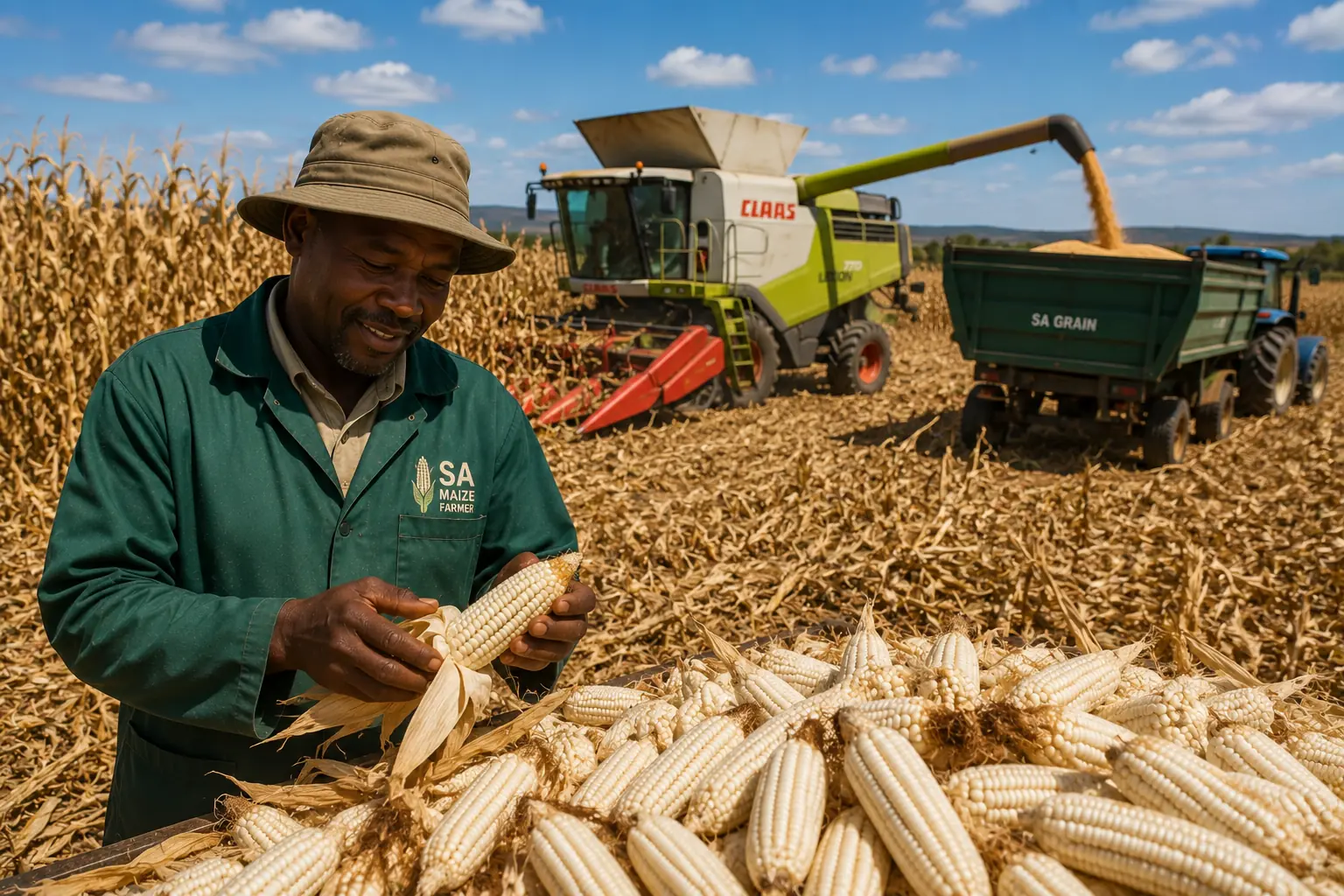
Maize in South Africa is typically harvested mechanically by combine harvester when grain moisture reaches 14–18%. The SA maize harvest runs from late March through June, depending on province, planting date, and variety maturity. Most commercial SA maize is delivered to registered silo facilities (grain elevators operated by co-ops and private companies) where it is graded, dried if necessary, and stored or marketed through the SA Futures Exchange (SAFEX) or forward contracts.
On-farm storage is an option for farmers with silo bags, metal bins, or concrete silos. Grain must be dried to below 13.5% moisture before storage to prevent aflatoxin contamination, weevil damage, and quality deterioration. Aflatoxin, produced by Aspergillus fungi on improperly stored maize, is a serious food safety risk in SA and disqualifies grain from the human consumption market if contamination levels exceed regulatory thresholds.
National average yield: 4.1 t/ha (dryland) | Top commercial dryland: 8–10 t/ha | Irrigated: 12–16 t/ha | White maize price (SAFEX 2025–26): R4 800–R5 500/tonne | Yellow maize price: R4 600–R5 200/tonne | Input cost range: R6 000–R15 000/ha depending on system and intensity