Canola farming has quietly become consistently among the potentially profitable oilseed crops in South Africa's grain belt. Known for its brilliant yellow flowers that blanket the Western Cape's Swartland and Overberg regions each winter, canola is far more than a pretty landscape. It is a high-value cash crop that fits perfectly into a wheat rotation system, improves soil structure, and commands strong prices from South African crush facilities and export terminals.
For farmers who are a commercial farmer looking to diversify beyond wheat or a smallholder exploring oilseeds for the first time, this guide breaks down everything you need to succeed with canola in South African conditions: cultivar selection, soil preparation, planting windows, fertilization, pest and disease management, harvesting, and how to get the best price for your crop.
Why Grow Canola in South Africa?
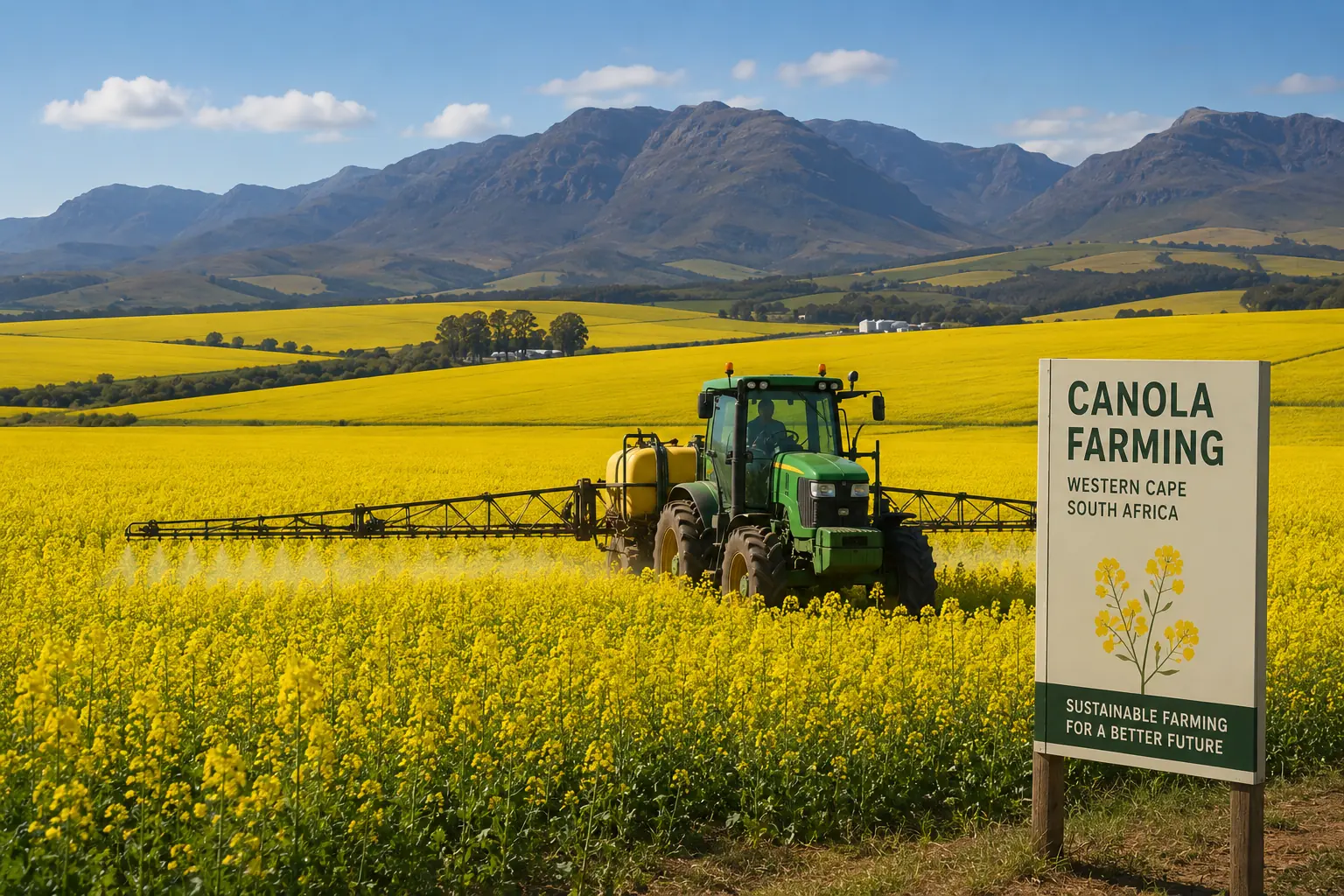
South Africa produces canola almost exclusively in the Western Cape Province, with the Swartland and Overberg regions accounting for the overwhelming majority of the national crop. Despite this geographic concentration, demand for canola oil, canola meal, and biodiesel feedstock has been growing steadily, and South Africa has historically been unable to produce enough to meet domestic crushing demand, meaning reliable market access for well-managed canola farms.
From an agronomic standpoint, canola offers powerful rotational benefits when planted before or after wheat. It breaks cereal disease and pest cycles, improves soil porosity through its deep taproot system, and leaves a residue that subsequent crops can utilize. Farmers who include canola in a canola-wheat-wheat rotation commonly report improved wheat yields in the seasons following canola, sometimes by as much as 15–20%.
Canola also has favourable economics. At typical yield levels of 1.5 to 2.5 tonnes per hectare under dryland conditions (and up to 3.5 tonnes per hectare under irrigation) and with South African farm-gate prices typically ranging between R6,500 and R9,500 per tonne depending on quality and season, canola can deliver gross revenues that compete strongly with wheat on a per-hectare basis, especially when rotational yield benefits are factored in.
Where in South Africa Can You Grow Canola?
Canola is a cool-season crop that thrives in winter rainfall areas and is not suited to the summer rainfall interior of South Africa without supplemental irrigation. The main production regions are:
Western Cape, Swartland
The Swartland district (encompassing towns like Malmesbury, Moorreesburg, Piketberg, and Porterville) is the heartland of South African canola production. The region's Mediterranean climate (wet winters, dry summers) is almost perfectly matched to canola's growth requirements. Annual rainfall of 400–550 mm, mostly falling between May and September, aligns directly with the crop's planting and growing window.
Western Cape, Overberg
The Overberg region, including the areas around Caledon, Bredasdorp, Napier, and Riversdale, is the second major canola-producing zone. The Overberg typically receives slightly higher rainfall than the Swartland and is known for producing good canola yields, particularly on the heavier wheat soils of the region.
Emerging Areas
Small-scale canola production has been trialled in parts of the Little Karoo, Northern Cape, and even some higher-altitude areas of the Free State under supplemental irrigation, but commercial-scale success outside the Western Cape remains limited. Farmers in these areas should conduct small-scale trials before committing significant land area to canola production.
Soil Requirements for Canola
Canola is moderately flexible in its soil requirements but delivers its best results in well-drained loam to clay-loam soils with a pH (KCl) of between 5.5 and 6.5. Heavy clay soils that waterlog easily are problematic, canola does not tolerate standing water, particularly during germination and the early seedling stage.
Before planting, a thorough soil analysis is essential. Key parameters to check include:
- pH (KCl): Target 5.5–6.5. Below 5.0, aluminium toxicity becomes a risk and lime application is necessary.
- Boron: Canola has a higher boron requirement than most cereal crops. Deficiency leads to hollow stems, poor pollination, and reduced seed set. Foliar boron applications at early flowering are a common practice.
- Sulphur: Canola is a brassica and has elevated sulphur needs. Many Western Cape soils are sulphur-deficient, and inclusion of sulphur in the fertilizer programme is standard practice.
- Phosphorus and Potassium: Adequate P and K levels are important for establishment and grain filling. Follow soil-test-based recommendations.
Subsoil compaction is a significant hidden yield-limiter in canola. Because the crop relies on its taproot to access deeper moisture reserves during grain fill, any hardpan layer within the top 60 cm can severely restrict yield potential. Deep ripping before establishment, followed by a conservation tillage programme, is advisable on compacted soils.
Cultivar Selection
South African canola farmers have access to a range of open-pollinated varieties (OPVs) and hybrid cultivars from both local and international breeding programmes. The choice between OPV and hybrid depends on your budget, market access, and yield targets.
Open-Pollinated Varieties (OPVs)
OPVs like Varola 50, Snowy, and Rainbow have been the backbone of the South African canola industry for decades. They are lower input cost, seed can be saved, and performance is well-understood in local conditions. For smallholders or farmers with tight input budgets, OPVs remain a practical choice.
Hybrid Cultivars
Hybrid canola cultivars generally offer a 10–20% yield advantage over OPVs under optimal management, along with improved uniformity and better harvestability. Leading hybrids used in South Africa include selections from the Bayer Dekalb range, Pioneer, and Nuseed catalogues. The tradeoff is higher seed cost and the inability to save seed, hybrid seed must be purchased fresh each season.
Always consult the Western Cape Department of Agriculture's annual cultivar evaluation reports and local agronomists when choosing cultivars for your specific area. Performance varies significantly between Swartland and Overberg conditions.
Planting Time and Establishment
Timing is everything with canola in South Africa. The crop must be planted into adequate early winter rainfall to achieve good establishment, while avoiding late plantings that push flowering and grain fill into the hot, dry Western Cape summer.
The ideal planting window for most of the Swartland and Overberg is late April to late May. Plantings before mid-April risk the seedlings encountering extended warm and dry conditions before winter rains establish. Plantings after the end of May progressively push key growth stages later into the season, reducing yield potential significantly.
Seeding Rate and Depth
Canola seed is very small, approximately 200,000–300,000 seeds per kilogram. Target a plant population of 50–80 plants per square metre for OPVs and 40–60 plants per square metre for hybrids, which translates to a seeding rate of roughly 3–5 kg/ha depending on cultivar and germination percentage. Seed should be placed at a depth of 15–20 mm in moist soil, not deeper, as the small seed struggles to emerge from depth.
Seedbed Preparation
A fine, firm seedbed is critical for even canola establishment. Because the seed is so small, cloddy or rough seedbeds lead to poor and uneven germination. Conventional tillage with a secondary pass using a disc harrow or vibrating tine cultivator to break down clods is standard practice. Under no-till or minimum-till systems, planters with good down-pressure and seed-soil contact capability can achieve adequate establishment, but field conditions must be carefully assessed.
Fertilization Programme
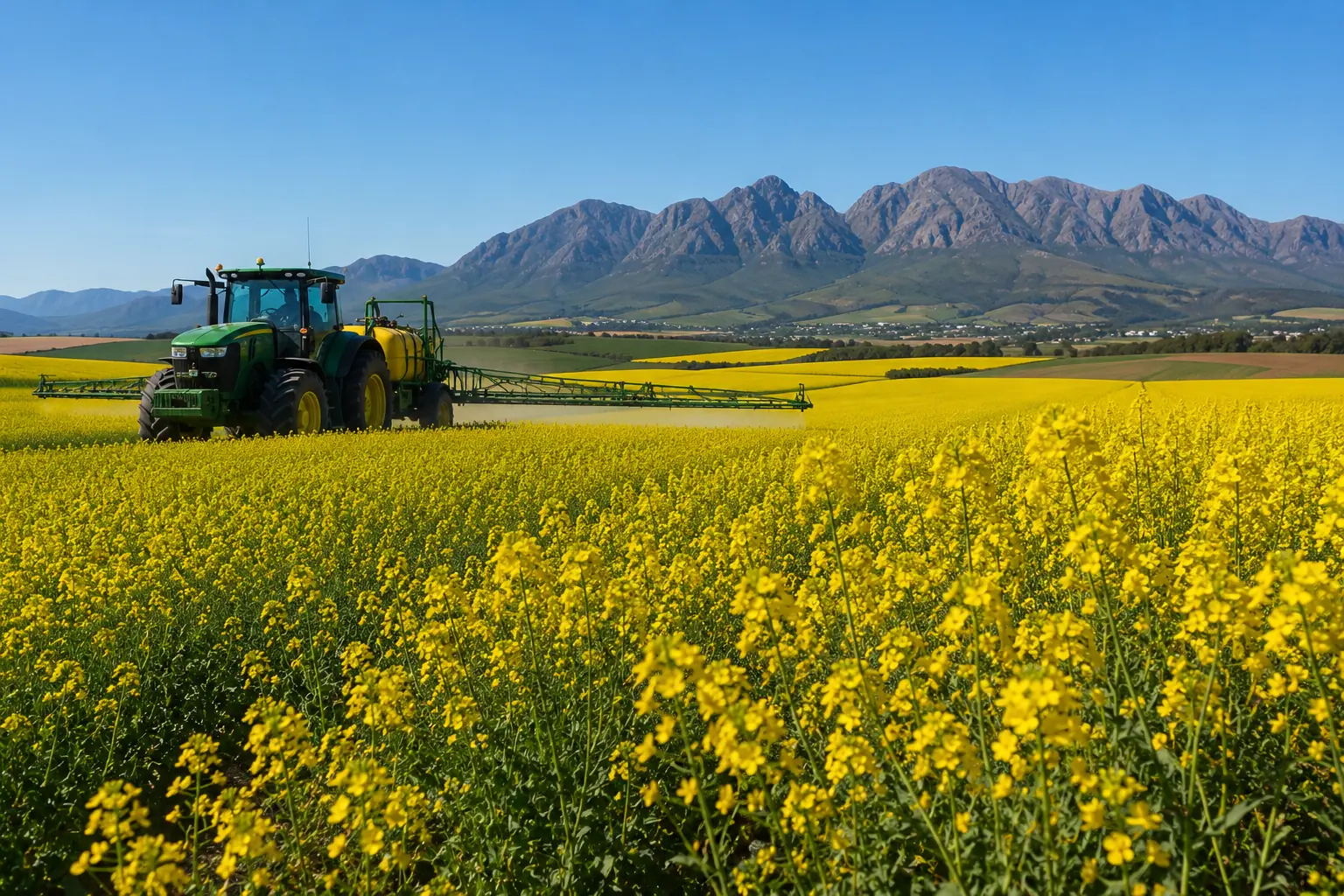
Canola is a nutrient-demanding crop. At a yield of 2 tonnes per hectare, canola removes approximately 80–100 kg of nitrogen, 40–50 kg of phosphate, and 80–100 kg of potassium per hectare. Unlike wheat, canola is also a significant sulphur consumer, plan for at least 20–30 kg S/ha in your fertilizer programme.
Nitrogen Management
Split nitrogen applications are strongly recommended for canola to match crop demand and minimize leaching losses over winter. A typical programme would apply 30–40% of the total nitrogen as a basal dressing at planting, with the remainder split between early stem elongation (approximately 8-10 leaf stage, or Zadoks equivalent GS30) and early flowering. Top-dressing with LAN (Limestone Ammonium Nitrate) is the most common approach in South African canola production.
Boron and Sulphur
A foliar boron application at early bud (GS50–51) and again at early flowering significantly reduces the incidence of hollow stems and improves seed set. Use a suitable foliar boron product at label-recommended rates. Sulphur can be incorporated in the basal compound fertilizer or applied as ammonium sulphate in early top-dressings.
Pest and Disease Management
Canola faces several significant pest and disease pressures in South African conditions. Proactive scouting and timely intervention are essential to protect yield potential.
Sclerotinia Stem Rot
Sclerotinia sclerotiorum is the most damaging fungal disease of canola in South Africa. The pathogen attacks stems at flowering, causing bleached, lodged plants and hollow pods with poor seed set. Management involves selecting cultivars with moderate sclerotinia tolerance, applying registered fungicides (typically carbendazim or boscalid-based products) at early flowering (20–30% of flowers open), and crop rotation to reduce soil inoculum levels.
Blackleg (Leptosphaeria maculans)
Blackleg is a serious stubble-borne disease that causes stem canker and premature ripening. Canola stubble from previous seasons harbours the pathogen. A minimum four-year break between canola crops on the same land is strongly recommended. Modern hybrid cultivars carry genes for blackleg resistance, prioritize resistance ratings when selecting cultivars in areas with a blackleg history.
Bagrada Bug
The bagrada bug (Bagrada hilaris) is a significant early-season pest of canola seedlings in the Western Cape. These small shield bugs, approximately 5–7 mm in length, feed on seedlings at the cotyledon and early true-leaf stage, causing characteristic wilting and wilting-induced plant death. Scout fields regularly after emergence and treat with a registered pyrethroid or neonicotinoid product if populations exceed economic thresholds.
Aphids
Turnip aphid (Lipaphis erysimi) and peach-potato aphid (Myzus persicae) both attack canola. Aphid pressure is typically highest during dry, mild periods and can be particularly damaging during flowering. Monitor for aphid colonies and apply treatment when populations are building rapidly in the crop.
Harvesting Canola
Canola is typically ready for harvest in South Africa between November and January, depending on planting date and season. The crop matures indeterminately, lower pods ripen before upper pods, and timing of harvest is a critical management decision that directly impacts yield and quality.
Direct Harvesting
Most South African canola farmers harvest directly with a combine harvester when 80–90% of seeds have changed from green to brown or black and seed moisture content has dropped to around 9–12%. Harvesting too early leads to green seed, which reduces oil content and attracts price penalties. Harvesting too late increases pod shatter losses, canola pods split readily and shed seed when dry and disturbed.
Swathing (Windrowing)
Some farmers opt to swath the crop when approximately 60–70% of seeds have colour-changed, cutting and laying it in windrows to finish drying before combining. Swathing reduces pod shatter risk and enables more timely harvesting of a crop that may be uneven in maturity, but requires additional machinery and introduces weather risk during the drying period.
For harvesting, combine header settings are critical. Use a draper or pick-up header if swathing is used. For direct harvesting, fit the header with canola knives or retain as much straw flow as possible to minimize shatter losses at the front of the machine.
Post-Harvest Storage and Marketing
Fresh canola should be delivered to a crusher or co-operative grain storage facility at 9% moisture or below to avoid quality deterioration. At higher moisture levels, heating and free fatty acid development reduce oil quality and attract price deductions. If on-farm storage is used, ensure the grain is at or below 9% moisture, adequately cleaned of chaff and debris, and stored in cool, well-ventilated conditions.
South Africa's canola market is served primarily by three crush facilities: Nola Industries' Malmesbury mill, the Grainoil facility in the Western Cape, and several smaller co-operative-linked processing operations. Prices are typically denominated in Rand per tonne and linked to international vegetable oil market prices, particularly European rapeseed prices, adjusted for quality premiums and discounts based on oil content, moisture, and free fatty acid levels.
Contracts with crushers or co-operatives are advisable to secure market access and price certainty. Forward pricing through Grain SA and the JSE Agricultural Futures market is also available to manage price risk.
🌱 Quick reference for Better Canola Yields
- Never plant canola after canola, maintain at least a 3-4 year rotation gap to manage blackleg and sclerotinia inoculum buildup in the soil.
- Apply boron foliar spray at early bud stage to prevent hollow stem and improve seed set.
- Scout for bagrada bug from crop emergence, early-season seedling losses are the most common cause of below-target plant populations.
- Use a combine harvest speed that minimizes pod shatter, canola requires slower, more careful combining than wheat.
- Register with a co-operative or crusher before planting to ensure market access at harvest time.
Government Support and Grants
South African canola farmers, particularly emerging and smallholder producers, can access several government support programmes to offset input costs and access infrastructure:
- CASP (Comprehensive Agricultural Support Programme): Provides infrastructure grants including irrigation, storage, and equipment to qualifying farmers through provincial Departments of Agriculture.
- Ilima/Letsema: A national programme that supports smallholder farmers with production inputs including seed and fertilizer during the planting season.
- ARC Canola Research: The Agricultural Research Council maintains an active canola research programme and provides technical assistance to commercial and emerging farmers through agronomist visits and trials-based information.
- Grain SA Farmer Development: Grain SA operates a comprehensive farmer development programme that includes canola production training, extension support, and market linkage assistance for emerging grain farmers in the Western Cape.
Contact the Western Cape Department of Agriculture (Elsenburg) or your local Grain SA development officer for more information on qualifying for these programmes.
⚠️ Important Disclaimer
The information here is for general educational purposes. Agronomy and market conditions change from season to season. Always consult a registered agronomist or extension officer for advice specific to your farm, and verify input and market prices with your local co-operative or agri-retailer before making production decisions.