Choosing the Right Farming Equipment for Your South African Farm
Equipment is the backbone of agricultural productivity. For a smallholder farmer with one hectare in Limpopo or a commercial grain producer in the Free State running 2,000 hectares, having the right tools (in good working condition, sized correctly for your operation, and affordable to maintain) makes the difference between a profitable season and a disastrous one.
The South African agricultural equipment market is among the most developed on the continent. Major international brands including John Deere, New Holland, CLAAS, Kubota, Massey Ferguson, and Mahindra all have significant dealer networks across the country, and a well-established second-hand machinery market ensures that smaller operations can access quality equipment at a fraction of new prices.
This guide breaks down everything South African farmers need to know, from the essential equipment categories and approximate price ranges, to choosing between new and second-hand, financing options, and where to buy in each region. It is relevant for growing maize in the Free State, running a poultry operation in Gauteng, or starting a smallholder vegetable garden in the Eastern Cape.
🚜 Key principle: Equipment should be matched to farm size, terrain, and crop type. Overinvesting in oversized machinery on a small farm is as costly as underinvesting, large tractors on small plots waste fuel, compact soil excessively, and are expensive to service. Always size your equipment to your current hectarage, with room to grow.
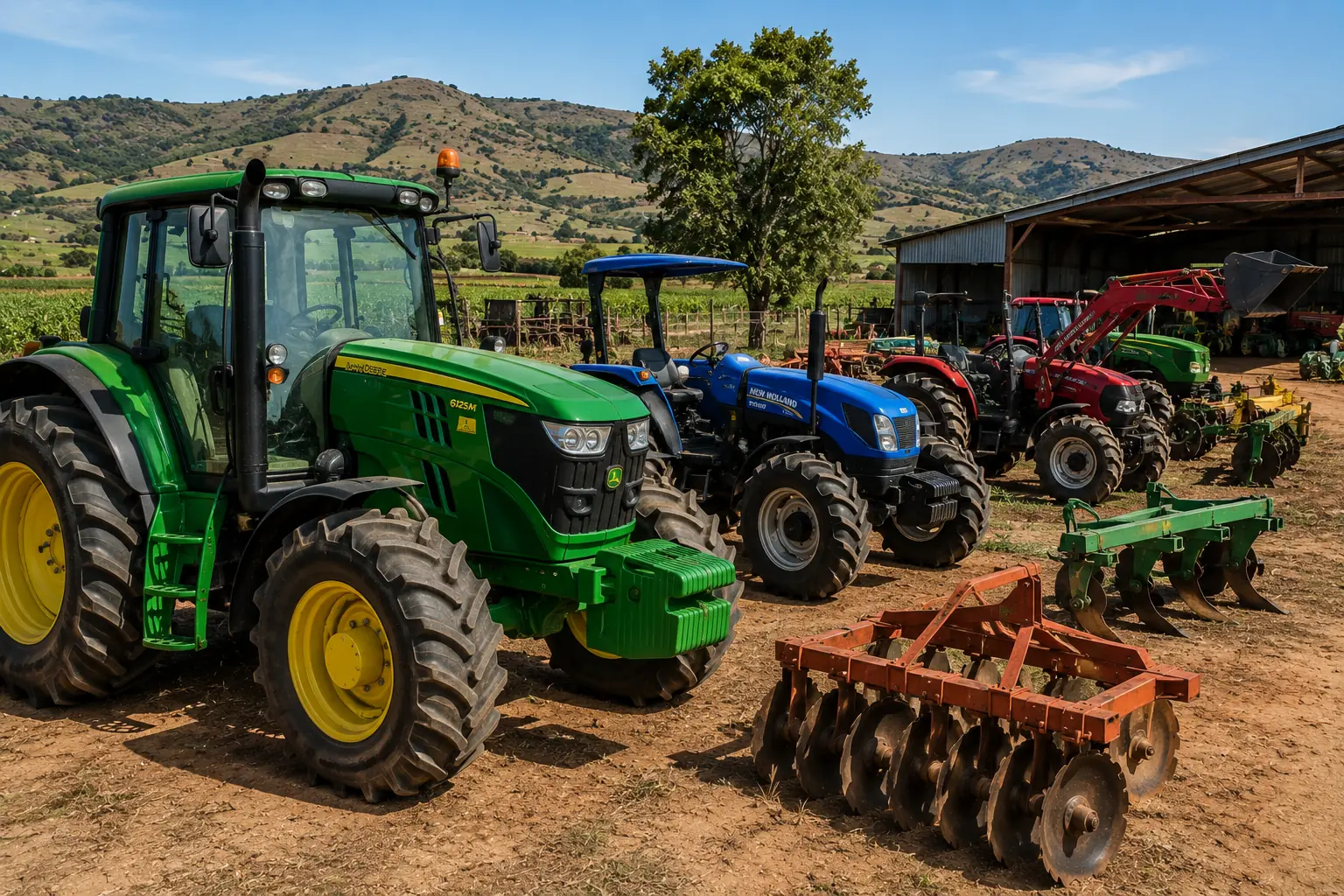
Essential Equipment Categories for South African Farmers
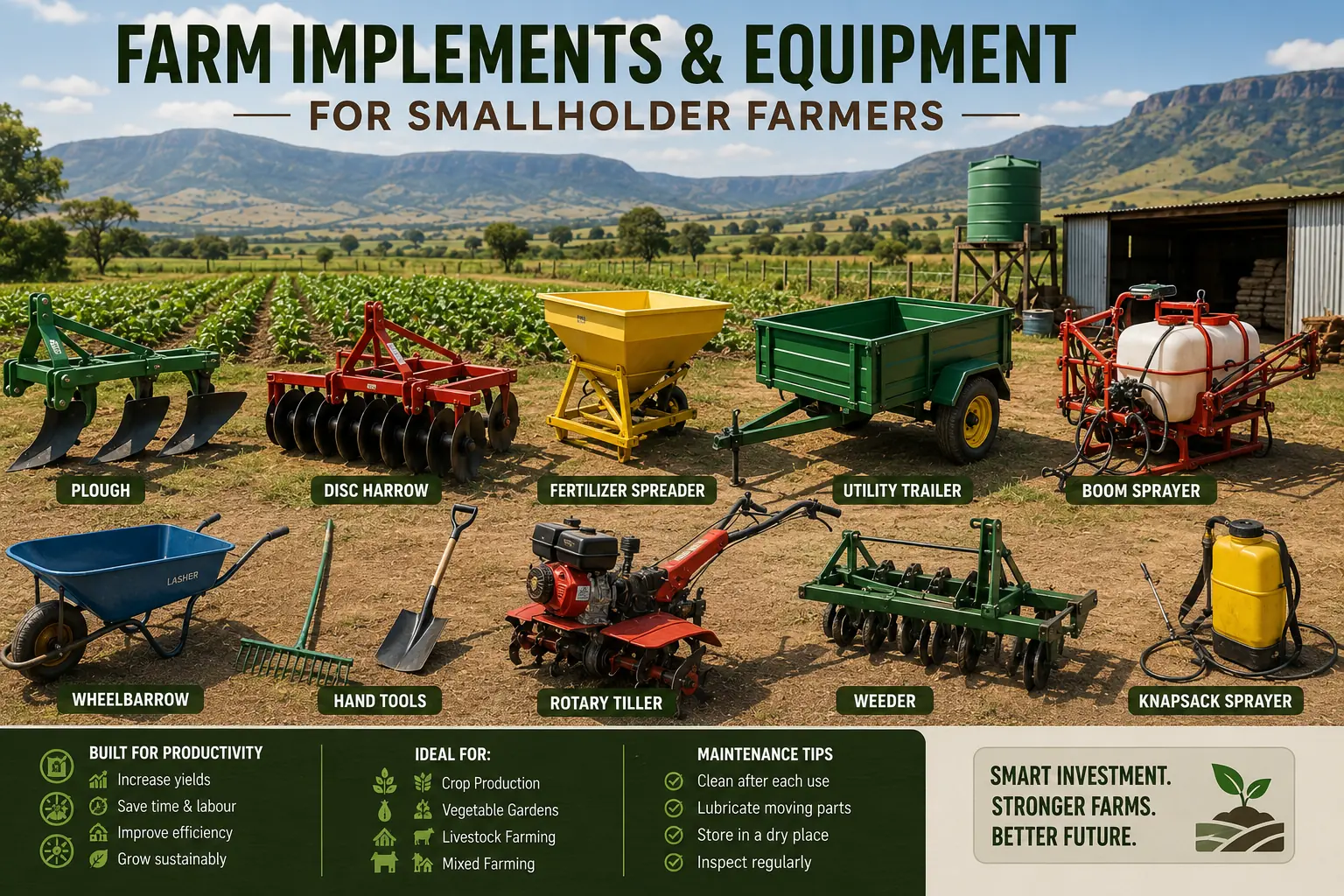
Farm equipment falls into several broad categories. Understanding what you need in each category (and what you can skip or defer) is the foundation of smart equipment investment:
Tractors
The primary power source on most South African farms. Choose horsepower (HP) matched to your hectarage and operations, see the sizing guide below.
Ploughs & Rippers
Mouldboard ploughs, disc ploughs, and subsoil rippers for primary tillage. Essential for first-time land preparation. Less needed on no-till farms.
Planters & Seeders
Precision planters for maize and sunflower, grain drills for wheat and canola, and vegetable transplanters for intensive vegetable production.
Irrigation Equipment
Drip irrigation, sprinkler systems, centre pivots, and pump sets. See our full irrigation systems guide for detailed recommendations per crop and province.
Sprayers
Boom sprayers, knapsack sprayers, and orchard air-blast sprayers for pesticide and herbicide application. Calibration is critical for effective and safe use.
Combine Harvesters
For commercial grain farmers. Many smallholders access combine harvesting through co-operative hiring arrangements rather than ownership.
Cultivation Implements
Disc harrows, rotary tillers, ridgers, and inter-row cultivators for seedbed preparation, weed control, and soil aeration.
Post-Harvest Equipment
Grain augers, grain silos, seed cleaners, cold rooms, and packhouse equipment. Critical for reducing post-harvest losses and maintaining produce quality.
Hand Tools
Hoes, forks, spades, pruning shears, wheelbarrows, and knapsack sprayers, the essential toolkit for any small-scale or urban farmer.
Tractor Sizing Guide for South African Farms
Choosing the correct tractor horsepower (HP) for your operation is critical. Undersized tractors struggle and wear out quickly; oversized tractors are expensive to run and cause excessive soil compaction. Use this guide as a starting point:
| Farm Size | Recommended HP Range | Suitable Brands in SA | New Price Estimate |
|---|---|---|---|
| 1–10 ha (smallholder) | 25–45 HP | Kubota, Mahindra, LS Tractor, Farmtrac | R180,000–R350,000 |
| 10–50 ha (small commercial) | 55–80 HP | Massey Ferguson, New Holland, Kubota | R450,000–R750,000 |
| 50–200 ha (medium commercial) | 90–140 HP | John Deere, New Holland, CLAAS, MF | R900,000–R1,600,000 |
| 200+ ha (large commercial) | 160–400 HP | John Deere, CLAAS, Case IH, New Holland | R1,800,000–R5,000,000+ |
⚠️ Fuel costs matter: A 120 HP tractor consumes approximately 10–14 litres of diesel per operating hour. At South African diesel prices (approximately R23–R26/litre in 2025), equipment operating costs are a significant line item. Always factor fuel consumption into your equipment investment decision. This is where oversized tractors hurt most.
The Second-Hand Farming Equipment Market in South Africa
South Africa has an extensive and active second-hand agricultural machinery market, among the best on the African continent. For most smallholder and emerging commercial farmers, buying second-hand is the most financially sensible approach, offering 30–60% savings on equivalent new equipment with acceptable risk if you know what to look for.
Where to Buy Second-Hand Farm Equipment in SA
- Omnia Auctions and BidOrBuy Agricultural Auctions: Regular farm equipment auctions are held across the country. These are excellent for buyers who know what they want and can inspect equipment in person before bidding. Check TractorHouse.co.za, AgriMag, and Omnia's auction calendar for upcoming events.
- AgriMag (agrimag.co.za): South Africa's leading agricultural classifieds platform for second-hand equipment, spanning tractors, implements, irrigation systems, livestock handling equipment, and packhouse machinery. Search by province and price range.
- Gumtree Agricultural Section: A surprisingly active marketplace for smaller equipment, hand tools, knapsack sprayers, small tillers, irrigation fittings, and sub-R100,000 tractors.
- Manufacturer Certified Pre-Owned Programmes: John Deere, New Holland, and Massey Ferguson all offer certified pre-owned machinery through their SA dealer networks. These units have been inspected, serviced, and often include a short warranty, worth the small premium for peace of mind.
- Farm Sales and Estate Auctions: When farms change hands or estates are liquidated, full equipment fleets often come to market at very competitive prices. Follow agricultural auctioneers including Bidvest Bank Agriculture and Farmers Weekly auction listings.
What to Check Before Buying Second-Hand Equipment
- Request full service history and engine hours (for tractors, more than 5,000 hours on older models requires careful inspection)
- Check for cracks in the engine block, excessive smoke (blue = oil burning, black = fuel/air issue, white = coolant), and unusual noises during a test run
- Inspect hydraulic systems for leaks and correct function, hydraulics drive most implements
- Check tyre condition, new tractor tyres can cost R8,000–R30,000 per tyre
- For harvesters, inspect the threshing cylinder, concave, sieves, and grain elevator for wear
- Where possible, have an independent tractor mechanic inspect before purchase, this typically costs R500–R1,500 and can save tens of thousands
Financing Farming Equipment in South Africa
New and second-hand equipment can be financed through several channels in South Africa. The right financing option depends on your farm size, cash flow profile, and credit history:
| Financing Option | Provider | Best For | Key Consideration |
|---|---|---|---|
| Agri Finance / Land Bank | Land Bank of South Africa | Small to large commercial farmers | Competitive rates, long terms; requires good credit history |
| Agricultural Asset Finance | ABSA, FNB, Nedbank, Standard Bank | Commercial farmers | Linked to existing farm account; strong relationship required |
| Manufacturer Finance | John Deere Financial, CNH Capital | Medium to large farms | Promotional rates available; tied to brand |
| CASP Grant | DALRRD via provinces | Smallholder & emerging farmers | Non-repayable grant; competitive application process |
| Equipment Hire / Co-ops | Grain SA, AFGRI, local co-ops | Very small operations | No capital outlay; availability can be limited at peak times |
For smallholder farmers who cannot access bank finance, the CASP (Comprehensive Agricultural Support Programme) and Ilima/Letsema grants specifically include funding for mechanisation and equipment. Applications are submitted through provincial DALRRD offices. Equipment co-operatives (where groups of smallholders collectively own and share machinery) are also increasingly being supported by government and NGO programmes in rural South Africa.
Maintenance and Servicing, Protecting Your Investment
A well-maintained tractor will run for 15,000–20,000 hours or more. A neglected one can fail catastrophically within 3,000 hours. Equipment maintenance is not optional. It is the most cost-effective form of farm management. Key principles for South African conditions:
- Follow manufacturer service intervals strictly, oil and filter changes on tractors are typically every 250 hours of operation; check your manual
- Keep air filters clean, South Africa's dusty farming conditions (particularly in Limpopo, the Northern Cape, and Free State) are extremely hard on air filtration systems; inspect and clean daily during dusty operations
- Grease all fittings daily during use, implement joints, PTO shafts, and linkage points must be greased according to schedule; this is the most commonly skipped maintenance task and among the most damaging to omit
- Store equipment undercover, South Africa's UV radiation and extreme temperature swings rapidly degrade rubber seals, hydraulic hoses, and electrical components on equipment left outdoors year-round
- Build a parts relationship with your dealer, having an established relationship with your nearest John Deere, MF, or Kubota dealer means faster parts access during harvest season when days lost to breakdowns cost the most