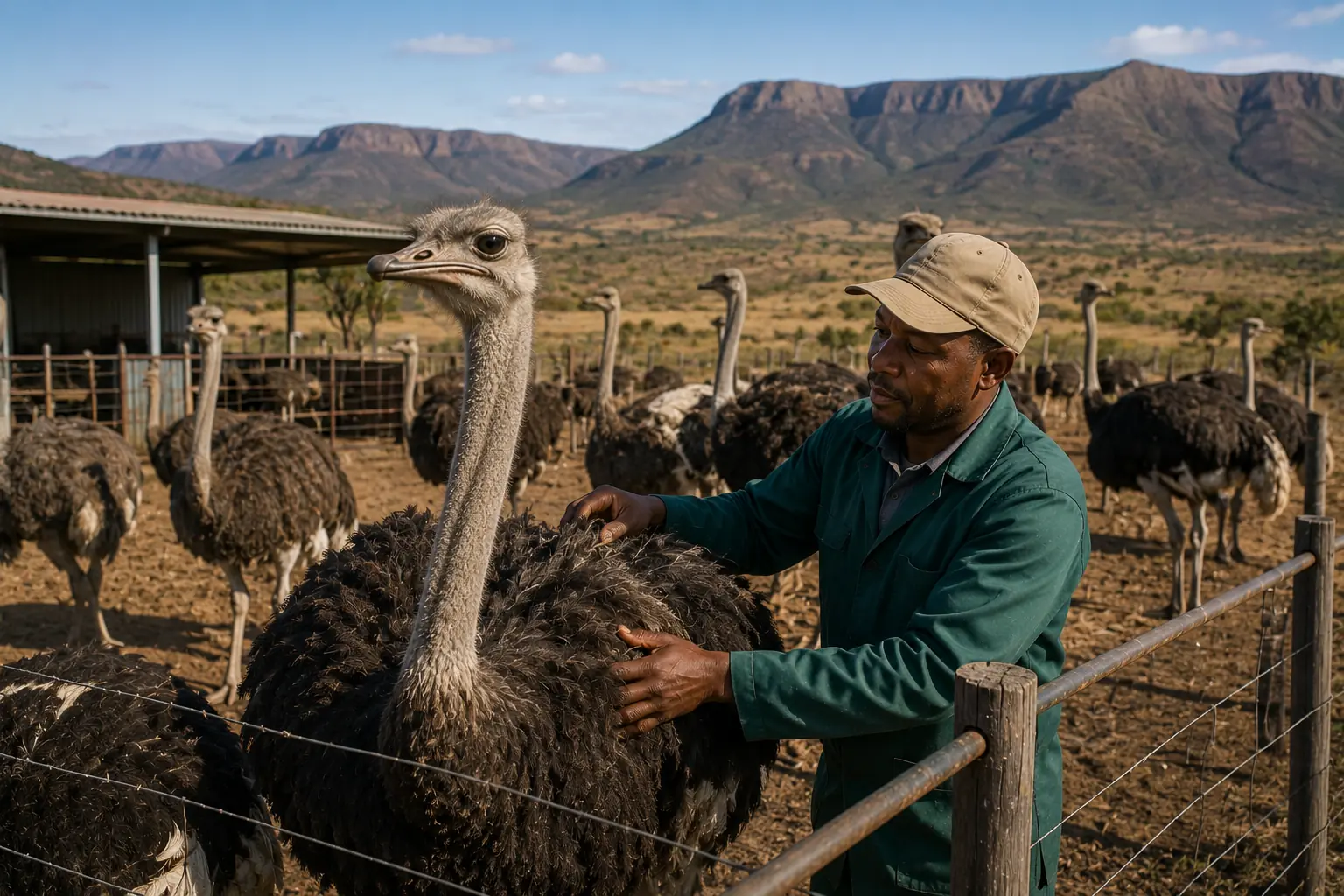
Why Ostrich Farming is Profitable in South Africa
South Africa's natural comparative advantage in ostrich production is extraordinary. The semi-arid Klein Karoo climate (hot, dry summers and mild winters) mirrors the ostrich's native East African savannah habitat precisely. The birds thrive on the region's natural veld grasses, reducing feed costs. Decades of breeding expertise, slaughter infrastructure, and established export markets make this a sector with a true national competitive moat.
For new and emerging farmers, ostrich farming offers a compelling multi-revenue model that few livestock enterprises can match. Unlike cattle or sheep which primarily generate income from a single product, ostriches generate revenue from meat, leather, feathers, eggs, fat, and live bird sales, and can begin generating returns from feathers within the first year.
Ostrich Breeds Farmed in South Africa
South African commercial farmers work with three primary ostrich varieties, each with distinct production strengths:
South African Black (SAB), The Commercial Standard
The South African Black is the dominant commercial breed and the backbone of the Klein Karoo industry. Males are jet black with white wing and tail feathers; females are grey-brown. The SAB grows to 100–130kg at slaughter, produces premium leather and excellent quality white feathers, and has good temperament in farm conditions. Most commercial slaughter operations are built around the SAB, and it is the breed of choice for new entrants to the industry. Chick prices range from R800–R2 000 depending on age and lineage.
Zimbabwean Blue Neck
The Blue Neck originates from Zimbabwe and is significantly larger than the SAB, often reaching 140–160kg live weight. The breed produces larger hides (higher leather revenue per bird) but is more aggressive and harder to manage than the SAB. Some larger SA commercial operations incorporate Blue Neck genetics for their superior carcass weight. Not recommended for first-time farmers due to handling challenges.
Red Neck (Masai)
The Red Neck (Struthio camelus massaicus) is a sub-species from East Africa noted for its distinctive red neck colouration in mature birds. It produces good leather but lower feather quality than the SAB. Found in some SA game farm contexts and specialty breeding operations, but rare in mainstream commercial production.
Land, Climate & Infrastructure Requirements
Ostriches are ideally suited to South Africa's semi-arid and arid regions. They are drought-tolerant, walk long distances naturally, and can survive on poor-quality vegetation that would starve other livestock. Key land and infrastructure requirements include:
- Land area: A minimum of 0.5–1 hectare per adult pair for breeding operations; up to 2–3 hectares per pair is recommended for extensive veld farming. For intensive grow-out camps, 6–8 birds per hectare is typical.
- Fencing: High-tensile game fencing of 1.8–2.0m height is essential. Ostriches are powerful and can clear lower fences. Budget R18 000–R35 000 per km of ostrich-appropriate fencing.
- Camps: A productive farm needs at minimum: a breeding camp (pairs or trios), a chick rearing camp (with wind protection), a grow-out camp (slaughter birds), and a holding pen near the handling facility.
- Handling facility: A robust catching pen, race, and crate system is non-negotiable for safe handling. Ostriches can deliver a lethal forward kick, proper infrastructure protects both birds and farm workers.
- Shelters: Unlike cattle or sheep, ostriches do not require elaborate housing. A simple shade structure or natural windbreak is sufficient in the Klein Karoo climate. In colder or wetter regions, basic covered roosting areas help chick survival.
- Water: Permanent, clean water supply. Mature ostriches consume 6–10 litres per day, more in summer. Drip-line or ballcock-fed troughs work well. See our irrigation systems guide for water infrastructure ideas.
Ostrich Nutrition & Feeding
Ostriches are omnivores in nature but are farmed as herbivores. Their digestive system is uniquely adapted to process large amounts of dry roughage, a major cost advantage in the Klein Karoo where natural veld can supply a significant portion of the diet. A practical feeding programme for a commercial South African ostrich farm looks like this:
Chick Starter Phase (0–3 months)
Newly hatched chicks are highly vulnerable. In the first 2–3 weeks, chicks survive primarily on absorbed yolk sac nutrients and require minimal external feeding. From week 3 onwards, provide a high-protein (20–22% CP) ostrich chick starter pellet at approximately 200–400g per chick per day, increasing gradually. Fresh, fine-leafed lucerne (alfalfa) is an excellent supplement. Mortality in this phase is the main financial risk, proper temperature management and predator protection are critical. Never feed chicks coarse roughage in the first month as their gizzard is not yet functional.
Grow-Out Phase (3–14 months)
Slaughter birds are typically processed at 10–14 months at a live weight of 90–110kg. During this phase, a balanced grower ration (14–16% CP) of 1.0–1.5kg per bird per day is standard, supplemented by free access to lucerne or natural veld grazing. On farms with good quality veld, ration supplementation can be reduced significantly in summer and autumn when grass quality is high. Feed costs are the single biggest operating expense in ostrich farming, optimising veld use and sourcing feed cooperatively through agri markets significantly impacts profitability.
Breeder Maintenance (Adult birds)
Adult breeding pairs need a maintenance ration of approximately 1.0kg per bird per day plus ad lib roughage, increasing to 1.5–2.0kg during the breeding season (July–January in the Western Cape). Breeding condition is crucial, thin birds produce fewer eggs, and poorly nourished hens lay infertile or thin-shelled eggs. Mineral supplementation (calcium, phosphorus, selenium) is important for productive breeders.
Breeding & Incubation
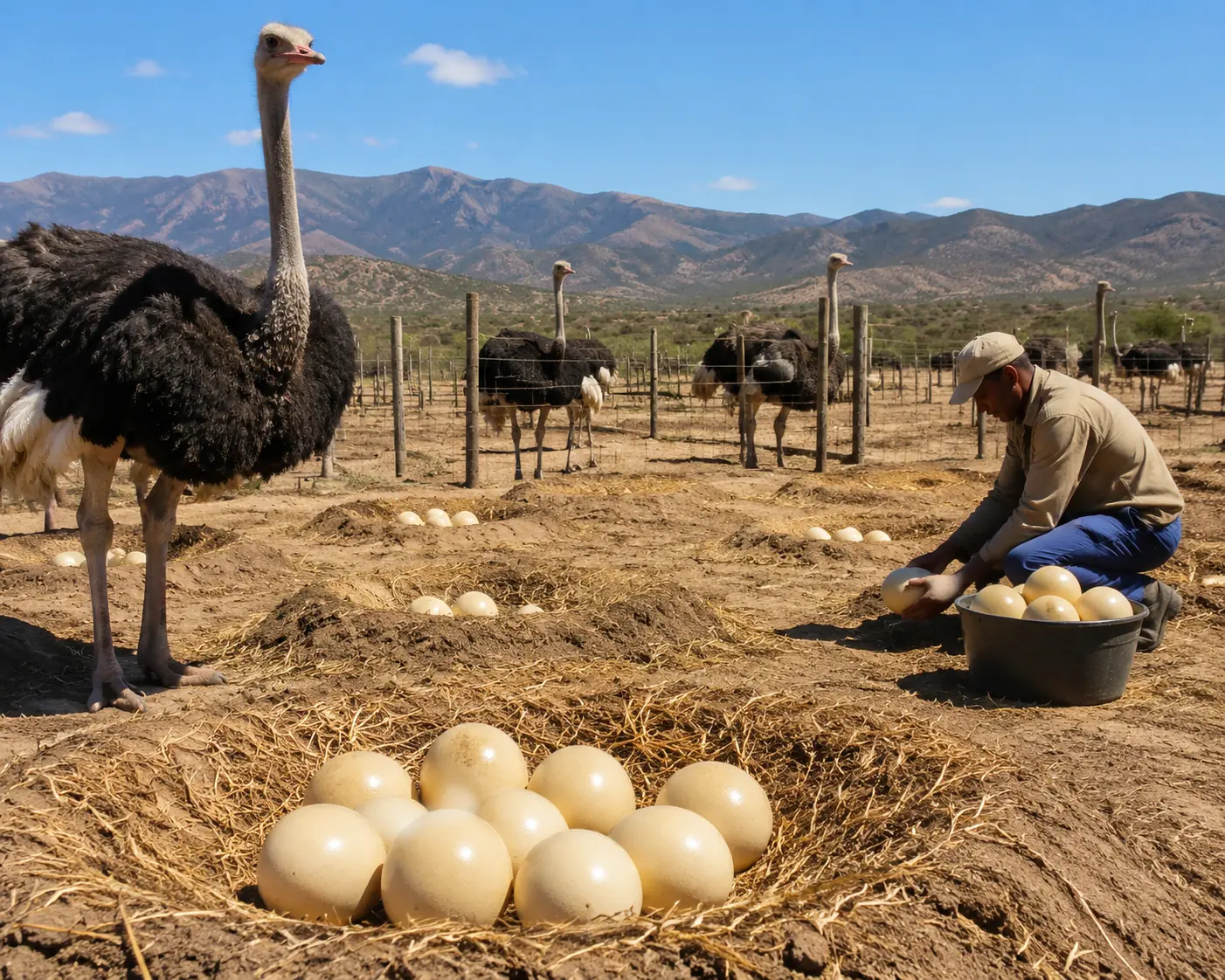
The ostrich breeding season in the Klein Karoo runs from approximately July to January, with peak laying in September–November. A productive hen lays 40–80 eggs per season, though commercial operations average 30–50 eggs per breeding hen per year under managed conditions.
An ostrich egg weighs approximately 1.3–1.8kg and is equivalent in volume to 24 chicken eggs. Incubation takes 42 days at 36.2°C with daily rotation. Hatchability in well-managed artificial incubation typically runs 60–75%.
Most commercial SA ostrich farms use artificial incubation rather than natural incubation by the birds. Eggs are collected from the nest (or off open veld) daily and set in forced-air incubators maintained at 36.0–36.4°C with 20–25% relative humidity and automatic turning every hour. Eggs are moved to a hatcher (slightly higher humidity, no turning) 3–4 days before the expected hatch date.
Natural pairing (1 male : 1 female) is the most productive arrangement for egg fertility, though trio pairing (1 male : 2 females) is used on farms where male-to-female ratios are imbalanced. Forced pairing, placing unfamiliar birds together, can result in fighting, injury, and poor egg fertility. Allow birds adequate time to establish pair bonds before expecting productive laying.
Health Management & Common Diseases
Ostriches are hardy animals with relatively few disease problems compared to poultry or pigs when properly managed. However, several conditions are common in SA commercial operations and require attention:
- Newcastle Disease, Ostriches are susceptible. Vaccination is mandatory in commercially farmed birds in SA. Follow the schedule recommended by your veterinarian and DALRRD (DAFR) extension services.
- Avian Influenza (AI), A notifiable disease in SA. Ostrich farms in the Klein Karoo have been affected by H5N1 and H5N8 outbreaks. Have a biosecurity protocol in place and report any unusual mortality immediately to DAFR.
- Chick Leg Problems (Splayed Legs / Rotated Tibias), Nutritional deficiencies or poor brooding floor conditions cause leg deformities in chicks. Preventable with proper flooring (non-slip rubber matting) and balanced nutrition.
- Impaction, Ostriches ingest stones, wire, plastic, and other foreign material that can cause proventricular or intestinal impaction. Keep camps free of debris and ensure birds have access to appropriate grit.
- Worms and External Parasites, Regular faecal worm egg counts and strategic drenching are part of a standard SA ostrich health programme. Consult an integrated pest management specialist experienced with ratites.
Maintain a relationship with a veterinarian experienced in ratite medicine. The South African Ostrich Business Chamber (SAOBC) in Oudtshoorn maintains a list of registered vets and extension officers servicing the industry.
Slaughter, Processing & the Value Chain
Ostriches are slaughtered at 10–14 months of age at live weights of 90–110kg, yielding a carcass of approximately 35–45kg. In South Africa, commercial ostrich slaughter is strictly regulated and must be conducted at a DAFR-registered abattoir. The Klein Karoo region has dedicated ostrich processing facilities that handle the full value chain (slaughter, deboning, leather tanning, and feather processing) often under one cooperative or company roof.
The main processing centres in the Klein Karoo are centred on Oudtshoorn, with several private and cooperative abattoirs serving the region. Smaller operations outside the Klein Karoo must arrange transport of live birds to registered facilities, a logistics and welfare consideration that affects profitability for remote producers.
The South African Ostrich Business Chamber (SAOBC) coordinates much of the industry's slaughter scheduling, minimum price negotiations, and export documentation. New producers are strongly encouraged to join SAOBC for access to this infrastructure and market intelligence.
Markets, Meat, Leather, Feathers & Eggs
The SA ostrich industry's strength lies in its diversified revenue streams. Here is a breakdown of each product category and its current SA market context:
Ostrich Meat
Ostrich meat is a deep-red, very lean beef alternative with a mild flavour. It is positioned as a premium, health-conscious protein in SA supermarkets (Woolworths, Pick n Pay Freshmarket) and game restaurants. At the abattoir gate, producers receive R35–R60 per kg carcass weight. Retail prices to the consumer run R80–R140 per kg for fillet and R50–R80 for minced ostrich. The European Union is the primary export destination, with Germany, Belgium, and the UK being the top buyers. To access EU markets, your abattoir must hold EU export approval, a key reason to use SAOBC-affiliated processing facilities. See our export farming guide for the certification process.
Ostrich Leather
Ostrich leather (recognisable by its distinctive quill bump pattern) is classified as a luxury material and commands prices comparable to crocodile and python leather in global fashion markets. SA tanneries in Oudtshoorn supply global luxury brands including major European fashion houses. A single hide from a slaughter-age bird (12–14 months) measures approximately 1.0–1.4 square metres and sells for R2 000–R6 000 ex-tannery depending on grade. Hides with clean, undamaged quill patterns fetch the highest premiums. Producers are paid for hides as part of the abattoir slaughter settlement.
Feathers
The ostrich's long white wing and tail feathers have been commercially valuable since the 1800s, when they fuelled Oudtshoorn's famous ostrich feather boom that built the town's Victorian "feather palaces." Today, feathers supply the automotive industry (specialised dusting equipment that does not scratch paintwork), the fashion and theatrical costume industry, and luxury home décor. Feathers can be harvested from live birds every 6–9 months, making this the only repeating revenue stream from the living bird before slaughter. A single adult bird yields 1.5–2.5kg of feathers per harvest. Grade A white feathers fetch R300–R500 per kg; coloured and down feathers are worth R50–R150 per kg.
Eggs & By-Products
Infertile or non-commercial eggs are sold as food (the equivalent of 24 chicken eggs each, used by restaurants and caterers), decorative items, and shell-craft raw materials at R80–R200 per egg. Ostrich fat (schmaltz) is processed into cosmetic and medical-grade oil sold for R600–R1 200 per litre. Bones are processed into stock and meal, and even the intestines find buyers in Asian traditional medicine markets via export channels.
Start-Up Costs & Financial Planning
Starting an ostrich farm requires significant capital. Here is a realistic cost range for a small commercial operation of 10 breeding pairs (producing approximately 300–500 chicks annually at full production):
- Land (10–20 ha leased): R20 000–R50 000/year or purchase from R800 000 upward in Klein Karoo
- Fencing (5km high-tensile game fence): R90 000–R175 000
- Handling facility & camps: R40 000–R80 000
- Incubators (2–4 units): R30 000–R80 000
- Breeding stock (10 pairs SAB adults): R60 000–R120 000
- First-year feed & operational costs: R80 000–R150 000
- Total estimated start-up: R320 000–R655 000
The CASP (Comprehensive Agricultural Support Programme) and Ilima/Letsema grant programmes have historically supported new ostrich farmers with infrastructure costs. The Land Bank offers agricultural loans at preferential rates. Visit our farming grants page for current programme details and application guidance.
Break-even for a well-managed 10-pair operation is typically achieved in year 3–4, with mature operations generating significant returns from the combined meat, leather, feather, and egg revenue streams. The SA ostrich industry has a strong cooperative infrastructure through SAOBC that helps small producers access abattoir, marketing, and export services that would be unaffordable individually.