Where to Grow Sunflowers in South Africa
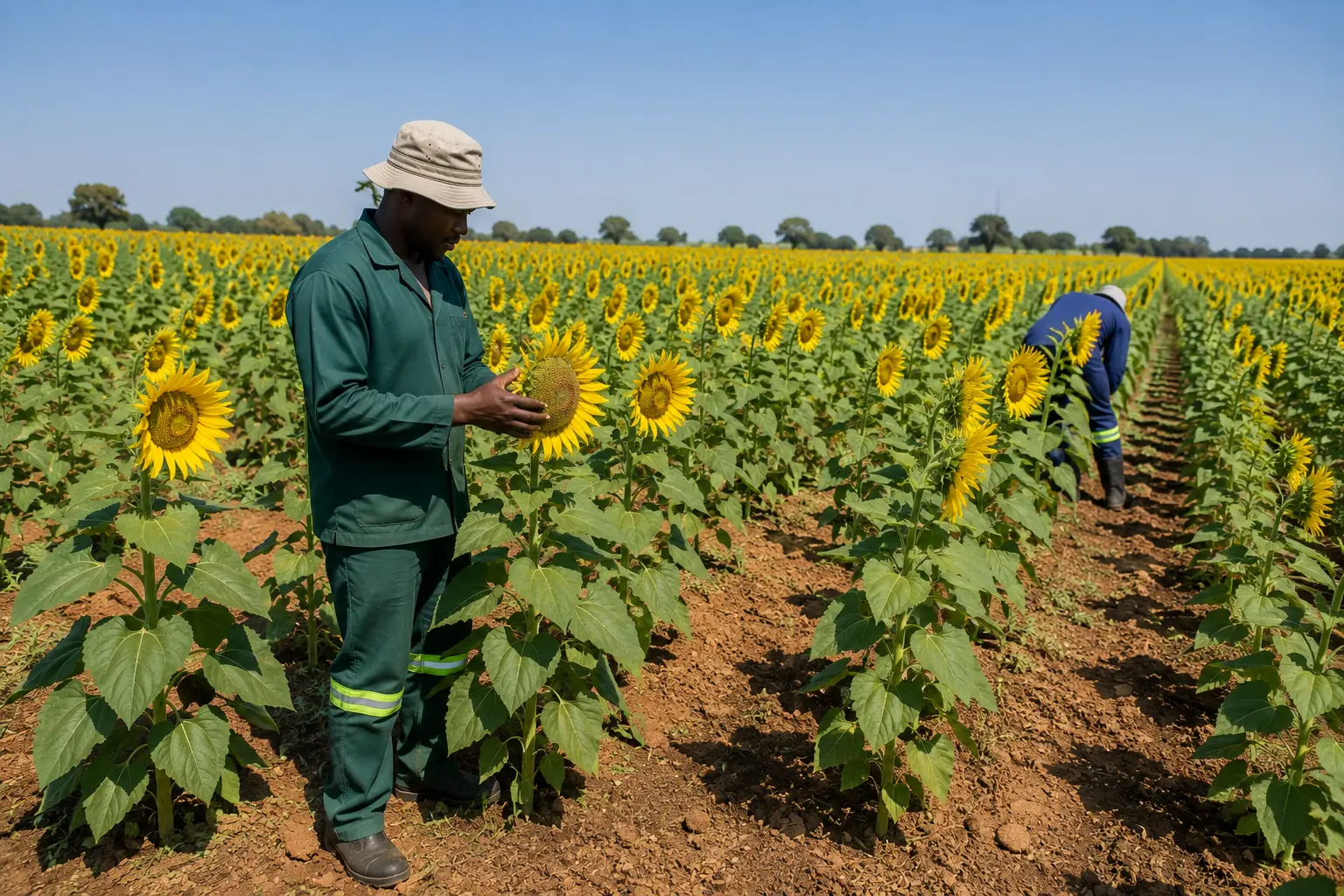
Sunflowers are grown across a wide band of South Africa's summer rainfall interior. The main production zones include:
- North West Province: Rustenburg, Potchefstroom, Lichtenburg, Vryburg and surrounding districts. The dominant production zone, benefiting from deep sandy loam soils and reliable summer rainfall patterns.
- Free State: Particularly the northern and central Free State (Parys, Kroonstad, Boshof areas). Often grown in rotation with maize.
- Northern Cape: Certain districts around Upington and Hopetown under irrigation or in higher-rainfall pockets.
- Limpopo: Selected areas of Limpopo where summer rainfall and soils permit, particularly around Mokopane and Polokwane.
- Mpumalanga: Some production on the Highveld in rotation with maize and soybeans.
Sunflower is not typically grown in the winter rainfall Western Cape or in tropical, high-humidity coastal areas where disease pressure is too high. The ideal production zone receives 400–700mm of summer rainfall, making it well-suited to areas that are too dry for reliable maize production.
Climate & Soil Requirements
Climate
Sunflower is one of the most climatically adaptable grain crops in South Africa. Key requirements include:
- Temperature: Optimal growth between 20°C and 28°C. Germination is best when soil temperature exceeds 10°C. Sunflower is more heat-tolerant than maize and significantly more drought-tolerant.
- Rainfall: A minimum of 350–400mm of well-distributed rainfall during the growing season. For dryland production, 450–600mm is ideal. Sunflower has a deep taproot that accesses subsoil moisture, giving it a significant advantage in dry years.
- Frost: Sensitive to frost at emergence and during flowering. Plant timing is critical to avoid late-season frosts in high-altitude areas (Highveld, eastern Free State).
- Frost-free growing period: A minimum of 120 frost-free days is required for most commercial varieties.
Soil Requirements
Sunflower is less demanding than maize in terms of soil quality, but performs best in:
- Deep, well-drained soils, the taproot can reach 2m deep in favourable soils, accessing deep moisture reserves
- pH (KCl) of 5.5–7.0, adaptable to slightly acid to neutral soils
- Medium-textured sandy loam to clay loam soils, common in the North West and Free State
- Adequate boron (B) levels, boron is a critical micronutrient for sunflower seed set; deficiency causes empty heads
Sunflower does not tolerate waterlogged conditions. Avoid pans, compacted clay soils, or lands with poor internal drainage. A soil analysis before planting is especially important for identifying boron deficiency and pH adjustment needs.
🌻 Key Point: Boron Nutrition
Boron deficiency is consistently among the most common nutrient problems in South African sunflower production. It causes poor seed set (hollow achenes, "empty" heads) and dramatically reduces yield. Test your soil for boron before planting and apply a foliar boron spray at the early flowering stage (R1–R2) if levels are marginal. Discuss rates with your agronomist or fertiliser company.
Sunflower Varieties in South Africa
Most commercial sunflower varieties in South Africa are F1 hybrids, developed by international seed companies including Syngenta, Pioneer (Corteva), BASF, and local breeders. Varieties are categorised by maturity class (early, medium, late), oil content, and seed size. Below are some of the types commonly used:
Agsun 8251 CL
Clearfield Technology
Clearfield® varieties are tolerant to imidazolinone herbicides, allowing effective weed control including broomrape (Orobanche). A top choice in North West where broomrape is a problem.
NK Adagio CL
Clearfield / Early
Syngenta Clearfield variety with good oil content and early maturity. Suited to shorter growing seasons and areas with early frost risk. Excellent standing ability.
P64HE99
High Oleic
Pioneer high-oleic variety, produces oil with a higher percentage of oleic acid (healthier fatty acid profile), commanding premium pricing from certain buyers and processors.
Sunbird 2070
Mid Season
Popular local variety with strong yield performance across North West and Free State environments. Reliable disease resistance and good stalk strength for mechanical harvesting.
Dekalb DK4040
Commercial Standard
Well-known BASF variety with broad adaptability, consistent oil content, and strong performance under variable rainfall conditions. Widely used in North West and Free State.
Confection Types
Niche / Snack Market
Large-seeded confection varieties for the snack food market. Higher prices per tonne but require specific buyers and contracts. Not suitable for standard oil crushing channels.
Always check the latest National Sunflower Performance Trials data published by the Agricultural Research Council (ARC) when selecting varieties. These trials are conducted at sites across the production zone annually and provide unbiased yield, oil content, and disease resistance comparisons. Your local seed company agronomist or Agri SA advisor can assist with variety selection for your specific area.
Land Preparation & Planting
Land Preparation
Effective land preparation improves moisture conservation, reduces weed pressure, and ensures optimal seedbed conditions. Key steps:
- Post-harvest residue management: Disc or plough in the previous crop's residue after harvest. In conservation agriculture systems, retain and manage residue as mulch on the surface (no-till or minimum-till approach).
- Soil sampling: Take soil samples to 60cm depth for pH, nutrients and boron testing. Apply lime if pH is below 5.5, ideally 6 months before planting.
- Tillage: Either conventional tillage (primary plough + secondary disc) or minimum tillage (single disc pass). No-till systems are increasingly used for sunflower in the North West, reducing input costs and improving moisture conservation.
- Bed the land: Create firm, level seedbeds. Loose, rough seedbeds cause uneven seed depth and poor germination.
Planting Time
Planting timing is critical for avoiding both late-season drought stress during grain fill and early autumn frosts at maturity. Recommended planting windows:
| Region | Planting Window | Notes |
|---|
| North West (dryland) | 20 Nov – 10 Jan | Optimal Nov–Dec. Jan plantings risk drought during grain fill. |
| Free State (northern) | 15 Nov – 31 Dec | Earlier plantings preferred to avoid frost at maturity. |
| Limpopo (Highveld) | 1 Nov – 15 Dec | Altitude affects frost risk; plant early in high-altitude areas. |
| Northern Cape (irrigation) | Oct – Jan (flexible) | Irrigation allows more flexibility; avoid extreme heat at flowering. |
Plant Population & Spacing
Sunflower is typically planted at:
- Row spacing: 0.9m or 1.0m between rows (compatible with standard planting and harvesting equipment)
- In-row spacing: 20–35cm between plants, depending on variety and moisture availability
- Target plant population: 25,000–40,000 plants per hectare for dryland production; up to 50,000/ha under irrigation
- Seeding depth: 3–5cm into moist soil. Shallower in heavy soils, deeper in sandy soils.
Use a calibrated planter with singulating discs for accurate plant spacing. Most commercial planters used for maize can be adapted for sunflower with appropriate disc plates.
Fertilisation of Sunflower
Sunflower has relatively modest fertiliser requirements compared to maize, but nutrient management (especially for nitrogen, phosphorus, and boron) directly impacts yield and oil content. Base all rates on soil analysis results:
| Nutrient | Typical Rate (kg/ha) | Timing | Notes |
|---|
| Nitrogen (N) | 30–60 | At planting or split | Avoid excessive N, promotes vegetative growth at expense of seed. |
| Phosphorus (P) | 15–30 | At planting (in-furrow) | Critical for root development and energy transfer. |
| Potassium (K) | 30–60 | At planting | Important on sandy soils prone to K leaching. |
| Boron (B) | 1–2 (foliar) | At R1–R2 flowering | Critical for seed set. Apply as foliar spray at early flower. |
| Sulphur (S) | 15–20 | At planting | Important for oil quality and protein synthesis. |
Over-application of nitrogen is one of the most common sunflower mistakes. It produces tall, leafy plants with poor seed fill and increases lodging risk. Always follow soil test-based recommendations from a certified agronomist or consult our fertilizer guide.
Weed Management in Sunflower
Weed control is critical in the first 6 weeks after emergence. Sunflower is sensitive to early-season weed competition, which can reduce yields by 30–50% if uncontrolled. Key approaches include:
- Pre-emergent herbicides: Applied at or shortly after planting to control germinating weeds before they emerge. Common active ingredients include metolachlor, trifluralin and pendimethalin.
- Clearfield® technology: Varieties with Clearfield® tolerance can be sprayed with imazamox herbicide (Pulsar or equivalent), which provides excellent broad-spectrum weed control including notoriously difficult weeds like pigweed and broomrape.
- Mechanical cultivation: Inter-row cultivation at 3–4 weeks removes weeds and breaks soil crusting. Practical and effective for small-scale growers.
- Broomrape (Orobanche cumana): A parasitic weed that attaches to sunflower roots. Highly problematic in the North West. Clearfield® varieties with Orobanche tolerance are the most effective management tool.
Pest & Disease Management
Key Pests
- Sunflower stem weevil (Cylindrocopturus adspersus): Larvae bore into stalks, causing lodging and yield losses. Plant early and use varieties with good stalk strength.
- Springbok mantis (Sphodromantis gastrica): Feeds on florets during flowering, reducing seed set in certain areas.
- Aphids: Can colonise plants in large numbers, causing leaf curl and transmitting viruses. Natural enemies (ladybirds, parasitic wasps) often provide adequate control.
- Bollworm (Helicoverpa armigera): Can damage developing seeds in heads. Monitor from flowering onwards.
- Birds (queleas, doves): Can cause severe damage to ripening heads, particularly in smaller blocks near bush or wetlands. Bird-scaring measures or early harvest can reduce losses.
Key Diseases
- Sclerotinia head rot (Sclerotinia sclerotiorum): Major disease in wetter areas or humid conditions. Causes rotting of the head and stalk. Manage through variety resistance, crop rotation with non-host crops, and avoiding dense plant populations.
- Downy mildew (Plasmopara halstedii): Seed-borne disease causing systemic infection. Use seed treated with metalaxyl. High-risk in wetter seasons.
- Alternaria leaf blight: Common in warm, wet conditions. Causes leaf spots and premature defoliation. Fungicide applications at flowering are sometimes warranted in high-risk years.
- Rust (Puccinia helianthi): Orange pustules on leaves. Choose rust-resistant varieties. Fungicide application if severe.
A good crop rotation with maize, soybeans or small grains breaks disease cycles and reduces weed pressure. Sunflower should not follow sunflower on the same land for at least 3 years. Read our full pest control guide for IPM strategies applicable across South African crops.
Harvesting Sunflowers in South Africa
Determining Harvest Readiness
Sunflowers are ready to harvest when:
- The back of the head turns yellow to brown
- Seeds are firm and rattle in the head
- Seed moisture is 12–14% for safe storage, or 9–10% for long-term storage
- Most leaves have dried and dropped naturally
Harvesting too early (above 16% moisture) increases drying costs and risk of spoilage. Harvesting too late increases shattering losses and bird damage. Sunflower can be dried naturally in the field until reaching safe moisture, as the standing crop tolerates some post-physiological-maturity weathering.
Combine Harvesting
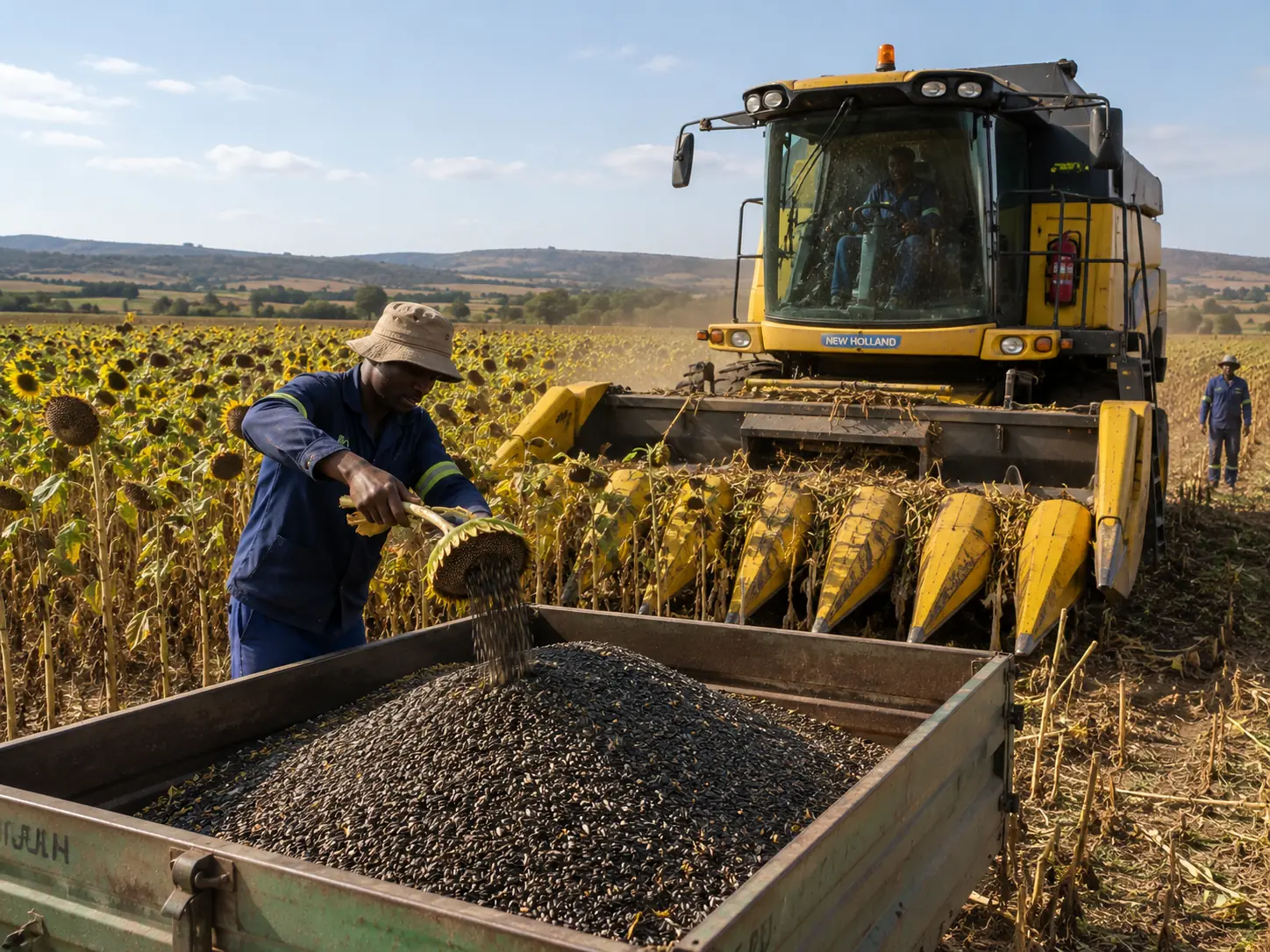
Commercial sunflower is harvested with a combine harvester fitted with a sunflower header, a wide-spaced reel with seed-catching pans to minimise losses. Correct header setup is critical: incorrect height or reel speed causes significant shattering and head losses. Harvesting early in the morning when dew is present reduces shatter losses.
For smallholder growers without access to a combine, manual harvesting (cutting heads with pangas or knives, then drying and threshing) is labour-intensive but feasible for small plots. Mobile threshing services are available in some areas through farmer cooperatives or private contractors.
Drying & Storage
If grain moisture exceeds 10%, drying is required before storage. Sunflower is dried at low temperatures (below 43°C) to preserve oil quality. Properly dried sunflower seed can be stored for 6–12 months in ventilated, vermin-proof structures. Monitor for insect infestation during storage.
Marketing & Selling Sunflower in South Africa
Sunflower ranks among the most liquid commodities in the South African grain market, with several well-established marketing channels:
- SAFEX (JSE Agricultural Products Division): Sunflower is traded on SAFEX, the South African Futures Exchange. Commercial farmers can hedge their price risk by selling futures contracts before harvest. SAFEX prices provide the benchmark for most physical trades.
- Grain silos and storage facilities: Most large-scale farmers deliver to nearby commercial silos (Senwes, Grainco, BKB etc.), where grain is stored and sold through the futures market or direct to buyers.
- Direct sales to oil crushers: Large oil crushing operations (South African Sunflower Products, Willowton Oil and Cake Mills, Pioneer Foods) sometimes buy directly from farmers, particularly for high-oleic or contract varieties.
- Agricultural cooperatives: Most production areas are served by cooperatives (Senwes, Afgri, Griekwaland Wes) that offer grain intake, storage, financing and marketing services to members.
- Smallholder channels: Smallholder growers can sell to local buyers, cooperatives, or aggregators. Some provincial programmes facilitate access to formal markets. See our agri markets guide for options.
📊 Profitability Snapshot
Average dryland sunflower yields in South Africa range from 1.0–1.8 t/ha, with exceptional yields reaching 2.5 t/ha under good conditions. At SAFEX prices ranging from R7,000–R10,000/tonne (approximate 2025 values), a typical yield of 1.5 t/ha generates R10,500–R15,000/ha gross income. Input costs (seed, fertiliser, herbicides, fuel) typically run R3,500–R6,000/ha for dryland production. Always check current SAFEX prices before planting, sunflower markets are volatile.
Sunflower in Crop Rotation
Sunflower is an excellent rotation crop for maize and soybean-based systems. Its deep taproot breaks up subsoil compaction, its drought tolerance reduces risk in dryer years, and it has different pest and disease profiles from cereal crops. Key rotation guidelines:
- Do not plant sunflower more than once every 3–4 years on the same land (Sclerotinia and Orobanche risk)
- Excellent previous crop for maize, leaves the soil in good structural condition
- Avoid following other Sclerotinia hosts (soybeans, beans, canola) in areas with high disease pressure
- Sunflower following maize is a common, profitable rotation in North West and Free State
Explore our full crop rotation guide for planning multi-year rotation programmes tailored to South African conditions.
Sunflower Farming for Smallholders
Sunflower is increasingly recognised as a viable smallholder cash crop in South Africa's drier interior provinces. Its drought tolerance makes it more reliable than maize in areas with below-average or erratic rainfall, and it can be stored and sold progressively after harvest without spoiling rapidly. Main decisions for smallholder growers:
- Access to a market buyer (cooperative, silo, private buyer) before planting
- Seed variety selection suited to your rainfall zone, consult your extension officer
- Access to a combine or mobile thresher at harvest. This is often the biggest constraint for smallholders
- Consider applying for support through the CASP or Ilima/Letsema government programmes, see our farming grants guide