Snail Farming (Heliculture) in South Africa, A Low-Capital, High-Value Niche with Growing Domestic and Export Demand
Snail farming, formally known as heliculture, is among the most unique and under-exploited agricultural opportunities available to South African farmers of all scales. Snails are slow-growing but efficient converters of plant material into high-protein, low-fat meat. They require minimal land (a viable snail farm can operate on as little as 50–100 square metres initially), comparatively low capital investment, no specialised heavy equipment, and produce a product, snail meat (escargot), that commands prices of R80–R250 per kilogram depending on species, processing, and market channel.
South Africa's snail farming industry is still at an early stage of development compared to European countries (particularly France, Italy, and Greece, which are the world's largest snail-consuming nations) and West African countries like Nigeria and Ghana where snail meat is a mainstream protein source. This creates both an opportunity and a challenge: there is significant unmet demand, both from upmarket restaurants and hotels looking for locally produced escargot, and from growing communities of West and Central African nationals living in South African cities who regularly consume snail as part of their diet, but established supply chains, processors, and market infrastructure are less developed than in more mature sectors.
For the farmer willing to invest time in understanding snail biology, building the right housing infrastructure, and developing market relationships, snail farming in South Africa offers a distinctive income stream that is well-suited to urban and peri-urban smallholders, farmers seeking to diversify an existing operation, and entrepreneurs looking to develop a niche food business with strong value-addition potential. This section covers all of it in practical detail.
🐌 Market opportunity: The global escargot (snail meat) market is valued at over USD 1 billion annually and growing. South Africa imports most of its commercial escargot from Eastern Europe. Locally farmed snails can command R80–R250/kg live or fresh-processed, depending on species, size, and market channel. Top-end Johannesburg and Cape Town restaurants pay R180–R300/kg for live or freshly processed snails. The West African community in South Africa represents a large under-served informal market for larger snail species.
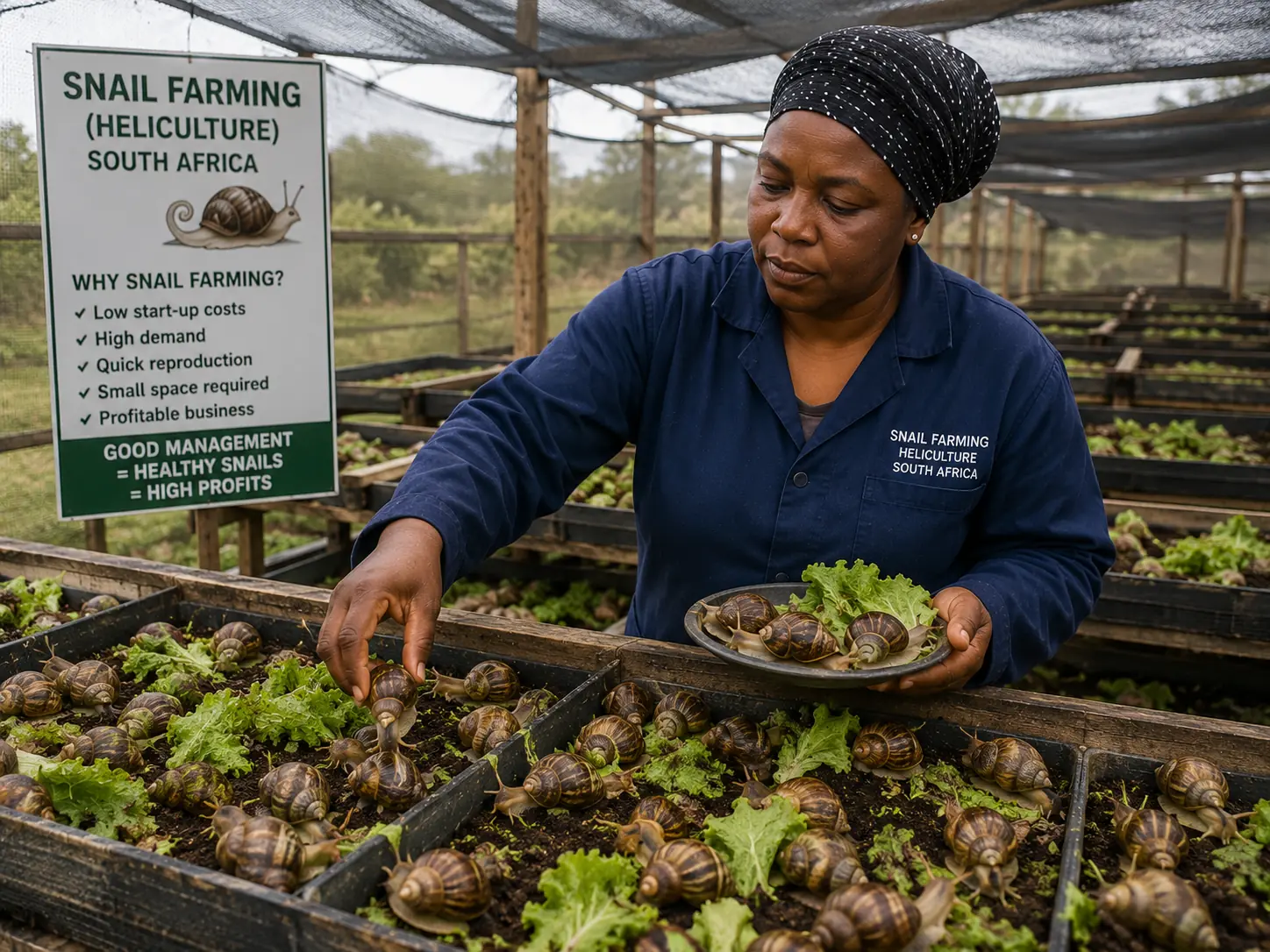
Best Snail Species for Farming in South Africa
Not all snails are suitable for commercial farming. The species you choose determines your market (restaurant escargot vs. informal/community vs. export), your housing and climate requirements, your growth rate, and your slaughter weight. Three main species are commercially farmed in South Africa or are suitable for local conditions:
| Species | Common Name | Adult Weight | Market | SA Suitability |
|---|---|---|---|---|
| Achatina achatina | Giant Ghana Snail / Tiger Snail | 200–450g+ | West African community market, premium restaurants, export | Excellent in warm humid regions (KZN coast, Limpopo lowveld, Eastern Cape coastal belt). The largest land snail in the world. Very high value per animal. Slower to mature (12–18 months to market size). |
| Achatina fulica | Giant African Land Snail (GALS) | 80–250g | Restaurant escargot, processing, informal markets | Highly adaptable across most SA climates including cooler areas. Fast breeder. Most widely farmed in SA. Can be invasive if animals escape, secure housing mandatory. |
| Archachatina marginata | Giant West African Snail | 150–500g | Premium restaurants, West African community, export | Best in warm, humid conditions. Highly prized for meat quality and large shell size. Strong demand from Nigerian and Ghanaian communities. Slower growth than fulica. |
| Helix aspersa (now Cornu aspersum) | Common Garden Snail / Petit Gris | 10–25g | European-style restaurant escargot, export to EU | Already widespread across SA. Well-suited to cooler Western Cape and highveld conditions. Primary escargot species for French-style cuisine. Smaller size, needs larger numbers for equivalent revenue. |
For most South African beginners, Achatina fulica is recommended as a starting species. It is the most widely available, adapts to a range of climates, breeds rapidly, and can be sold to restaurants, informal markets, and the growing West African community. Farmers in warm and humid coastal areas (KZN, Eastern Cape coast) who can develop market relationships with restaurants or export buyers should also consider Achatina achatina or Archachatina marginata for their substantially higher per-kilogram value.
⚠️ Important biosecurity note: Achatina fulica (Giant African Land Snail) is classified as an invasive species in many countries and is already naturalistic in parts of South Africa. Escaped snails can damage crops and natural vegetation. Ensure your snailery housing is completely escape-proof, fine mesh enclosures, regular perimeter checks, and never releasing snails into the environment. Check with your provincial conservation authority and DALRRD for any local regulations regarding snail farming species.
Climate and Environmental Requirements for Snail Farming
Snails are ectotherms (cold-blooded), they cannot generate their own body heat and are entirely dependent on their environment for temperature regulation. South Africa's climate diversity means that farming conditions vary significantly by region, and housing design must compensate for sub-optimal ambient conditions.
- Temperature: African snail species (Achatina, Archachatina) grow best at 22–28°C. They become inactive below 15°C and aestivate (go dormant) below 10°C. In the Western Cape, Free State, and Gauteng highveld where temperatures regularly drop below 10°C in winter, greenhouse-style housing with supplemental heating is required for year-round production. In KZN coastal areas, Limpopo lowveld, and tropical parts of Mpumalanga, outdoor or semi-outdoor production is viable year-round. Helix aspersa tolerates cooler temperatures (10–18°C optimal) and is better suited to cooler SA regions.
- Humidity: Snails require high relative humidity, 75–95%, to remain active, feed, and grow. They lose moisture rapidly in dry conditions and will withdraw into their shells and aestivate when humidity drops below about 60%. In South Africa's dry interior regions, maintaining adequate humidity requires daily or twice-daily misting of the snailery, dense planting of the enclosure with moisture-retaining vegetation, and shading to prevent heat and moisture loss. Coastal and high-rainfall areas naturally provide better humidity conditions.
- Soil: Snails lay their eggs in moist, loose soil. The snailery substrate (floor material) must be loose, friable, non-compacted, and free of pesticides, salt, and chemicals. A mixture of loam soil and well-composted organic matter at 15–20cm depth in the enclosure is ideal. Avoid sandy soil (drains too fast, dries out) and heavy clay (compacts and waterloggs). Soil pH should be near neutral (6.5–7.5), snails need calcium for shell development, and calcium availability is best in this pH range.
Building Your Snailery, Housing Systems for South African Conditions
Snaileries can be built on a range of scales and budgets. The most important design requirements are: escape-proof, predator-proof (rats, birds, hedgehogs, and toads will readily eat snails), shade from direct sun, good humidity retention, and ease of management (feeding, watering, monitoring, and harvesting).
Basic Outdoor Pen (Smallholder / Starter System)
A simple outdoor pen of 10–20m² can house a starter colony of 200–500 snails. Construct a frame from wooden poles or metal angle iron, cover all sides and the top with fine wire mesh (0.5–1mm aperture, finer than standard insect mesh is needed to prevent juvenile snails from escaping). Bury the mesh 15–20cm below the soil surface to prevent burrowing escape. Provide shade using shade cloth (60–70% shade rating). Plant the pen interior with dense vegetation, snails use plants for shelter, moisture, and supplementary food. Plantain, comfrey, lettuce, pumpkin leaves, and morogo are excellent snailery plants. Install an automatic micro-misting system or mist twice daily in dry conditions.
Greenhouse / Tunnel Snailery (Semi-Intensive)
A poly-tunnel or greenhouse structure 30–100m² in size, fitted with shade cloth lining, automatic humidity control (fogger nozzles on a timer), and divided into feeding, breeding, and growing sections. This system allows year-round production in all SA climates by controlling temperature and humidity. Fit internal fencing to create separate zones, broodstock pen, egg hatching area, juvenile growing pens, and adult grow-out pen. Clean concrete or compacted earth floors with raised growing beds filled with prepared substrate. This is the most commercially viable system for serious operators targeting restaurant or export markets.
Container or Tyre-Stack System (Urban / Peri-Urban)
For urban and township farmers with very limited space, snails can be raised in stacked car tyres filled with substrate, large plastic containers with ventilated lids, or modified IBC tanks. A single stack of 5 tyres can house 50–100 adult snails. This system has very low start-up cost and can be operated in a small backyard or rooftop space. It is suitable for supplying local restaurants, fresh markets, and informal community sales rather than large-scale export volumes. See our urban farming guide and container farming guide for more small-space farming ideas.
Outdoor Free-Range System (Low Density, Large Area)
On suitable farms with warm humid climates, snails can be farmed at low density in larger outdoor enclosures of 500m²–1ha, heavily planted with food plants and sheltering vegetation. Stocking density: 20–50 snails per m² for growing snails. This system has the lowest management intensity but is more exposed to predators and climate variability. Best suited to KZN coastal farms and Eastern Cape with natural high humidity and mild temperatures year-round. Fencing must be buried and mesh fine enough to contain juveniles, the highest-escape-risk stage.
Feeding Snails on a South African Farm
Snails are herbivores with a broad diet, they will eat most plant material, decaying organic matter, and calcium sources. A good feeding programme in a commercial snailery balances growth rate, shell quality (which depends on calcium intake), and feed cost. The ideal snail diet in a South African farming context includes:
- Leafy greens (primary diet): Lettuce, spinach, kale, morogo (African leafy vegetables), pumpkin leaves, pawpaw leaves, banana leaves, comfrey, plantain, and cabbage. Feed daily or every 2 days. Remove uneaten food before it rots, decaying food causes disease and attracts pests.
- Fruit and vegetables: Pawpaw (papaya), banana, sweet potato, pumpkin, melon, and cucumber. High moisture content helps maintain snail hydration. Break or chop large pieces.
- Calcium supplement (critical for shell growth): Snails need significant calcium for shell construction. Provide crushed oyster shell, egg shells (baked to sterilise at 200°C for 20 minutes, then crushed), or agricultural limestone (dolomite) in a separate feeding dish at all times. Without adequate calcium, shells become thin, brittle, and misshapen, reducing marketability and snail health.
- Grain-based concentrate (supplementary): Ground maize, wheat bran, soy flour, or commercial broiler starter feed can be used as a concentrated supplementary feed to accelerate growth, particularly useful in intensive greenhouse systems. Mix with water to form a mash and offer in shallow dishes.
- Foods to avoid: Never feed salt (kills snails), citrus (too acidic), onions, garlic, processed or spiced human food, meat, or pesticide-contaminated plants. Ensure all feed is free of agricultural chemical residues, snails are very sensitive to pesticide contamination.
Snail Breeding and Reproduction
Understanding snail reproduction is essential for managing production cycles. Snails are hermaphrodites, every individual has both male and female reproductive organs. However, they cannot self-fertilise and must mate with another individual to reproduce. Mating typically occurs at night during warm, humid conditions. After mating, both individuals are capable of laying eggs, typically 100–400 eggs per clutch (depending on species) in a hole dug in the soil substrate. Key reproductive facts:
- Achatina fulica: Matures sexually at 6–8 months. Lays 100–300 eggs per clutch, 4–6 clutches per year. Eggs hatch in 10–20 days at 28°C.
- Achatina achatina: Matures at 12–18 months. Lays fewer eggs (80–200 per clutch) but individual egg/hatchling value is higher due to large adult size. 2–4 clutches per year.
- Helix aspersa: Lays 40–100 eggs per clutch, 3–5 clutches per year. Seasonal breeder, most active in spring and summer.
To optimise breeding: maintain a separate broodstock pen with the best (largest, healthiest) adult animals; provide optimal temperature and humidity; provide abundant calcium for egg production; remove egg clutches to a separate hatching container with moist substrate at 25–28°C; and move newly hatched juvenile snails to a dedicated nursery pen away from adults (who may compete for food or accidentally crush juveniles).
Harvesting and Processing Snails for Market
Snails are typically harvested at the species-specific commercial size: for Achatina fulica, this is 80–150g liveweight (shell diameter 7–10cm); for Achatina achatina and Archachatina marginata, commercial size is 150–400g+. Harvest time from hatching to market weight:
- Achatina fulica: 6–10 months under good conditions
- Achatina achatina: 12–18 months
- Helix aspersa: 8–14 months
Purging (Essential Before Sale)
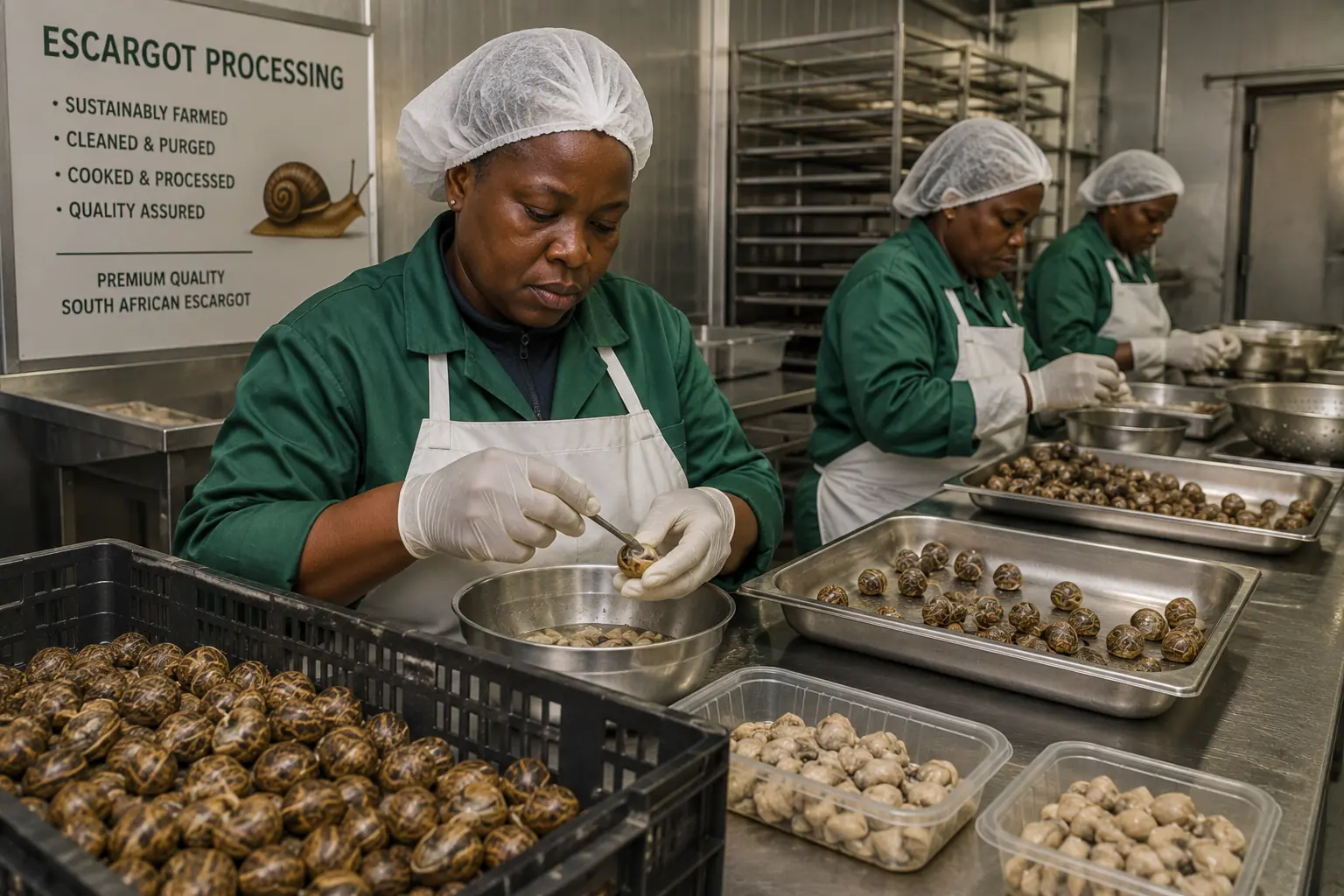
Before harvesting for market, snails must be purged, placed in a clean container without food for 48–72 hours to empty their digestive tracts. This removes any potentially harmful plant matter, soil, or compounds from the gut and significantly improves the flavour of the meat. During purging, keep snails slightly moist (not wet) and in a ventilated container. After purging, snails are ready for live sale or further processing.
Processing for Restaurant and Export Markets
For upmarket restaurant supply and export, snails are typically processed as follows: blanch live (purged) snails in boiling salted water for 3–5 minutes; remove the snail from the shell with a small fork or pick; trim the digestive gland (dark-coloured part); clean shells thoroughly; refrigerate or freeze snail meat; and vacuum-pack or freeze in standardised portions. Frozen snail meat can be exported or stored for restaurant supply on a schedule. For restaurants preferring live delivery, supply in ventilated containers with moist substrate, snails survive well for 2–4 days in cool conditions.
Live Snail Price (Restaurant)
Achatina species, large size, purged, Johannesburg or Cape Town
R120–R250/kgProcessed Escargot (Frozen)
Blanched, cleaned, vacuum-packed meat for restaurant supply
R200–R450/kgInformal / Community Market
Live or fresh snails for West/Central African community buyers
R80–R150/kgCommon Pests and Diseases in South African Snaileries
- Rats and mice: The most destructive predators in snaileries, they eat snails, eggs, and juveniles, and their droppings contaminate feed and substrate. Maintain excellent rodent control around the snailery, snap traps, bait stations (external to snailery only), and securing all feed in sealed containers. Fine mesh at the base of all enclosures is essential. See our pest control guide.
- Toads and frogs: Enter snaileries at night and eat juvenile snails. Inspect perimeter mesh for ground-level gaps regularly. Remove any toads found inside.
- Flies (egg and larvae): Blowfly maggots can infest snails, particularly during hot humid conditions. Remove uneaten food daily. Keep the snailery clean.
- Nematodes: Parasitic nematodes can affect snail health in high-density pens. Maintain good sanitation, remove old substrate and replace every 6–8 weeks, or whenever it appears compacted, malodorous, or infested.
- Calcium deficiency: Not a disease but a common management failure, shells become soft, thin, or irregular. Provide calcium supplement (crushed shell or limestone) ad libitum at all times.
Selling Snails in South Africa, Market Access
- Upmarket restaurants and hotels: The highest-value channel. Contact the head chefs at French, Italian, Mediterranean, and fine dining restaurants in Johannesburg (Sandton, Rosebank), Cape Town (Waterfront, V&A, De Waterkant), and Durban directly with samples. Many SA restaurants currently import escargot from Eastern Europe, locally farmed, fresh snails are a compelling alternative. Develop relationships proactively and offer trial supplies.
- West and Central African community markets: Achatina achatina and Archachatina marginata are staple foods for large communities of Nigerian, Ghanaian, Cameroonian, and Congolese nationals living in South African cities. This is a significant, year-round demand market that is largely unserved by domestic production. Sell live or fresh via informal markets, WhatsApp groups, or direct supply networks in areas with large West African populations.
- Export markets: South Africa's growing snail farming sector is beginning to develop export relationships with European buyers (France, Italy, Belgium) and Nigerian/Ghanaian importers. Export requires PPECB phytosanitary inspection, food safety compliance, and cold chain logistics. See our export farming guide for how to access export certification.
- Direct sales and agri-tourism: On-farm escargot experiences (cooking demonstrations, snail tasting, farm visits) are a growing niche particularly for Western Cape and KZN farms targeting food tourism. This value-added channel multiplies farm income with minimal additional production cost.
- Cosmetic and pharmaceutical industries: Snail mucin (the slime secretion) is a growing ingredient in South African and export cosmetic markets, face creams, serums, and beauty products using snail slime are a global trend. Some SA snaileries have begun supplying mucin extract to cosmetic manufacturers as a secondary income stream.