Green Bean Farming in South Africa, A Fast-Turnover Cash Crop for Local and Export Markets
Green beans (Phaseolus vulgaris), also called French beans, snap beans, or string beans, are firmly among South Africa's most commercially important vegetable crops. They are grown across multiple provinces for both the domestic fresh produce market and for export to the European Union and the United Kingdom, where South African green beans hold a respected reputation for quality and consistent supply during the European winter season.
What makes green beans particularly attractive to South African farmers is their short production cycle. From planting to first harvest is typically just 50–65 days, making it possible to run two or even three crops per year on irrigated land. Combined with consistently strong local demand and a well-established export infrastructure, green beans are firmly among the most accessible entry points into commercial vegetable farming for smallholders and emerging farmers across Limpopo, Mpumalanga, the Western Cape, and KwaZulu-Natal.
South Africa exports tens of millions of rands' worth of green beans annually, primarily to the UK and European retailers during the October–April window when northern hemisphere production is limited. To access these markets, farmers must achieve GlobalGAP certification and supply through registered export packhouses, but the premium prices achieved on export contracts make this investment very worthwhile for established growers.
🫘 Quick numbers: A well-managed hectare of irrigated green beans can yield 8–15 tonnes of fresh pods. At local fresh produce market prices of R8–R18/kg, that is R64,000–R270,000 gross per hectare per crop. On export contracts, the same produce can earn R18–R35/kg, significantly lifting returns for certified growers supplying export packhouses.
Best Green Bean Varieties for South African Conditions
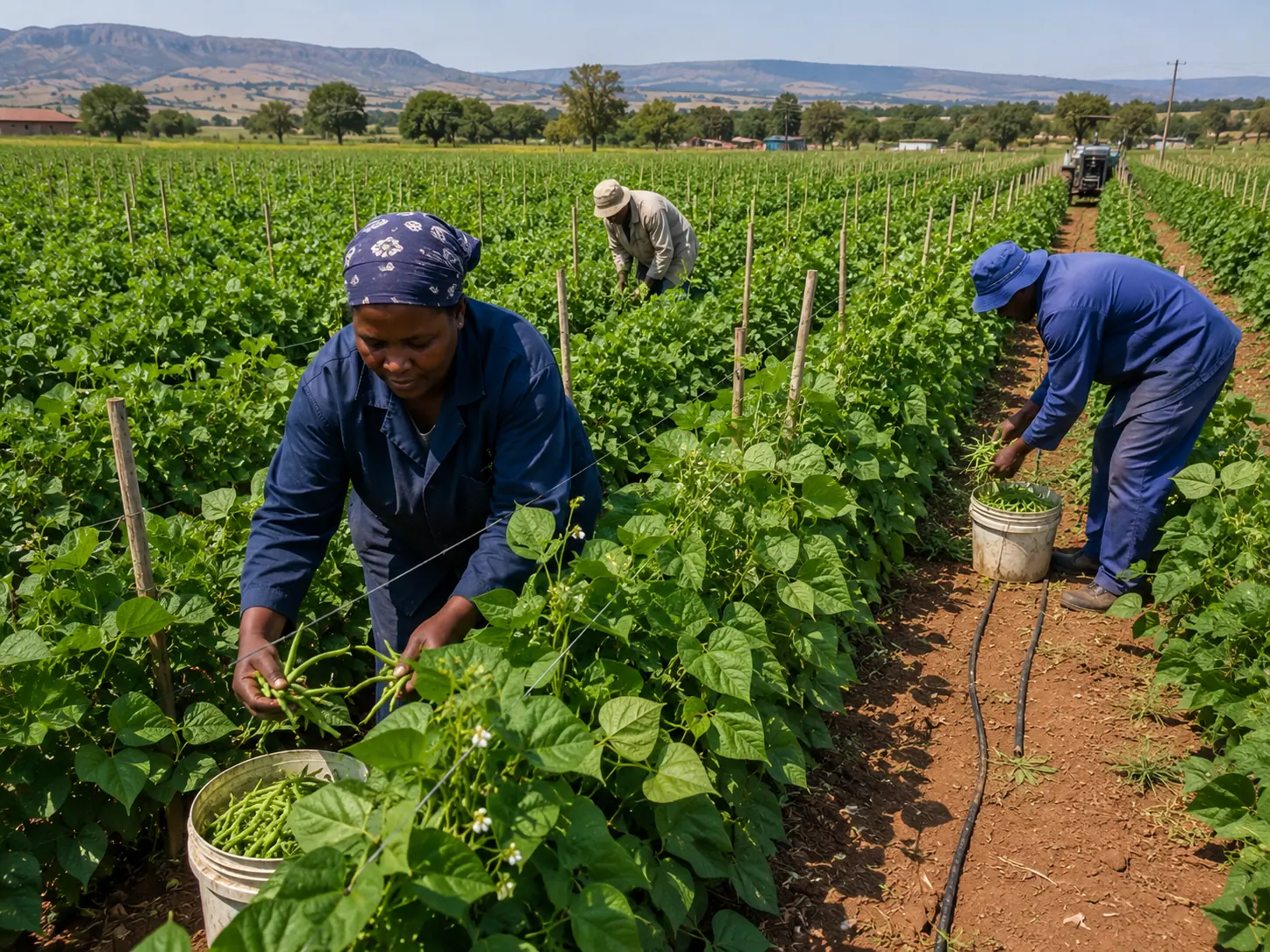
Green bean varieties are divided into two growth habits: bush beans (determinate, no staking required, most common in commercial SA production) and pole beans (climbing, require trellising, higher yield per plant but more labour). For commercial production, bush varieties dominate in South Africa because they allow mechanised harvesting and suit the dense planting systems used by export packhouse suppliers.
| Variety | Type | Pod Colour | Days to Harvest | Best Market | Notes |
|---|---|---|---|---|---|
| Paulista | Bush | Dark green | 52–58 days | Export, local fresh | Most widely grown export variety in SA; uniform straight pods |
| Bronco | Bush | Medium green | 50–55 days | Export, retail | Excellent shelf life; preferred by UK supermarket buyers |
| Maxibel | Bush (filet) | Dark green | 50–54 days | Export premium, restaurants | Fine French bean; highest export value but labour-intensive harvest |
| Safari | Bush | Green | 55–60 days | Local fresh market | Good heat tolerance; reliable in Limpopo summer conditions |
| Espada | Bush | Green | 54–60 days | Local, processing | Good disease resistance; suited to KZN and Mpumalanga |
| Helda (Romano) | Pole | Flat green | 65–75 days | Local retail, informal markets | Popular with smallholders; flat runner-type bean with strong domestic demand |
Climate and Soil Requirements
🌡️ Climate
Green beans are a warm-season crop that thrives at temperatures between 18°C and 28°C. They are frost-sensitive and cannot tolerate temperatures below 4°C, even a light frost will damage young plants and abort flowers. In South Africa's summer rainfall regions (Limpopo, Mpumalanga, KZN, Free State), green beans are planted from spring through summer. In the Western Cape and Northern Cape, they are grown as summer crops using irrigation. The optimal production window for export markets (targeting the European winter shortage) is October to March, aligning well with South Africa's main summer growing season.
Soil
Green beans perform best on well-drained, fertile sandy loam to loam soils with a pH of 5.8–6.8. They are shallow-rooted (most roots in the top 30cm), making soil structure and consistent moisture supply critical. Waterlogging even for 24 hours during flowering or pod fill can cause significant crop loss. Before planting, incorporate 20–25 tonnes/ha of compost or well-rotted manure to improve organic matter, water retention, and soil biology. Conduct a soil test and correct pH with agricultural lime well before planting, green beans are sensitive to aluminium toxicity in acidic soils below pH 5.5. See our soil and fertilizer guide for pre-plant preparation details.
Water and Irrigation
Green beans need consistent moisture but are intolerant of waterlogging. Total water requirement is 300–400mm per crop, delivered ideally through drip or overhead sprinkler irrigation. Critical water stress periods are germination (soil must stay moist for 7–10 days after planting), flowering (water stress at bloom causes flower drop and dramatically reduces yield), and pod fill (water stress at this stage reduces pod length, weight, and quality). Drip irrigation is preferred for export production because it keeps foliage dry and reduces the spread of foliar diseases. For smallholder production, overhead sprinklers or furrow irrigation are more accessible options. See our irrigation systems guide for specifications.
Step-by-Step Green Bean Production Guide
Land Preparation
Plough or rip to 300mm depth and disc to a fine, even seedbed. Apply and incorporate compost (20–25 t/ha) and base fertiliser, a typical recommendation for green beans is 500–600kg/ha of 2:3:2(22) or a similar balanced compound, applied in the seed furrow or incorporated before planting. Avoid excess nitrogen at planting as this promotes leafy growth at the expense of flowering. Raised beds (15–20cm) on heavier soils significantly reduce waterlogging risk.
Planting
Direct seed green beans at a depth of 3–4cm. For bush varieties grown for export, plant at 5–7cm within rows and 45–60cm between rows, giving a population of approximately 250,000–350,000 plants per hectare. For local market production with wider spacing (60cm between rows), 180,000–220,000 plants/ha is standard. Seed germination takes 7–10 days at soil temperatures above 18°C. Do not plant in cold or wet soil, seeds will rot rather than germinate. Treat seed with a registered fungicide and rhizobium inoculant (to boost biological nitrogen fixation) before planting.
Fertilisation
Green beans, as legumes, fix atmospheric nitrogen through root nodule bacteria, provided good rhizobium inoculant is used at planting. This means nitrogen requirements are lower than for most other vegetables. A typical topdressing programme involves 100–150kg/ha of LAN applied in split applications at 3 weeks and 6 weeks after emergence. Potassium and phosphorus are the more critical limiting nutrients for pod quality and yield, maintain adequate levels based on soil test results. Foliar micro-nutrient sprays (boron, molybdenum) during flowering support pod set and are especially important in soils with acidic pH.
Pest and Disease Management
The primary pest threats to South African green bean production are the bean fly (Ophiomyia phaseoli), a major problem in Limpopo and Mpumalanga, which attacks the stem base of young seedlings and can devastate a crop in the first two weeks after emergence; thrips (Thrips tabaci), which cause scarring on pods and transmit viruses; and spider mites under hot, dry conditions. Principal diseases include bean rust (Uromyces appendiculatus), angular leaf spot, and anthracnose in wet conditions. Use registered insecticides and fungicides, practice strict crop hygiene, and follow a structured integrated pest management programme. For export production, all pesticide applications must comply with EU and UK Maximum Residue Level (MRL) requirements, always use export-approved products and maintain spray records.
Harvesting
Bush green beans reach harvest maturity at 50–65 days after planting. The correct harvest stage is when pods are firm, snapping cleanly when bent, seeds are small and not yet bulging, and pod diameter is within the export or market specification. For export markets, pods must be harvested at a strict diameter, typically 6–9mm for fine beans and 9–11mm for bobby beans. Over-mature pods (with visible seed bulging) are rejected. Harvest every 2–3 days during the peak picking period as pods pass through the export window quickly. On small farms, hand harvesting is standard. At commercial scale, machine harvesting is used for processing crops only, export quality pods must be hand-harvested to avoid bruising.
Post-Harvest Handling and Cold Chain
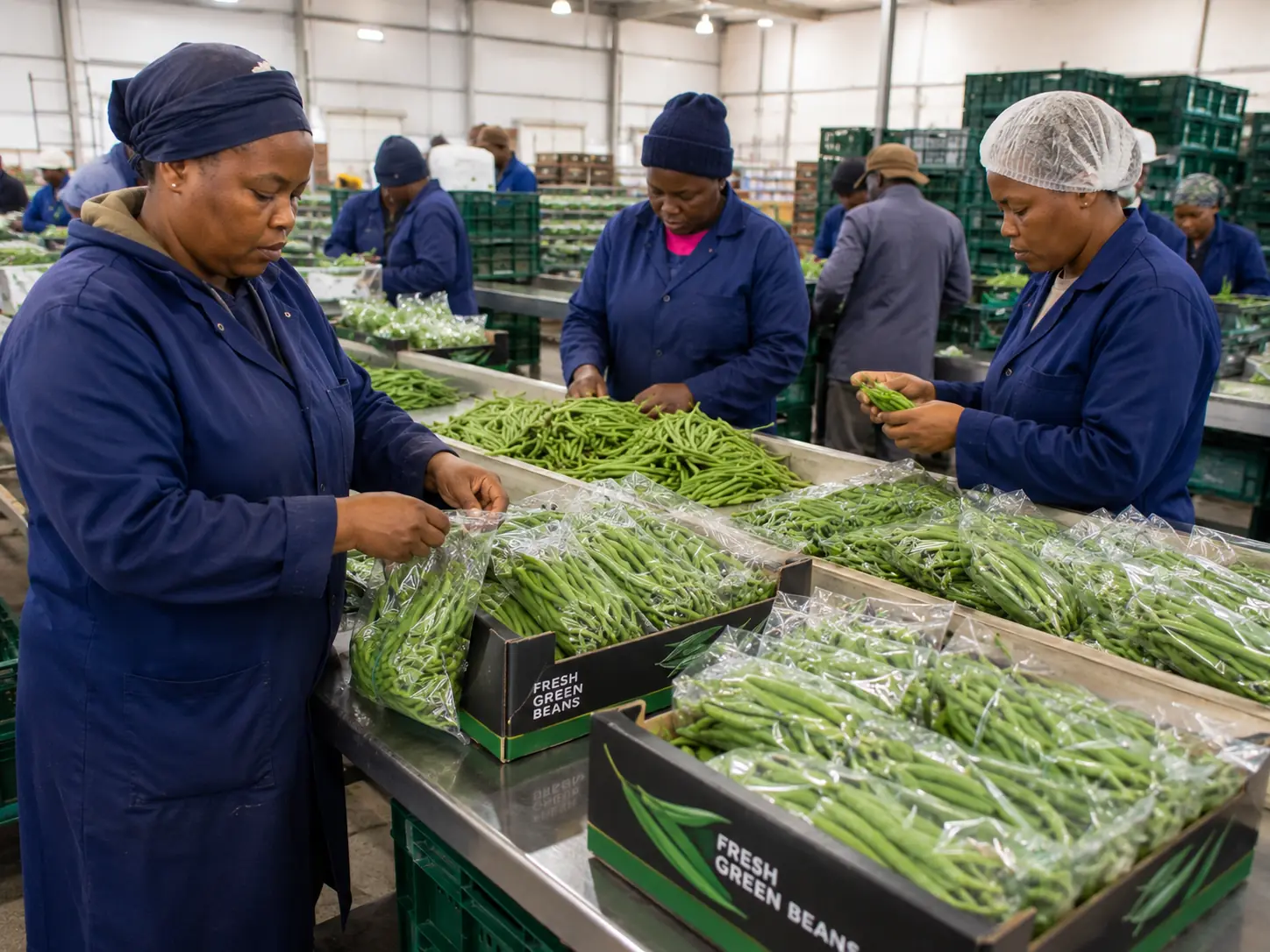
Green beans are highly perishable. After harvest, pods must be cooled to 4–7°C within 2–4 hours (hydrocooling or forced-air cooling) to extend shelf life and maintain export quality. At ambient temperatures above 20°C, quality deteriorates within 24–48 hours. For export supply, all post-harvest handling must occur within a PPECB-registered packhouse with cold chain certification. Grade, inspect for bean fly damage, and pack into standard export cartons (typically 3kg or 5kg nets for fine beans). The cold chain must be maintained from packhouse through refrigerated transport to Durban or Cape Town port. See our export farming guide for full cold chain and PPECB requirements.
Green Bean Planting Calendar for South Africa
| Region | Jan | Feb | Mar | Apr | May | Jun | Jul | Aug | Sep | Oct | Nov | Dec |
|---|---|---|---|---|---|---|---|---|---|---|---|---|
| Limpopo (irrigated) | Grow | Harvest | — | — | — | — | — | Plant | Grow | Plant | Grow | Plant |
| Mpumalanga | Grow | Harvest | — | — | — | — | — | — | Plant | Grow | Harvest | Plant |
| Western Cape (irrigated) | Grow | Harvest | — | — | — | — | — | — | Plant | Grow | Harvest | Plant |
| KwaZulu-Natal | Harvest | — | — | — | — | — | — | Plant | Grow | Harvest | Plant | Grow |
Market Channels for Green Beans in South Africa
🏪 National Fresh Produce Markets
The Johannesburg, Tshwane, Cape Town, and Durban fresh produce markets handle the bulk of South Africa's domestic green bean trade. Prices are highly seasonal, peaking from June to August when local supply is reduced and imported product fills the gap. Establishing a consistent supply relationship with a registered market agent ensures reliable access to these markets. Grade your product carefully, market agents give the best commissions and placement to farmers delivering consistent, well-graded product.
🌍 Export to the EU and UK
South Africa's export window for green beans to Europe runs primarily from October to April. The principal buyers are UK supermarkets (Tesco, Sainsbury's, Marks & Spencer) and European wholesale importers in the Netherlands, Germany, and France. To access these markets you need GlobalGAP certification (or an equivalent like GRASP for UK retailers) and must supply through a registered PPECB export packhouse. First-time exporters should approach established export agents or packhouses in the Limpopo, Mpumalanga, or Western Cape regions as a starting point, most operate outgrower schemes for certified growers. See our full export farming guide for step-by-step entry requirements.
🛒 Supermarkets and Direct Retail
Pick n Pay, Checkers, Woolworths, and SPAR all stock South African green beans, typically sourced through their procurement teams or approved suppliers. Woolworths and Pick n Pay have dedicated local farmer programmes that provide market access to smaller certified growers, contact their agricultural procurement departments directly or through a commodity organisation.
🏭 Processing and Freezing
Several frozen vegetable processors in South Africa, including McCain Foods, source green beans from contracted growers for the frozen vegetable market. Processing contracts typically pay lower prices than fresh market but provide volume certainty and avoid the grading losses of fresh market supply. Espada and similar broad-podded varieties are preferred for processing over fine export varieties.