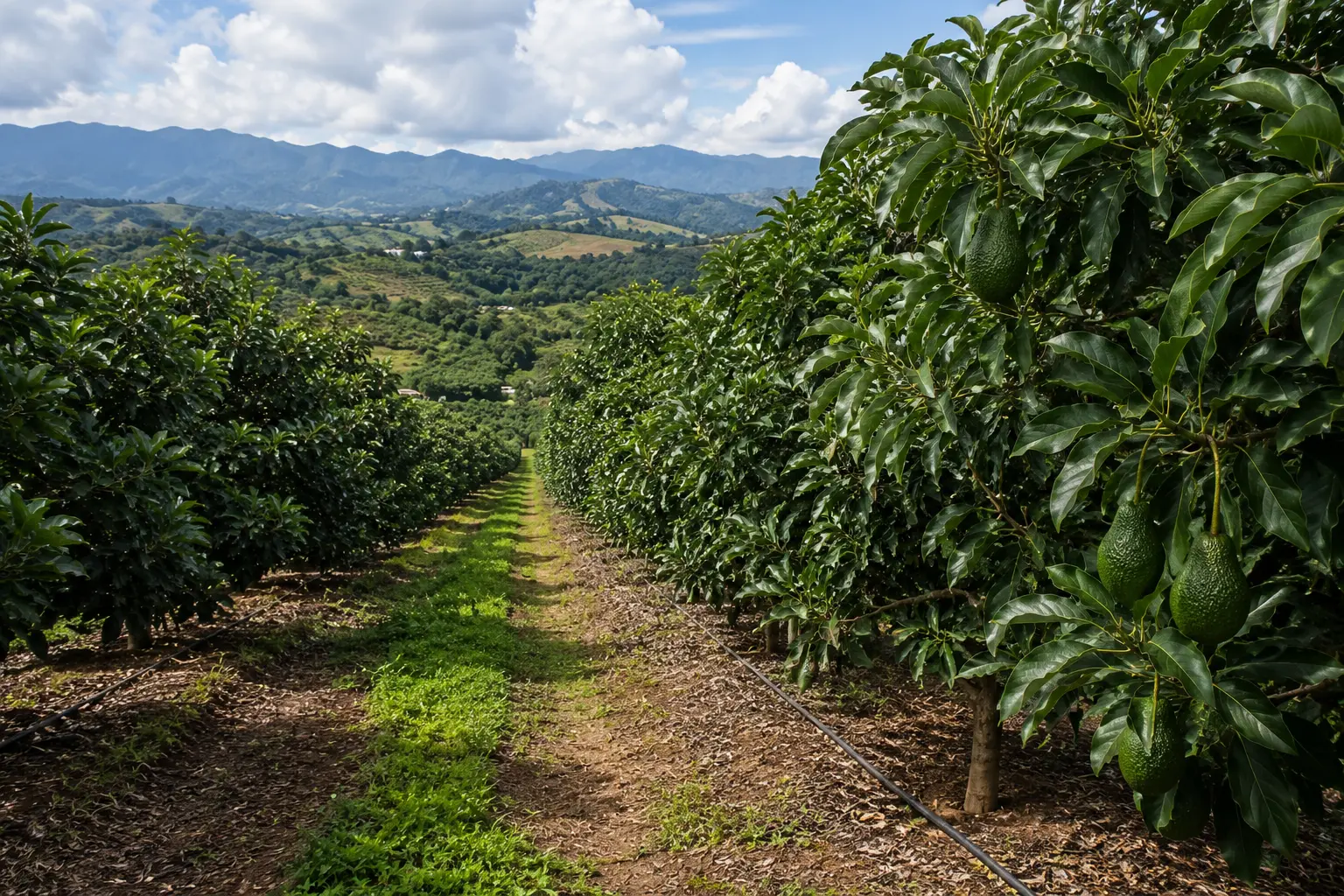
Climate and Soil Requirements for Avocado Farming in SA
Avocados are subtropical trees that thrive under specific climate conditions. Getting the site selection right is the single most important decision you will make as an avocado farmer, it determines everything from tree health and fruit quality to irrigation requirements and susceptibility to disease.
Ideal Climate Conditions
- Temperature: Avocados grow best between 18°C and 30°C. They are frost-sensitive, temperatures below 2°C can damage young trees, while severe frost kills established trees. Limpopo, with its warm subtropical climate and low frost risk, is ideal.
- Rainfall: 1,000–2,000 mm of well-distributed rainfall per year is ideal. Most SA avocado regions receive 700–900 mm and supplement with irrigation.
- Wind: Strong winds cause physical damage to fruit and significantly reduce pollination efficiency. Windbreaks (using Casuarina or other suitable species) are essential in exposed sites.
- Altitude: 300–1,500 metres above sea level suits most cultivars. Higher altitudes produce firmer fruit with better shelf life, important for export.
Ideal Soil Conditions
Avocado trees have specific soil requirements and are particularly sensitive to waterlogging. The single most critical factor is drainage, avocados are extremely susceptible to Phytophthora root rot, a devastating fungal disease that thrives in waterlogged soil. Key soil requirements include:
- Deep, well-drained loam or sandy loam soil (minimum 1.2m depth)
- pH between 5.5 and 6.5 (slightly acidic)
- Good organic matter content, amend with compost before planting
- Avoid clay-heavy soils or sites with a hardpan subsoil layer
- Conduct a soil analysis before planting, contact your provincial DALRRD office for subsidised soil testing services
⚠️ Phytophthora Root Rot, SA's Biggest Avocado Threat
Phytophthora cinnamomi (root rot) is responsible for the majority of avocado orchard failures in South Africa. It cannot be cured once established, only prevented through excellent drainage, proper rootstock selection, phosphonate fungicide applications, and avoiding over-irrigation. Never plant avocados in low-lying areas where water collects after rain.
Best Avocado Cultivars for South Africa
Cultivar selection is critical. South African farmers have access to excellent locally adapted varieties as well as internationally recognised cultivars that meet export market requirements. Avocado cultivars are classified as either Type A (flowers open female in the morning, male in the afternoon) or Type B (flowers open male in the morning, female in the afternoon). For good pollination and maximum yield, you must plant a mix of both types in your orchard.
| Cultivar | Type | Skin | Harvest (SA) | Best For |
|---|---|---|---|---|
| Hass | A | Pebbly, turns black | June–November | Export, premium market |
| Fuerte | B | Smooth, green | May–September | Local market, processing |
| Ryan | A | Smooth, green | August–November | Local fresh market |
| Pinkerton | A | Pebbly, green | June–August | Export, long shelf life |
| Maluma Hass | A | Pebbly, turns black | May–October | Export, early season |
| GEM | A | Pebbly, stays dark | July–November | Export, premium sizing |
Hass dominates the SA export market because it is the world's preferred commercial avocado, consumers recognise the skin-colour change as a ripeness indicator. Fuerte remains popular on the domestic fresh market, especially in Gauteng and KZN. If you are planting for export, focus on Hass or Maluma Hass as your primary cultivar, with Fuerte or Pinkerton as your B-type pollinator rows.
Establishing Your Avocado Orchard
Avocado farming is a long-term commitment. Your orchard will begin producing commercially in years 3–5 and will reach full production in years 7–10. Planning and establishing correctly from the start is essential, mistakes at the planting stage are expensive and slow to correct.
Planting and Spacing
Standard commercial planting density in South Africa is 250–500 trees per hectare, depending on the system. Traditional low-density orchards use 8m × 8m or 10m × 10m spacing. High-density hedgerow systems (increasingly popular with Hass) use 5m × 2m or 4m × 2m spacing and can produce earlier commercial yields. Use certified grafted nursery trees on rootstocks selected for Phytophthora resistance, Dusa® and D9 are the most widely used resistant rootstocks in South Africa.
Irrigation for Avocados in SA
While Limpopo and KZN receive significant summer rainfall, avocados require supplementary irrigation through dry periods. The trees are particularly sensitive to water stress during flowering (August–October) and during rapid fruit development (November–February). Micro-jet or drip irrigation systems are standard in commercial SA orchards. Mature trees typically require 800–1,200 mm of water per year across rainfall and irrigation combined. Water use is a major factor in planning, SA's National Water Act requires water use licences for agricultural extraction above certain thresholds.
Fertilisation and Soil Management
Avocados are moderate feeders but benefit greatly from a well-structured fertilisation programme based on annual leaf and soil analysis. Key nutrients include nitrogen (for vegetative growth), potassium (for fruit development and quality), and phosphorus (root health). In South African conditions, foliar zinc and boron sprays are often necessary as these micronutrients are commonly deficient in SA soils.
Organic matter management is critical, mulching under the tree canopy with straw, wood chips, or compost conserves moisture, suppresses weeds, moderates soil temperature, and improves the biological activity that supports healthy root systems. A 15–20cm mulch layer is standard practice in SA commercial orchards.
Pests and Diseases to Watch in SA Avocado Orchards
Beyond Phytophthora root rot, South African avocado farmers must actively manage several other threats. Avocado thrips (Scirtothrips perseae) cause cosmetic scarring on fruit skin that reduces export grade and value, control with targeted insecticide applications timed to the flowering period. False codling moth (FCM) is a major export compliance concern as it is a quarantine pest in the EU, strict FCM management protocols including mating disruption and bait stations are required for export certification. See our integrated pest management guide for more.
Cercospora spot and other fungal leaf diseases can reduce photosynthesis and fruit quality in humid seasons, preventative fungicide programmes are standard in KZN and mist-belt Limpopo orchards. Avocado sunblotch viroid is a serious disease with no cure, only plant certified disease-free nursery material from registered SA nurseries.
Harvesting and Post-Harvest Management
Unlike most fruits, avocados do not ripen on the tree, they ripen after harvest. Correct harvest timing is therefore determined by oil content rather than external appearance. South Africa uses an oil content threshold of 8% (for Hass) as the minimum maturity standard for domestic market and 11% for export. Regular oil testing by accredited SA labs starts from May/June depending on cultivar and region.
Avocados must be hand-picked with care to avoid bruising. Fruit with stems attached and no cuts or abrasions commands the best export prices. After picking, fruit should be pre-cooled to 5°C within 24 hours and packed in export cartons meeting GlobalGAP and destination-country import standards. See our export farming guide for full details on SA export certification requirements.
Markets and Selling Your SA Avocados
South African avocados sell into three main market channels. The export market (primarily EU, Netherlands, UK, France) offers the highest prices but requires strict quality, food safety, and traceability compliance including GlobalGAP certification. The South African Fresh Produce Markets (Johannesburg, Cape Town, Tshwane, Durban) offer the most accessible route for domestic sales, average prices vary seasonally from R12–R28 per kg. Direct supply to retailers (Pick n Pay, Woolworths, Checkers) and restaurant groups is increasingly possible for quality-consistent producers. The processing market (guacamole, avocado oil, cosmetics) absorbs fruit that does not meet fresh market grade standards.
The South African Avocado Growers' Association (SAAGA) is the key industry body, membership provides access to market information, technical support, and export coordination. For government funding to establish or expand your orchard, visit our farming grants page and explore CASP and DALRRD support programmes.