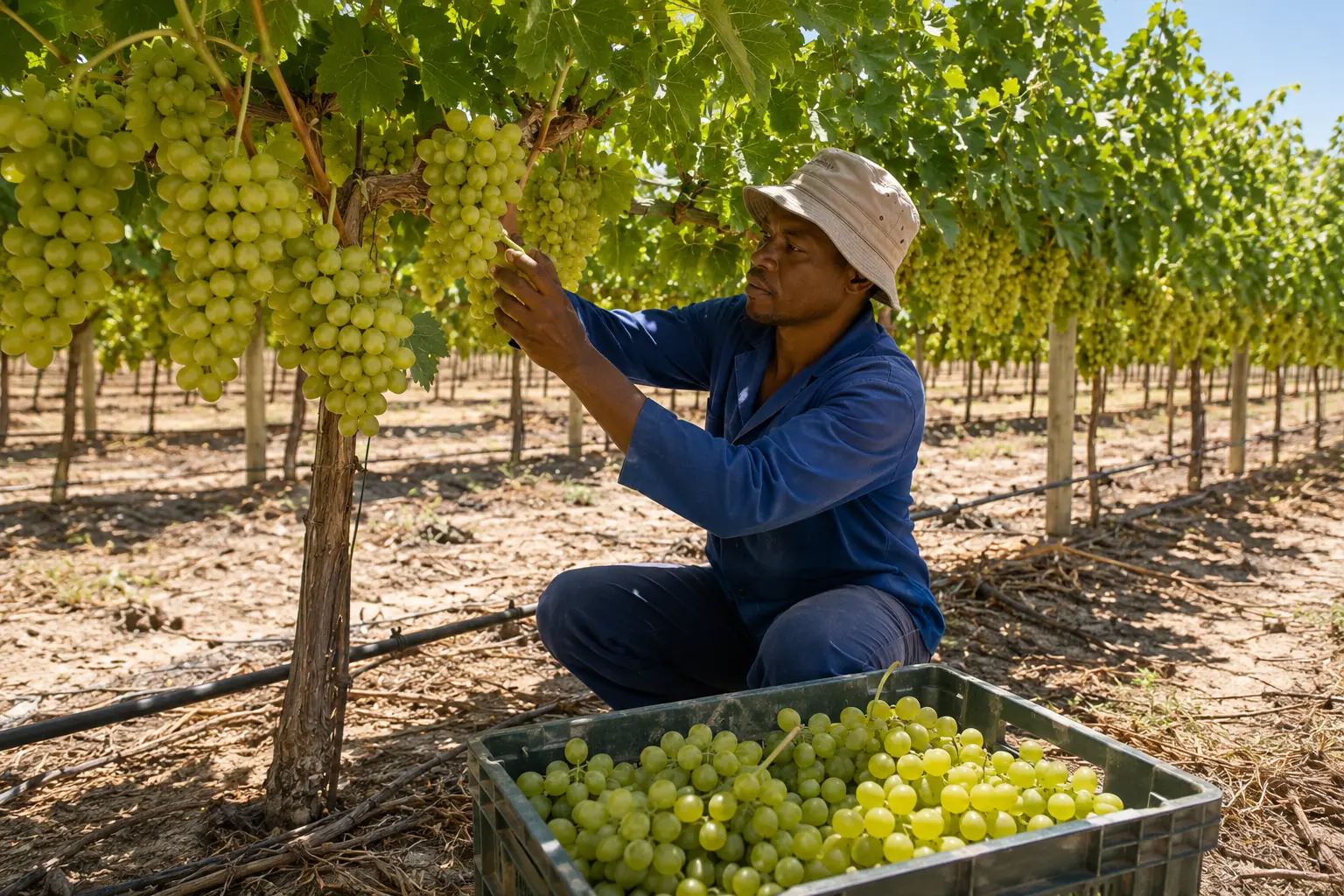
SA Table Grape Regions: Climate and Timing
South Africa's table grape industry spans three distinct production regions, each with a different harvest window and climatic profile. Understanding these regional differences is essential for variety selection and market positioning:
- Orange River (Northern Cape): The earliest and largest production region. Hot desert climate with very low humidity, ideal for table grapes. Harvest runs from late October through January. The early harvest window gives SA growers a significant price premium in UK and European markets before other Southern Hemisphere competitors (Chile, Peru) arrive. Key production areas: Upington, Keimoes, Kakamas, Augrabies.
- Hex River Valley (Western Cape): A cooler, higher-altitude region producing premium quality table grapes with excellent colour and flavour. Harvest runs December–February. The Hex River is world-famous for Red Globe and Crimson Seedless grapes. High land values and a history of premium export quality make this SA's most prestigious table grape region.
- Olifants River and Western Cape coastal areas: Mid-season production complementing the Orange River and Hex River harvests. Increasingly important for newer premium seedless varieties. Harvest November–February depending on variety and microclimate.
Key Table Grape Varieties for South Africa
Variety selection is the single most consequential decision in table grape farming. Market trends, exporter requirements, climate suitability, and consumer preferences must all be factored in. The SA table grape industry has undergone a dramatic variety shift over the past decade, moving away from traditional seeded varieties toward premium seedless cultivars that command higher prices in European and UK markets.
Many of the highest-demand table grape varieties on the export market right now are proprietary, owned by international breeding programmes (IFG/Sun World, ARRA, Lemnagrow) and requiring annual licensing fees or royalty payments per hectare. Before planting any proprietary variety, confirm licensing availability and costs with your exporter or the SA Table Grape Industry (SATI). Licensed varieties often deliver premium export prices that more than justify the licensing cost.
Trellising Systems for South African Table Grapes
The trellis system fundamentally determines canopy management, labour requirements, and grape quality. South African table grape farms use several trellis systems, with the choice depending on variety, region, and management approach:
Pergola (Overhead Flat Trellis)
The traditional SA table grape trellis, a flat overhead system where vine arms are trained horizontally and bunches hang below the canopy in full shade. The pergola produces excellent berry colour uniformity (less sunburn risk) and is well-suited to the high-light intensity of the Orange River region. Labour-intensive to manage but widely used on established Northern Cape farms. Rows are typically 3–4m apart with in-row vine spacing of 2–3m.
Single Guyot / Vertical Shoot Positioning (VSP)
A vertical trellis system where canes are trained upward and shoots are tucked between foliage wires. Used on some Western Cape and newer SA farms. Better sunlight penetration for berry colouring and disease management than pergola, but requires careful canopy management to avoid excessive shading. More suited to cooler regions where light intensity is lower than the Orange River.
Smart-Dyson and Lyre Systems
More complex, labour-efficient trellis systems increasingly adopted on newer SA commercial table grape farms. Better light distribution, easier mechanical operations, and improved ventilation compared to traditional pergola. Higher establishment cost but lower long-term labour costs for pruning and canopy management.
Irrigation Management in SA Table Grape Vineyards
Table grapes are among the most irrigation-intensive fruit crops in South Africa. In the Orange River region (which receives less than 200mm of annual rainfall) virtually all the vine's water needs come from irrigation, drawing on the Orange River via extensive pump and canal systems. In the Western Cape, winter rainfall contributes significantly but supplementary drip irrigation is still essential for consistent quality production.
Drip irrigation is the standard for modern SA table grape vineyards, delivering 600–900mm of water equivalent per season depending on region, variety, and vine size. Deficit irrigation strategies (deliberately reducing water supply at specific phenological stages) are used to control vine vigour, improve berry colour and Brix (sugar content), and increase berry size consistency.
Irrigation scheduling in SA table grapes is increasingly driven by pressure bomb (leaf water potential) measurements, soil moisture sensors, or evapotranspiration-based calculations. Over-irrigation is as damaging as under-irrigation in table grapes, excess water dilutes berry flavour, delays ripening, and encourages vigorous vegetative growth at the expense of fruit quality.
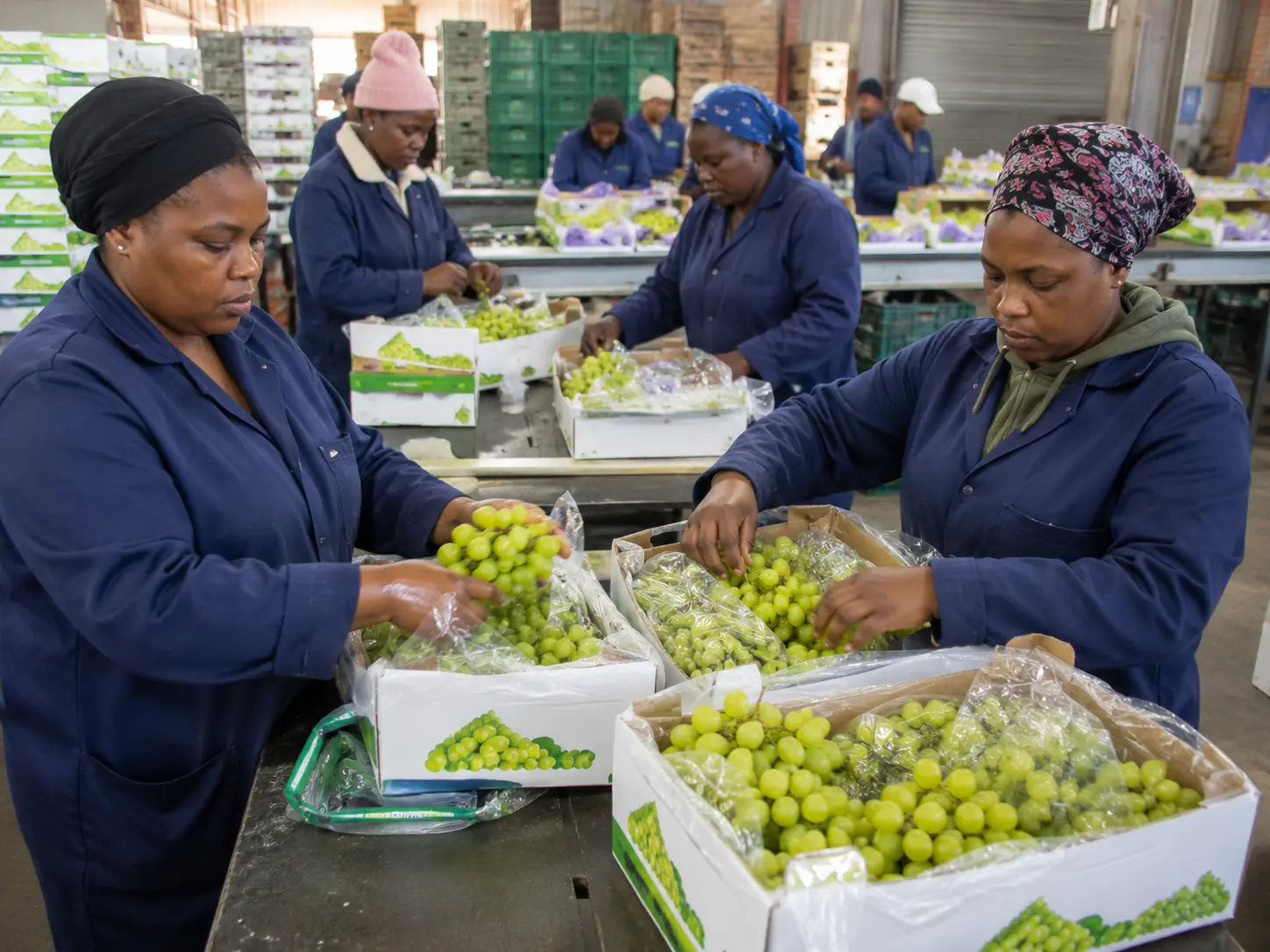
GlobalGAP Certification: The Gateway to SA Grape Export Markets
GlobalGAP (Good Agricultural Practices) certification is essentially mandatory for any SA table grape farmer wanting to access European supermarket supply chains, the highest-value market for SA export grapes. Major UK and EU retailers including Tesco, Woolworths UK, Marks & Spencer, Lidl, and Aldi require GlobalGAP certification from all their fresh produce suppliers.
GlobalGAP covers: food safety (pesticide residue management, water quality, hygiene); worker health, safety, and welfare; environmental impact and sustainability; and traceability from farm to market. Certification involves an initial training process, on-farm risk assessment, implementation of a quality management system (including record-keeping), and annual third-party audit by an accredited certification body.
In South Africa, GlobalGAP audits are conducted by accredited certification bodies including SIZA (Sustainability Initiative of South Africa), which adds social and environmental auditing to the GlobalGAP food safety framework. SIZA certification is increasingly required by UK and EU retailers alongside GlobalGAP, particularly for labour practices on SA farms.
The investment in GlobalGAP certification typically ranges from R15 000–R50 000 for the initial certification process (consultant fees, system implementation, audit cost) plus R8 000–R25 000 annually for renewal audits. This is a cost that is repaid many times over by access to premium export prices unavailable to non-certified farms.
Table Grape Export Channels and Pricing in South Africa
The vast majority of SA export table grapes move through one of several large exporters and marketing agents who handle logistics, cold chain management, phytosanitary certification, and market relationships on behalf of producers. Key players in the SA table grape export sector include Capespan, Dole South Africa, Grape Company, Ovata, and numerous independent exporters and trading houses.
Export pricing is typically structured as a returns model, the exporter deducts marketing, logistics, cold chain, and handling costs from the FOB (Free on Board) or delivered price achieved in market, and remits the net return to the farmer. Understanding the cost structure of your export agreement is essential: transport from farm to pack house, export documentation, cold storage, sea freight, and destination charges can collectively represent 40–60% of the gross export price.
For premium varieties in peak export windows, SA farmers can achieve net returns of R35–R65 per kg for export-grade fruit after all deductions. The highest returns are achieved in the early-season window (October–December) when SA is the primary Southern Hemisphere supplier to Europe. Local market prices are significantly lower (R15–R30/kg at Fresh Produce Markets) but require no export certification or cold chain investment.
Yield: 20–40 tonnes per hectare (variety and system dependent) | Net export return: R35–R65/kg after costs | Gross income: R700k–R2.6m/ha at full production | Input costs: R150 000–R300 000/ha/year (fertiliser, crop protection, labour, irrigation, certification) | Establishment cost: R250 000–R450 000/ha | Break-even: typically year 5–7 post-establishment
Key Pests and Diseases in SA Table Grape Vineyards
Table grape vineyards face significant pest and disease pressure in South Africa, and integrated pest management (IPM) is essential for producing export-quality fruit while managing pesticide residue levels within EU Maximum Residue Limits (MRLs):
- Powdery mildew (Erysiphe necator): The most economically significant fungal disease on SA table grapes. Causes white powdery growth on berries and leaves, ruining export quality. Weekly or fortnightly fungicide applications from budburst are standard. Resistance management through rotating fungicide groups is critical.
- Botrytis (grey mould): Post-harvest and pre-harvest rot particularly damaging in compact-bunched varieties and in humid conditions. Controlled through canopy management (aeration), early harvest of susceptible varieties, and pre-harvest fungicide programmes.
- Mealybugs: Major cosmetic quality problem on export grapes. Mealybug contamination causes rejections at ports and destination markets. Managed through systemic insecticides, biological control agents (parasitic wasps), and careful monitoring.
- Bud mites (Calepitrimerus vitis): Cause bud damage and reduced budburst in SA vineyards. Controlled through sulphur sprays during dormancy.
- False codling moth (Thaumatotibia leucotreta): A phytosanitary pest, its presence in export consignments causes rejection and can result in market bans. Comprehensive monitoring, trapping, and chemical/biological control is mandatory for EU export certification.