Tea Farming in South Africa: A Uniquely South African Opportunity
South Africa is home to two of the one of the world's most distinctive herbal teas, rooibos (Aspalathus linearis) and honeybush (Cyclopia spp.), both of which are endemic to the fynbos biome and found nowhere else on earth. Rooibos, the flagship South African tea, is cultivated exclusively in the Cederberg and surrounding mountain regions of the Western Cape. Honeybush grows in the Eastern Cape and along the southern coastal ranges. Together, these two crops form the backbone of a fast-growing South African tea industry that exports to more than 60 countries and generates hundreds of millions of rands in export revenue each year.
Global demand for rooibos and honeybush has grown dramatically over the past two decades, driven by their caffeine-free status, rich antioxidant profiles, and growing consumer interest in functional and herbal beverages. Rooibos received EU Protected Designation of Origin (PDO) status in 2021, a milestone that legally protects the name "rooibos" for teas grown in the certified production area of the Western Cape, similar to how Champagne is protected for sparkling wine from France. This protection gives South African rooibos producers a powerful market positioning advantage.
🍵 South Africa exports approximately 14,000–18,000 tonnes of rooibos per year, with Germany, the Netherlands, Japan, the UK, and the USA being the top export markets. Honeybush exports are smaller but growing rapidly, with Germany and Japan showing particularly strong demand for certified organic honeybush.
Beyond rooibos and honeybush, South Africa also produces small quantities of green tea (Camellia sinensis) in the Mpumalanga Escarpment region (particularly around Tzaneen and the Magoebaskloof area), where altitude and rainfall conditions are suitable. This page covers all three categories, with primary focus on rooibos and honeybush as the dominant and most commercially established South African tea crops.
Rooibos Farming in South Africa: The Guide
What is Rooibos?
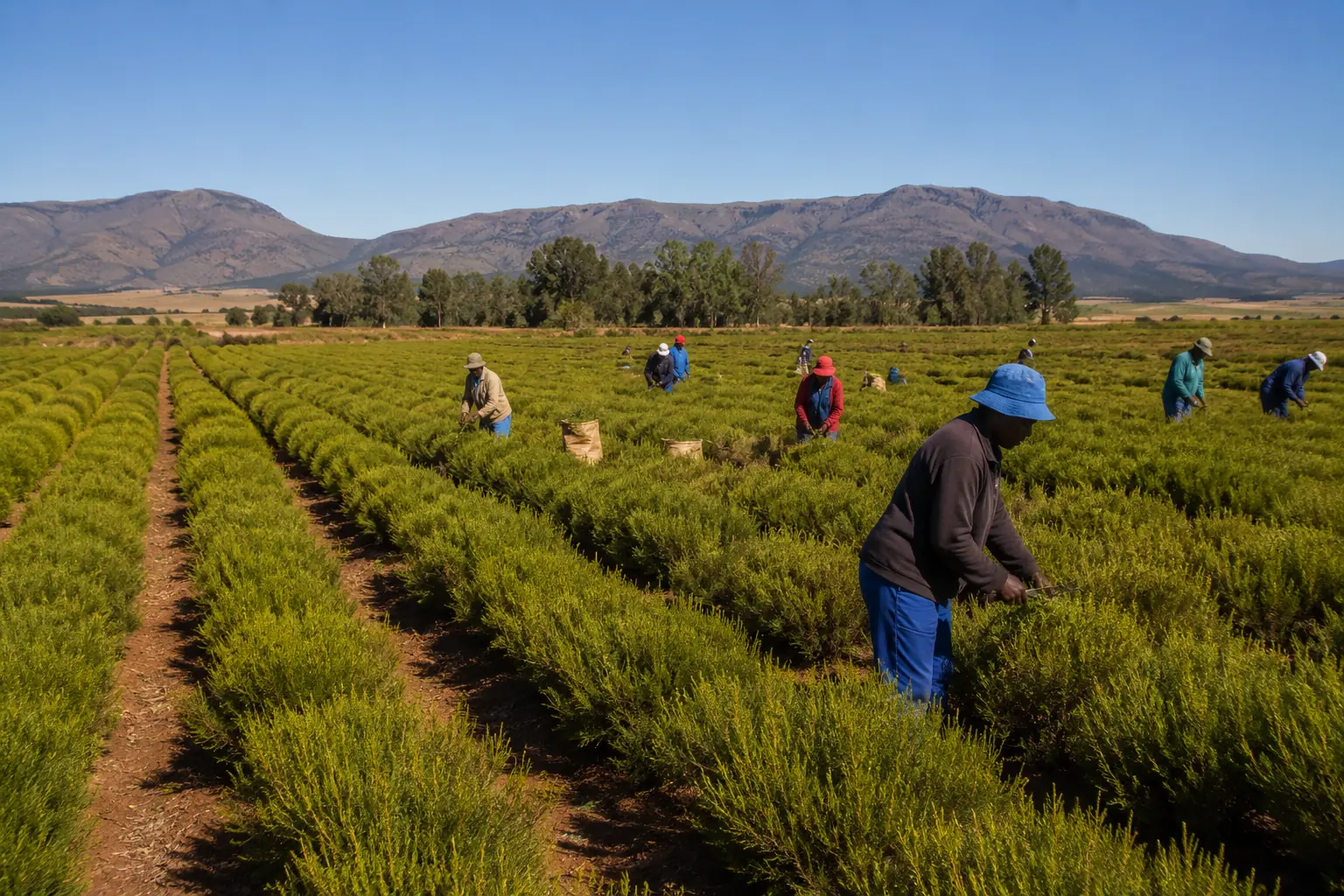
Rooibos (Aspalathus linearis) is a leguminous shrub native to the Cederberg mountains and surrounding fynbos areas of the Western Cape. It grows exclusively on nutrient-poor, acidic, sandy soils and requires a Mediterranean climate, cool, wet winters and hot, dry summers. The plant produces needle-like leaves and small yellow flowers. When harvested, cut, bruised, and oxidised, the green plant material ferments to the characteristic rich red colour and sweet, slightly nutty flavour of "red rooibos." Unfermented ("green rooibos") has a lighter, grassier taste and commands premium prices in health food markets for its higher antioxidant content.
Where Can Rooibos Be Grown in SA?
Rooibos cultivation is legally restricted to the PDO-designated production area, which covers parts of the Cederberg, Bokkeveld, Hantam, Wuppertals, and the Agter-Pakhuis regions of the Northern and Western Cape. This area is defined by unique soil type (coarse, red-sandy, acidic) and climatic conditions. Rooibos planted outside this zone will grow poorly and cannot legally be sold as rooibos under the PDO. If your farm falls within or near the PDO area, contact the SA Rooibos Council for confirmation and registration guidance.
Soil and Climate Requirements for Rooibos
Rooibos is uniquely adapted to harsh conditions that most crops cannot tolerate. It thrives in:
- Soil: Coarse, well-drained, acidic sandy soils with pH 4.5–6.0 and very low nutrient levels. Rooibos is nitrogen-fixing (a legume) and does not require nitrogenous fertilisers. Rich soils actually reduce yield and quality.
- Rainfall: 150–400mm per year, mostly in winter (May–August). Supplementary irrigation is used on many farms.
- Temperature: Frost-tolerant in winter; tolerates summer temperatures up to 40°C. The combination of cold winters and hot, dry summers is essential for quality rooibos.
- Altitude: 100–1,500m above sea level across the production area.
⚠️ Rooibos is extremely difficult to establish. Germination rates from seed are very low (typically 5–20%), and seeds require scarification (light sandpapering or nicking) and sometimes smoke water treatment to break dormancy, mimicking the fynbos fire cycle. Seedling mortality in the field during the first year can be high. Many commercial farmers use nursery-raised seedlings to improve establishment success.
Seed Collection and Germination
Rooibos seeds are harvested from 2–3 year old plants in December–January. Seeds require scarification (lightly rub with sandpaper to scratch the hard seed coat) followed by soaking in smoke water (available from specialty nurseries) or gibberellic acid solution. Germination takes 7–21 days in seed trays. Seedlings are grown in the nursery for 3–6 months before transplanting. Alternatively, purchase seedlings from established Cederberg nurseries.
Land Preparation and Planting
Rooibos should NOT be planted on previously cultivated land without proper soil preparation. Clear existing vegetation, prepare rows to reduce weed competition, and plant seedlings in late autumn (April–May) when rains begin. Spacing is typically 1.0–1.5m between plants and 1.5–2.0m between rows. Do not add compost or fertiliser, rooibos fixes its own nitrogen and over-fertile soil produces leafy growth at the expense of yield quality. Apply a small amount of superphosphate at planting if soil phosphorus is very low.
First Three Years: Establishment
Rooibos takes 1.5–2 years to reach first harvest. During establishment, weed control is critical, rooibos seedlings compete poorly with weeds. Hand weeding or careful shallow cultivation between rows is required. Supplementary irrigation in the first summer (2–3 times) improves survival significantly. No nitrogen fertiliser is needed. Monitor for woolly aphid (Brevicoryne brassicae relatives) which can attack young stems. By year 3, plants should be 60–90cm tall and ready for productive harvesting.
Harvesting Rooibos
Rooibos is harvested once per year, typically January–March (midsummer) when the plant's sugar content peaks. Harvesters cut branches with sickles or specialised cutting tools, leaving a short stub to regrow. Harvested material is tied into bundles, then cut and milled by machine into 5–10mm pieces. For red rooibos, the milled material is spread in thin layers on drying sheets, moistened, and left in the sun to oxidise (ferment) for 8–12 hours, turning the green to red. For green rooibos, the material is immediately steam-pasteurised to halt oxidation, then dried at low temperature.
Drying, Quality, and Selling
After oxidation, red rooibos is spread on drying tables or sheets and sun-dried for 2–4 days until moisture content drops below 8–10%. Quality control includes checking for foreign matter, correct moisture, and flavour profile. Most rooibos farmers sell green (raw, unprocessed) rooibos to a processing factory or cooperative, the SA Rooibos Council coordinates price-setting and market access. Some farmers with processing facilities can produce packaged rooibos for direct retail or export, commanding significantly higher margins.
Honeybush Farming in South Africa
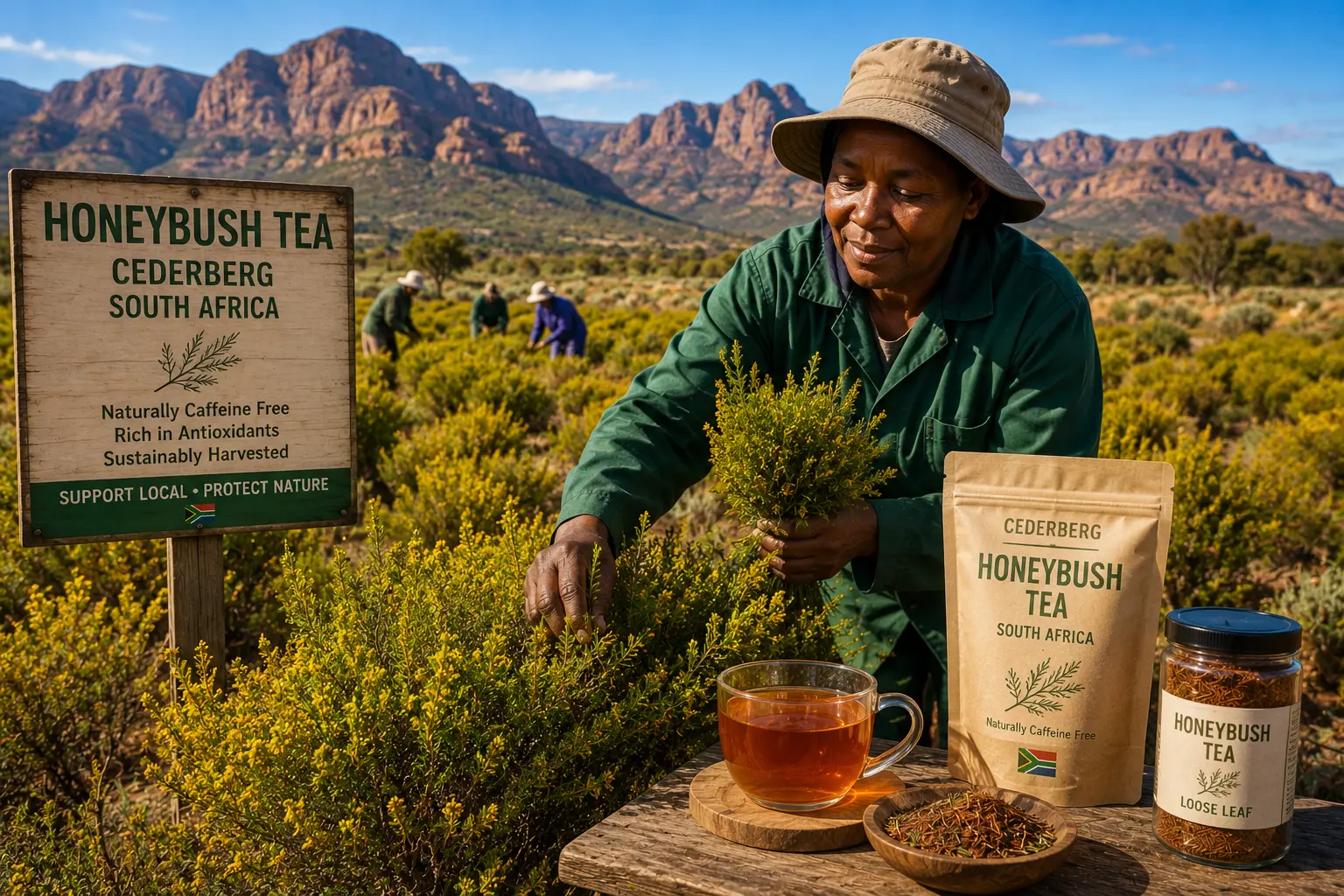
Honeybush is a collective name for several Cyclopia species native to South Africa's fynbos, primarily the Eastern Cape, the Garden Route, and the Overberg in the Western Cape. Like rooibos, it is caffeine-free, antioxidant-rich, and naturally sweet, its name comes from the honey-like fragrance of its flowers. Honeybush has historically been a wild-harvested crop, but commercial cultivation has expanded significantly since the 1990s as export demand has grown, particularly for certified organic honeybush in Germany, Japan, and the USA.
Key Honeybush Species for Cultivation
- Cyclopia intermedia, The most commercially cultivated species; vigorous, high-yielding, adapts well to cultivation. Known as "common honeybush" or "bergtee."
- Cyclopia subternata, Lower-altitude species, easier to establish on farm; slightly milder flavour profile.
- Cyclopia genistoides, Coastal species, naturally occurring near Riversdale and Stilbaai; used in artisan and specialty products.
- Cyclopia sessilifolia, Mountain species, rich flavour, used in high-end blends.
Climate and Soil for Honeybush
Honeybush thrives in the sandy, acidic fynbos soils of the Eastern Cape and southern Western Cape, similar in many respects to rooibos habitat but with somewhat higher rainfall (400–700mm/year) and more moderate temperatures. It tolerates moderate frost but not severe freezes. Drainage is critical, waterlogged soils cause root disease and plant death. Like rooibos, honeybush is a legume and does not need nitrogen fertiliser. Organic certification is relatively easy to achieve on honeybush farms given the low-input nature of cultivation.
Rooibos and Honeybush Processing: From Field to Cup
Processing quality has a direct impact on price received, especially in export markets where buyers have strict specifications for moisture content, flavour, colour, microbial counts, pesticide residues, and heavy metals. Understanding basic processing is essential even if you sell bulk green material, because how you handle the crop post-harvest affects the moisture at delivery and the price offered.
| Processing Stage | Red Rooibos | Green Rooibos | Honeybush |
|---|---|---|---|
| Cutting/harvesting | Branches cut Jan–Mar | Branches cut Jan–Mar | Branches cut Oct–Jan |
| Bruising/milling | Machine-cut 5–10mm | Machine-cut, then steam | Machine-cut or roller-bruised |
| Oxidation | 8–12 hours sun-assisted | None (steam-arrested) | 6–10 hours oxidation |
| Drying method | Sun drying, 2–4 days | Low-temp tunnel drying | Sun drying or tunnel drying |
| Target moisture | Below 10% | Below 8% | Below 10% |
| Price premium vs red | Base price | 2–4× premium | Variable; organic commands premium |
Where to Sell Rooibos and Honeybush in South Africa
Bulk Sales to Processors and Exporters
The majority of rooibos farmers sell bulk green (unprocessed, dried) material to processors and export companies, the largest of which include Rooibos Ltd, Cape Natural Tea Products, Joekels Tea, and numerous smaller processors. Prices are negotiated seasonally and are influenced by total harvest volumes, export demand, and moisture/quality grades. The SA Rooibos Council publishes indicative price information and supports farmer market access.
Value-Added Products: Packaged Tea and Extracts
Farmers or farmer cooperatives that invest in basic packaging and branding can sell directly to South African retailers (Woolworths, Pick n Pay, Spar) or to export buyers as branded rooibos. The margin increase from bulk green material to packaged tea bags can be 400–800%. Green rooibos extract (used in cosmetics, health supplements, and functional beverages) commands even higher prices. This is a growing niche for innovative producers. Honeybush extract is used in skincare products and health supplement formulations, particularly in the German and South Korean markets.
Organic Certification: A Key Value Driver
Both rooibos and honeybush lend themselves well to organic certification because they require minimal inputs and are not reliant on synthetic pesticides or fertilisers. Certified organic rooibos commands a 20–40% premium over conventional in European markets. Major certification bodies operating in SA include Ecocert, Control Union, and SGS. Certification takes 2–3 years from application to first certified harvest and involves annual audits. The initial cost (R15,000–R40,000 for first certification) is quickly recovered through premium pricing.
Direct Export to Europe and Japan
South Africa's rooibos and honeybush teas are highly regarded in Europe (Germany, Netherlands, UK) and Japan. Direct export bypasses local middlemen and can triple or quadruple net revenue per kilogram. However, it requires compliance with EU food safety regulations (pesticide MRLs, heavy metals, mycotoxins), food business registration, and often Rainforest Alliance or organic certification. For most smallholder producers, joining a farmer cooperative or producer organisation with export capacity is the most practical route to export markets. See our export farming guide for full details.
💰 Rooibos price indicators (2024–2025): Conventional bulk green rooibos: R18–R35/kg. Organic certified bulk: R30–R55/kg. Processed/packaged conventional rooibos: R80–R200/kg wholesale. Green rooibos: R120–R350/kg wholesale. Retail price for packaged rooibos (20 bags): R20–R60 at SA supermarkets; €3–€8 in Europe. Honeybush bulk: R25–R60/kg conventional; R50–R120/kg organic.
Rooibos Farming Costs and Returns Per Hectare
| Cost Item | Once-Off (per ha) | Annual (per ha) |
|---|---|---|
| Land clearing & preparation | R4,000 – R10,000 | — |
| Seedling purchase or seed propagation | R6,000 – R15,000 | — |
| Planting labour | R2,500 – R5,000 | — |
| Weed control (years 1–2) | R3,000 – R8,000 | R1,500 – R3,500 |
| Irrigation (establishment) | R8,000 – R20,000 | R1,000 – R3,000 |
| Harvesting labour | — | R3,000 – R8,000 |
| Processing & transport | — | R1,500 – R4,000 |
| Total (years 1–2, no harvest) | R23,500 – R58,000 | R7,000 – R18,500 |
| Typical yield (mature, yr 3+) | 400–800 kg dry/ha/year (1–2 tonnes fresh) | |
| Gross revenue at R25/kg bulk | R10,000 – R20,000/ha/year | |
| Gross revenue at R50/kg organic | R20,000 – R40,000/ha/year | |
Rooibos farming is a long-term investment crop. The first two years produce no revenue, and establishment costs are significant. However, from year 3 onward, a mature rooibos farm requires relatively low annual inputs and can produce for 15–20+ years without replanting. Organic certification and value-added processing dramatically improve margins. Commercial rooibos farming on 50–200 hectares with organic certification and some value-added processing capacity can be a profitable, export-oriented enterprise.
Green Tea (Camellia sinensis) Farming in South Africa
Camellia sinensis, the plant that produces green tea, black tea, oolong, and white tea, grows in limited areas of South Africa. The Magoebaskloof region of Limpopo (near Tzaneen) has historically been the most significant area, with the Sapekoe Tea Estates operating large-scale commercial tea gardens there for decades. The estates produce mainly black tea for the South African domestic market. Altitude (900–1,400m), high rainfall (1,000–1,500mm/year), and warm temperatures make this area viable for Camellia sinensis.
Small-scale green tea cultivation is possible for individual farmers in the Magoebaskloof and Haenertsburg areas. The crop requires consistent high rainfall or intensive irrigation, acidic soils (pH 4.5–5.5), and significant investment in processing equipment (withering troughs, rolling machinery, firing ovens). The barrier to entry for artisan green tea production in SA is high, but specialty SA-grown green tea commands strong prices in niche markets. This is an emerging rather than established opportunity for most smallholders.
Government Support for Tea Farmers in South Africa
The SA Rooibos Council (SARC) provides grower support, market information, and industry coordination. The Honeybush South Africa producer organisation similarly supports honeybush growers. DALRRD's CASP and Ilima/Letsema programmes fund infrastructure (irrigation, storage, processing equipment) for qualifying producers. The Industrial Development Corporation (IDC) has funded value-added tea processing businesses. The Western Cape Department of Agriculture provides extension support for rooibos farmers including pest management and post-harvest advice. Visit our farming grants guide for a full overview of available funding.