Where Are Tomatoes Grown in South Africa?
Tomatoes are uniquely versatile, they can be grown year-round in warmer zones and seasonally in cooler areas. The major commercial production regions include:
- Limpopo (Letsitele, Tzaneen, Musina, Marble Hall): A major production region. Warm subtropical conditions allow near-year-round production, particularly in the Letsitele and Tzaneen valleys. The region supplies a major share of South Africa's fresh market tomatoes.
- Mpumalanga (Marble Hall, Graskop, White River): Significant open-field and tunnel production, particularly for fresh market supply to Gauteng.
- North West (Brits, Hartbeespoort, Pella): Important for fresh market supply to Gauteng, with well-established irrigation schemes along the Crocodile River.
- Western Cape (Hex River Valley, Berg River, Paarl area): Processing tomatoes under irrigation; some tunnel fresh market production near Cape Town.
- Eastern Cape (Addo, Graaff-Reinet, Cradock area): Processing tomatoes; smallholder fresh market production.
- KwaZulu-Natal (Midlands, Midmar, coastal areas): Seasonal fresh market and smallholder production.
- Gauteng and peri-urban areas nationwide: Urban and peri-urban tunnel, container, and smallholder production for local fresh markets.
Climate & Soil Requirements
Climate
Tomatoes are warm-season crops but are sensitive to temperature extremes at both ends. Optimal growing conditions in South Africa:
- Day temperature: 21–28°C for vegetative growth; cooler nights (15–20°C) improve fruit set and colour development
- Night temperature: Above 10°C for good fruit set; below 10°C causes flower drop. Above 30°C nights also cause flower drop.
- Temperature stress: Extended temperatures above 35°C cause blossom drop, poor fruit set, and catfacing. Tunnels and shade nets can buffer heat stress.
- Frost: Tomatoes are frost-sensitive at all growth stages. Plan plantings to avoid frost risk in frost-prone areas.
- Humidity: High humidity promotes foliar diseases (early blight, late blight, Botrytis). Good ventilation in tunnels is critical.
Soil Requirements
Tomatoes perform best in deep, well-drained, fertile soils:
- Soil texture: Sandy loam to clay loam, good drainage combined with adequate water and nutrient holding capacity
- pH (water): 6.0–6.8 is optimal. Below 6.0, nutrient availability (especially calcium, magnesium and phosphorus) decreases. Above 7.0, micronutrient deficiencies develop.
- Drainage: Waterlogging causes immediate root death and Phytophthora root rot. Raised beds or ridges improve drainage on heavier soils.
- Organic matter: High organic matter improves nutrient availability, water retention and soil microbial activity. Compost incorporation before planting is strongly recommended.
💡 Always Soil Test Before Planting
Tomatoes are heavy feeders and pH-sensitive. A soil test before each season costs R300–R500 but saves multiples of that in wasted fertiliser and yield losses from nutrient imbalances. Target pH 6.0–6.8 and ensure adequate calcium and magnesium levels, deficiencies of these cause blossom-end rot, among South Africa's most common and preventable problems in SA tomato production.
Tomato Varieties in South Africa
Variety selection is critical and depends on your market (fresh vs processing), production system (open field vs tunnel), and regional disease pressures. All commercial tomatoes in South Africa are F1 hybrids from seed companies including Seminis (Bayer), Syngenta, De Ruiter, Rijk Zwaan, and Sakata. Key variety categories:
Heinz 1370
Processing / Canning
The cornerstone of South Africa's processing tomato industry. Determinate, concentrated set, ideal for once-over mechanical harvest. Grown under contract for Tiger Brands and other processors in Western Cape and Eastern Cape.
Zeal F1
Fresh Market, Round
A widely used fresh-market type in South African production. Strong disease resistance package (including TYLCV tolerance), good shelf life, and consistent sizing. Suited to open field in Limpopo and Mpumalanga.
Rodade F1
Fresh Market, Round
Popular Syngenta variety with excellent uniformity and fruit colour. Strong performance in Limpopo's warm conditions. Good transport tolerance, important for long hauls to Johannesburg fresh produce markets.
Cobra F1
Tunnel / Greenhouse
Indeterminate variety for tunnel and greenhouse production. High yield potential, good fruit quality, and tolerance to common greenhouse diseases. Suited to cooler growing conditions in Western Cape and KZN.
Roma VF
Plum / Roma Type
The classic paste/plum tomato. Meaty, low-moisture flesh ideal for cooking, sauce and home processing. Popular with smallholder growers and home market sellers. More disease tolerant than many round types.
Cherry Tomato Types
Premium / Niche Market
Sweet cherry tomatoes command significantly higher prices at retail and food service. Varieties like Jolly F1, Supersweet 100, and Sakura are popular for tunnel and greenhouse production in the Western Cape and Gauteng peri-urban areas.
Always check with your seed supplier or extension officer for the latest variety trial results in your specific region. Disease resistance is particularly important, Tomato Yellow Leaf Curl Virus (TYLCV) is a major threat in Limpopo and Mpumalanga, and TYLCV-tolerant varieties are strongly recommended in these areas.
Seedling Production & Transplanting
Nursery / Seedling Production
Commercial tomato production in South Africa uses transplants (seedlings) rather than direct seeding. This gives a uniform, disease-free plant stand and saves field time. Options for obtaining transplants:
- Commercial nurseries: Many large nurseries in Limpopo, Mpumalanga and the Western Cape supply certified, disease-screened transplants to growers. This is the most reliable option for commercial growers.
- On-farm seedbed: Seed is sown into plug trays (typically 200-cell or 128-cell) filled with a sterile peat-based growing medium, in a protected seedbed or shade house. Seedlings are ready for transplanting in 4–6 weeks when they have 3–4 true leaves and a stem diameter of 3–4mm.
Transplanting
Tomatoes are transplanted into prepared beds or ridges at a spacing appropriate for your production system:
| Production System | Row Spacing | In-Row Spacing | Plants/ha |
|---|
| Open field (determinate) | 1.5m | 0.3–0.4m | 17,000–22,000 |
| Open field on ridges | 1.5–1.8m | 0.4–0.5m | 11,000–17,000 |
| Tunnel (indeterminate, trellised) | 1.0–1.2m | 0.4–0.5m | 17,000–25,000 |
| Smallholder open field | 1.2–1.5m | 0.4–0.5m | 13,000–20,000 |
Transplant in the late afternoon or on overcast days to reduce transplant stress. Water each plant in immediately and ensure the first irrigation runs within 6–12 hours. Protect young transplants from wind, hail and direct sun for the first week. Plant deeper than in the nursery, tomatoes develop adventitious roots along the buried stem.
Irrigation & Water Management
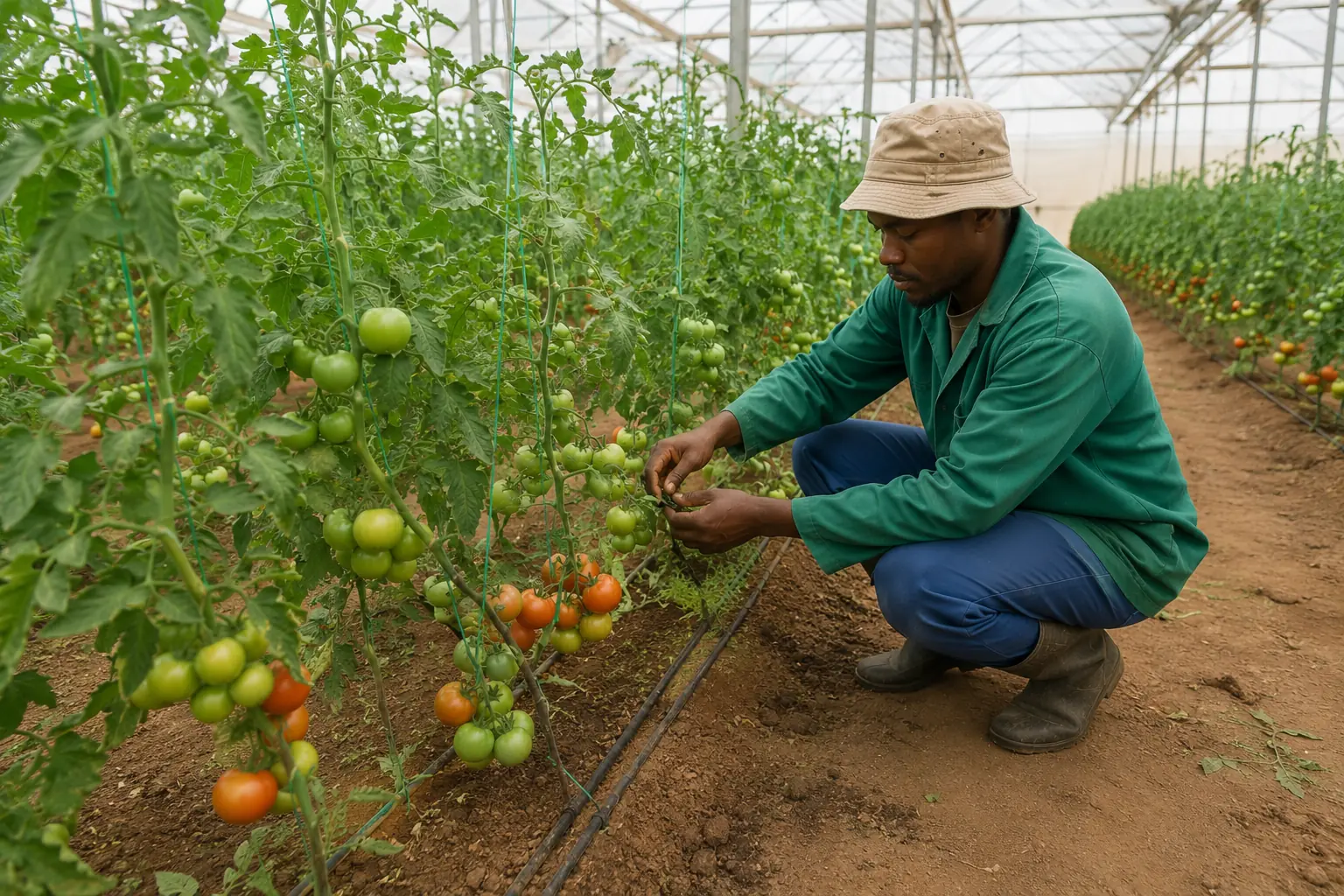
Tomatoes have high water requirements and are sensitive to both water stress and waterlogging. Drip irrigation is the preferred system for commercial tomato production in South Africa, offering precise water delivery, reduced disease pressure (no wet foliage), better fertiliser efficiency (fertigation), and water savings of 30–50% versus overhead systems.
- Drip lines: Place one drip line per row, 20–30cm laterals spacing, emitters at 20–30cm intervals. For sandy soils, more frequent watering at lower volumes is recommended.
- Irrigation scheduling: Base on evapotranspiration (ET) data or soil moisture sensors. Tomatoes require approximately 400–600mm of water per season for open field production; more for tunnel systems.
- Critical water stress periods: Flowering and fruit set are the most stress-sensitive stages. Water deficit during flowering causes blossom drop; during fruit fill it causes blossom-end rot and cracking.
- Overhead irrigation: Acceptable for processing tomatoes and some smallholder systems, but increases foliar disease risk significantly. Visit our irrigation systems guide for detailed system comparison and costs.
Fertilisation & Nutrition
Tomatoes are among the most nutrient-demanding vegetable crops. Commercial production typically uses a combination of basal fertilisation (pre-plant or at transplant) and fertigation (dissolved fertilisers applied through drip irrigation) throughout the season. Key nutritional requirements:
| Nutrient | Role | Deficiency Symptom | Typical Rate (kg/ha/season) |
|---|
| Nitrogen (N) | Vegetative growth, fruit size | Pale yellowing, stunted growth | 150–250 |
| Phosphorus (P) | Root development, flowering | Purple leaf undersides, poor root growth | 80–120 |
| Potassium (K) | Fruit quality, disease resistance | Brown leaf margins, poor colour | 200–350 |
| Calcium (Ca) | Cell wall strength, fruit integrity | Blossom-end rot (BER) | 150–200 |
| Magnesium (Mg) | Chlorophyll, photosynthesis | Interveinal yellowing of older leaves | 30–60 |
| Boron (B) | Pollen viability, fruit set | Hollow fruit, corky texture | 1–2 (foliar) |
🍅 Preventing Blossom-End Rot (BER)
BER is the most common nutritional disorder in South African tomato production, it appears as a dry, sunken dark patch on the base of the fruit. It is caused by calcium deficiency in the developing fruit, usually triggered by irregular watering rather than a lack of calcium in the soil. Maintain consistent soil moisture levels through careful irrigation scheduling and apply calcium nitrate through fertigation weekly during fruit development. High potassium and ammonium nitrogen levels compete with calcium uptake and worsen BER.
Pest & Disease Management
Key Diseases of Tomato in South Africa
- Early blight (Alternaria solani): Dark, concentric-ringed leaf spots. Common in warm, humid conditions. Manage with fungicide programmes and removing lower leaves to improve airflow.
- Late blight (Phytophthora infestans): Water-soaked leaf lesions; greasy appearance. Can destroy crops rapidly in cool, wet weather. Apply preventive fungicides; avoid overhead irrigation.
- Fusarium and Verticillium wilt: Soilborne fungi causing wilting and vascular discolouration. No chemical cure, use resistant varieties, soil solarisation, and crop rotation.
- Tomato mosaic virus (ToMV) and Tomato Yellow Leaf Curl Virus (TYLCV): TYLCV is spread by whiteflies and causes severe yellowing, leaf curl, and stunting. Plant TYLCV-tolerant varieties in Limpopo and Mpumalanga where whitefly pressure is high.
- Bacterial canker (Clavibacter michiganensis): Causes wilting and white, raised surface spots on fruit. Spread through contaminated seed and tools. Use certified clean seed; sterilise tools between plants.
Key Pests
- Tomato leafminer (Tuta absoluta): Highly invasive pest that mines through leaves and bores into fruit. Extremely damaging, among the most important tomato pests in SA. Manage with pheromone traps, biological control (Bacillus thuringiensis), and targeted insecticides.
- Whitefly (Bemisia tabaci): Sap-sucker and TYLCV vector. Monitor with yellow sticky traps; use reflective mulch to deter colonisation; apply insecticides when thresholds are exceeded.
- Bollworm (Helicoverpa armigera): Caterpillar that bores into fruit causing entry holes and secondary rot. Monitor with pheromone traps; apply targeted bioinsecticides or synthetic products.
- Root-knot nematodes (Meloidogyne spp.): Extremely common on South African soils. Cause stunted, unproductive plants with galled roots. Use nematode-resistant rootstocks (grafted tomatoes) or nematicides at transplanting.
- Red spider mite (Tetranychus urticae): Causes stippled, dry leaves in hot, dry conditions. Very common in Limpopo and Mpumalanga. Apply miticides; maintain adequate irrigation to reduce stress-driven outbreaks.
Visit our detailed pest control and IPM guide for integrated strategies for tomato production in South Africa.
Harvesting Tomatoes in South Africa
Fresh Market Tomatoes
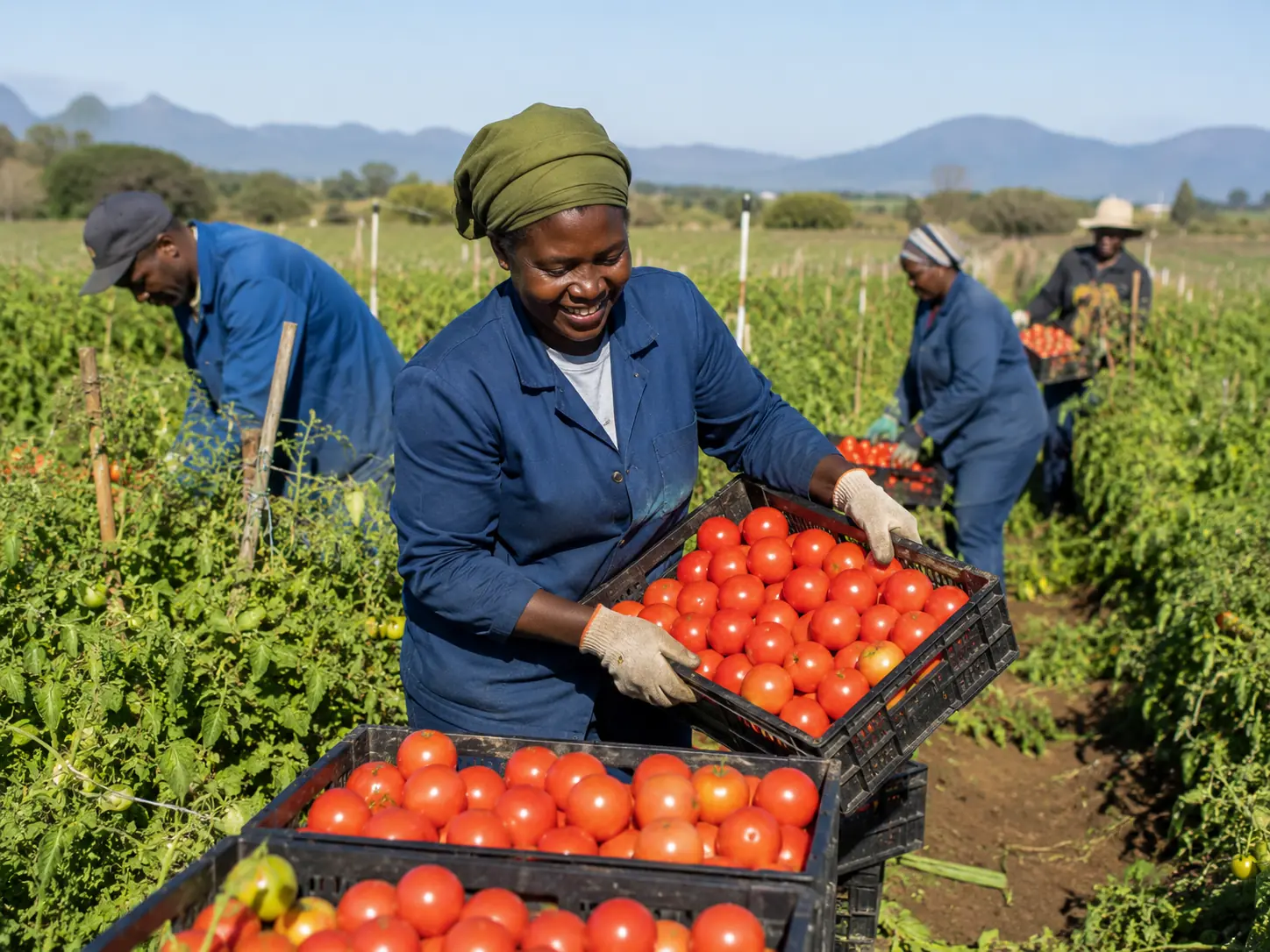
Fresh market tomatoes are harvested by hand, multiple times over the season. Tomatoes are picked at the breaker stage (first colour change, approximately 30% red) for long-distance transport to fresh produce markets, or at light red to red stage for local markets and direct sales. Key points:
- Harvest every 3–5 days as fruit ripens progressively on the vine
- Pick in the early morning when temperatures are cool, heat causes rapid deterioration
- Handle carefully in crates or plastic bins, bruising causes rapid rotting and grade loss
- Determinate varieties (bush type) have concentrated set and may be harvested in 2–3 passes; indeterminate types (stake/trellis types) continue producing for months
- Grade fruit for size, colour and defects before packing, the Johannesburg Market (JMPD) and other fresh produce markets grade strictly
Processing Tomatoes
Processing tomatoes are harvested by machine when the crop is fully ripe (deep red). The entire crop is harvested in a single pass with a self-propelled harvester. This requires:
- Determinate varieties with a concentrated fruit set and firm, crack-resistant skin
- Irrigation cutoff 2–3 weeks before harvest to firm up fruit
- Delivery directly to the processor (factory gate pricing, typically per tonne at agreed grades)
Selling Tomatoes, Market Access in South Africa
South Africa has well-developed tomato markets across all distribution channels. The main options for fresh market growers:
- Johannesburg Fresh Produce Market (JFPM, City Deep): The largest fruit and vegetable market in Africa. Growers consign tomatoes through registered agents who sell on their behalf. Price is market-driven, it fluctuates significantly with supply and demand. The JFPM price benchmark is tracked daily and published online.
- Other national fresh produce markets: Markets in Cape Town (Epping), Durban (Mobeni), Pretoria, Port Elizabeth and Bloemfontein operate on the same commission agent model.
- Retail supermarket supply: Woolworths, Pick n Pay, SPAR, Shoprite and Checkers all source tomatoes directly from producers meeting their quality, food safety (GlobalG.A.P.), and volume specifications. Direct retail supply requires strict traceability, pack house facilities and consistent supply.
- Processing contracts: Canning tomato growers sell on contract to processors such as Tiger Brands (All Gold), Simba, and smaller regional processors. Contract price is pre-agreed at planting.
- Informal markets and direct sales: Smallholder growers often sell directly from the farm gate, at taxi ranks, spaza shops, or informal township markets. Higher margin but lower volume and no guaranteed buyer.
Visit our agri-markets guide for more on fresh produce market agents, export certification, and cooperative selling structures. See farming grants for government support available to smallholder tomato producers.
📊 Cost and market considerations
Open-field irrigated tomato yields in South Africa typically range from 40–80 t/ha; tunnel production can reach 100–150 t/ha under excellent management. Fresh market prices at the Johannesburg Market fluctuate from R200–R800/10kg carton depending on the season, oversupply in summer (Dec–Feb) typically pushes prices down sharply. Target off-peak production (May–August) for better prices. Input costs for open-field tomatoes run R50,000–R120,000/ha including seedlings, fertiliser, irrigation, pesticides, labour and packaging. Consult your local extension officer for a full enterprise budget before investing.
Tomato Farming for Smallholders in South Africa
Tomatoes are among the most popular and accessible vegetable crops for smallholder farmers across South Africa. Their relatively short production cycle (90–120 days for most varieties), high value per kilogram, and strong local demand make them attractive as a cash crop. Main decisions for smallholder tomato growers:
- Start with a small area, begin with 0.25–0.5ha to learn the crop before scaling up. Tomatoes have high management intensity and mistakes scale up with area.
- Access water reliably, tomatoes without consistent irrigation in summer will fail. Even a simple overhead sprinkler system or gravity-fed drip line can dramatically improve results.
- Find your market before planting, know your buyer and expected price before committing to a season. Unsold ripe tomatoes lose value within days.
- Use disease-resistant hybrid varieties, open-pollinated (non-hybrid) varieties are cheaper but significantly more disease-susceptible. The extra cost of hybrid seed pays back in better disease resistance and yield.
- Contact your local DALRRD office or Agri SA office for support through the CASP or Ilima/Letsema government programmes, see our farming grants guide.