CASP in more detail
According to a reply from the Minister of Agriculture to Parliament, CASP was allocated about R2 billion nationally in 2024/25, with Ilima/Letsema at about R400 million. That money is split between nine provinces and then between thousands of applicants, so most individual projects are modest.
CASP is organised around six areas: information and knowledge management; technical and advisory support; training; marketing and business development; on-farm and off-farm infrastructure and inputs; and financial support. In practice, the projects you see funded are boreholes, fencing, drip irrigation, pack sheds, cold rooms, tools and implements, and seed and fertiliser for approved beneficiaries.
Who can apply
CASP is aimed mainly at land reform beneficiaries and other black producers. Some provinces extend it to communal-area and verified smallholder farmers who are actively farming but cannot get commercial finance. You do not need a formal farm. Township food gardens, communal grazing groups and peri-urban plots have all been supported.
The usual requirements are South African citizenship, active farming (or a clear plan to start) on land you can show you have the right to use, no realistic access to commercial finance, and a workable project proposal. Your province may add its own conditions.
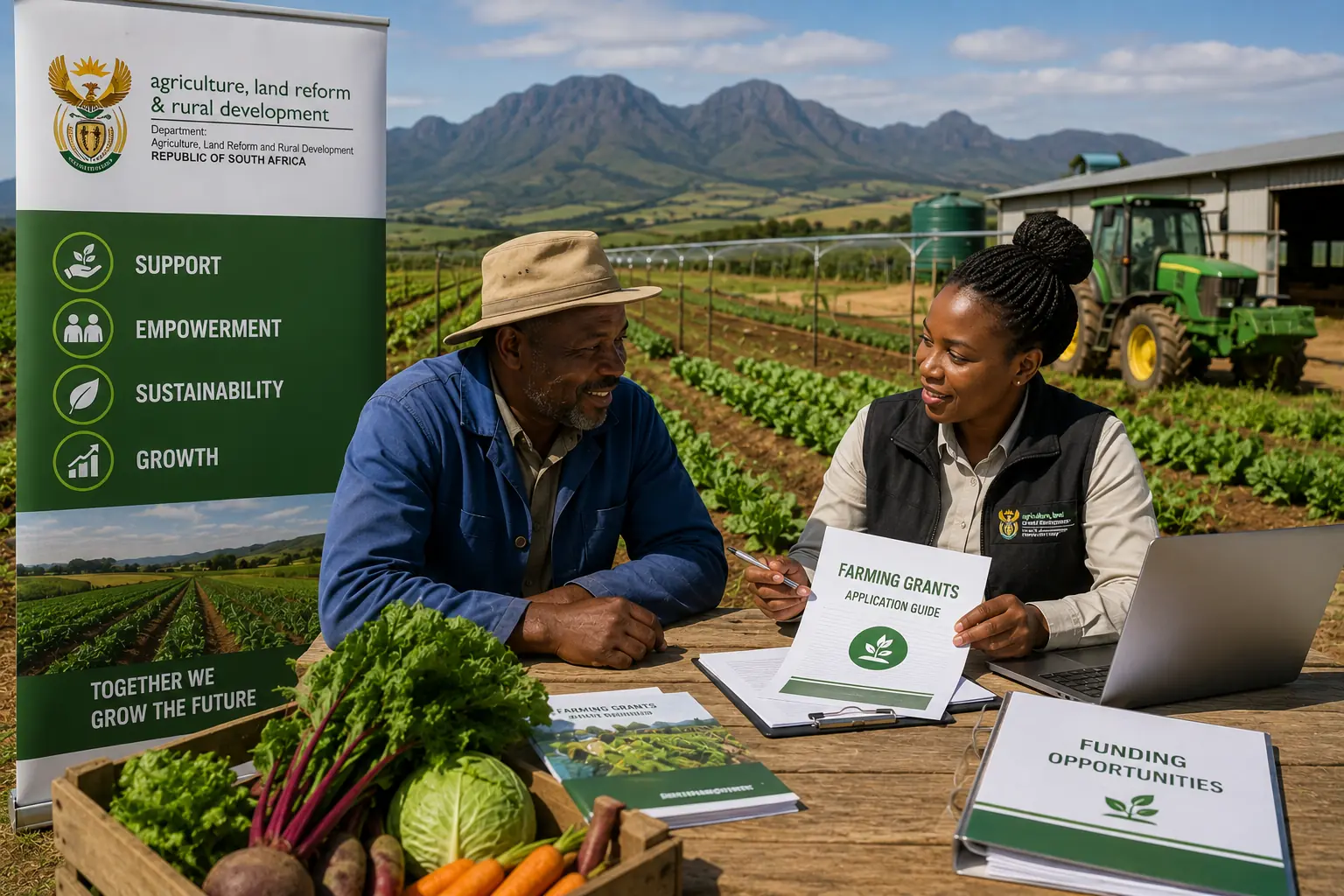
For CASP and Ilima/Letsema, the first conversation is nearly always with your local extension officer.
Provincial departments
Every province has its own agriculture department with its own priorities and its own application calls. The names below come from the government's provincial directory. Departments have been renamed and merged over the years, so use the directory link below to find the current website and phone number for your area.
| Province | Department | Commonly supports |
|---|
| Eastern Cape | Dept. of Rural Development and Agrarian Reform (drdar.gov.za) | Smallholder livestock, vegetable gardens, irrigation |
| Free State | Dept. of Agriculture and Rural Development | Grain and livestock, mechanisation, storage |
| Gauteng | Dept. of Agriculture and Rural Development | Urban and peri-urban vegetables, tunnels, hydroponics |
| KwaZulu-Natal | Dept. of Agriculture and Rural Development | Food gardens, livestock, sugarcane growers, aquaculture |
| Limpopo | Dept. of Agriculture and Rural Development | Fruit, vegetables, livestock, irrigation |
| Mpumalanga | Dept. of Agriculture, Rural Development, Land and Environmental Affairs | Sugarcane, vegetables, livestock |
| Northern Cape | Dept. of Agriculture, Environmental Affairs, Land Reform and Rural Development | Irrigated crops, grapes, rooibos, livestock, dryland grain |
| North West | Dept. of Agriculture and Rural Development (dard.nwpg.gov.za) | Maize, sunflower, livestock, macadamia, hemp, groundnuts |
| Western Cape | Dept. of Agriculture (Elsenburg) | Market access, agri-processing, smallholder support |
Official directory of provincial departments (gov.za). Some provinces publish their yearly funding call on their own website. North West, for example, has announced that its applications for the 2026/27 financial year are open.
Other places to look
sefa (Small Enterprise Finance Agency)
For farmers who are registered businesses but too small for the Land Bank or IDC. Loans are repaid with interest, either directly from sefa or through an intermediary. sefa.org.za
National Empowerment Fund (NEF)
The NEF funds black-owned businesses, and agro-processing and value-adding food businesses fall within its scope. It is aimed at businesses with a proper business case, not early-stage subsistence projects. Funding products and minimum amounts change, so check the current list. nefcorp.co.za
Seda (Small Enterprise Development Agency)
Seda is not a funder. It gives free business support to small enterprises, including help with business plans, which is where many farm applications fall down. Offices are in most larger towns. seda.org.za
Buyer and supplier development programmes
Large food companies, retailers and agribusinesses run supplier development programmes for emerging farmers, sometimes with inputs, mentorship or guaranteed offtake. If a company already buys the crop you grow, ask its sourcing team whether it runs one.
Youth support
NARYSEC (the National Rural Youth Service Corps) trains unemployed rural youth and now sits under the Department of Land Reform and Rural Development, not Agriculture. Recruitment happens in rounds, so ask at your nearest district office whether one is open. Provinces also run youth and women set-asides within CASP and the Blended Finance Scheme.
Start with your extension officer
For CASP, Ilima/Letsema and most provincial support, the extension officer registers you as a farmer, visits the site, helps with the project proposal and tracks the work afterwards. Without that relationship, applications tend to stall. If you do not know who yours is, phone the provincial department and ask for the officer covering your municipality.
Why applications get turned down
- No business plan, or a weak one. Say what you will grow, how much, who will buy it and what the grant money pays for. Seda can help for free.
- No proof you can use the land. A title deed, lease, land reform allocation letter or a signed permission letter from the traditional authority.
- Not registered with the department. Most programmes want you on the provincial farmer register first, and that goes through your extension officer.
- The project does not hold up on site. No water, wrong soil, no road to market. A site visit before you apply catches this.
- Tax status not in order. SARS replaced paper tax clearance certificates with a Tax Compliance Status (TCS) PIN, which you request on eFiling. Many funders ask for it even for grants. sars.gov.za
- Wrong programme. Applying to a scheme whose criteria you do not meet costs you time and credibility. Ask first.