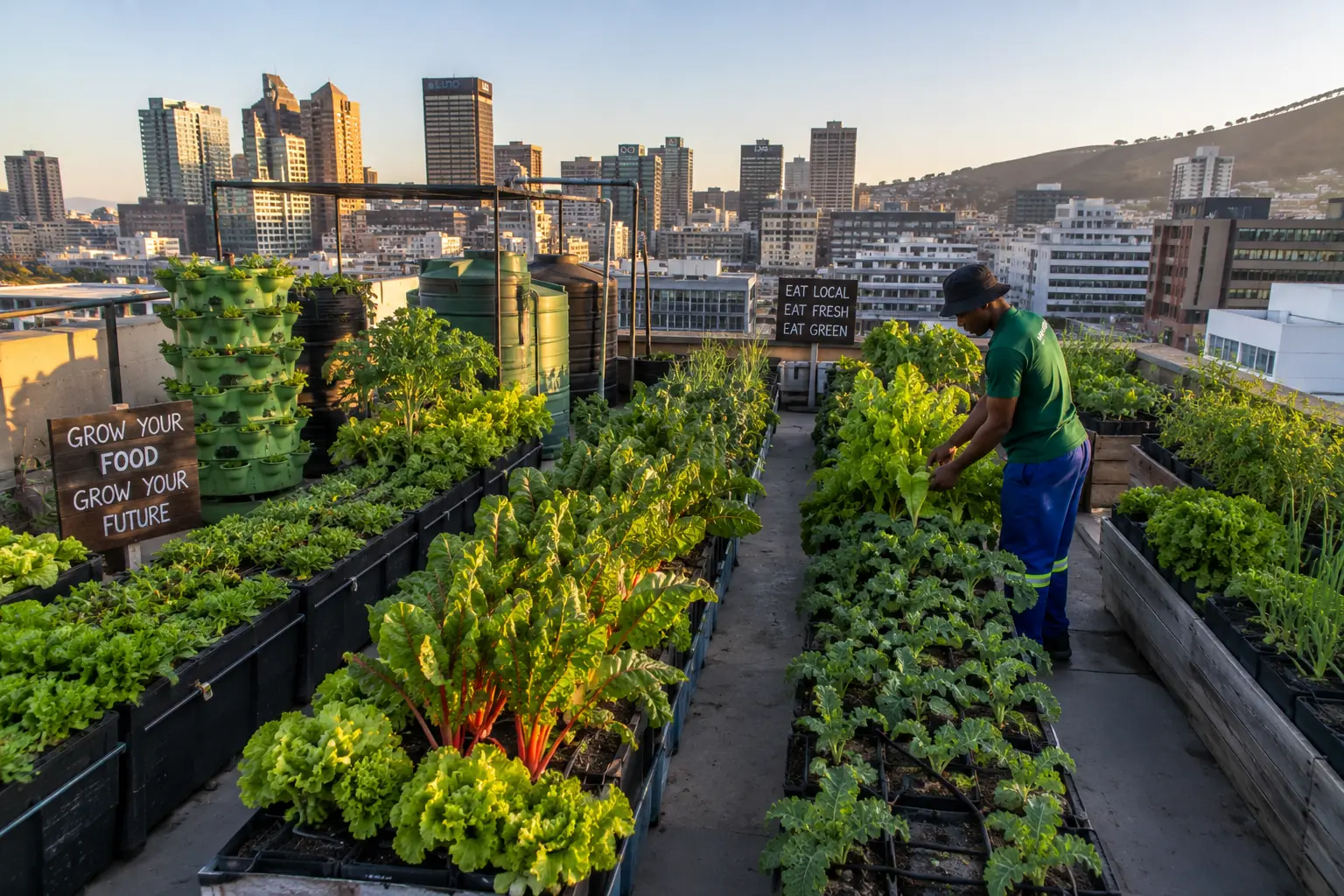
Garden soil is completely unsuitable for rooftop farming. It is too heavy (typically 1 400–1 600 kg/m³ when wet), compacts in containers, drains poorly, and introduces weed seeds and soil pathogens. The right growing media for SA rooftop farms are engineered for low weight, excellent drainage, and good water retention:
- Coco peat (coconut coir), A lightweight, renewable growing medium derived from coconut husks. Excellent water retention (holds 8–9x its weight in water), pH neutral, and biologically inert. Available in compressed bricks from most SA nurseries and hydroponics suppliers. Weight: ~100 kg/m³ dry, ~500–600 kg/m³ saturated.
- Perlite, Volcanic glass expanded by heat. Ultra-lightweight, excellent drainage, pH neutral. Used as a coco peat amendment (typically 30–50% perlite in a mix) to improve drainage and reduce compaction. Weight: ~100 kg/m³.
- Vermiculite, Expanded mica mineral. Holds more water and nutrients than perlite while still being lightweight. Used in seed-starting mixes and wicking bed media. Weight: ~130 kg/m³.
- LECA (Lightweight Expanded Clay Aggregate), Porous clay balls used in hydroponics and as a growing medium base. Reusable, inert, and excellent drainage. Weight: ~300–500 kg/m³.
- Recommended mix for SA rooftop container beds: 50% coco peat + 30% perlite + 20% quality compost (worm castings or mature compost). This mix weighs approximately 350–450 kg/m³ when moist, roughly half the weight of garden soil.
Water Management for Rooftop Farms in South Africa
Water is the most critical operational input for any rooftop farm. In SA's water-scarce cities, managing water efficiently is both an environmental responsibility and a financial necessity. A well-designed rooftop irrigation system can reduce water use by 40–60% compared to hand watering:
Drip Irrigation
Individual drip emitters (2–4 litres per hour) on a timer are the standard irrigation solution for rooftop container systems. A simple battery-operated timer (R150–R350) connected to a gravity-fed header tank or municipal tap can automate irrigation entirely, making daily rooftop visits optional. For large commercial rooftop operations, a full drip system with pressure-compensating emitters, fertigation (fertiliser injection), and remote monitoring sensors can optimise both yield and water use. See our irrigation systems guide for drip system design principles.
Rainwater Harvesting on the Rooftop
The same roof that hosts your garden is a rain catchment surface. A 200m² rooftop garden in Cape Town (average 515mm annual rainfall) can harvest approximately 103 000 litres of rain per year, more than enough to supplement or in wet years fully supply irrigation. Install a first-flush diverter to keep the first dirty wash-off out of your tank, and size your tank for 2–3 weeks' irrigation needs (typically 2 000–5 000 litres for a 100m² intensive garden). IBC totes make excellent, affordable, food-safe rainwater storage.
Wicking Beds
A wicking bed is a self-watering container with a water reservoir at the bottom, separated from the growing media by a geotextile membrane. Plants draw water upward by capillary action (wicking) as needed, dramatically reducing surface evaporation losses. In SA's hot, often windy rooftop conditions, wicking beds can reduce irrigation frequency by 50–70% compared to conventional containers. IBC totes or purpose-built polystyrene boxes make excellent wicking bed bodies.
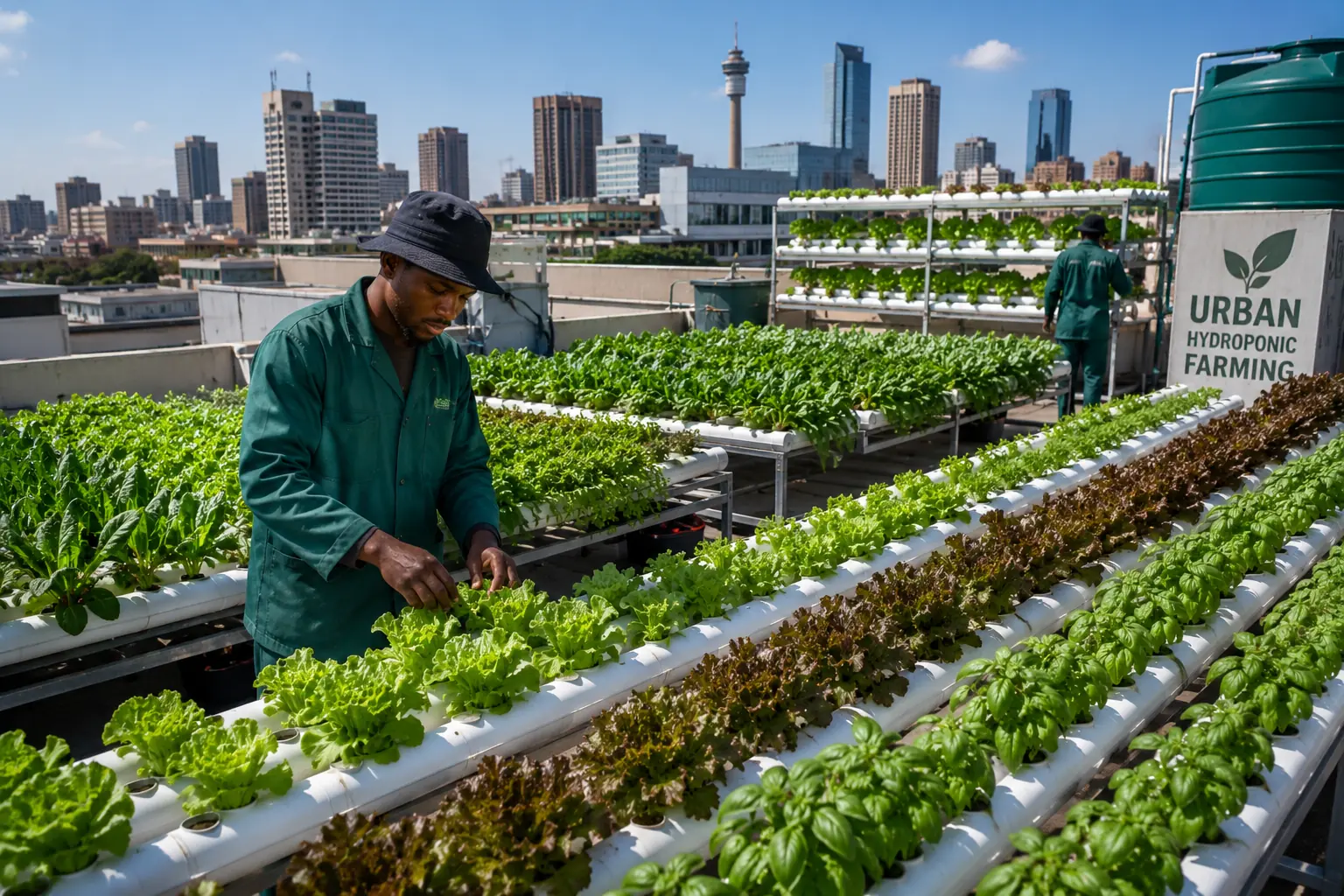
NFT hydroponic channels on a Cape Town commercial rooftop, producing restaurant-quality lettuce with minimal water and no soil
Best Crops for South African Rooftop Farms
Not all crops suit rooftop conditions. Rooftops are windier, hotter, and more exposed than ground-level gardens. The best rooftop crops in SA are heat-tolerant, wind-resilient, productive in containers, and in strong demand from restaurants and local markets:
| Crop | Container Depth | SA Rooftop Suitability | Market Value |
|---|
| Lettuce & Salad Leaves | Shallow 15cm | Excellent, fast turnover, high demand, suits hydroponics | R35–R60/kg |
| Herbs (Basil, Parsley, Chives, Coriander) | Shallow 15cm | Excellent, high value, low weight, suits small containers | R80–R200/kg |
| Spinach & Swiss Chard | Medium 25cm | Very good, heat tolerant, continuous harvest, low-maintenance | R20–R40/kg |
| Cherry Tomatoes | Deep 40cm | Good, needs support structure, very high market value | R60–R120/kg |
| Chillies & Small Peppers | Deep 35cm | Good, compact plants, heat-loving, excellent restaurant demand | R80–R150/kg |
| Microgreens | Shallow 5cm | Excellent, highest value per m², 7–14 day cycle, low weight | R200–R500/kg |
| Spring Onion & Garlic | Medium 20cm | Very good, fast growing, consistent demand, suits containers | R40–R80/kg |
| Kale & Brassicas | Medium 25cm | Good, cold season crop (Western Cape), trendy in SA restaurants | R40–R80/kg |
| Strawberries | Shallow 15cm | Good, thrives in containers, high visual appeal and value | R80–R160/kg |
| Edible Flowers (Nasturtium, Viola) | Shallow 15cm | Excellent niche, premium restaurant market, very high value per kg | R500–R1 500/kg |
Planning Regulations & Building Permissions in SA Cities
Rooftop farming regulation in South Africa is still evolving, with different municipalities taking different approaches. Here is the current position in the main SA cities:
Johannesburg (City of Joburg)
The CoJ does not have a specific rooftop farming bylaw but requires building owners to obtain approval for any structural alteration to a rooftop, including the installation of permanent growing infrastructure. A structural engineer's sign-off and submission of plans to the Johannesburg City Planning Department is required for permanent installations. Lightweight, removable container systems typically do not require formal planning approval but should be discussed with your body corporate or landlord. CoJ's Urban Agriculture Policy supports rooftop food production as part of the city's food security framework.
Cape Town (City of Cape Town)
Cape Town has the most progressive urban agriculture policy of any SA city, with active support for rooftop farming under its Urban Agriculture Policy Framework. Building plan approval is required for permanent structures (pergolas, shade sails attached to building structures) but container gardens on existing flat roofs generally do not require formal approval beyond the owner's consent. The COCT's Greenpreneurs programme has provided support and mentorship to rooftop farmers in the city.
Durban / eThekwini
eThekwini Municipality supports urban agriculture through its food security programmes. Rooftop installations on commercial buildings require building plan submission and structural engineer's certificate. Township and informal settlement rooftop gardens have received support from community development organisations operating with municipality backing.
Costs, Revenue & Business Models
A realistic budget for a 100m² commercial rooftop hydroponic herb and salad leaf operation in Johannesburg or Cape Town:
- Structural engineer assessment + waterproofing inspection: R5 000–R12 000
- NFT hydroponic channels (100m² equivalent): R30 000–R60 000
- Nutrient dosing system + tank: R8 000–R20 000
- Drip irrigation + timer system: R5 000–R12 000
- Shade cloth structure + wind barrier: R10 000–R25 000
- Rainwater tank (2 000 litre): R3 000–R6 000
- First crop cycle seed + nutrients: R2 000–R4 000
- Total estimated setup: R63 000–R139 000
A 100m² NFT system producing lettuce and herbs can yield approximately 150–200kg per month of mixed produce. At a wholesale price of R60–R80/kg to local restaurants, this represents R9 000–R16 000 monthly revenue, with operating costs (water, nutrients, seed, labour) of R3 000–R5 000 per month, net income of R4 000–R11 000 per month from a 100m² rooftop is achievable by year 1. Check available DAFR and metro urban farming grants, several have supported rooftop food enterprises in recent years.