Selling Farm Products in South Africa
South African farmers have several routes to market: selling directly to consumers, advertising online, trading from the roadside or farm gate, supplying hawkers and traders, approaching restaurants and small shops, or working toward a supermarket contract. Which one suits you depends on how much you produce, where your farm is, what you grow, how it's packaged, how far you can transport it, and how quickly it needs to move.
This guide walks through the main options in roughly the order most small farmers try them.
1. List your products onlineIf you rely only on people who happen to drive past the farm, you're leaving customers on the table. A free listing on a platform such as MzansiFarm lets you describe what you have — vegetables, fruit, livestock, eggs, whatever it is — so buyers can find you instead of the other way around.
A good listing does more work than a short one. Compare these two:
“Cabbage for sale.”
versus
“Fresh cabbage, Mpumalanga. Harvested this week, available in bulk. Good for households, hawkers, restaurants and retailers. Farm collection available, bulk orders welcome — contact for current stock and pricing.”
The second version answers the questions a buyer would otherwise have to ask you directly, which means fewer wasted calls and faster sales.
What to include in a listing
| Detail | Why it matters |
| Product name and clear description | Buyers search by product; vague titles get skipped |
| Quantity available | Bulk buyers need to know if it's worth the trip |
| Price or pricing method | Cuts down on “what's your price?” messages |
| Location | Distance often decides who buys |
| Collection or delivery | Some buyers won't collect; some won't pay for delivery |
| Minimum order (if any) | Saves time with buyers below your threshold |
| Harvest or availability date | Tells buyers how fresh it is and when to expect more |
| Photos | Listings with clear photos get more enquiries |
| Contact details | Make it easy to reach you |
Online listings matter most when you have more produce than your regular local customers can absorb. Five hundred cabbages won't sell one household at a time before they spoil — but a trader, restaurant or shop that buys in bulk can move that volume in a single transaction. Use a listing platform alongside your existing customers, not instead of them.
Sites like MzansiFarm also carry affiliate links to farming inputs — seed, fertiliser, irrigation gear, packaging, tools and similar supplies. Worth browsing when you're restocking, but keep it separate in your head from your own selling: the tomatoes are your business, the fertiliser links are just a convenience.
2. Sell from the farm gateFarm-gate selling is the simplest option there is. Customers come to you and collect vegetables, fruit, eggs, milk, seedlings, flowers, firewood or livestock directly. Since the buyer handles transport, you save on delivery costs and can sell things that wouldn't be worth trucking to a distant market.
It still needs some structure, though. Decide where people collect, how they pay, and what hours you're open for it — and keep a record of what sold, so you actually know which lines are worth the shelf space. If you're selling food, make sure you meet the relevant food-safety and agricultural rules for your product.
3. Sell from the roadsideRoadside stalls are common wherever farms sit near busy roads, and fruit, vegetables and mielies do well with passing traffic. But you can't just set up a table wherever cars go past.
Informal trading is regulated at municipal level, and the rules differ from one municipality to the next. The City of Tshwane, for example, requires informal traders to hold a licence or permit and to trade only at an approved site. Before you set anything up, call your local municipality and ask:
•Is roadside trading allowed at this spot?
•Do I need a permit?
•Is this an approved trading area?
•Are there restrictions on what I can sell, or hygiene requirements?
•Do I need permission for a stall or signage?
Don't pick a spot just because traffic is heavy there — check it's safe for drivers and pedestrians too. Once you're set up, make it easy for someone doing 100 km/h to decide in three seconds: clear pricing, product name, quantity, a contact number, and produce that looks clean and undamaged.
4. Sell to hawkers and local tradersYou don't have to sell to the final customer yourself. A trader who already has customers in a nearby township or town can take a large volume off your hands in one sale — useful if you've just harvested more than you can move directly.
The trade-off is price. A trader might offer R8/kg on tomatoes you could sell directly for R10/kg. But direct sales cost you time, marketing effort and often transport, so the real gap is smaller than it looks. Work it out per kilogram after costs, not just on the headline price, before deciding which is better for a given harvest.
5. Approach restaurants, takeaways and small shopsRestaurants, takeaways, butcheries, cafés, guesthouses and independent shops all need regular supplies of things like vegetables, fruit, eggs, herbs, meat or poultry. The thing they actually care about is reliability — a kitchen that needs tomatoes every week can't build a menu around a supplier who might or might not deliver.
Before you approach a business, know exactly what you can supply, how much, how often, at what price, how it's packaged, how it's delivered, and how long it keeps. Don't promise volumes your farm can't produce consistently — one missed delivery can lose you the account.
6. Sell through a fresh produce market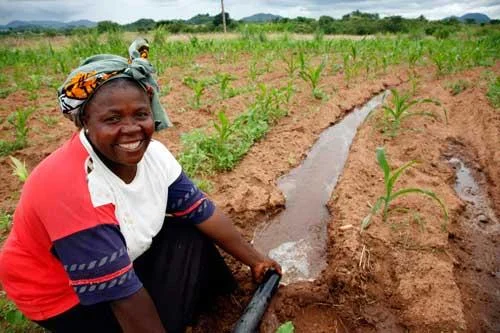
South Africa's formal fresh produce markets are worth investigating once you have enough volume to make them worthwhile. The National Agricultural Marketing Council tracks how smallholders access these markets, including the type of market used, volumes sold, selling arrangements, prices, payment terms and distance travelled.
Before committing to a market, find out the market agent's commission, the transport cost to get there, the grading requirements, and what you're actually likely to be paid — not just the price quoted on the board. Fees and shrinkage can eat a large share of the sale.
7. Work toward supplying a supermarketA supermarket contract opens up a much bigger customer base, but it's a different level of demand entirely. Large retailers need suppliers who can deliver consistent quality and quantity, proper packaging, traceability, and food-safety compliance every time.
The Department of Agriculture advises farmers targeting formal markets to understand food-safety, plant-health and quality standards and to follow good agricultural practice. Shoprite's Small Supplier Toolkit, for instance, requires food suppliers to be food-safety compliant and expects retail-ready products — meaning correct packaging, labelling and barcoding, among other requirements.
If you're still working out consistent quality or quantity, a supermarket shouldn't be your first target. It's easier to build up to it, one stage at a time:
Farm →local customers → traders, shops and restaurants →larger buyers → formal retail
Each stage teaches you something the next one needs — production scheduling, quality control, packaging, invoicing, deliveries, handling complaints, stock control, payment terms, record-keeping. Get those working at a small scale first.
The Department of Agriculture's market-access guidance treats quality as a competitive factor in formal markets, alongside good agricultural practice on the farm and proper handling further down the chain. Small farmers benefit from starting these habits early, rather than trying to adopt them all at once before a big buyer's first order:
•Harvest at the right stage, not early or late for convenience
•Sort out damaged produce before it reaches a customer
•Grade where it's appropriate to
•Keep produce clean
•Use packaging suited to the product and the buyer
•Keep basic production and sales records
•Store produce correctly
•Protect it during transport
•Know where and when each batch was harvested
None of this is supermarket-specific — it pays off even if you never sell past the farm gate.
9. Work out your actual margin, not just your priceThe most common mistake is setting a price without knowing what it costs you to produce the crop.
Say you sell 1,000 kg of potatoes at R8/kg. That's R8,000 in revenue — but revenue isn't profit. Seed, fertiliser, chemicals, labour, irrigation, fuel or electricity, packaging, transport, market fees and spoilage all come off that figure first.
| Amount |
| Revenue (1,000 kg × R8/kg) | R8,000 |
| Production and selling costs | R5,500 |
| Gross margin | R2,500 |
This is also how you compare buyers properly. A buyer offering a higher price per kilogram isn't automatically the better deal if getting the produce to them costs more in transport or packaging than selling closer to home for less.
10. Spread your sales across more than one channelMost farmers end up using several channels rather than one: MzansiFarm listings for online enquiries, farm-gate sales for local customers, a roadside stall for passing traffic, traders for bulk volume, restaurants and shops for steady repeat orders, fresh produce markets for larger quantities, and eventually supermarkets for formal retail. Relying on a single buyer leaves you exposed if that buyer disappears or renegotiates; splitting volume across two or three channels usually pays for the extra admin.
11. Keep records from day oneEven a small operation should track: date, product, quantity harvested, quantity sold, price, buyer, transport cost, other selling costs, amount actually received, and anything still outstanding. Over time this tells you which products and which customers are worth your effort — and it's the same information a bigger buyer or your accountant will eventually want to see.
It's also worth understanding your tax position early. SARS has specific provisions for farming enterprises, including VAT rules that apply to agricultural businesses under certain conditions — worth a conversation with a tax practitioner once your farming income starts to add up.
12. Match the method to your farmThere's no single best channel. A farmer with 50 kg of vegetables a week is usually better off with direct customers, a farm stall or a couple of local shops. A farmer moving several tonnes needs traders, formal markets, processors or retail buyers to shift that volume. A farmer with a genuinely premium product can sometimes build a direct customer base on quality alone, at a price the bulk channels wouldn't pay.
Match your channel to your volume, product, location, quality and ability to deliver consistently — in that order.
A starting plan for a small farmer1.List your products on MzansiFarm with clear photos, prices, quantities and location.
2.Spread the word locally — WhatsApp, Facebook groups, word of mouth — pointing people to the listing.
3.Offer farm-gate collection where it's practical.
4.Approach local hawkers, shops, restaurants and schools that might buy in bulk.
5.Check your municipality's rules before setting up a roadside stall.
6.Track every sale — costs and revenue — so you know which channel is actually paying.
7.Only increase production once you've confirmed there's a buyer for the extra volume.
8.Once quality and quantity are consistent, look at fresh produce markets, processors and supermarket supplier programmes.
Closing thoughtSelling well isn't about chasing the single highest price. It's about finding buyers that match what your farm can reliably produce, at a margin that's actually worth the work. For most smaller farmers, that starts with direct sales and online listings, plus local traders and businesses, and grows from there into formal markets and retail as volume and consistency allow. Find the buyer before you plant the bigger crop — not after.
Sources referenced
•City of Tshwane — informal trading by-law and permit requirements
•National Agricultural Marketing Council — smallholder access to fresh produce markets
•South African Department of Agriculture, Land Reform and Rural Development — market-access and good agricultural practice guidance
•Shoprite Group — Small Supplier Toolkit
•South African Revenue Service (SARS) — VAT and farming enterprise provisions