Mzansi Farming Hub
One digital platform for South Africa's farmers
A vegetable farmer outside Polokwane and a transport operator based in Durban have little reason to ever visit the same website. Add a buyer hunting for a bulk maize supplier, an agribusiness trying to advertise fertiliser, and an affiliate marketer hoping to earn a commission on farm equipment, and you have five different needs that, in South Africa, are usually scattered across five different tools — when they're served at all.
Mzansi Farming Hub was built to close that gap. It brings farmers, buyers, sellers, affiliates, service providers and transporters into one online space, shaped around how South African agriculture actually works rather than around a generic ecommerce template. In practice, that means one platform covers:
•Publishing — practical farming articles that double as a knowledge base
•Selling — a marketplace built for agricultural products, not retail boxes
•Sourcing — buyer requests for produce that isn't listed yet
•Promoting — affiliate marketing and sponsored advertising
•Delivering — built-in transport, tracking and proof of delivery
•Getting paid — settlement tied to a completed, confirmed sale
Knowledge farmers can actually use
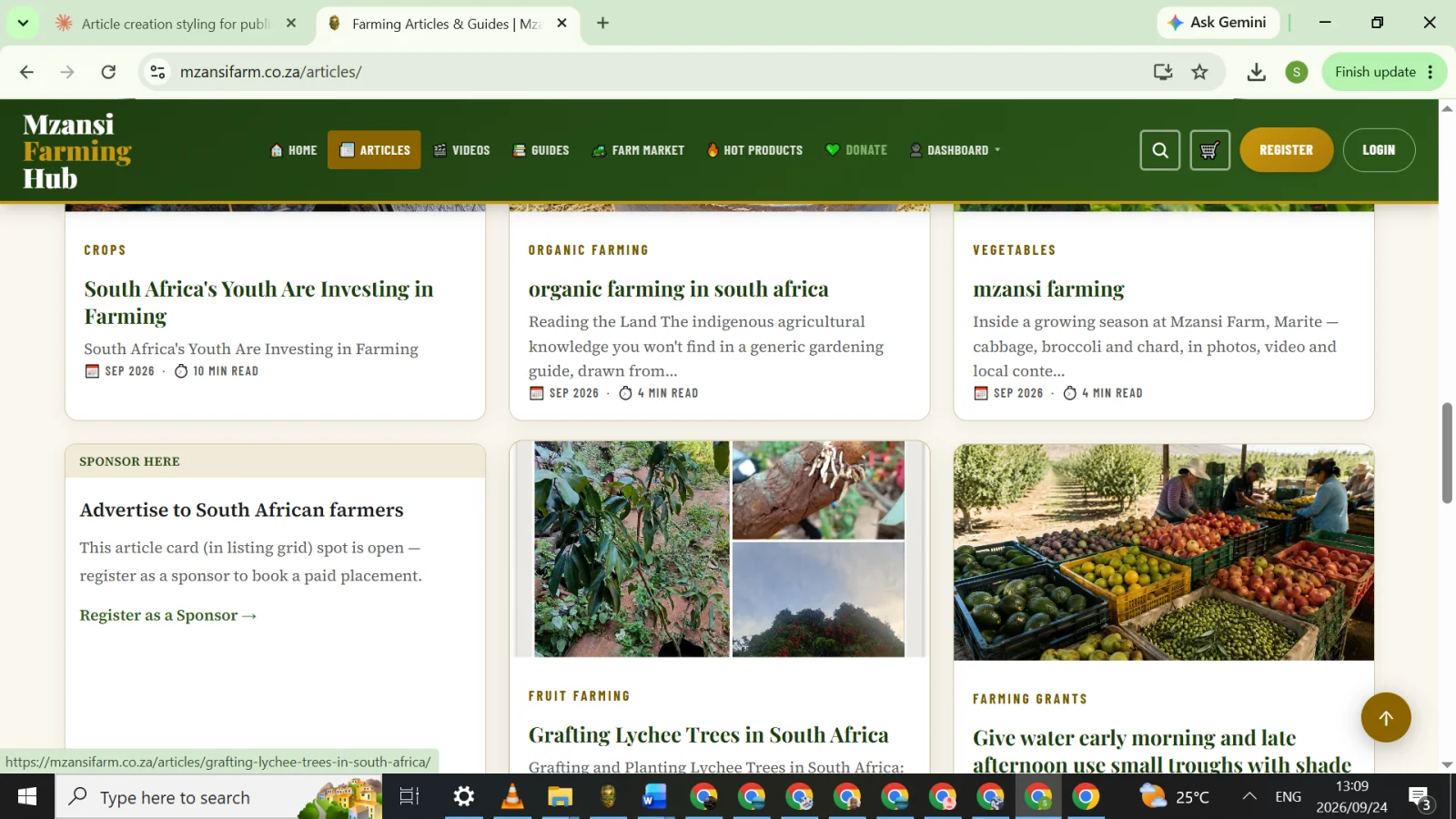
At its core, the platform runs an agricultural publishing system. Farmers and other contributors write on subjects that matter on the ground: crop production, livestock, soil management, fertilisation, pest control, farm planning, harvesting, irrigation and the business side of running a farm.
The articles do more than inform, though. A well-written piece on drip irrigation can lead a reader straight to an irrigation supplier's storefront, turning knowledge into a route toward products, services or opportunities elsewhere on the site. Over time that builds into two things at once: a genuine agricultural knowledge base people return to, and a form of presence for farmers who would rather earn attention through useful writing than through advertising spend alone.
A marketplace built for what farmers actually sell
Most online marketplaces are designed around retail goods that ship in boxes. This one is built for agricultural products — produce, livestock, and the kind of goods that don't fit a generic listing template. Farmers set out what they have, describe it and sell directly to customers, without an extra layer of middlemen in between.
Those listings aren't sealed off from the rest of the site, either. Because the marketplace connects to the platform's content and affiliate systems, a product can just as easily be found through an article or a referral as through a search bar.
Storefronts, not just listings
Farmers get more than a product page — they get a storefront built around their business as a whole. That's a meaningful difference: a standard online catalogue rarely tells a shopper anything about who's behind a product, while here customers can see the farmer and the operation alongside what's for sale.
For a farmer without the time, budget or technical skill to build a proper ecommerce site, that storefront works as a shortcut — an extra selling channel that doesn't require starting from zero.
When buyers do the asking
Not every transaction starts with a listing. Sometimes a buyer knows exactly what they need and can't find it, so instead of waiting, they can post a request describing it. Farmers who can supply the product respond directly.
That makes it a two-way marketplace — farmers advertise what they have, buyers advertise what they're after — which matters in agriculture, where availability shifts constantly with season, harvest, location and capacity.
Beyond products: farmer services
Not everything a farmer has to offer is physical. The platform also carries listings for agricultural services, connecting people who need expertise, labour or specialised work with providers who can supply it, opening a second income stream that has nothing to do with selling produce.
Turning promotion into income
An affiliate system runs alongside the marketplace, letting affiliates promote eligible products and earn a commission on the sales they generate. That promotion isn't locked to a single seller — an affiliate or publisher can build content around products from several different farmers and stores at once.
In practice, an article about growing vegetables can introduce readers to a specific product from a participating farmer, so the article works as both a teaching resource and a sales channel.
Content with a commercial edge
Affiliate-style articles take that further, explaining how a product works and why it's useful while steering interested readers toward the marketplace. Rather than keeping information and commerce in separate lanes, the platform lets one lead into the other — readers arrive for knowledge and sometimes leave with a purchase.
Advertising space for agricultural businesses
Businesses and product owners can run sponsored campaigns, supplying their own images, links and placement details to reach an audience already interested in farming. Combined with longer-term promotional options for affiliates and agribusinesses, advertisers get more than one route into the farming community's attention.
Articles that outlast a social post
A sponsored article doesn't disappear the way a social media post does after a day or two of engagement. Businesses and affiliates can publish permanent agricultural articles that explain a product or service in depth, giving readers a lasting way to find them long after a social post would have scrolled out of view.
Getting the product there: transport and logistics
Selling online only solves half the problem — the product still has to move from farm to customer. Mzansi Farming Hub builds a logistics layer directly into the marketplace, linking farmer, transporter and buyer within the same system. It handles:
•Transport charges and service areas
•Shipment creation and transporter assignment
•Live shipment tracking
•Pickup and delivery coordination
•Proof of delivery
So arranging transport isn't left entirely to buyers and farmers to sort out on their own, outside the platform.
A dedicated side for transporters
Transporters work through their own section of the site, where they're assigned shipments, receive delivery jobs and update progress as deliveries move along. Administrators get separate tools for managing transporters, coverage areas, rates and shipments, giving the platform a genuine structural role connecting sellers, buyers and transport providers rather than simply listing them.
Following a shipment through its stages
Any order that needs platform logistics becomes a shipment with its own lifecycle, one that buyers can follow and administrators can oversee from start to finish:
•Assignment — a transporter is matched to the order
•Collection — the shipment is picked up from the farmer
•Transport — the order is in transit
•Delivery — the shipment reaches the buyer, with proof of delivery attached
Payments built around the whole transaction
Money moving through the platform is tied to the order, the seller and, where relevant, the logistics behind it, rather than treated as a payment floating free of context. That matters because an agricultural sale is rarely just the price of one product — it can involve transport costs, marketplace fees and affiliate commissions too, all of which need to reconcile against the same transaction.
How farmers actually get paid
Farmers can track their earnings directly, but a sale doesn't turn into withdrawable cash the moment it's made. Funds move through set stages tied to delivery and transaction confirmation before settlement — a level of control that protects both sides of a deal rather than releasing money the instant a payment clears.
Keeping standards on the marketplace
With products coming from many different farmers and businesses, some form of quality control is unavoidable. Listings go through an approval process before they're publicly visible, and the platform includes farmer verification and supporting evidence checks — a deliberate choice to keep the marketplace curated rather than letting every submission go live automatically.
Building a farmer's online identity
Farmers get a profile that ties together their products, articles and agricultural activity in one place. That matters because buyers usually want more than a photo and a price — they want to know who grew the product, where it came from and what kind of operation stands behind it. A storefront and a profile together let that reputation build up over time.
Who uses the platform
Several distinct groups work side by side on Mzansi Farming Hub: farmers and growers, buyers, agricultural businesses, affiliates and publishers, transporters, administrators and service providers. The table below sets out what each group does.
User group | Role on the platform |
Farmers and growers | Publish articles, list products and build an online business presence. |
Buyers | Discover products and post requests for what they need. |
Agricultural businesses | Offer services and promote products or solutions. |
Affiliates and publishers | Create promotional content and refer customers to eligible products. |
Transporters | Handle assigned shipments — collection, transport and delivery. |
Administrators | Manage approvals, verification, transport operations, payments and marketplace activity. |
Because all of these groups share the same agricultural ecosystem, activity that would normally be scattered across separate websites and apps ends up connected in one place: a farmer sells, a buyer finds the product, an affiliate promotes it, a publisher writes about it, a transporter delivers it, and the platform coordinates the chain in between.
Designed with small farmers in mind
A meaningful part of the thinking behind Mzansi Farming Hub is lowering the barrier for smaller farmers to reach a digital market. Nobody needs a large operation, a custom-built website or a professional ecommerce setup to take part — the listings, publishing tools, promotion and transaction infrastructure are already there, making the platform a realistic next step for farmers moving from local sales toward a wider online market.
Where content meets commerce
What sets the platform apart isn't any single feature — it's how the pieces connect. It isn't only a publishing site, an online store, an affiliate network or a logistics tool; it's built so those systems feed into one another:
•An article draws in visitors. Practical, well-written content brings farmers and buyers to the platform in the first place.
•Visitors discover products. Articles, storefronts and requests all lead back to the marketplace.
•Products become sales. A discovery turns into an order, with affiliates earning commission where they referred it.
•Transporters handle delivery. The order moves from farm to buyer, tracked at every stage.
•Delivery is confirmed. The buyer signs off, and proof of delivery is recorded.
•The farmer gets paid. Once the sale is confirmed, earnings move toward settlement.
The result works less like a set of disconnected pages and more like one continuous agricultural loop — knowledge, discovery, promotion, sale, transport and delivery, all running through the same system.