Water is one of the biggest costs and risks a South African farmer carries. Good soil, healthy plants, and a solid market for the crop still won't save a season if too much of the water being pumped, channelled, or delivered to the field never actually reaches the crop.
The scale of the problem is well documented. The Department of Water and Sanitation reports that irrigated agriculture is the country's largest registered water-use sector, accounting for more than 60% of registered water use, and its assessment of irrigation schemes for 2018/19 put overall water loss at roughly 20% between the water released and the water that reached its intended use — with some areas far worse than the average, including 33% in the Limpopo Water Management Area. For any farmer paying for electricity or diesel to run a pump, every lost litre is money spent for nothing.
Where the water actually goes
Losses rarely come from a single obvious leak, and they build up at several points between the source and the plant. A cracked pipe, a leaking joint, or a damaged valve releases water continuously without giving anything back, and open canals lose water the same way before it ever reaches a field — a 2025 study of the Vaalharts Irrigation Scheme identified transmission losses through irrigation infrastructure as a major contributor to the country's overall irrigation losses.
Losses also happen in the field itself. Water applied faster than the soil can absorb it runs off before the roots can use it, and on sandy soils, water can sink past the root zone before the crop draws on it. Hot, windy weather adds evaporation on top of that, and irrigating at the wrong time of day can mean paying to pump water that does almost nothing for the crop.
Smallholder farmers feel this hardest, because replacing infrastructure is expensive. Research on South African smallholder irrigation schemes points to poor infrastructure, weak maintenance, limited resources, and management difficulties as the main barriers to efficient water use.
A real example: Vhulaudzi village, Limpopo
A research project in the village of Vhulaudzi, in the Vhembe district of Limpopo, gives a concrete picture of what this looks like on the ground. Site visits and interviews with local farmers found that most fields were still watered using traditional furrow irrigation — a method with low water efficiency — while climate change and shifting rainfall patterns were already squeezing crop and livestock production. The researchers pointed to open canals and outdated distribution infrastructure as clear targets for improvement, and noted that switching to drip irrigation could lift water efficiency by as much as 70% for maize, the district's dominant crop. Beyond the water savings, drip was also flagged as better for the soil itself, since it causes less compaction and erosion than furrow irrigation or flood irrigation, and frees up water that would otherwise go to the fields for livestock use instead.
The pattern in Vhulaudzi echoes what shows up across smallholder schemes more broadly: the technology to save water is rarely the bottleneck. What holds farmers back is money for the initial setup, access to technical support, and reliable maintenance once a system is in the ground.
Fixing this doesn't require a new irrigation system
A full system replacement can cost hundreds of thousands of rand, and it isn't the place to start. The cheapest wins come first.
1. Fix leaks before buying anything new. Walk the entire irrigation line while the pump is running and check pipe joints, valves, connectors, damaged pipes, leaking taps, broken sprinklers, loose fittings, and spots where water pools unexpectedly. A small leak near the pump can look trivial, but left running for a full growing season it adds up to a real amount of wasted water, and replacing a damaged connector or a short length of pipe is far cheaper than installing a new system.
2. Use drip irrigation where it earns its keep. Drip irrigation delivers water close to the plant instead of soaking the whole field, which works well for row crops such as tomatoes, peppers, cabbage, and most vegetables. South African research has focused specifically on drip systems and on improving their efficiency, and the Vhulaudzi findings above show just how large that efficiency gap with furrow irrigation can be. A full-farm conversion isn't necessary — start with the highest-value crop, or the section losing the most water, and expand once the system proves itself. On very small farms, simple low-pressure drip lines are a realistic starting point rather than a fully automated setup.
3. Irrigate by the crop, not by the calendar. Watering every morning out of habit ignores what the crop actually needs, since water demand depends on the crop, the soil, the weather, and the growth stage. Checking the soil around the root zone before irrigating avoids watering that isn't needed. The Water Research Commission's work on irrigation efficiency frames the goal clearly: produce more with the same amount of water, or the same amount with less. The target isn't maximum water use — it's maximum crop output per litre applied.
4. Mulch, cheaply. Mulching is one of the most affordable tools available to a small farmer. Dry grass, crop residue, and other organic material spread around plants cuts direct evaporation from the soil and helps hold moisture in the root zone, and as it breaks down, it also improves soil quality. The one caution is to avoid material contaminated with chemicals, pests, or disease.
5. Harvest rain instead of losing it. South Africa's rainfall is highly variable, but rain that falls on a farm doesn't have to disappear down a drainage channel — it can be collected from suitable roofs into storage tanks, or slowed and captured in the field using basic water-harvesting techniques that encourage infiltration. Research from the Eastern Cape on in-field rainwater harvesting shows real benefit, but also a clear warning: no single system works everywhere without adaptation. Farmers in that study reported real problems with labour demands, complexity, and upkeep, which is a reminder that the cheapest system on paper isn't useful if it's too demanding to maintain.
6. Improve the soil before increasing irrigation. Sometimes the issue isn't how much water goes on, it's what happens to it once it's there. Soil with good structure holds and supplies moisture far more effectively, and organic matter improves both structure and water-holding capacity, though the right approach depends on soil type and crop. This matters most on sandy soils, where water moves through quickly, so before increasing irrigation in response to dry-looking plants, it's worth checking whether the soil is retaining the water already applied.
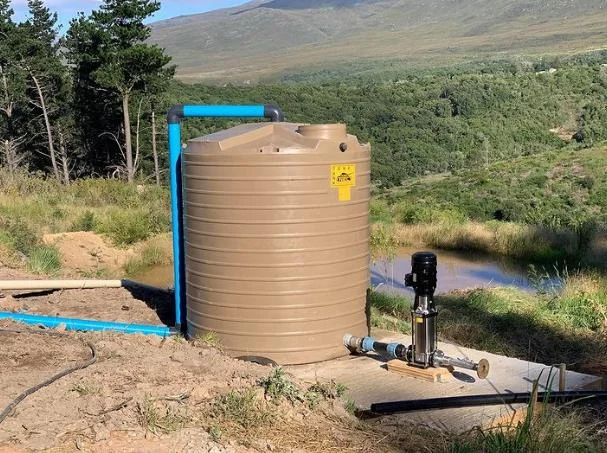
7. Use storage tanks strategically. A tank doesn't create water, but it makes an existing supply easier to manage, letting a farmer receiving water intermittently store it and irrigate on the crop's schedule instead of whenever water happens to be available. Paired with rainwater collection and a small pump, a tank-based setup is often more realistic for a small vegetable farm than a large commercial network.
A staged approach for small farmers
Rather than one large investment, the work can be broken into stages:
Improve the field — mulch, build soil organic matter, reduce bare soil
3
Improve irrigation — move to drip or other efficient methods where it pays off
4
Store water — tanks and appropriate rainwater harvesting
5
Measure — track water pumped or delivered against area irrigated and yield
That last step is the one most often skipped, but without it, there's no way to know whether the earlier stages are actually working.
The goal is less waste, not just less water
There's a real difference between using less water and wasting less water. Cutting irrigation to the point where the crop suffers doesn't improve a farm's economics, it just trades one loss for another — the better target is water that produces no crop benefit at all, not water use in general.
This matters beyond any single farm. The Water Research Commission notes that irrigation underpins a large share of South Africa's agricultural output, including high-value crops such as vegetables, fruit, and potatoes. The country can't treat irrigation water as unlimited, but smallholders also can't be expected to adopt solutions built for large commercial operations.
Sometimes the right fix is a sophisticated irrigation system, but more often, for a small farmer, it's a repaired pipe, a layer of mulch, a well-placed drip line, a storage tank, or simply watering at a better time of day. The first litre saved is usually the cheapest one a farmer will ever get.
Sources
Department of Water and Sanitation — National State of Water Resource Report 2019/20 (irrigation water-loss estimates)
Water Research Commission — research and guidance on agricultural water efficiency and irrigation
Agricultural Research Council — research on efficient irrigation methods
Research on South African smallholder irrigation schemes and infrastructure challenges
Research on rainwater harvesting among smallholder farmers in the Eastern Cape
Strategies for Improving Water Management on Smallholder Farms in the Village of Vhulaudzi, Vhembe District, South Africa
We use essential browser storage to run this site, and — where you allow it —
advertising cookies (third-party ad networks), basic analytics, and affiliate tracking
cookies used when you follow a product link to a retailer (so that retailer can
credit us for the referral). See our
Cookie Policy for details.