Written by Siphesihle Zangwa, researcher, University of Mpumalanga. Cleaned up and edited by Samukelo Moloko, publisher, MzansiFarm. Updated 5 November 2026.
The Xhosa New Year Begins with a Star: iSilimela and the Pleiades
The traditional Xhosa year begins in June, when a small cluster of stars returns to view. The Pleiades, sometimes called the Seven Sisters, are known as isiLimela in isiXhosa. The first month of the Xhosa calendar, iSilimela, is named after them.
The name is closely connected to the verb ukulima, meaning to cultivate. Royal Museums Greenwich, in its research on southern African star lore, explains that the return of the cluster warned people that the time for hoeing was approaching. Xhosa men also counted their years of manhood from the June when isiLimela first appeared.
Most of the other traditional Xhosa month names refer to something visible in the natural environment, such as growing grass, flowering trees or pumpkin plants beginning to soften.
Xhosa Month Names and Their Meanings
Ten of the twelve months are named after something growing, flowering or ripening. The other two, June and May, are associated with the night sky. The list below follows Grocott’s Mail.
| MonthXhosa nameMeaning or seasonal sign | ||
| June | iSilimela | The Pleiades and the beginning of the Xhosa year |
| July | eyeThupha | Some trees begin to bud |
| August | eyeKhala | The aloe flowers |
| September | eyoMsintsi | The coral tree flowers |
| October | eyeDwarha | A medicinal plant used on wounds and sores; its tree is in flower |
| November | eyeNkanga | Ragwort, a small plant with brief yellow flowers |
| December | eyoMnga | The mimosa, with small yellow flowers |
| January | eyoMqungu | A tall grass cut for thatching roofs |
| February | eyoMdumba | A seed or grain becomes visible |
| March | eyoKwindla | Harvest time |
| April | uTshazimpunzi | Pumpkins droop and some trees drop their leaves |
| May | uCanzibe | Saturn, bright in the night sky |
October’s plant was traditionally used on wounds and sores, especially sore backs on horses. November and December both refer to small yellow flowers: first ragwort, followed by mimosa.
Differences Between Traditional Xhosa Month Lists
Not all sources agree on the meanings of every month. One source associates the flowering aloe with July and the first tree buds with August, while another reverses these meanings. May is linked to Saturn in one source and Canopus in another.
These differences show that traditional seasonal knowledge can vary between communities and recorded accounts.
The Xhosa Farming Calendar: When Agricultural Work Takes Place
Gavin Heron studied farming in Shixini, near Willowvale in the Transkei. In 1990, he found that agricultural labour demand generally runs from October, when the ground is prepared for planting, until early March, when harvesting begins.
Weeding reaches its busiest period between December and February.
Although isiLimela returns in June and marks the beginning of the traditional Xhosa year, the heaviest agricultural work does not begin until October, about four months later. The yellow flowers of eyeNkanga and eyoMnga appear during the weeding season, while the harvest month, eyoKwindla, follows soon afterwards.
Ploughing Companies and Community Work Parties
Much of the traditional Xhosa farming work was organised collectively. Heron describes two main forms of cooperation.
Ploughing companies were made up mostly of relatives. Around 70% of their members were related to the head of the company through the male line.
Work parties, known as amalima, were organised by neighbourhood. These gatherings were usually short, with everyone contributing an equal amount of time. Heron identifies two types: isicelo and amandwandwa.
Traditional Beer Celebrations After Farm Work
A work party traditionally ended with beer. Speeches during these gatherings emphasised mutual assistance and community cooperation. Heron recorded a phrase used by participants: “We Gcaleka help each other.”
P.A. McAllister, who conducted fieldwork in Shixini between 1976 and 1998, wrote that beer gatherings such as umsindleko also drew the attention of the ancestors to the homestead.
How Rain Affects Traditional Xhosa Farming
Heavy rainfall can disrupt ploughing. When the ground is too wet, oxen struggle to walk without slipping, and the soil does not break up properly.
Heron also found that some families planted late because their land had not been ploughed on time. This shows how closely the traditional farming calendar depended on weather conditions and the availability of shared labour.
Xhosa Gardens, Traditional Crops and Seed Saving
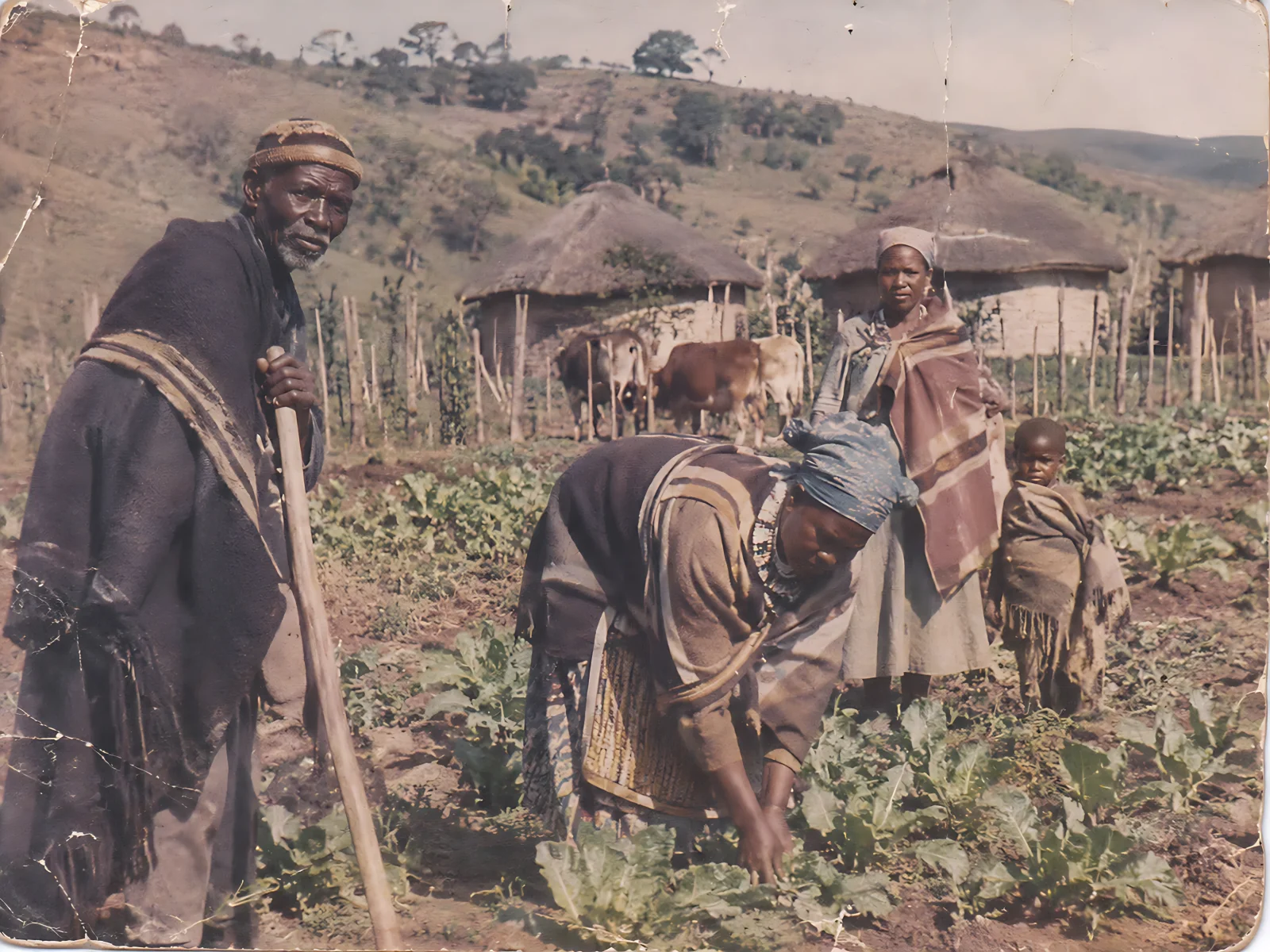
In Xhosa-speaking homesteads, gardens were traditionally managed mostly by women. A Rhodes University history of the Xhosa from around 1700 to 1835 describes gardens situated between huts and rivers. They were often fenced with mimosa bushes, the same tree associated with the December month name, to keep cattle away from crops.
The same historical account describes coastal grassland as suitable for growing maize, millet, tobacco and pumpkins, although the land was generally better suited to livestock farming than intensive crop production.
Sorghum and Maize in Xhosa Food and Farming
Sorghum was the older traditional grain. McAllister, writing about the Willowvale district, recorded a shift from sorghum to maize that accompanied the adoption of ploughs and oxen purchased with migrant wages.
Sorghum nevertheless remained important. When S. Shava studied Tuku A village in the Peddie district in 2000, residents described their main diet as consisting of sorghum, maize and amasi (soured milk).
The Role of Women and Wild Plants in Xhosa Agriculture
Lethukuthula Jongisa’s 2005 study of Umzimkulu found that women traditionally used digging sticks and practised conservation tillage. They were responsible for hoeing, weeding and harvesting, and held knowledge about which wild plants were safe to eat.
Shava also recorded a belief concerning wild greens, known as imifuno. These plants were considered women’s food, and men who ate them were said to become weak and cowardly.
Why Traditional Seed Saving Matters
Food For Mzansi reports that smallholder farmers, mostly women, rely on their own saved seed for 60% to 70% of what they plant in provinces that include the Eastern Cape.
Women in these communities select more than 60% of their seed varieties according to taste, cooking time and storage quality.
Community seed banks operated by farmer groups now exist in several provinces, including one in Sterkspruit in the Eastern Cape. Household seed banks also provide an important form of insurance. When one neighbour loses a variety because of theft, pests or a poor harvest, another household may still have that seed available.
Cattle in Xhosa Culture and Traditional Farming
Writing in the Mail & Guardian in 2016, Kwanele Sosibo described cattle as the main offering in funeral rituals dedicated to the ancestors.
The Bellowing Cattle Sacrifice
During the preparation of a traditional sacrifice, the animal must bellow. When it does, people say Icamaku livumile, meaning that the ancestors are willing.
If the animal remains silent, the sacrifice cannot proceed.
Ubulunga: The Ceremonial Cow in Xhosa Culture
Two heifers are traditionally set aside as ubulunga. One is given by a man to his bride, while the other is given by her father. These animals are sacred and may not be slaughtered.
Hair from their tail-brushes is made into necklets worn by family members to connect with the ancestors, particularly when someone is ill or becoming a diviner. An old ubulunga animal is kept alive for as long as possible.
The Role of Cattle in Xhosa Agricultural Work
The Rhodes University history explains that sourveld was grazed during summer and sweetveld during winter. Sourveld was sometimes burned to make it sweet.
Heron found that draught oxen were used to pull ploughs in Shixini. He also observed that cattle connected families through bridewealth and the ancestral tradition. This helps explain why so many members of ploughing companies were related to the company head.
Cattle Ownership in Xhosa Families
McAllister notes that sons working as migrant labourers sometimes bought cattle, but the herd was still counted as belonging to the father.
The 1856 Xhosa Cattle Killing
The 1856 cattle killing caused widespread dispossession among the Xhosa people. Sosibo describes the devastating effects, while McAllister adds that Xhosa cattle holdings never fully recovered.
Xhosa Harvest Festivals: What Historical Sources Reveal
The written historical record does not show evidence of one major harvest festival shared by all Xhosa communities. The best-documented first-fruits ceremonies in southern Africa are mostly associated with Zulu traditions.
In 1938, Max Gluckman argued that the prohibition against eating new crops before the ceremony helped reduce jealousy in villages where crops ripened at different times. He also suggested that the ceremony demonstrated loyalty to the chief.
According to Gluckman, these ceremonies took place after a period of scarcity and before the abundance of the main harvest.
Ingcubhe: The Traditional First-Fruits Feast
The isiXhosa language has a word associated with this type of event: ingcubhe, also written as incubhe or incubi.
The Dictionary of South African English describes it as a festival marking the first harvest of the season among the Bhaca.
W.C. Scully described the “incubi” in 1907 as a first-fruits feast in which the chief, after being treated with medicines, threw an assegai towards the rising sun. By 1913, he wrote that the Baca were still practising the ritual long after other communities had abandoned similar customs.
In 1962, W.D. Hammond-Tooke wrote that possession of the ingcubhe medicines added to the power and prestige of the Bhaca chief.
What Historical Sources Do Not Say About Xhosa Harvest Festivals
None of the sources behind this article describes a harvest festival practised across all Xhosa chiefdoms.
McAllister’s research in Willowvale describes beer gatherings and thanksgiving animal sacrifices directed towards the ancestors. One such gathering was held to welcome a migrant worker returning home, but his research does not document a first-fruits ceremony.
Published studies of Transkei farming also contain little evidence of a formal ritual specifically intended to bless the fields.
Preserving Traditional Xhosa Seasonal Knowledge
Wikipedia notes that younger urban isiXhosa speakers increasingly use anglicised month names, while rural communities in the Eastern Cape continue to use traditional names.
Grocott’s Mail observes: “This is a bit of the indigenous knowledge that is disappearing.”
Changing Seasonal Signs in the Xhosa Veld
Sinoxolo Magaya’s 2021 dissertation recorded how residents of Lusikisiki in the Eastern Cape and Umzimkulu in KwaZulu-Natal observed natural signs to understand seasonal changes.
Examples included:
- Peach trees flowering: A sign that spring has started.
- Frogs croaking: An indication that rain is approaching.
- A hollow appearance in the moon: A sign of possible wind during the day.
Residents told Magaya that plant and animal signs were becoming less reliable and less common, while weather signs had remained relatively steady.
In Peddie, an elder told Shava in 2000 that some wild fruits had disappeared because the area was becoming drier.
These observations highlight the importance of protecting indigenous seasonal knowledge, traditional farming practices, local plant varieties and the environmental signs that have guided Xhosa communities for generations.

Sources and References
- Grocott’s Mail – Xhosa month names.
- Xhosa calendar – Wikipedia.
- Royal Museums Greenwich – South African star myths.
- Rhodes University – A History of the Xhosa c.1700–1835.
- Heron, G. (1990) – Shixini farming study.
- McAllister, P.A. – Willowvale and Shixini fieldwork.
- Shava, S. (2000) – Tuku A village thesis.
- Magaya, S. (2021) – Indigenous weather forecasting, University of the Witwatersrand.
- Food For Mzansi – Seed banking.
- Jongisa, L. (2005) – Umzimkulu study.