How soil-water monitoring technology helps farmers improve irrigation scheduling, reduce unnecessary water use and protect crop roots.
Written by Siphesihle Zangwa, researcher, University of Mpumalanga. Cleaned up and edited by Samukelo Moloko, publisher, MzansiFarm. Updated 5 November 2026.
Irrigating a crop is not simply a matter of switching on the pump every few days. The amount of water in the soil changes with rainfall, temperature, wind, soil type and the stage of crop growth. A schedule that works during a cool week may leave plants short of water during a hot spell. It can also waste water when rain has already replenished the soil.
Soil moisture sensors help farmers make irrigation decisions using measurements from the field rather than relying entirely on a fixed timetable. They show how wet or dry the soil is at the points where they are installed. This information can help determine when irrigation is needed and whether applied water is reaching the crop's active root zone.
For South African farmers facing pressure on water supplies and rising irrigation costs, soil-water monitoring offers another way to manage production. The technology ranges from relatively simple manual instruments to electronic probes connected to automated irrigation controllers.
The equipment matters, but correct installation, regular maintenance and an understanding of the readings matter just as much.
1. How Soil Moisture Sensors Work
Soil moisture sensors measure different aspects of water in the soil. Two important measurements are soil-water content and soil-water tension.
Soil-water content indicates how much water is present in a given volume of soil. Soil-water tension indicates how strongly the soil holds onto that water and how difficult it is for plant roots to extract it.
The distinction matters because different instruments produce different readings. A farmer should understand what a particular sensor measures before using its readings to decide when to irrigate.
Tensiometers
A tensiometer measures soil-water tension using a water-filled tube with a porous ceramic tip and a pressure gauge.
As the soil dries, it holds water more tightly. The tensiometer records the increasing suction needed to draw water through its ceramic tip.
These instruments are used to help determine when irrigation should begin. They are relatively straightforward, but they need regular attention. Air bubbles, low water levels and poor installation can affect the readings.
Capacitance Sensors
Capacitance sensors estimate soil-water content by measuring changes in the soil's electrical properties.
They can monitor moisture at selected depths, depending on the equipment. Some models remain permanently installed in the field and send readings to a data logger or monitoring system.
These probes are useful for following changes in soil moisture after rainfall or irrigation. Their accuracy depends on correct installation, good soil contact and suitable calibration.
Time-Domain Reflectometry (TDR) Sensors
Time-domain reflectometry instruments use electromagnetic signals to estimate the amount of water in the soil.
Because water affects the soil's dielectric properties, the instrument can use changes in signal behaviour to estimate soil-water content.
TDR equipment is used where detailed monitoring is needed, including at different depths in the root zone. The cost and technical requirements should be considered before investing in a system.
Manual and Connected Monitoring Systems
Not every farm needs an internet-connected irrigation system.
Some instruments require the farmer to visit the field and record readings manually. Others use data loggers, wireless connections or mobile networks to send information to a phone or computer.
Connected systems can make it easier to monitor several irrigation blocks, but they also introduce additional costs and maintenance requirements. A reliable manual instrument may be more useful than an expensive electronic system that cannot be properly maintained.
2. Why Sensor Placement Matters
A soil moisture sensor only measures conditions around the point where it is installed. It does not automatically describe the moisture level across an entire field.
This is particularly important under drip irrigation, where water forms a wetted area around each emitter.
A sensor installed too close to a dripper may record high moisture levels while the rest of the active root zone remains relatively dry. A probe outside the wetted area may give the opposite reading.
The South African Sugarcane Research Institute (SASRI) specifically warns that incorrectly positioned soil-water sensors cannot deliver their full irrigation-scheduling benefits.
Position Sensors Within the Active Root Zone
The sensor should represent the soil conditions experienced by the crop's roots.
Consider the irrigation method when selecting an installation point. Under drip irrigation, position the sensor within the normal wetted area rather than directly beside the emitter. Under sprinkler irrigation, choose a representative location that receives normal water application.
The exact position depends on the crop, soil and irrigation system.
Monitor More Than One Soil Depth
A single sensor depth may not show what is happening throughout the root zone.
Installing instruments at different depths helps farmers distinguish between shallow moisture loss and water movement deeper into the soil.
For example:
- A shallow sensor can indicate when the upper soil layer is drying.
- A deeper sensor can show whether irrigation water is reaching the lower part of the root zone.
- A sensor below the main root zone can help identify excessive drainage when used appropriately.
Sensor depths should be selected according to the crop's rooting pattern and the purpose of monitoring. There is no single installation depth suitable for every crop.
Account for Differences Across the Field
Soil texture and water distribution can vary between sections of the same farm.
A sandy section may lose available moisture faster than a heavier clay soil. Differences in irrigation pressure, blocked emitters or uneven sprinkler coverage can also affect readings.
Where a field contains distinct soil types or irrigation zones, consider monitoring them separately. One sensor should not be expected to represent conditions across an entire farm when the field is highly variable.
3. Using Soil Moisture Readings to Schedule Irrigation
A sensor reading becomes useful when the farmer knows how it relates to crop water requirements.
For example, a falling soil-water content reading may indicate that the soil is drying between irrigation cycles. A rising reading after irrigation shows that water has entered the monitored area.
The farmer must then consider whether the water has reached the required root depth and whether the crop needs another irrigation cycle.
Consider the Crop's Growth Stage
Water requirements change as a crop develops.
Young plants generally have smaller root systems, while established crops can draw water from a larger soil volume. Flowering, fruit development and grain formation may also involve periods when water shortages have greater consequences for yield or quality.
Irrigation thresholds should therefore account for the crop, soil type and growth stage. A reading suitable for one crop should not automatically be applied to another.
Check Rainfall and Weather Conditions
Rainfall can change soil moisture considerably, particularly in the upper soil layers.
Temperature, wind and atmospheric demand also influence how quickly crops use water. A farmer who follows the same irrigation timetable throughout the season may apply water unnecessarily after rain or fail to meet crop demand during hot weather.
Use sensor readings alongside rainfall records and, where available, local weather information and crop-water-use estimates.
Check Whether Water Is Moving Too Deep
Applying more water does not always improve crop performance.
When irrigation exceeds the water-holding capacity of the active root zone, some water may drain below the roots. This represents a loss of irrigation water and can also carry dissolved nutrients away from the area where the crop can use them.
Readings at more than one depth can help identify this problem. A shallow sensor may show that the surface soil is becoming wet, while a deeper sensor indicates whether water is reaching the lower root zone.
The Water Research Commission's agricultural water-management guidance distinguishes between instruments that measure soil-water content and those that measure soil-water potential. In particular, tension readings can help indicate when irrigation is needed, but do not directly calculate the volume of water to apply.
4. Calibrating and Maintaining Soil Water Sensors
A sensor should not be treated as accurate simply because it produces a digital reading.
Soil texture, installation conditions and the instrument's calibration can influence the results. This is particularly important when farmers use readings to calculate actual soil-water quantities rather than simply monitor changes over time.
Why Calibration Is Important
A manufacturer's standard calibration may not accurately represent every farm's soil conditions.
Site-specific calibration can improve the relationship between an instrument's readings and the actual water content of the soil.
The Water Research Commission's agricultural water-management guidance explains that calibration requirements depend partly on how the information will be used. Following trends in soil moisture may require less calibration than calculating absolute water-content values for a detailed water balance.
Follow the manufacturer's instructions and obtain technical assistance when accurate measurements are important to irrigation decisions.
Routine Sensor Maintenance
Regular checks help prevent misleading readings and equipment failure.
Farmers using electronic probes should inspect cables, connections, batteries and data loggers. Tensiometers require attention to their water levels and air bubbles.
Also check that probes remain properly positioned and that soil contact around the sensor has not been disturbed.
A faulty sensor can create the same irrigation problems as having no monitoring system at all if the farmer continues making decisions based on incorrect readings.
5. Smart Irrigation Controllers and Automated Watering
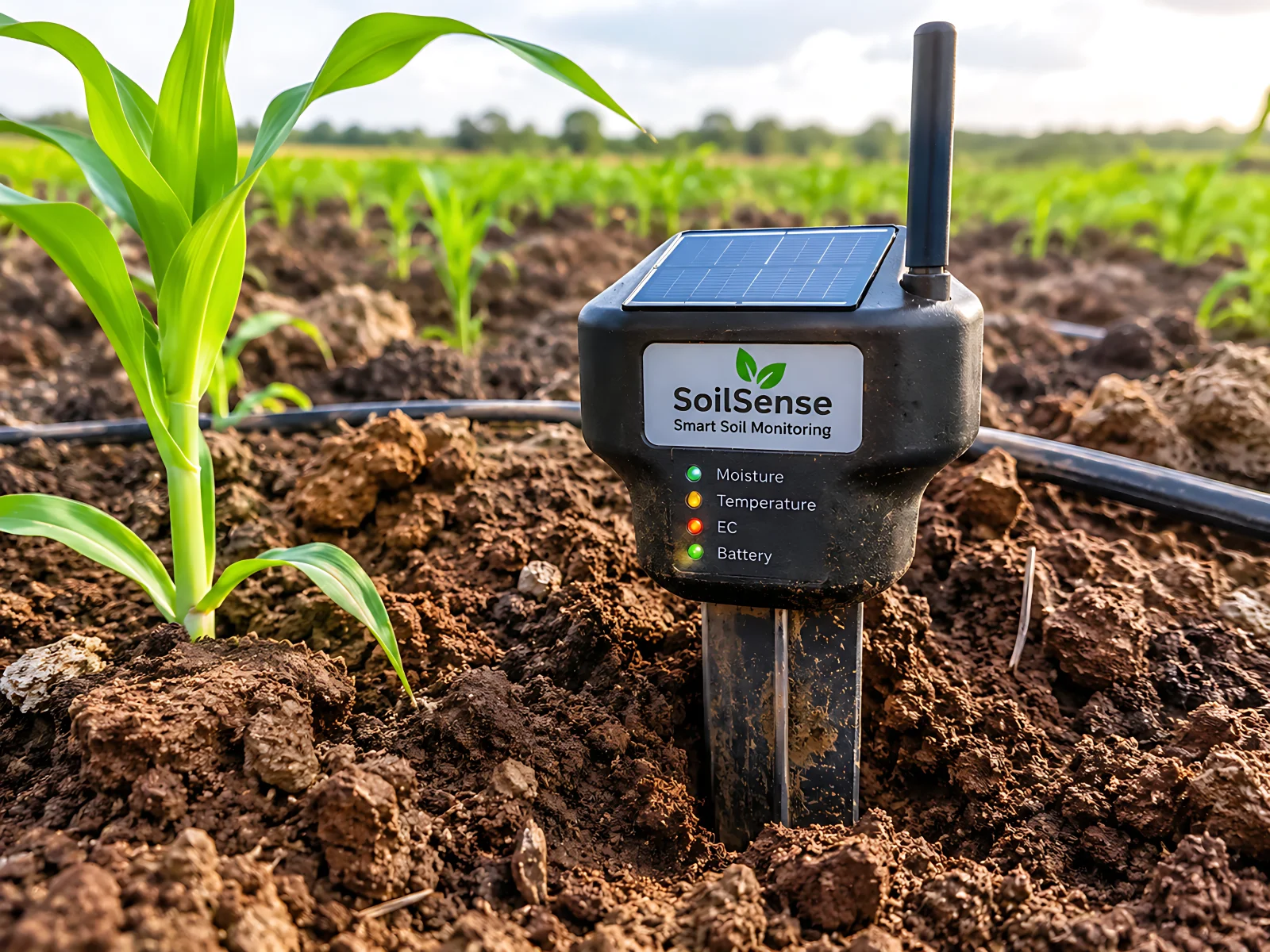
Some soil moisture monitoring systems can connect directly to irrigation controllers.
Instead of relying exclusively on preset operating times, these systems use sensor information to help determine when an irrigation cycle should start or stop.
A connected system may allow the farmer to:
- View soil moisture readings from a phone or computer.
- Monitor different irrigation blocks.
- Receive alerts when moisture levels move outside selected limits.
- Adjust irrigation timing according to monitored conditions.
- Record changes following rainfall and irrigation.
Automation can reduce routine checking, particularly on farms with several production areas. It does not remove the need for regular field inspections.
A sensor may report adequate moisture at its installation point while a blocked emitter or damaged pipe leaves another part of the field dry.
The controller should also have safe operating limits and a practical backup arrangement. A failed probe, flat battery or lost connection should not leave crops without irrigation.
6. Choosing the Right Soil Moisture Monitoring System
The most expensive monitoring equipment is not necessarily the best investment for a particular farming operation.
A small vegetable grower may need a simple instrument that can be checked manually. A commercial orchard or large irrigated crop operation may benefit from several monitoring stations connected to a central system.
Before buying, consider:
Crop and rooting depth: The monitoring system must provide useful information about the soil where the crop takes up water.
Soil type: Sandy, loamy and clay soils have different water-holding characteristics. Sensor readings need to be interpreted accordingly.
Irrigation method: Drip, sprinkler and flood irrigation create different water-distribution patterns.
Installation requirements: Check whether the equipment can be installed correctly using the labour and technical support available.
Electricity and communication: Connected equipment needs a dependable power source and, depending on the system, reliable network access.
Maintenance: Establish what servicing, replacement parts and technical assistance will cost.
Budget: Compare the purchase price with the possible benefits of improved irrigation management. Include installation, calibration, repairs and ongoing data costs.
Small-scale farmers should not feel pressured to purchase a fully automated system. Starting with a few well-positioned sensors can provide useful information without creating unnecessary expenditure.
7. Testing Soil Sensors Before Installing Them Across the Farm
A trial on one irrigation block is a sensible way to assess whether a monitoring system is suitable.
Choose an area where irrigation timing or uneven water application is already a concern. Install the sensors according to the manufacturer's guidance and record their positions and depths.
Compare the readings with observations from the field. Check soil conditions around the probes and look at the crop for signs of water stress.
Keep records of:
- Irrigation dates and operating times.
- Rainfall received.
- Soil moisture readings at different depths.
- Crop condition during different growth stages.
- Water applied during each irrigation cycle.
- Harvest quantity and crop quality.
- Equipment faults and maintenance costs.
These records help show whether the system is making irrigation decisions more accurate and whether the investment is justified.
A farmer should also compare performance with the previous irrigation method where records are available. Do not assume that installing sensors automatically reduces water consumption or increases yields. The results depend on how the equipment is used and whether irrigation management changes in response to the information.
8. What South African Research Says About Sensor-Based Irrigation
South African research organisations have examined how soil-water monitoring can improve irrigation management.
The South African Sugarcane Research Institute's September 2022 publication, Placement of Soil Water Sensors for Irrigation Scheduling, provides guidance on choosing and positioning instruments. Its central finding for farmers is practical: incorrect placement limits the value of sensor-based scheduling.
The Water Research Commission's 2019 review, Sensors for the Improvement of Irrigation Efficiency in Nurseries, examines instruments that can monitor soil-water conditions in small nursery containers. It identifies sensor-based irrigation as an alternative to traditional timer-controlled watering and discusses the advantages and limitations of different technologies.
A 2026 review published in AgriEngineering, titled Opportunities and Challenges of Sensor- and Acoustic-Based Irrigation Monitoring Technologies in South Africa, examines the wider use of monitoring technology in South African irrigation. It considers the opportunities and practical limitations of adopting these systems in different agricultural settings.
Together, these publications show why sensor selection, installation and practical farm conditions deserve as much attention as the technology itself.
Making Better Irrigation Decisions With Soil Moisture Sensors
Soil moisture sensors can give South African farmers a clearer picture of what is happening below the surface. They help identify when the root zone is drying, whether irrigation is reaching deeper soil layers and whether water is being applied more frequently than necessary.
The best results come from matching the equipment to the crop, installing it in representative locations and checking the readings against actual field conditions.
Start with a small monitoring trial, maintain the instruments and keep records of irrigation and crop performance. Expand the system only when the results justify the additional cost.
A sensor provides information; the farmer still has to interpret it. That combination of field knowledge and reliable measurements is what makes smart irrigation useful.
Research Sources and Further Reading
South African Sugarcane Research Institute (SASRI)
Placement of Soil Water Sensors for Irrigation Scheduling (September 2022) – Guidance on selecting and positioning soil-water sensors for irrigation scheduling.
Water Research Commission (WRC)
Review: Sensors for the Improvement of Irrigation Efficiency in Nurseries (2019) – Research into sensor-based irrigation systems and monitoring in nursery production.
AgriEngineering (2026)
Nxumalo, G.S., Ramabulana, T.S., Vilakazi, N.F. and Nagy, A. – Opportunities and Challenges of Sensor- and Acoustic-Based Irrigation Monitoring Technologies in South Africa: A Scoping Review with Machine Learning-Enhanced Evidence Synthesis – A review of irrigation monitoring technologies and their application in South African agriculture.