Written by Siphesihle Zangwa, researcher, University of Mpumalanga. Cleaned up and edited by Samukelo Moloko, publisher, MzansiFarm. Updated 6 November 2026.
In 2025, South Africa imported 1,179,170 tonnes of semi-milled and wholly milled rice, worth approximately US$541.9 million. Thailand supplied more than 1 million tonnes, while India supplied another 149,114 tonnes. Local commercial production remains negligible, according to the United States Department of Agriculture's March 2026 report.
South Africa has grown rice in small quantities, but the crop has never developed into a major agricultural industry. Water availability is a major obstacle. The country receives considerably less rainfall than many established rice-producing nations, and traditional paddy cultivation requires additional water for flooded fields.
Imports have filled the gap. Thailand and India already have large rice industries, established exporters and the capacity to supply South African wholesalers throughout the year.
Why Rice Farming Struggles in South Africa
South Africa receives an average of about 500 mm of rainfall annually, compared with the global average of 860 mm, according to the South African Government's 2024/25 Yearbook. Rainfall varies considerably between provinces, and recurring droughts put further pressure on water supplies.
Rice has particular water requirements. In traditional paddy farming, fields are prepared and kept under shallow standing water during much of the growing season. Water is needed to saturate the soil before planting, replace losses through seepage and percolation, and maintain the water layer.
The Food and Agriculture Organization explains these requirements in its publication Crop Yield Response to Water. Water use varies according to soil conditions, climate and cultivation methods.
South African farmers already compete for limited irrigation water. Commercial rice production would need a reliable allocation, suitable land and infrastructure to manage water throughout the growing season.
The USDA's March 2026 Grain and Feed Annual describes South Africa's climate and limited water resources as reasons why large-scale rice cultivation remains impractical. It records no commercial rice production in its national production estimates.
Where Is Rice Grown in South Africa?
Small quantities of rice have been grown in South Africa, particularly in KwaZulu-Natal. The Free State and Limpopo have also appeared in records of local production.
A Land Bank analysis published in 2022 identified the following provincial shares of recorded domestic production:
| ProvinceShare of local production | |
| KwaZulu-Natal | 43% |
| Free State | 34% |
| Limpopo | 19% |
The figures describe the distribution of the small recorded crop. They do not mean these provinces supply 43%, 34% and 19% of South African rice consumption.
Earlier attempts to establish rice production in KwaZulu-Natal did not develop into a significant commercial industry. The USDA's latest production estimates still record negligible output.
Could Dryland Rice Grow in South Africa?
Rice does not always need to grow in flooded fields. Upland rice varieties can grow in ordinary soil without standing water throughout the growing season.
These varieties still need adequate moisture, particularly during establishment and grain development. Their performance depends on rainfall, soil conditions and the availability of supplementary irrigation.
The Land Bank has identified dryland rice as a possible area for further research and commercial development. The USDA also refers to research into varieties that require less water.
However, there is a difference between growing a crop successfully in a trial and producing it profitably at commercial scale. Farmers would need dependable seed supplies, suitable varieties and access to rice mills. Buyers would also have to accept the grain at a price that covers production and processing costs.
South Africa has not yet established a commercial dryland rice industry capable of supplying the local market.
How Much Rice Does South Africa Import?
Imports remain above 1 million tonnes a year.
The USDA uses a May-to-April marketing year for its rice statistics. Its March 2026 report gives the following figures:
| Marketing yearRice imports | |
| 2024/25 | 1.15 million tonnes |
| 2025/26 estimate | 1.20 million tonnes |
| 2026/27 forecast | 1.23 million tonnes |
During the first nine months of the 2025/26 marketing year, South Africa had already imported 946,000 tonnes.
The USDA estimates domestic rice consumption and residual use at 1.01 million tonnes for 2025/26, rising to 1.03 million tonnes in 2026/27. Consumption has grown by approximately 2% annually over the past decade.
Parboiled rice accounts for about 90% of the rice consumed in South Africa. The remainder includes specialty varieties and wholegrain rice.
The distinction between imports and consumption is important because South Africa also sends imported rice to neighbouring countries.
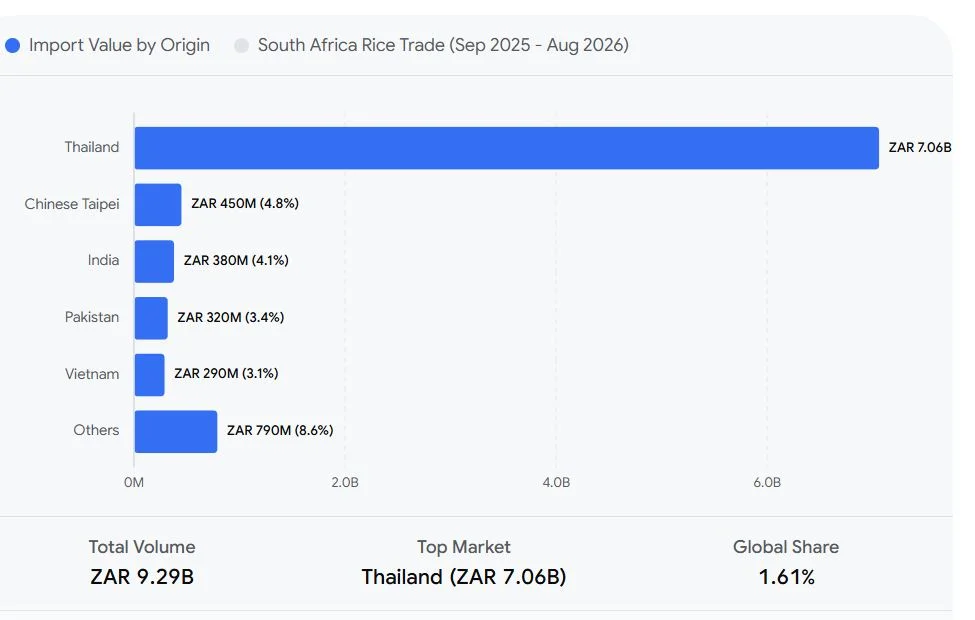
Thailand and India Supply Nearly All Imported Rice
South African importers buy most of their rice from Thailand and India. Both countries have established commercial production and export industries.
UN Comtrade figures published through the World Bank's World Integrated Trade Solution show the following suppliers for calendar year 2025:
| CountryQuantity imported | |
| Thailand | 1,005,710 tonnes |
| India | 149,114 tonnes |
| Vietnam | 8,829 tonnes |
| Pakistan | 5,760 tonnes |
| China | 1,257 tonnes |
Thailand accounted for approximately 85% of the country's semi-milled and wholly milled rice imports. India supplied another 13%. Together, they accounted for almost 98% of the recorded trade.
Why Thailand Is South Africa's Main Supplier
Thailand has a long-established rice export industry. Its jasmine rice is particularly well known and is sold into premium international markets.
Thai exporters also supply rice for mainstream supermarket brands in South Africa. Importers have established relationships with suppliers who can provide the quantities required by local packers and retailers.
India's Role in the South African Rice Market
India is an important supplier of parboiled rice, which makes up most of the local market.
Its exporters compete on price, particularly in the lower-cost retail segment. Wholesalers and packers buy imported rice for distribution under different brands and package sizes.
Other countries, including Pakistan and Vietnam, supply smaller quantities.
India's 2023 Rice Export Restrictions Affected South African Buyers
South Africa's dependence on imported rice makes the local market vulnerable to export restrictions in supplier countries.
In July 2023, India prohibited exports of non-basmati white rice. The government introduced the measure amid concerns about domestic food supplies and rising prices.
India was already one of South Africa's leading suppliers. The restriction reduced the amount of rice available to international buyers and put pressure on importers seeking alternative sources.
BusinessTech reported at the time that South African consumers could face higher prices as importers dealt with the restrictions.
India later eased some of its export controls. International supply improved, and lower global prices subsequently brought relief to importing countries.
For South African retailers, the effects of an export restriction can take time to reach supermarket shelves. Importers may still have stock purchased at earlier prices, while new orders are negotiated at different rates.
How Much Does South Africa Spend on Rice Imports?
Rice is one of South Africa's largest agricultural food imports by value.
The National Agricultural Marketing Council's Agricultural Trade Performance Brief 2025, published in March 2026, records the following import values:
| YearRice import value | |
| 2024 | US$640.9 million |
| 2025 | US$541.3 million |
The value fell by approximately 16% in 2025. Rice accounted for about 7% of the country's total agricultural import value that year.
The reduction does not mean South Africans stopped buying rice. International prices fell, allowing importers to purchase larger quantities without spending as much as they had in the previous year.
South Africa Has No Import Duty on Rice
South Africa applies a zero-tariff policy to rice imports.
The USDA's February 2026 tariff schedule lists rice entering duty-free across the main categories:
- Rough or paddy rice.
- Brown or husked rice.
- Milled rice.
- Broken rice.
Importers still pay shipping, insurance, port handling, storage, milling and distribution costs.
The zero customs tariff also means local rice growers do not receive tariff protection against cheaper overseas supplies.
South Africa Re-Exports Rice to Other African Countries
A portion of imported rice is sold beyond South Africa's borders.
The country has established wholesale, retail and transport networks serving neighbouring markets. Businesses import rice through South African ports and distribute it to countries that depend on regional supply chains.
The USDA recorded 166,000 tonnes of rice re-exports during the 2024/25 marketing year. It estimates 175,000 tonnes for 2025/26 and forecasts 190,000 tonnes for 2026/27.
The main destinations in 2024/25 were:
| CountryRice received | |
| Botswana | 48,000 tonnes |
| Eswatini | 40,000 tonnes |
| Zimbabwe | 26,000 tonnes |
| Namibia | 17,000 tonnes |
| Zambia | 11,000 tonnes |
| Lesotho | 10,000 tonnes |
Many of these countries are landlocked and use South African ports and distribution businesses to obtain imported food.
Large retailers also operate across southern Africa, allowing them to distribute products through existing warehouses and transport arrangements.
The re-export trade explains why the total amount of rice entering South Africa is higher than domestic consumption.
What Would It Take to Establish a Commercial Rice Industry?
Dryland rice research has given South African agriculture another possibility to investigate. Farmers interested in growing the crop would first need varieties suited to their local conditions.
Water availability remains a major consideration, even for varieties that do not require flooded paddies. Commercial growers would need to establish expected yields under local rainfall conditions and calculate whether supplementary irrigation would make financial sense.
Milling is another consideration. Rice requires specialised processing to remove the husk and produce the grain sold to consumers. A farmer who grows a successful crop still needs access to a mill and a buyer.
Imported rice already arrives in large quantities from established producers. A local grower would have to compete with the landed cost of that grain.
The USDA's March 2026 report records zero commercial rice production in its national production estimates. Its forecasts continue to put imports above 1.2 million tonnes annually.
Research Sources and Further Reading
South African rice production and imports
Land Bank Research — South Africa's Reliance on Rice Imports — Local production figures, provincial growing areas and the potential for dryland rice.
USDA Foreign Agricultural Service — Grain and Feed Annual, South Africa, 25 March 2026 — Rice production, consumption, imports, re-exports, supplier countries and import tariffs.
National Agricultural Marketing Council — Agricultural Trade Performance Brief 2025 — South African agricultural import values and rice's position in the food import market.
Water and rice cultivation
South African Government — Yearbook 2024/25: Water and Sanitation — National rainfall and water availability.
Food and Agriculture Organization — Crop Yield Response to Water — Water requirements for flooded rice and irrigation management.
International rice trade
World Bank WITS — South African Rice Imports by Country, 2025 — Import quantities and values by supplying country.
Wandile Sihlobo — On Rice — South Africa's reliance on imported rice and international suppliers.
BusinessTech — Your Favourite Rice Dishes Are About to Become More Expensive — India's 2023 export restrictions and their effect on South African buyers.
Editorial note: Import figures use different reporting periods. USDA figures follow marketing years running from May to April, while World Bank trade figures and NAMC import values use calendar years. The figures should therefore be read within their stated periods and product classifications.